3.4.1.5 - Newton's Laws of Motion
Newton's laws give us a clean way to connect forces to motion. In this lesson, you will see how the first law describes equilibrium, how the second law turns a resultant force into a calculation, how the third law explains interaction pairs, and how free-body diagrams help you decide which forces belong in the maths.
Newton's First and Third Laws
Newton's first law describes what happens when the forces on an object balance. If the resultant force is zero, the object's velocity does not change, so it either stays at rest or keeps moving in a straight line at constant speed.
Newton's First Law
An object remains at rest or continues to move with constant velocity unless acted on by a resultant force.
This is why an air-track glider can keep moving at nearly constant velocity after a short push: friction is so small that the resultant force is close to zero. On an ordinary floor, friction provides a backward force, so the object slows unless another force keeps acting.
Newton's third law is about interactions between two objects. Whenever object A exerts a force on object B, object B exerts a force of the same type back on object A.
Newton's Third Law
If object A exerts a force on object B, then object B exerts an equal and opposite force on object A.
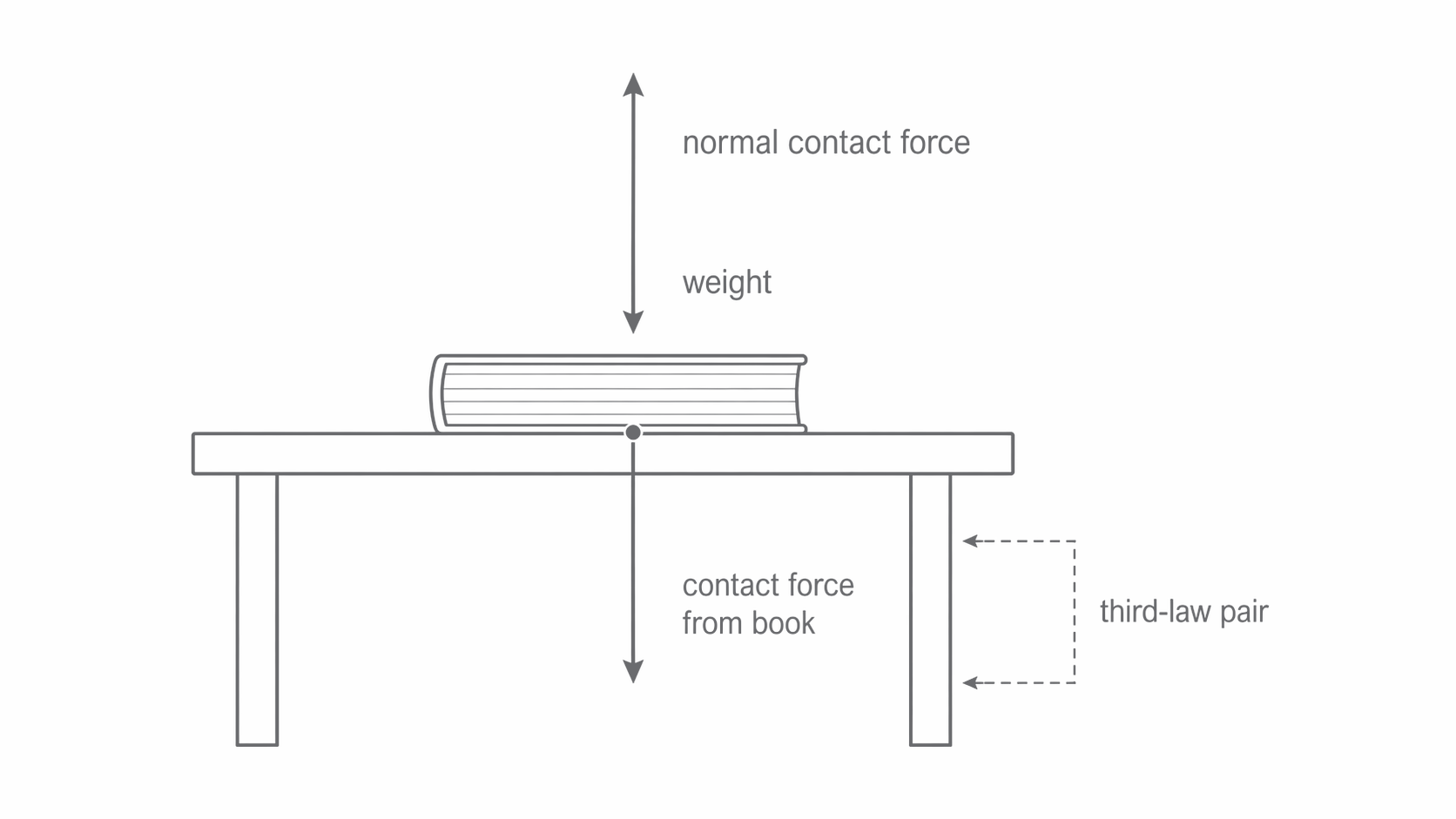
The important point is that the two forces act on different objects, so they do not cancel each other out. For a book resting on a table, the table's upward force on the book and the book's downward force on the table are a third-law pair. The book's weight and the table's upward support force are not a third-law pair because both act on the book. In the diagram below, notice that the contact forces between the book and table form the third-law pair because they act on different objects.
[DIAGRAM: asset_name: 4.1.5 - Newton's Laws of Motion - Diagram 1; asset_slug: 4.1.5 - Newton's Laws of Motion - Diagram 1; recommended_method: retained_png; description: A book resting on a table. On the book, draw weight downward and normal contact force upward. On the table, draw the downward contact force from the book. Label the third-law pair as the contact forces between book and table.]
Newton's Second Law and Verifying It
Newton's second law tells us how much acceleration a resultant force produces. For the constant-mass situations in this specification, the relationship is written as .
Newton's Second Law
The acceleration of an object is proportional to the resultant force acting on it and inversely proportional to its mass. The acceleration is in the direction of the resultant force.
For the constant-mass problems in this topic, that proportional relationship is written as a simple equation.
Newton's Second Law for Constant Mass
Here, is the resultant force in newtons, is the mass in kilograms, and is the acceleration in . The newton is defined so that a force of gives a mass of an acceleration of .
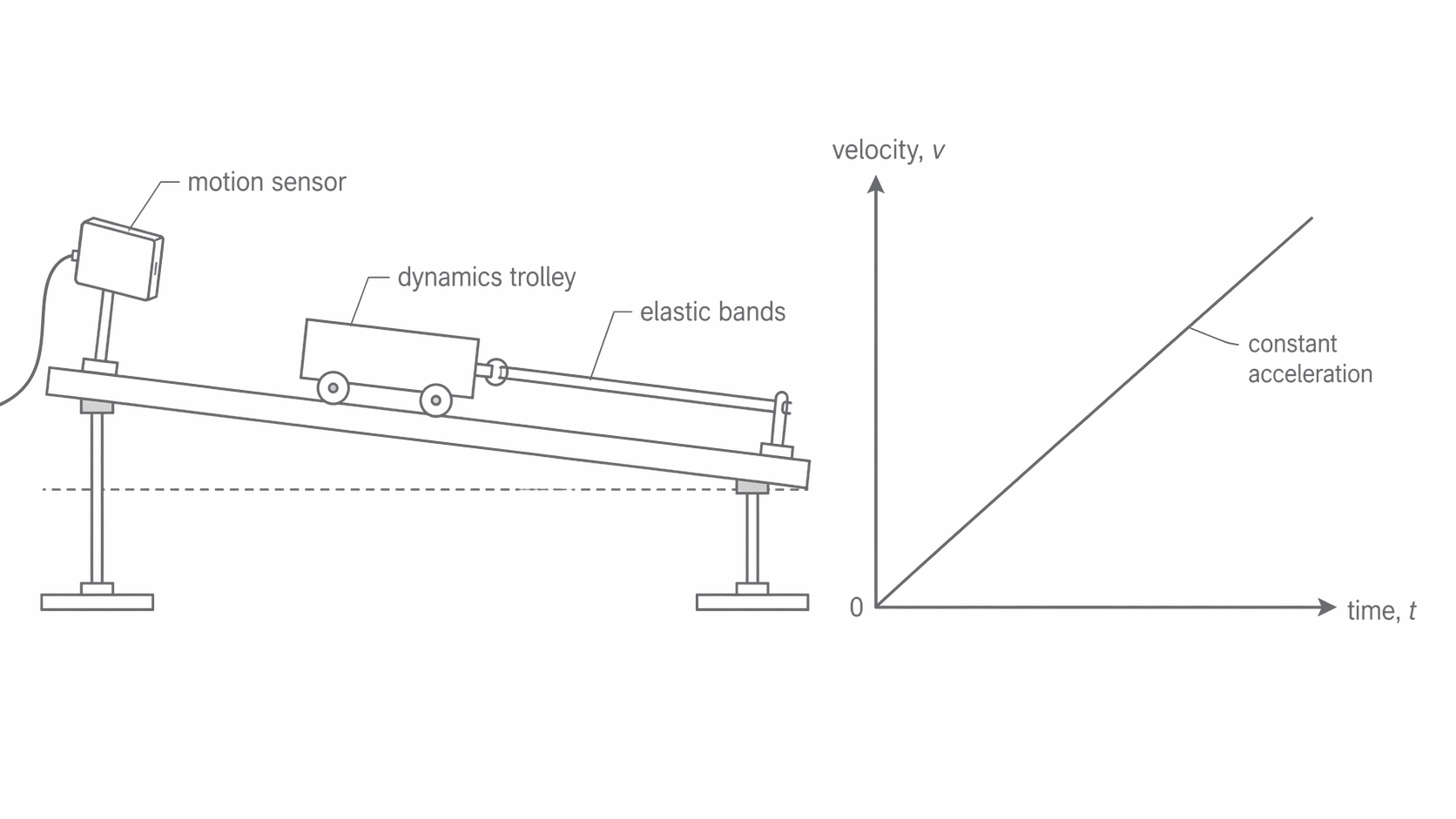
You can verify this law using a dynamics trolley, a motion sensor, and a sloping runway adjusted so friction is compensated. If the trolley moves at constant velocity after a gentle push, the slope is about right. Pulling the trolley with one, two, and three identical stretched elastic bands gives different constant forces, and the velocity-time graphs show constant accelerations. The pattern of results is that acceleration doubles when force doubles for fixed mass, and acceleration halves when mass doubles for fixed force. In the figure below, notice how the stretched bands provide the pull while the straight velocity-time line shows a constant acceleration.
[DIAGRAM: asset_name: 4.1.5 - Newton's Laws of Motion - Diagram 2; asset_slug: 4.1.5 - Newton's Laws of Motion - Diagram 2; recommended_method: retained_png; description: A trolley on a gently tilted runway connected to a motion sensor. Elastic bands pull the trolley along the runway. Beside it, show a velocity-time graph with a straight line, labelled "constant acceleration".]
That evidence supports and , which combine to give . Once force is measured in newtons, this becomes .
The same law explains free fall. A falling object has weight acting downward, so the acceleration is in the direction of that resultant force. If air resistance is negligible, all objects accelerate downward at the same rate because the ratio is just .
Free-Body Diagrams
A free-body diagram shows all the forces acting on one chosen object and nothing else. It is the quickest way to decide which forces balance and which produce the resultant force in . In the diagram below, notice that the horizontal and vertical forces balance, so the car continues at constant velocity with zero resultant force.
[DIAGRAM: asset_name: 4.1.5 - Newton's Laws of Motion - Diagram 3; asset_slug: 4.1.5 - Newton's Laws of Motion - Diagram 3; recommended_method: retained_png; description: A car on a level road. Show weight downward, normal contact force upward, driving force forward, and resistive force backward. Make the horizontal arrows equal length to represent constant velocity.]
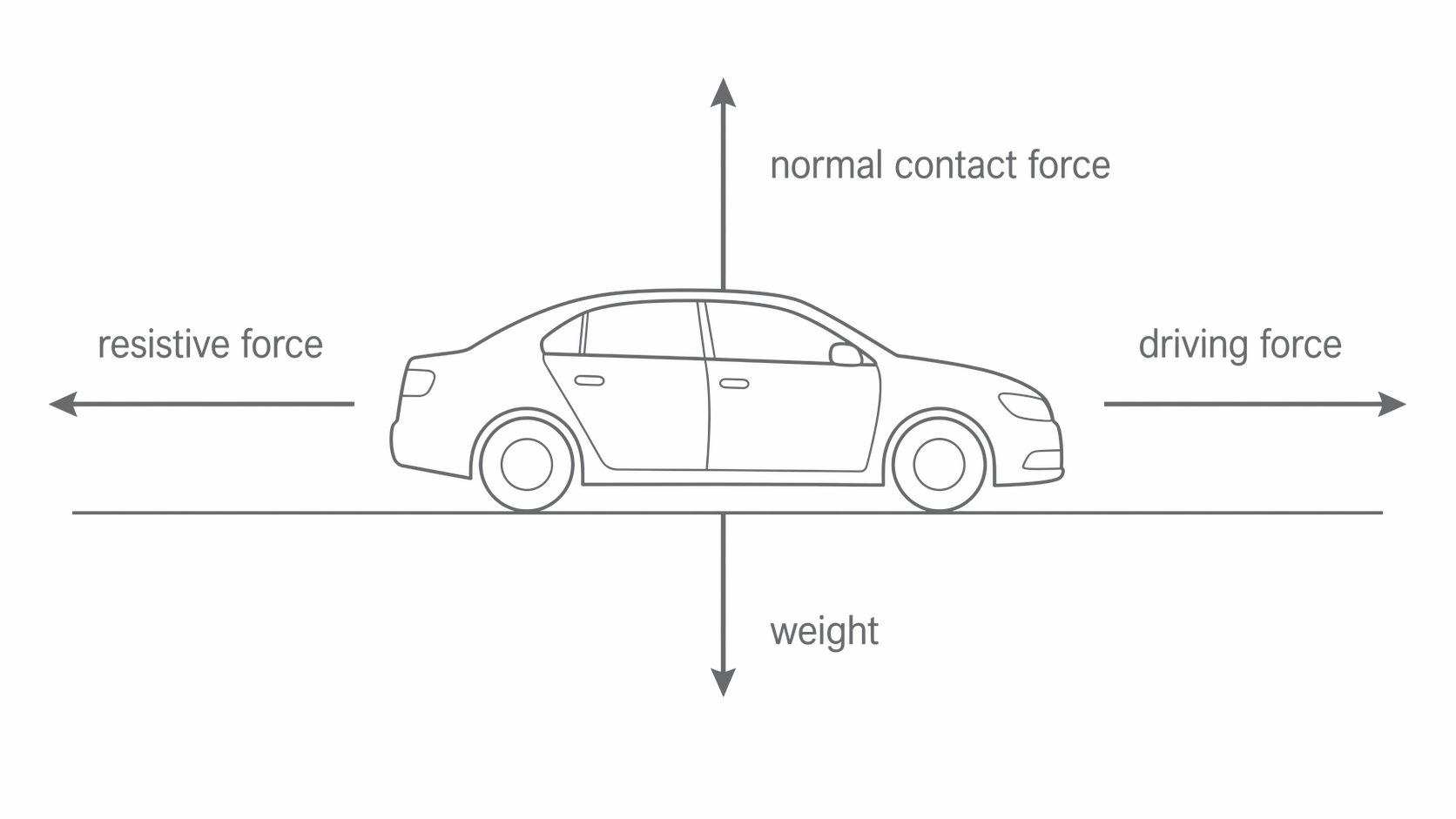
To use a free-body diagram well, pick the object, draw every force on that object, label the directions clearly, and then find the resultant force in the direction you want to analyse. If the arrows balance, acceleration is zero. If they do not balance, the difference between them is the resultant force.
Weight is often needed before you can find the mass of an object.
Weight
In this equation, is weight in newtons, is mass in kilograms, and is gravitational field strength. Near the Earth's surface, .
Mass and weight are not the same thing. Mass measures inertia, which is resistance to a change in motion. Weight is the gravitational force acting on that mass. A object has a smaller weight on the Moon than on Earth, but its mass is unchanged.
Free-body diagrams also help you avoid a common error with third-law pairs. The forces on a single free-body diagram all act on the same object, so none of them is paired with another force on that same diagram by Newton's third law.
Applying the Laws to Multi-Force Situations
Most exam questions combine the ideas above. In a lift, for example, the main vertical forces on the lift are tension upward and weight downward. If you take upward as positive, then the resultant force is .
When the lift moves at constant velocity, , so . If it accelerates upward, then . If it accelerates downward, then . The sign of the acceleration matters more than whether the lift happens to be travelling up or down at that moment.
Bathroom scales in a lift measure the support force on you, not your true weight. When the lift accelerates upward, the scale reading increases because the floor must push up on you more strongly to produce the upward resultant force.
The same thinking works for towing problems. For a trailer, the forward tension in the tow bar may be the only horizontal force you need to analyse, so for the trailer. For the whole car-and-trailer system, the internal tow-bar forces cancel and the external driving force produces the acceleration of the combined mass.
By this stage, the key routine should feel consistent: draw the forces, decide on the positive direction, find the resultant force, and then apply the correct Newton's law.