3.2.2.2 - Collisions of Electrons with Atoms
When a fast-moving electron collides with an atom, it can transfer energy to that atom. If the transfer is large enough, the atom can be ionised or excited. These ideas are used to explain fluorescent tubes and are usually measured in electron volts rather than joules because the energies are so small.
Part 1: Ionisation
Ionisation happens when enough energy is transferred to remove an electron from an atom completely. The atom then becomes a positive ion.
Ionisation
Ionisation is the process in which an atom loses or gains one or more electrons and becomes an ion. In this topic, ionisation usually means removing an electron from an atom by collision.
If a colliding electron has less kinetic energy than the ionisation energy, it cannot ionise the atom. If it has at least the ionisation energy, ionisation can occur and any extra energy appears as kinetic energy of the outgoing electrons.
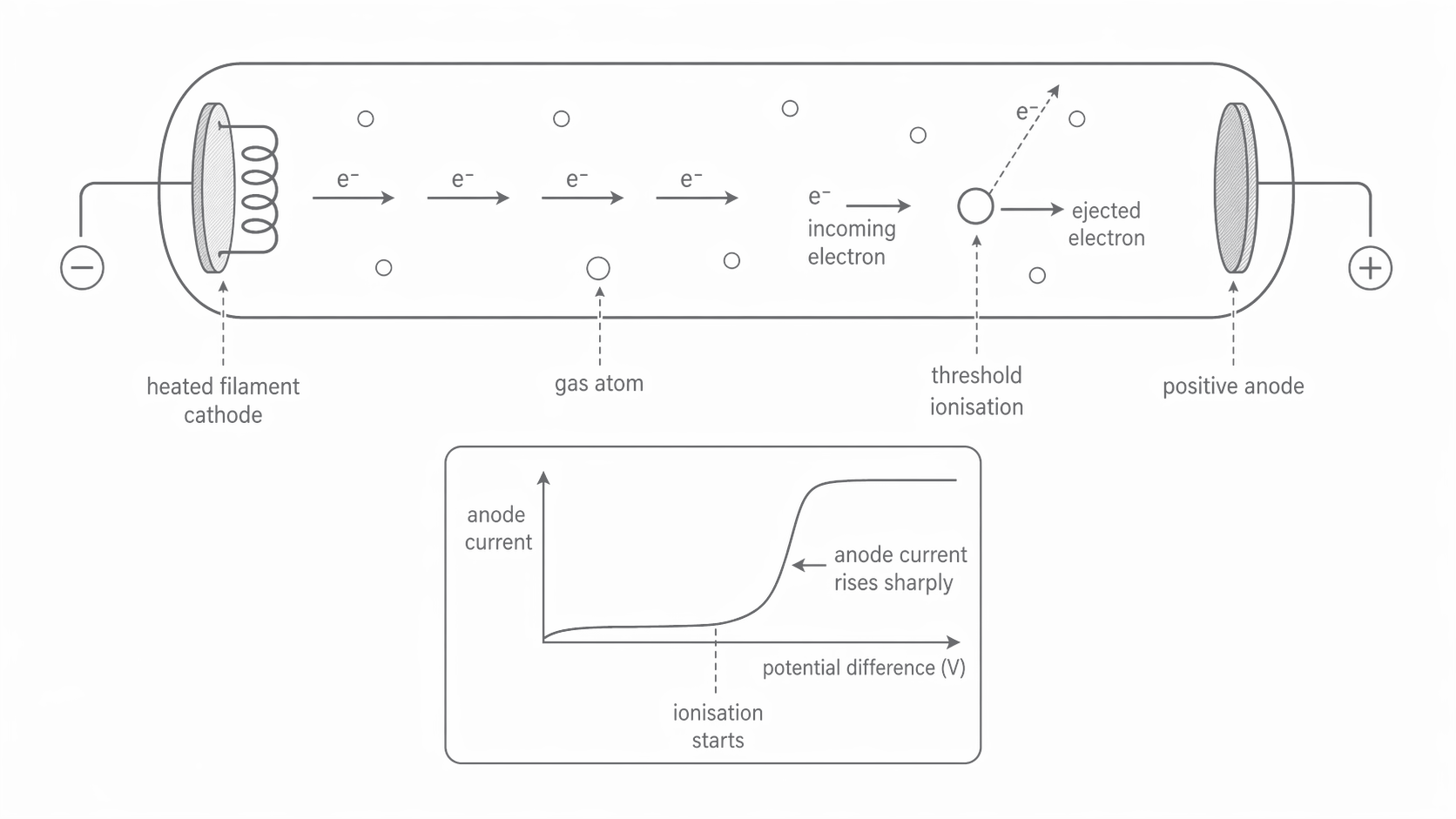
One way to measure ionisation energy is to accelerate electrons through a low-pressure gas towards a positive anode. As the potential difference is increased, the electrons arrive with greater kinetic energy. When they first have enough energy to ionise gas atoms near the anode, the current rises sharply.
Ionisation Energy from Threshold Potential Difference
Here is the charge of the electron and is the potential difference at the point where ionisation begins. For an electron, a potential difference of corresponds to an energy gain of .
The figure below shows the tube arrangement and the key event to notice: once electrons near the anode reach the threshold energy, a collision can eject an electron from a gas atom and the anode current rises sharply.
[DIAGRAM: asset_name: 2.2.2 - Collisions of Electrons with Atoms - Diagram 1; asset_slug: 2.2.2 - Collisions of Electrons with Atoms - Diagram 1; recommended_method: retained_png; description: Low-pressure gas tube with a heated filament cathode on the left, a positive anode on the right, and gas atoms between them. Show electrons accelerating towards the anode, one threshold collision near the anode ejecting an electron from a gas atom, and an annotation or simple inset indicating that the anode current rises sharply once ionisation starts.]
Part 2: Excitation
Not every useful collision removes an electron. A smaller energy transfer can move an atomic electron to a higher energy level while keeping it inside the atom.
Excitation
Excitation is the process in which an atomic electron absorbs energy and moves to a higher energy level without leaving the atom.
Excitation only happens if the colliding electron can supply one of the atom's allowed excitation energies. If the colliding electron does not have enough energy for a particular transition, the atom does not absorb that energy overall.
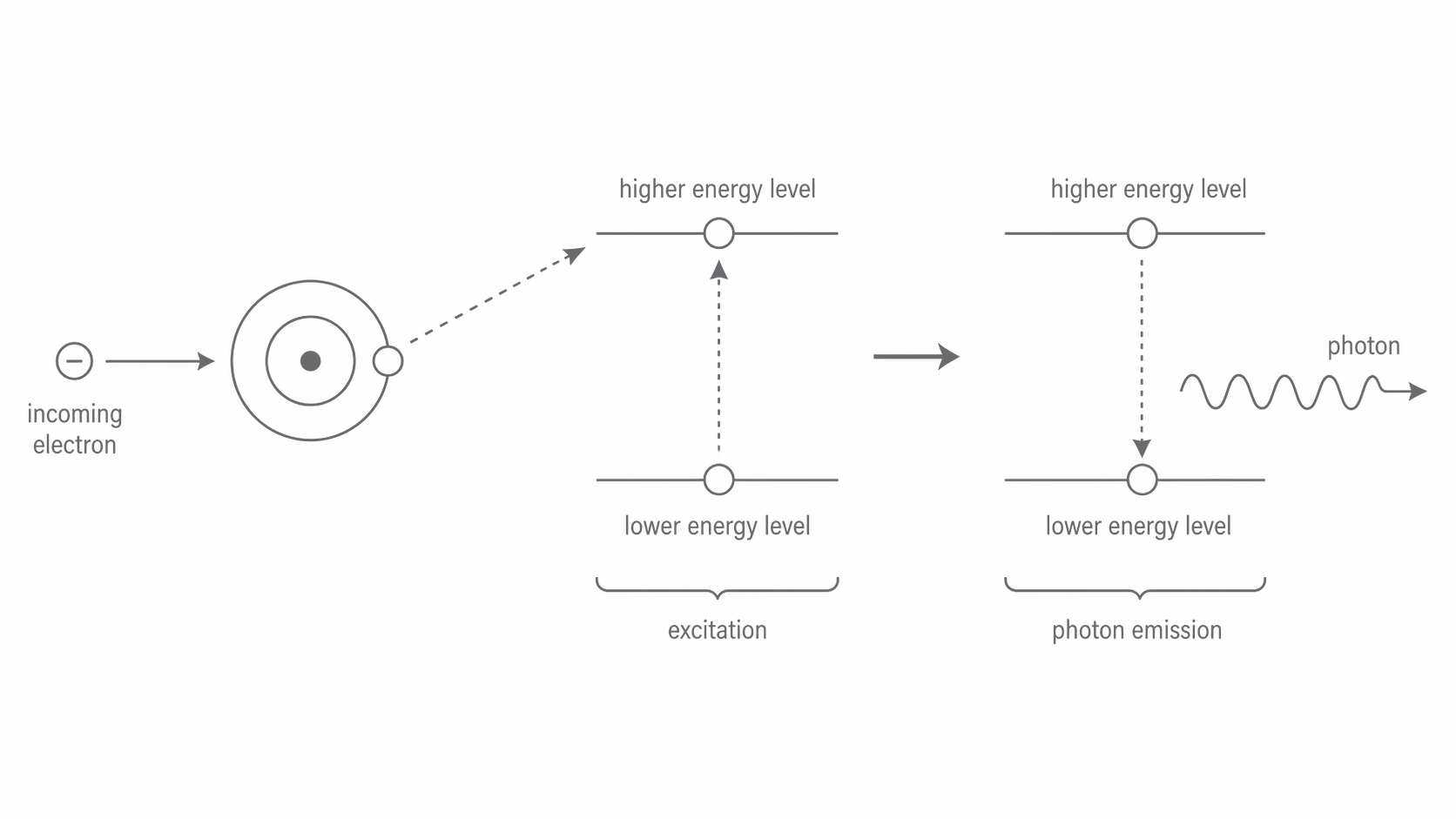
An excited atom is unstable. Its electron soon returns to a lower energy level and the atom emits a photon whose energy matches the energy difference between the two levels.
The diagram below highlights the two stages to notice in excitation: the incoming electron first raises the atom to a higher level, and later the atom drops back down and emits a photon.
[DIAGRAM: asset_name: 2.2.2 - Collisions of Electrons with Atoms - Diagram 2; asset_slug: 2.2.2 - Collisions of Electrons with Atoms - Diagram 2; recommended_method: retained_png; description: Two-level atom schematic with a lower energy level and a higher energy level. Show an incoming electron transferring energy so an atomic electron moves up to the higher level, then show the atomic electron dropping back down and emitting a photon. Label excitation and photon emission clearly.]
Ionisation and excitation are related, but they are not the same. Ionisation removes an electron completely. Excitation leaves the electron bound to the atom and is always associated with a specific allowed energy difference.
Part 3: The electron volt
Atomic energies are awkwardly small in joules, so physicists use the electron volt instead.
Electron Volt
One electron volt, , is the energy gained by an electron when it moves through a potential difference of .
Because the work done on a charge moving through a potential difference is , one electron moving through gains
Electron Volt Conversion
To convert from eV to J, multiply by . To convert from J to eV, divide by .
The electron volt is still a unit of energy, not a unit of potential difference. A value such as describes the kinetic energy of a particle. For a single electron accelerated from rest, that kinetic energy would have been gained by moving through a potential difference of .
Part 4: Fluorescent tubes
The fluorescent tube is the main application that brings ionisation and excitation together.
Inside a fluorescent tube, a high potential difference accelerates free electrons through low-pressure mercury vapour. Some collisions ionise mercury atoms and help maintain the discharge. Other collisions excite mercury atoms, and when those atoms de-excite they emit mostly ultraviolet photons. The phosphor coating on the inside of the tube absorbs the ultraviolet radiation and then emits visible light.
The figure below traces the full chain to notice in a fluorescent tube: electron collisions in mercury create ultraviolet radiation, and the phosphor coating then converts that ultraviolet radiation into visible light.
[DIAGRAM: asset_name: 2.2.2 - Collisions of Electrons with Atoms - Diagram 3; asset_slug: 2.2.2 - Collisions of Electrons with Atoms - Diagram 3; recommended_method: retained_png; description: Fluorescent tube with electrodes at each end, low-pressure mercury vapour inside, and a phosphor coating on the inner wall. Show fast electrons moving through the vapour, one collision causing ionisation, another causing excitation, an ultraviolet photon emitted by mercury, and the phosphor coating absorbing that UV photon and emitting visible light out of the tube.]
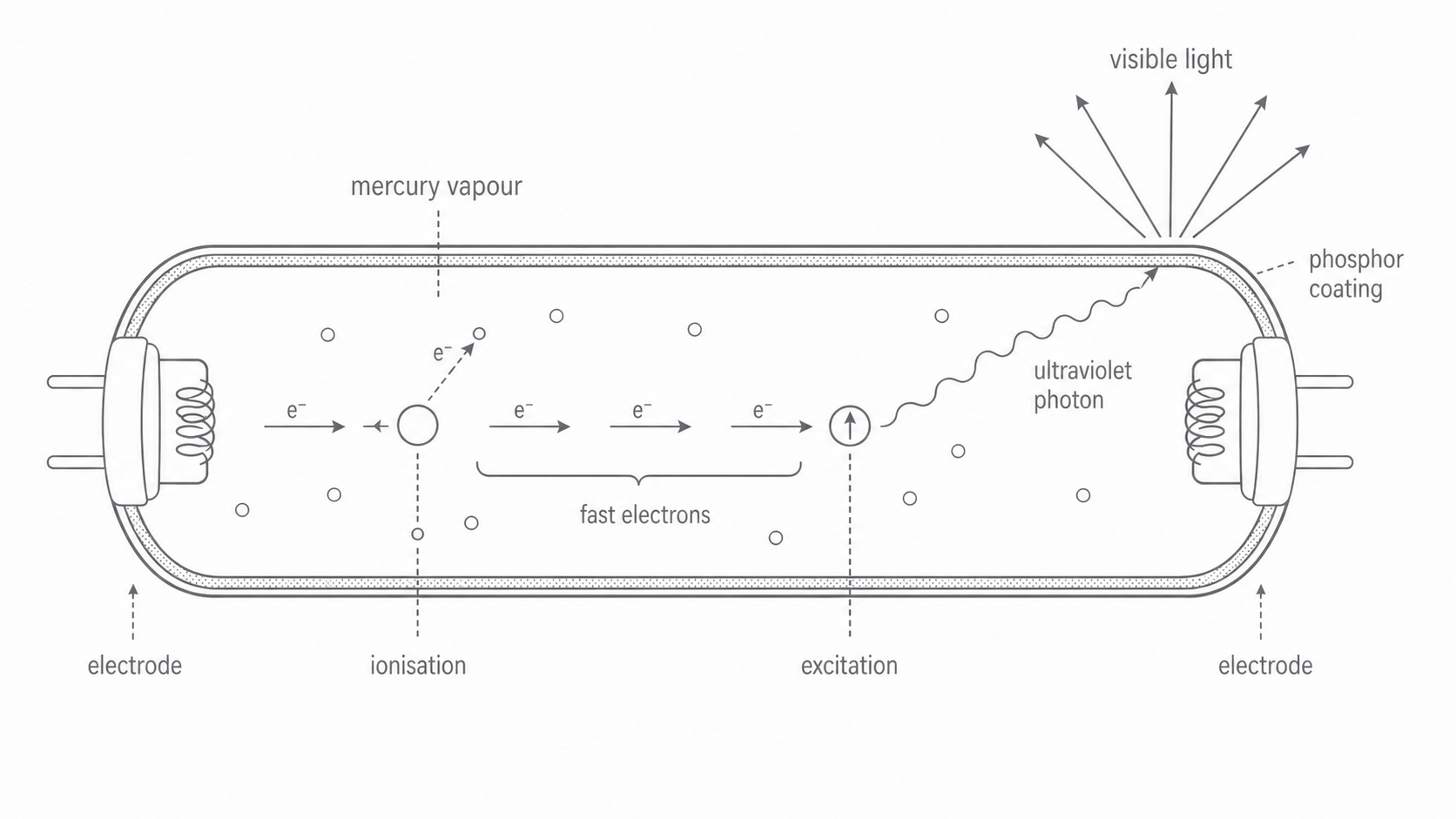
The visible light therefore comes from two linked stages: first the mercury atoms emit ultraviolet photons, then the phosphor converts that ultraviolet radiation into visible radiation.
Part 5: Using energy conservation
Collision questions are usually easiest if you write an energy balance. The initial kinetic energy of the colliding electron is shared between any energy transferred to the atom and the kinetic energy left afterwards.
Energy Conservation in a Collision
If the atom is excited, the transferred energy is an excitation energy. If the atom is ionised, the transferred energy must at least equal the ionisation energy, and there may also be kinetic energy given to the freed electron.
For example, if an electron is accelerated from rest through a potential difference , then for that electron the initial kinetic energy is . That means if an electron excites a mercury atom by and still has afterwards, the accelerating potential difference must have been .
Explaining Fluorescent Tubes
Once you separate the ideas carefully, most questions on this topic become straightforward: identify whether the atom was ionised or excited, work in eV first if that is easiest, and then convert to joules only when the question asks for it.