3.3.1.1 - Progressive Waves
Progressive waves are described using a small set of linked quantities: amplitude, wavelength, frequency, period, speed, phase, and phase difference. In this lesson, we will build those ideas carefully so that the equations and definitions fit together rather than feeling like isolated facts.
Part 1 — What a Progressive Wave Is
A progressive wave transfers energy from one place to another without carrying matter along with it. In a mechanical wave, the particles of the medium oscillate about fixed equilibrium positions. In an electromagnetic wave, it is the electric and magnetic fields that oscillate. In both cases, the disturbance travels, but the material itself does not travel with the wave.
Progressive Wave
A wave that transfers energy from one place to another without any net transfer of matter.
To describe a wave properly, we start with the motion of a single particle. The displacement of a particle is its distance and direction from equilibrium at a particular instant. The largest displacement reached is called the amplitude.
Amplitude
The maximum displacement of a vibrating particle from its equilibrium position.
The next key distance is the wavelength. For a progressive wave, points one wavelength apart are in the same stage of vibration, so they have the same displacement and the same direction of motion at the same time.
Wavelength
The minimum distance between two points on a wave that are vibrating in phase.
For a transverse wave, wavelength can be measured from crest to crest or trough to trough. Amplitude is measured from the equilibrium line to a crest or to a trough, not from crest to trough. In the diagram below, notice that amplitude is a vertical measurement from the equilibrium line to one crest, while wavelength is the horizontal distance between two matching points on successive cycles.
[DIAGRAM: asset_name: 3.1.1 - Progressive Waves - Diagram 1; asset_slug: 3.1.1 - Progressive Waves - Diagram 1; recommended_method: retained_png; description: A transverse wave with the horizontal axis labelled distance and the vertical axis labelled displacement. Mark the equilibrium line, the amplitude A from the equilibrium line to a crest, and the wavelength lambda between two adjacent crests.]
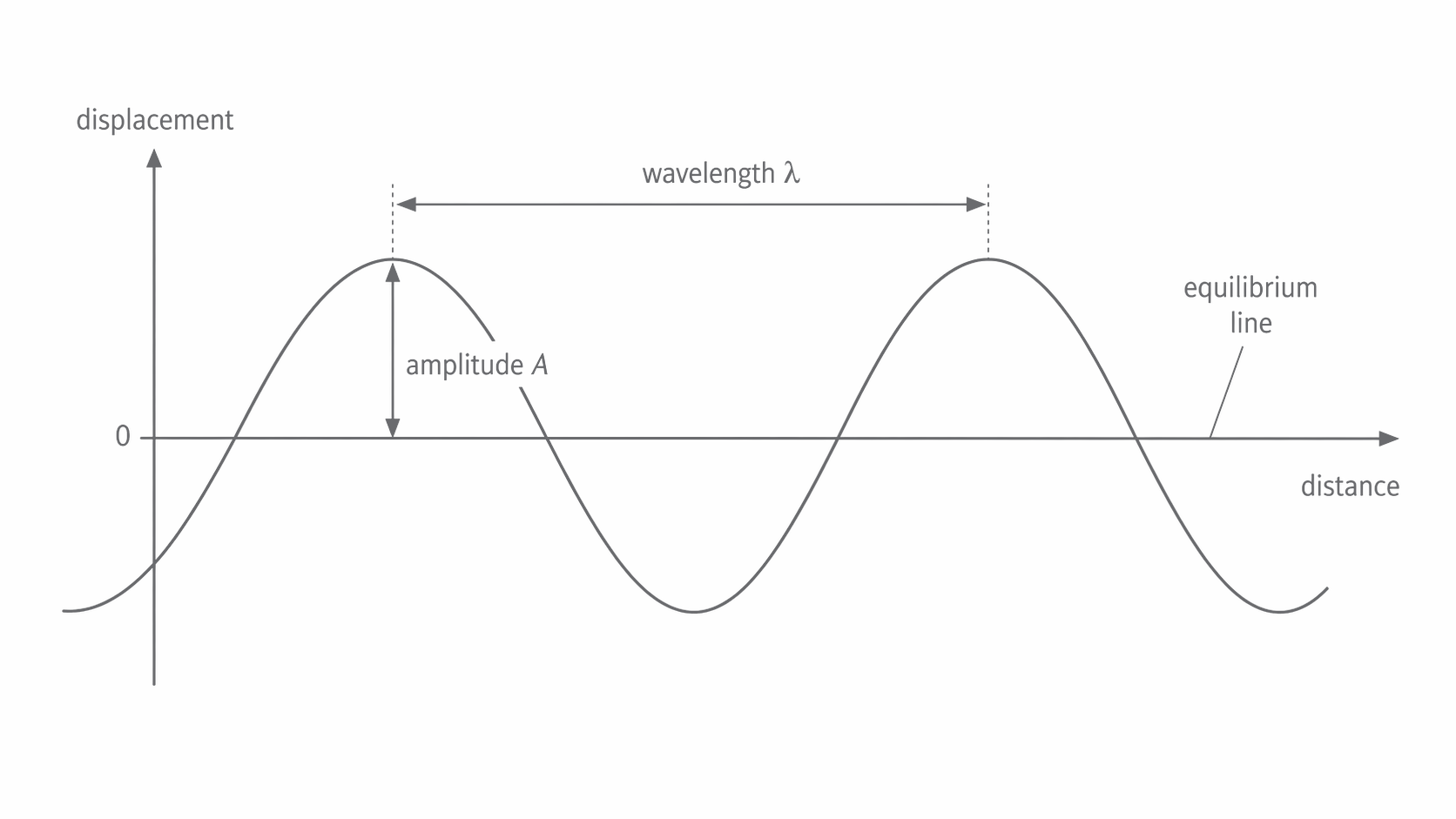
These distance measures matter because they tell us both how large the oscillation is and how far the pattern repeats before the motion starts to cycle again.
Part 2 — Frequency, Period, and Wave Speed
The timing of the oscillation is described by frequency and period. Frequency tells you how many complete oscillations happen each second, while period tells you how long one complete oscillation takes.
Frequency
The number of complete oscillations passing a point each second.
Because one quantity counts oscillations per second and the other gives the time for one oscillation, they are reciprocals of each other.
Frequency and Period
Here, is the frequency in hertz (Hz) and is the period in seconds (s). A large frequency means a small period, and a small frequency means a large period.
Wave speed is the distance travelled by the wave pattern each second. In one period, the wave advances by one wavelength, so the speed is wavelength divided by period.
Wave Speed
The distance travelled by a wave per unit time.
Combining that idea with gives the standard wave equation used throughout this topic.
Wave Equation
In this equation, is the wave speed in m s, is the frequency in Hz, and is the wavelength in m. This equation applies to all progressive waves.
Once you know any two of speed, frequency, and wavelength, you can always find the third. That makes these quantities the backbone of most wave calculations.
Part 3 — Phase and Phase Difference
To say where a particle is in its oscillation, we use phase. This is more precise than just saying "moving up" or "moving down" because it identifies the particle's position within the cycle.
Phase
The position of a point within a wave cycle.
Two points are in phase if they have the same displacement and are moving in the same direction at the same time. Two points are in antiphase if they are half a cycle apart, so when one has maximum positive displacement the other has maximum negative displacement.
Phase Difference
The fraction of a cycle by which one point or wave leads or lags behind another, expressed in radians, degrees, or fractions of a cycle.
One full cycle is rad, , or 1 cycle. So a quarter of a cycle is rad, , or 1/4 of a cycle. A half-cycle difference is rad, , or 1/2 of a cycle.
For two points separated by a distance on a wave of wavelength , the phase difference is:
Phase Difference Along a Wave
This relation is useful because it converts a measured distance along the wave into an angular difference. If , the phase difference is rad, so the points are in phase again. If , the phase difference is rad, so the points are in antiphase. In the diagram below, notice how each quarter-wavelength step changes the phase, so O and S line up in phase again while O and Q are in antiphase.
[DIAGRAM: asset_name: 3.1.1 - Progressive Waves - Diagram 2; asset_slug: 3.1.1 - Progressive Waves - Diagram 2; recommended_method: retained_png; description: A sine wave with points O, P, Q, R, and S marked at equal quarter-wavelength intervals. O is at a crest, Q is at a trough, and S is the next crest. Label the separations O to P as lambda/4, O to Q as lambda/2, and O to S as lambda.]
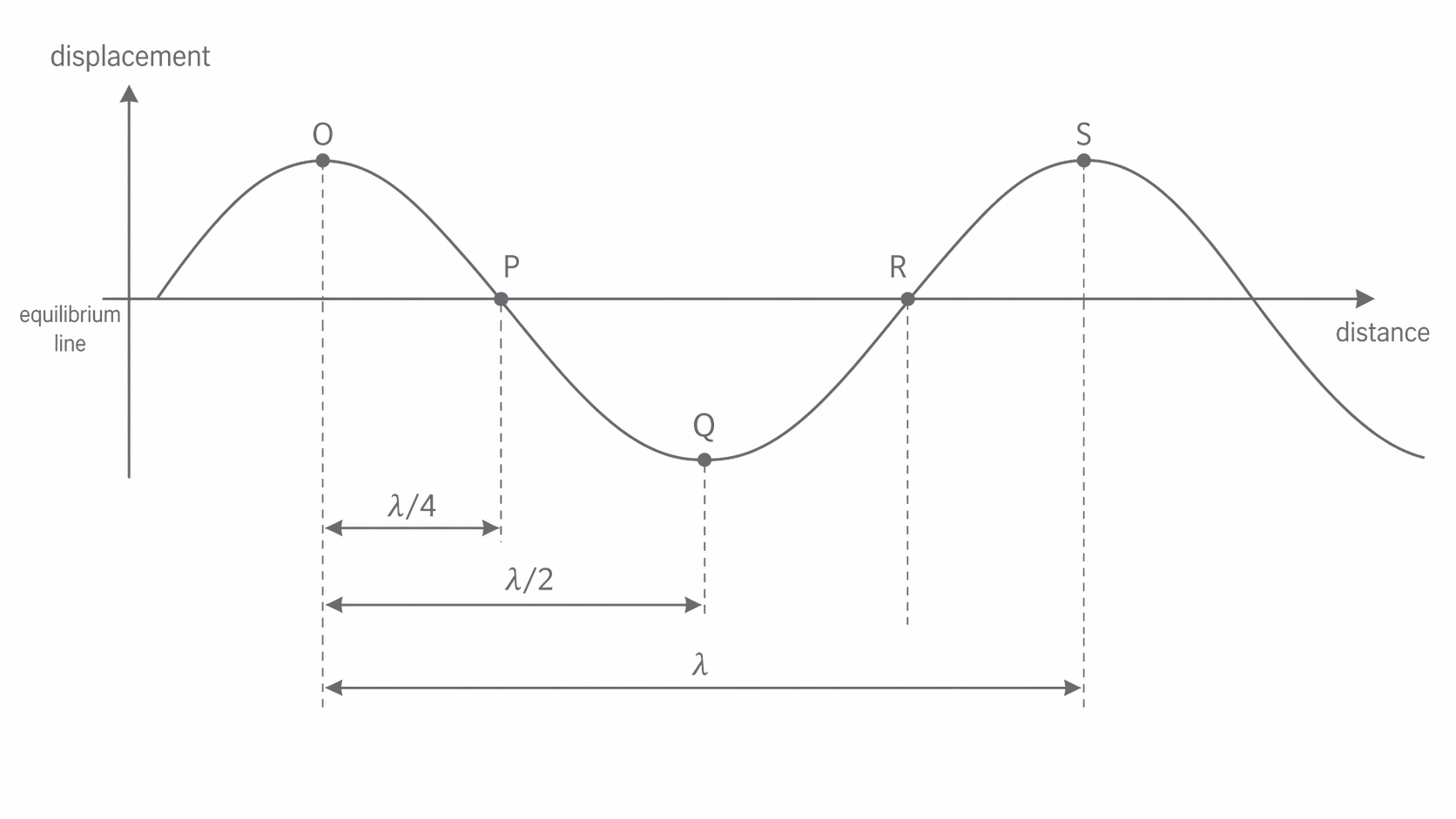
Phase is what lets us compare different points on the same wave without needing to see the whole wave drawn out. It is especially useful when you move from simple wave descriptions to interference and stationary waves.
Part 4 — Bringing the Ideas Together
The main wave quantities are tightly connected. Amplitude tells you how large the oscillation is. Wavelength tells you how far apart repeating points are. Frequency and period describe the timing. Speed links the space and time descriptions, and phase tells you exactly where a point is within the cycle.
If you can explain how these quantities fit together, you are ready for the rest of the waves topic, where the same ideas reappear in superposition, stationary waves, and practical measurements.