3.4.1.7 - Work, Energy and Power
When a force makes something move, energy is transferred. This lesson stays focused on the core calculations you need here: work done by a force, power as the rate of doing work, the meaning of the area under a force-displacement graph, and efficiency.
Part 1: Work Done and Direction
Work done measures energy transferred by a force. The key idea is that the force must have a component in the direction of the displacement, because only that component can transfer energy to or from the object.
Work done
Work done is the force multiplied by the displacement in the direction of the force.
If a force of magnitude acts at an angle to a displacement , the component of the force parallel to the motion is . That is why angled-force questions use the cosine of the angle between the force and the displacement.
Work Done by a Force
Here, is the work done in joules, is the force in newtons, is the displacement in metres, and is the angle between the force and the displacement. If , the force is fully along the motion and . If , the force is perpendicular to the motion and the work done is zero.
In the schematic below, notice that the displacement is horizontal while only the horizontal component acts along the motion, so that is the part used in the work calculation.
[DIAGRAM: asset_name: 4.1.7 - Work, Energy and Power - Diagram 1; asset_slug: 4.1.7 - Work, Energy and Power - Diagram 1; recommended_method: retained_png; description: A box pulled along a floor by a force at an angle theta above the horizontal. Show displacement s horizontally, the full force F, and the horizontal component F cos theta in the direction of motion.]
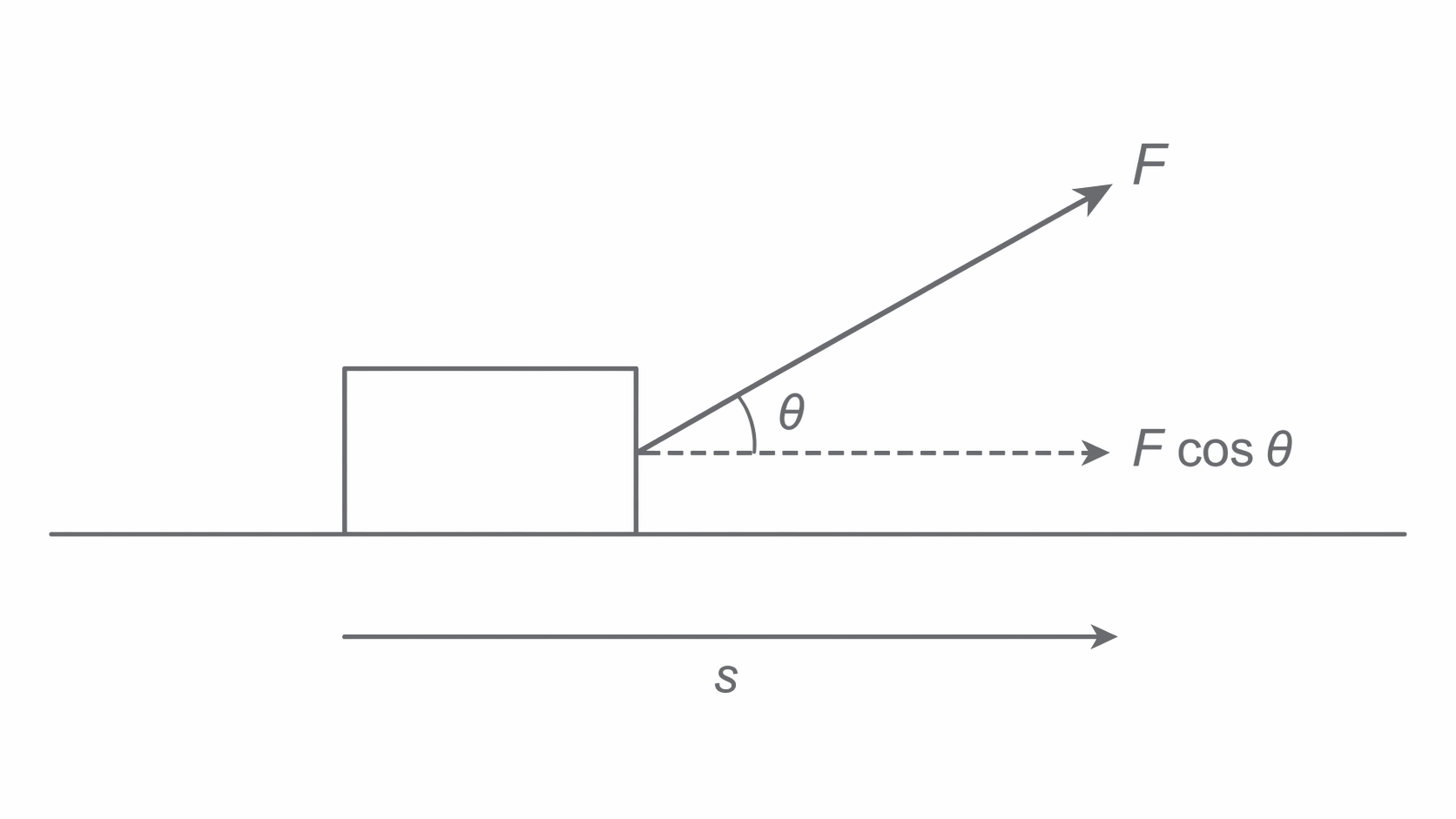
This is why carrying a shopping bag at constant height does not mean you are doing mechanical work on the bag because of the upward force from your hand. Your force is vertical, but the bag's displacement is horizontal, so there is no component of force along the displacement.
In angled-force questions, the most common mistake is to use the full force without resolving it. Always check that you are using the part of the force that acts along the motion.
Part 2: Variable Force and Graphs
The equation works directly when the force is constant. When the force changes as the object moves, you need the force-displacement graph instead. On this graph, force is on the vertical axis and displacement is on the horizontal axis.
Work from a Force-Displacement Graph
For a constant force, the area is a rectangle, so the result is just . For a force that increases steadily from zero, the area is a triangle, so the work done is . This is why the energy needed to stretch a spring can be found from the triangular area under its force-extension graph.
In the pair of graphs below, notice that the shaded rectangle and triangle represent the energy transferred because the area under each graph is the work done.
[DIAGRAM: asset_name: 4.1.7 - Work, Energy and Power - Diagram 2; asset_slug: 4.1.7 - Work, Energy and Power - Diagram 2; recommended_method: retained_png; description: Two force-displacement graphs side by side. Left: constant force shown as a horizontal line with a shaded rectangular area. Right: force rising linearly from the origin with a shaded triangular area. Label the shaded area as work done.]
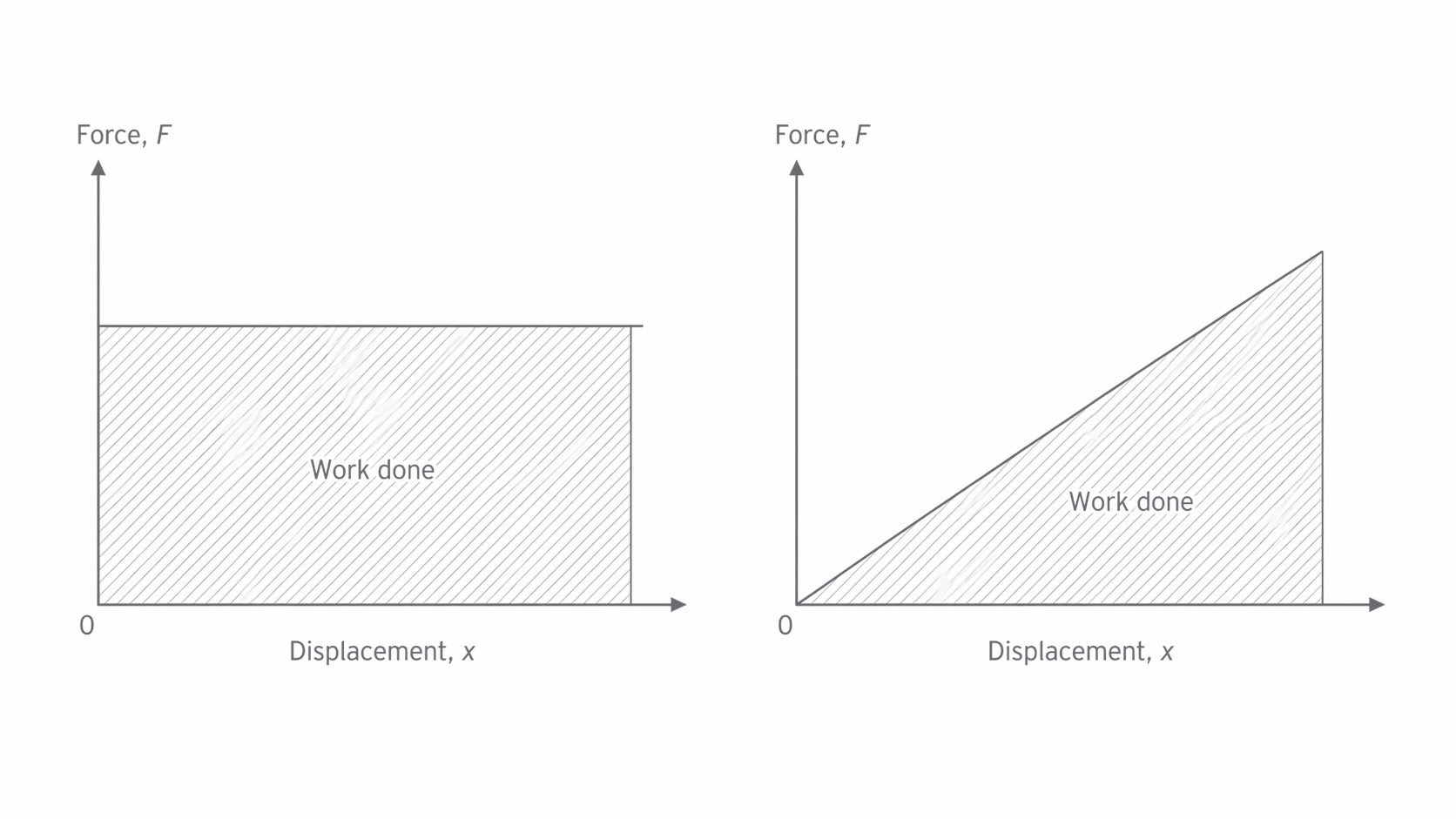
The graph method matters because the work done depends on the whole force-displacement relationship, not just the final force. In an exam, pay close attention to the shape of the graph before choosing rectangle, triangle, or a combination of areas.
If the graph is curved or made of several straight sections, split the shaded region into simple shapes and add the areas. The final area is still the total work done.
Part 3: Power
Power tells you how quickly work is done or energy is transferred. Two devices might do the same amount of work, but the one that does it in less time has the greater power.
Power
Power is the rate of doing work, or the rate of energy transfer.
If an amount of work is done in a time interval , the average power is . If a force acts in the direction of motion and the object moves at speed , then the distance moved each second is , so the power can also be written in terms of force and speed.
Power Equations
In these equations, is power in watts, is work done in joules, is time in seconds, is the force in the direction of motion, and is the speed. The equation is especially useful for vehicles and motors moving at steady speed.
In level flight at constant speed, an aircraft's thrust balances the resistive forces. That means the engine power can be found from , using the thrust and the speed. Engineers use this idea when comparing how much power is needed at different cruising speeds.
If the speed increases while the opposing force stays the same, the power increases as well, because more work is being done every second. If both the force and the speed increase, the power rises even more quickly.
Part 4: Efficiency
Efficiency compares what you get out of a device with what you put in. In physics, the useful output can be written using either energy or power, as long as you compare like with like.
Efficiency
Efficiency is the ratio of useful output energy or useful output power to the total input energy or input power.
Real systems are always less than 100% efficient because some energy is transferred in unwanted ways, usually as heating or sound. A more efficient device wastes a smaller fraction of the input.
Efficiency
This ratio has no unit. A value of 0.80 means 80% of the input is useful and 20% is wasted. In exam answers, be clear about which quantity is the useful output and which quantity is the total input.
In the energy-flow diagram below, notice that only part of the electrical input becomes useful mechanical output, with the rest leaving as wasted thermal and sound energy.
[DIAGRAM: asset_name: 4.1.7 - Work, Energy and Power - Diagram 3; asset_slug: 4.1.7 - Work, Energy and Power - Diagram 3; recommended_method: retained_png; description: An energy flow diagram for an electric motor showing 300 kW electrical input, a useful mechanical output arrow, and smaller wasted thermal and sound output arrows.]
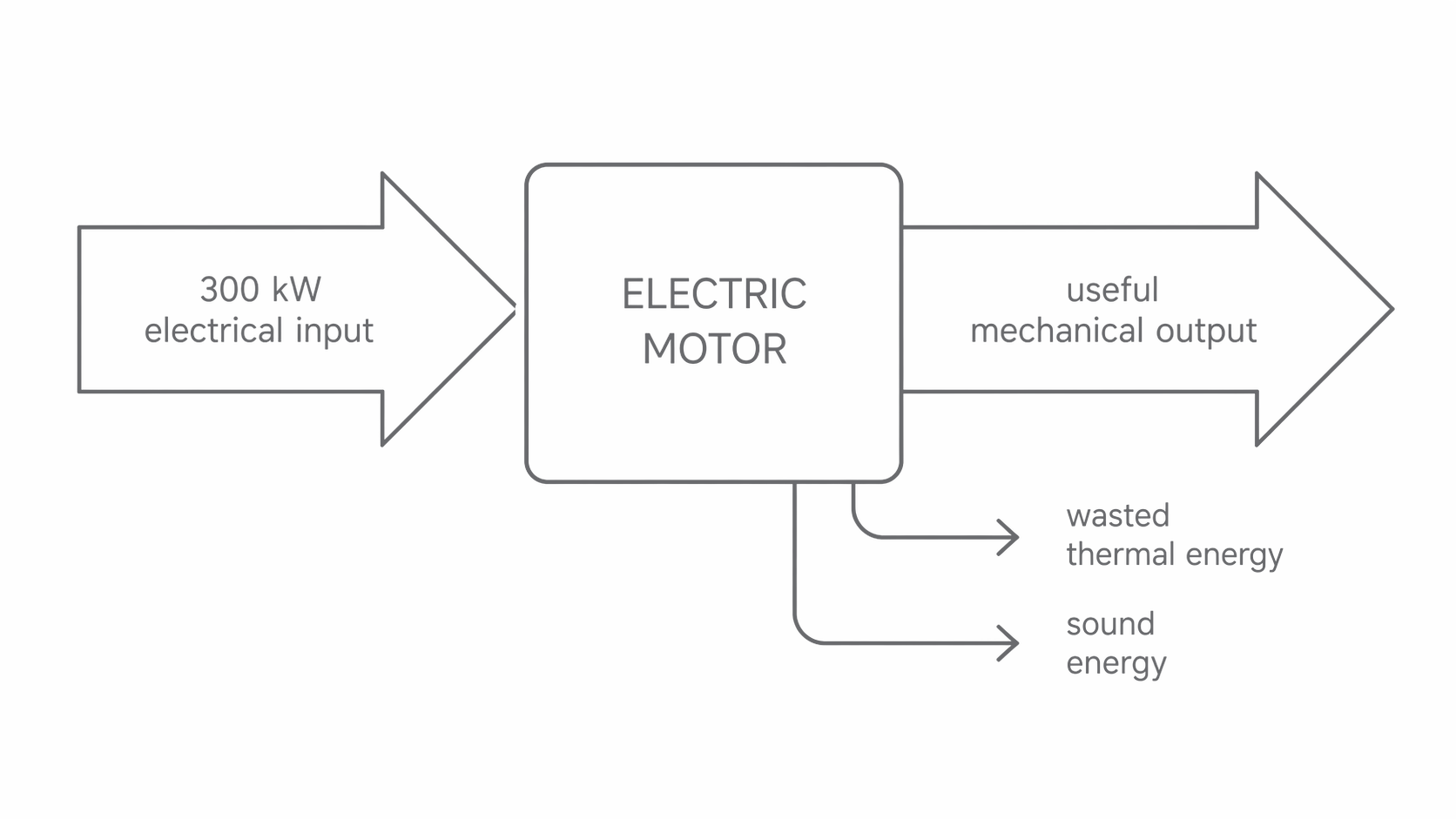
Questions like this pull the whole lesson together: work links force and displacement, power tells you how fast energy is transferred, and efficiency tells you how much of that transfer is useful.