3.4.1.8 - Conservation of Energy
Energy is one of the most fundamental concepts in physics. Every process in the universe — from a pendulum swinging to a roller coaster descending a track — obeys a single, unbreakable rule: energy is always conserved. In this lesson, you will learn how to apply the principle of conservation of energy quantitatively, linking gravitational potential energy, kinetic energy, and work done against resistive forces.
1. The Principle of Conservation of Energy
Principle of Conservation of Energy
Energy cannot be created or destroyed; it can only be transferred from one form to another. The total energy of a closed system remains constant.
This principle is one of the most powerful tools in physics. It allows us to analyse the motion of objects without needing to know every detail of the forces acting — we simply track where energy goes. In any process:
When we say a system is "closed", we mean no energy enters or leaves it. In practice, friction and air resistance transfer energy to the surroundings as heat, so we must account for this dissipated energy. The key idea is that energy is never lost — it is always transferred somewhere.
Regenerative braking in electric vehicles exploits conservation of energy. When the driver brakes, the electric motor runs in reverse as a generator, converting the car's kinetic energy into electrical energy that recharges the battery, rather than dissipating it entirely as heat in brake pads. This can recover up to 70% of the kinetic energy that would otherwise be wasted.
2. Gravitational Potential Energy and Kinetic Energy
Two forms of energy appear repeatedly in mechanics problems: gravitational potential energy and kinetic energy. You must be able to recall and use both equations.
Gravitational Potential Energy
The energy an object possesses due to its position in a gravitational field. For objects near the Earth's surface, the change in gravitational potential energy depends on the object's mass, the gravitational field strength, and the change in height.
For vertical motion close to the Earth's surface, the change is given by the AQA equation below.
Change in Gravitational Potential Energy
Where:
- is the change in gravitational potential energy (J)
- is the mass of the object (kg)
- is the gravitational field strength ( near the Earth's surface)
- is the change in vertical height (m)
Note that this equation assumes is constant over the height change . This is valid provided is much smaller than the radius of the Earth.
Kinetic Energy
The energy an object possesses due to its motion. It depends on the object's mass and the square of its speed.
This is why even a modest increase in speed can produce a much larger change in energy.
Kinetic Energy
Where:
- is the kinetic energy (J)
- is the mass of the object (kg)
- is the speed of the object ()
A crucial consequence of the term: if the speed of an object doubles, its kinetic energy quadruples. This is why stopping distances increase dramatically at higher speeds.
3. Energy Conservation Without Resistive Forces
When resistive forces (such as air resistance and friction) are negligible, the total mechanical energy of a system is conserved. This means any loss of gravitational potential energy equals the gain in kinetic energy, and vice versa.
If you choose to write the quantities as signed changes, then . In AQA mechanics questions it is usually clearer to compare the loss of with the gain in .
Notice that mass cancels from both sides. This tells us something remarkable: in the absence of resistive forces, the speed an object reaches after falling through a given height is independent of its mass.
In the pendulum diagram below, notice how the energy labels swap between maximum gravitational potential energy at the ends and maximum kinetic energy at the lowest point.
[DIAGRAM: asset_name: 4.1.8 - Conservation of Energy - Diagram 1; asset_slug: 4.1.8 - Conservation of Energy - Diagram 1; recommended_method: retained_png; description: A simple pendulum swinging between positions A (maximum height on left, above equilibrium), B (equilibrium, lowest point, maximum speed), and C (maximum height on right). Arrows showing and at A and C; and at B.]
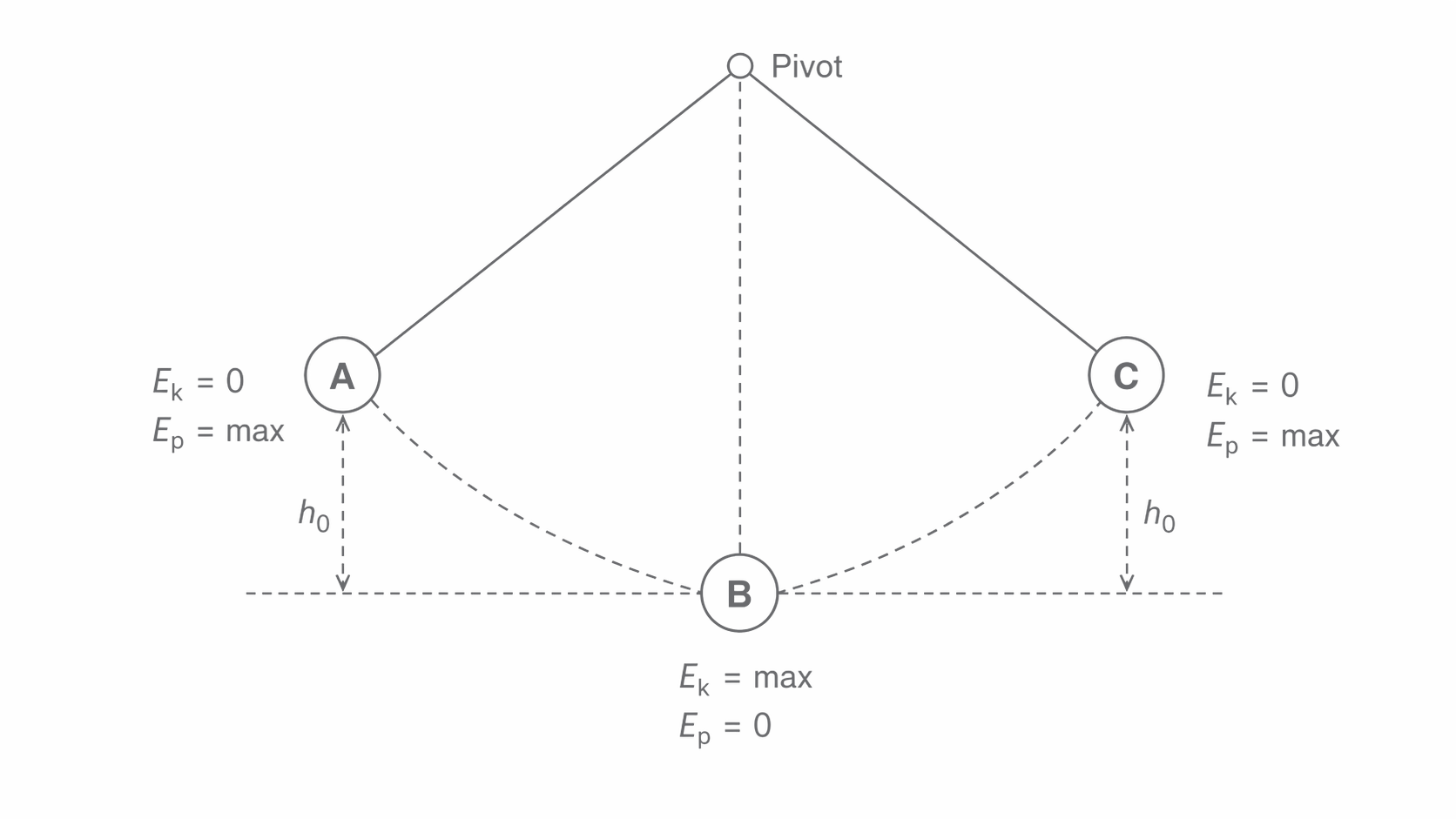
The pendulum is a classic example. Consider a pendulum bob released from rest at height above its equilibrium position. At any height above the equilibrium:
At the lowest point (), the bob has maximum speed:
Worked Example: A simple pendulum of mass swings and rises to a maximum height of above its equilibrium position. What is the maximum speed of the pendulum bob? (Ignore air resistance.)
At the maximum height, all energy is gravitational potential energy. At the equilibrium position, all energy is kinetic energy.
4. Energy Conservation With Resistive Forces
In real-world situations, resistive forces such as friction and air resistance act on moving objects. These forces do work on the object, transferring kinetic energy to thermal energy in the surroundings. The energy is not destroyed — it is dissipated.
When resistive forces are present, conservation of energy gives:
Or equivalently:
where is the distance travelled along the path (not the vertical drop) and is the average resistive force along that path.
In the track diagram below, notice the difference between the vertical drop , which sets the change in gravitational potential energy, and the longer path distance , which is used for the work done against friction.
[DIAGRAM: asset_name: 4.1.8 - Conservation of Energy - Diagram 2; asset_slug: 4.1.8 - Conservation of Energy - Diagram 2; recommended_method: retained_png; description: A fairground vehicle on a sloping track. Label the vertical drop , the distance along the track , the weight acting downward, the velocity at the bottom, and a friction arrow opposing motion along the track surface.]
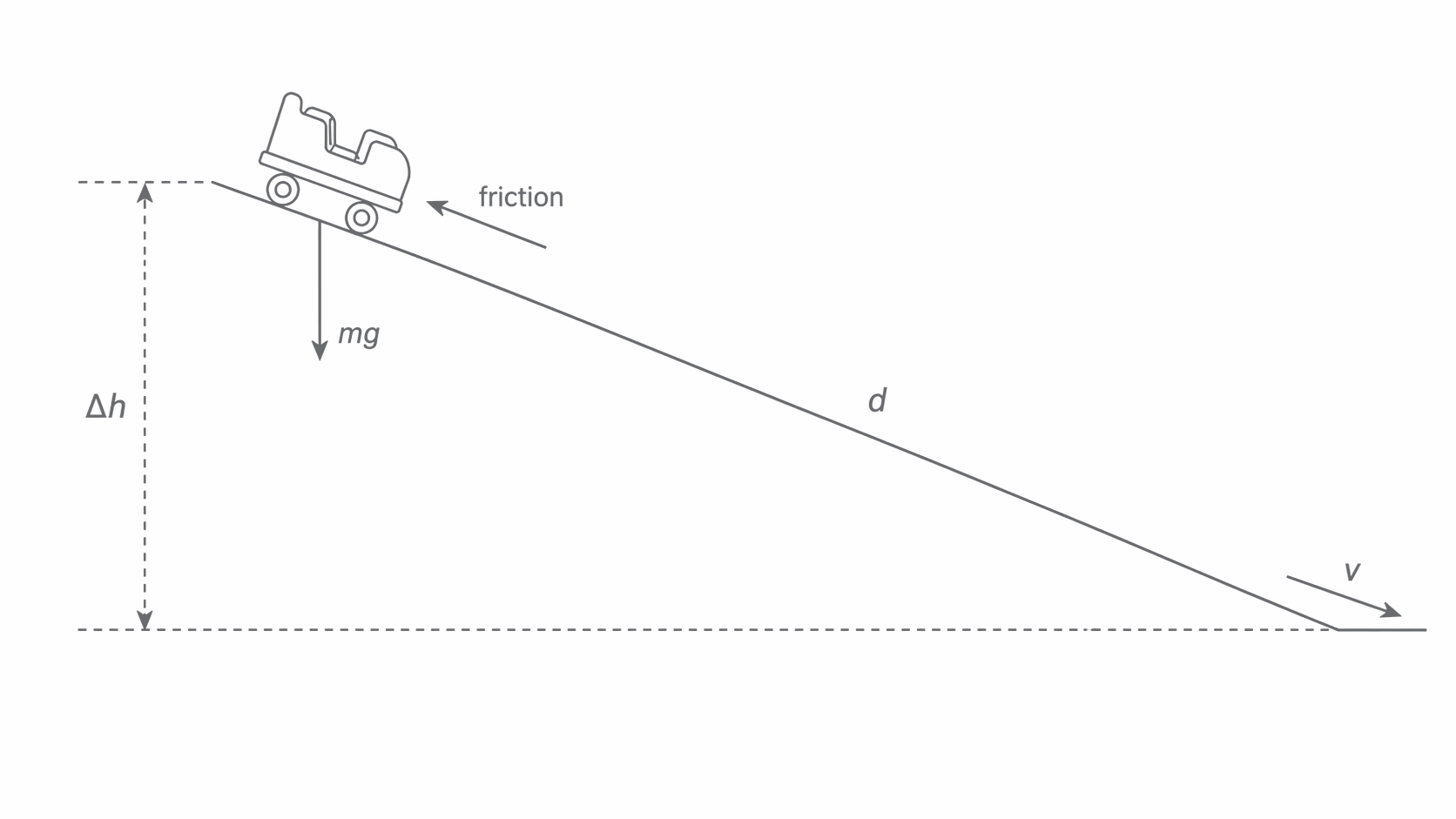
Worked Example: A fairground train of mass starts from rest at the top of a track and descends through a vertical drop of over a track distance of . It reaches a speed of at the bottom. Calculate (a) the loss of potential energy, (b) the gain of kinetic energy, (c) the average frictional force.
(a) Loss of potential energy:
(b) Gain of kinetic energy:
(c) Work done against friction:
Since :
When resistive forces act, the energy "lost" from the mechanical system equals the work done against those forces. Tracking where energy goes — not just how objects move — is the heart of energy conservation problems.
The next question uses exactly the same bookkeeping, but with smaller numbers and a different context.
5. Qualitative Energy Analysis and Problem-Solving Strategy
The specification requires both quantitative (numerical) and qualitative (descriptive) application of energy conservation. Being able to describe the energy transfers in a system — without doing any calculation — is an essential exam skill.
Example — a ball thrown upward with air resistance:
- The thrower does work on the ball, giving it kinetic energy.
- As the ball rises, kinetic energy is transferred to gravitational potential energy — the ball slows down.
- Simultaneously, the ball does work against air resistance, so some kinetic energy is transferred to thermal energy in the surrounding air.
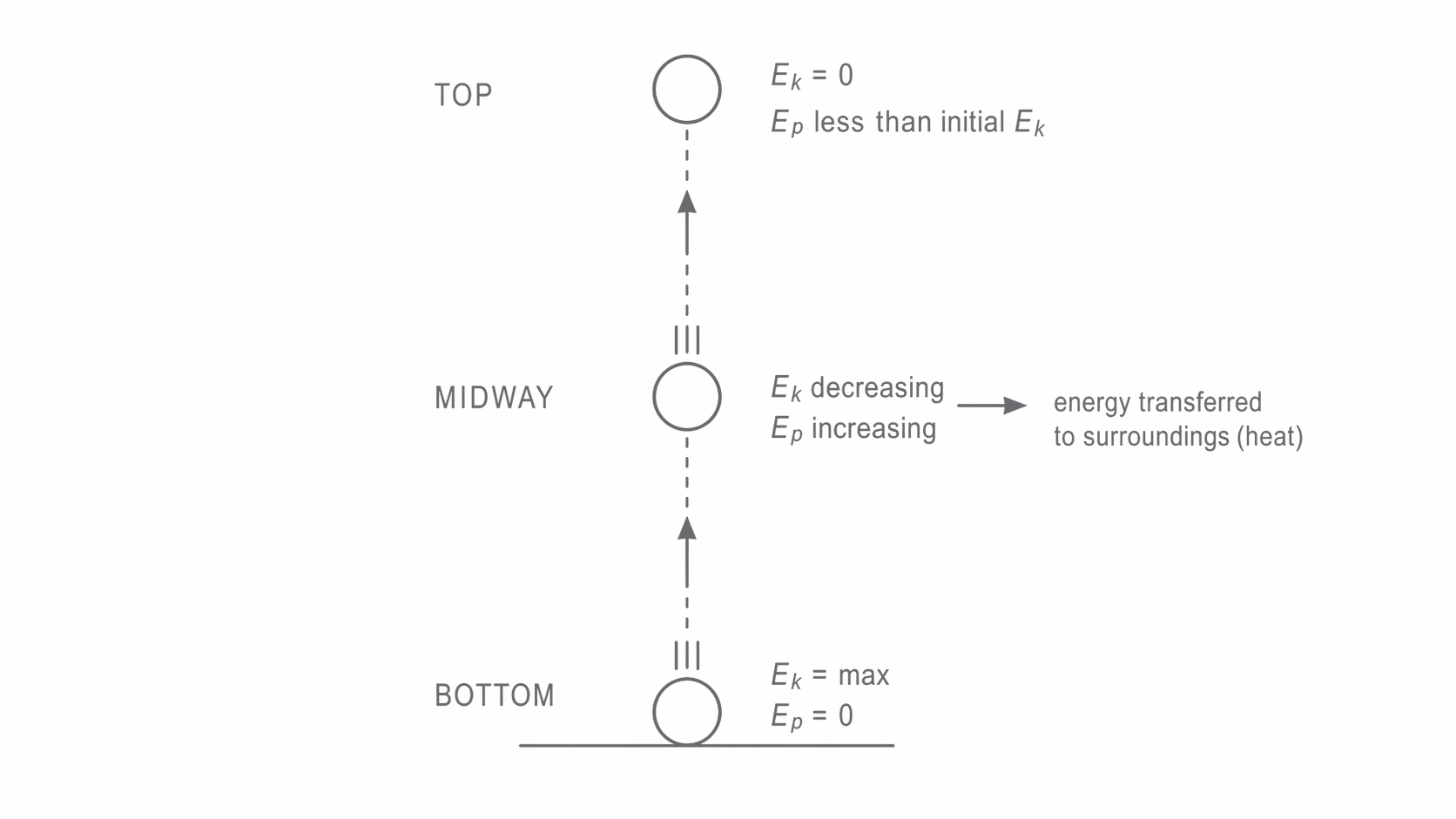
- At maximum height, the ball momentarily stops. Its gravitational potential energy at this point is less than its initial kinetic energy because some energy has been dissipated.
- As the ball falls, gravitational potential energy is converted back to kinetic energy, but air resistance again dissipates energy.
- The ball returns to the thrower's hand with less kinetic energy (and therefore less speed) than it was thrown with.
In the diagram below, notice that as the ball rises, kinetic energy decreases, gravitational potential energy increases, and some energy is transferred sideways to the surroundings because of air resistance.
[DIAGRAM: asset_name: 4.1.8 - Conservation of Energy - Diagram 3; asset_slug: 4.1.8 - Conservation of Energy - Diagram 3; recommended_method: retained_png; description: A vertical path of a ball thrown upward. At the bottom: , . Midway up: decreasing, increasing, arrow to the side labelled "energy transferred to surroundings (heat)". At the top: , .]
Problem-solving strategy for energy conservation questions:
- Identify the system — what objects and energy stores are involved?
- Identify the initial and final states — what is the energy at the start and end?
- List all energy transfers — gravitational potential energy, kinetic energy, work done against friction, elastic potential energy, etc.
- Write the conservation equation — total energy at start = total energy at end.
- Substitute known values and solve for the unknown.
The following question brings together all the ideas from this lesson, requiring you to reason through energy conservation in a multi-step scenario.
The same energy accounting underpins large-scale systems such as hydroelectric power generation.
Hydroelectric power stations are a direct application of gravitational potential energy conservation. Water stored at height in a reservoir has gravitational potential energy. When released, this converts to kinetic energy as the water flows downhill through pipes, then the moving water drives turbines connected to generators. A typical station such as Dinorwig in Wales has a head height of around 500 m, and the energy conversion efficiency from potential energy to electrical energy can exceed 90%.