3.3.2.1 - Interference
Interference shows what happens when waves overlap. In light, it produces the bright and dark fringes of Young's double-slit experiment; in sound and other electromagnetic waves, it produces alternating maxima and minima of intensity. In this lesson you will learn the conditions for interference, how the double-slit arrangement produces a stable pattern, how fringe spacing depends on wavelength and geometry, what changes when white light is used, and why Young's experiment changed physics.
Part 1 - Path Difference and Coherence
Two ideas control every interference pattern: path difference and coherence. Path difference tells you how much farther one wave has travelled than the other. Coherence tells you whether the phase relationship between the waves stays fixed long enough for a stable pattern to appear.
Path Difference
The difference in the distance travelled by two waves from their sources to the same point.
At any point where two waves meet, the path difference determines whether they reinforce or cancel. If the waves arrive in phase, the resultant amplitude is larger. If they arrive exactly half a cycle out of phase, the waves cancel completely.
Conditions for Interference
Here, is the wavelength and is an integer. A bright fringe is produced where the path difference is a whole number of wavelengths. A dark fringe is produced where the path difference is a whole number plus half a wavelength.
Coherent Sources
Sources that emit waves of the same frequency with a constant phase difference.
Coherent sources do not have to be exactly in phase. They just need the phase difference between them to stay constant. This is why two separate filament lamps do not produce a steady interference pattern: their light is emitted independently, so the phase relationship changes randomly. A laser is much more useful because it is highly monochromatic and coherent, so the pattern stays stable.
Part 2 - Young's Double-Slit Experiment
Young's experiment uses one light source to create two coherent sources. Light is directed at two narrow, closely spaced slits. Each slit diffracts the light, and the two diffracted waves spread out and overlap on a screen. Where the waves arrive in phase, a bright fringe appears. Where they arrive out of phase, a dark fringe appears.
In the diagram below, notice how one source feeds both slits, how the waves spread after diffraction, and how the fringe spacing is measured across the screen.
[DIAGRAM: asset_name: 3.2.1 - Interference - Diagram 1; asset_slug: 3.2.1 - Interference - Diagram 1; recommended_method: retained_png; description: Young's double-slit experiment. A monochromatic source on the left illuminates two narrow slits labelled S1 and S2. Diffracted waves spread from both slits and overlap on a distant screen on the right. Show alternating bright and dark fringes on the screen. Label slit separation s, slit-to-screen distance D, and fringe spacing w.]
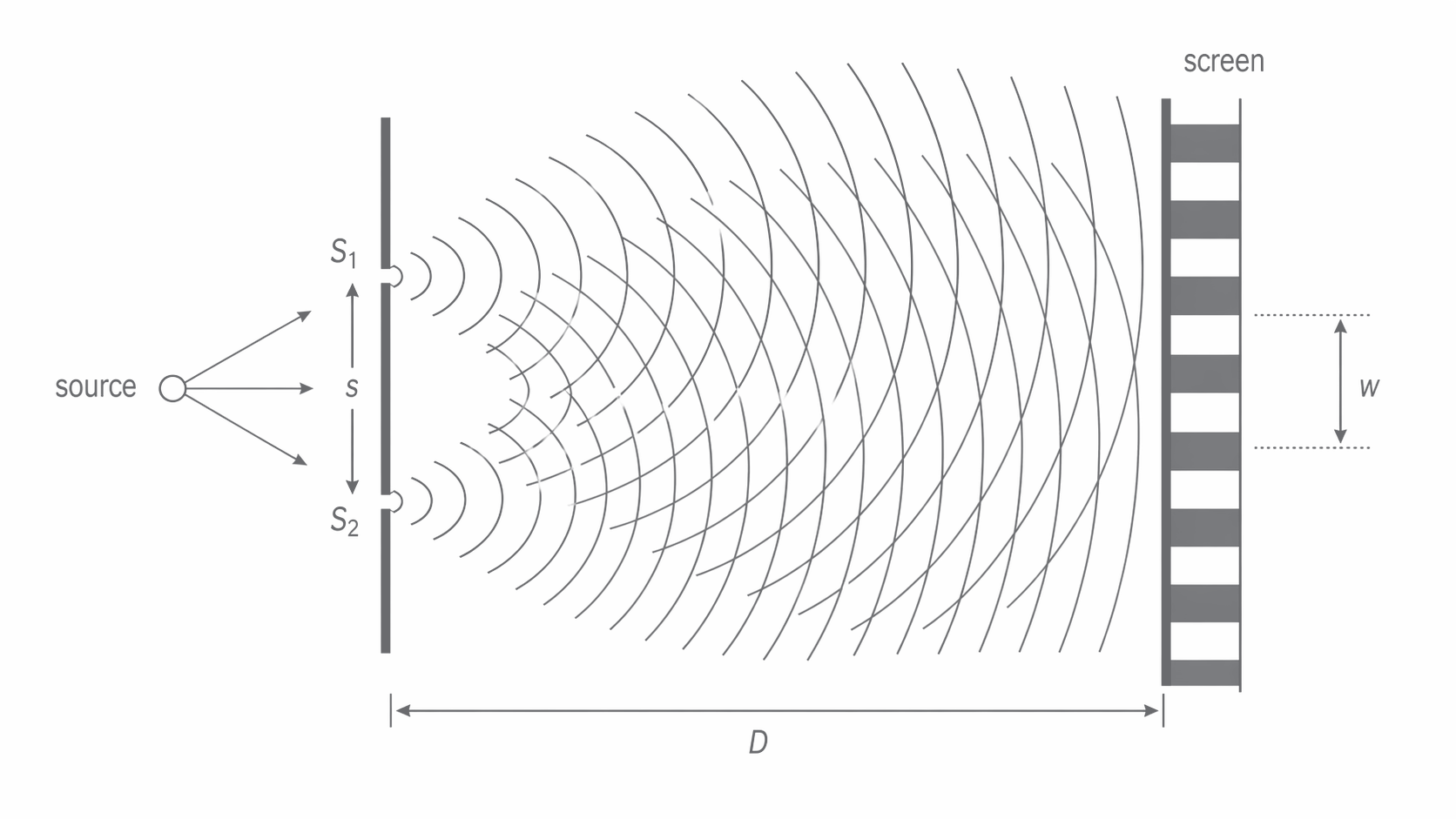
If a laser is used, it can illuminate the double slit directly because the light is already coherent and nearly monochromatic. If the original source is a lamp, the light should first pass through a narrow single slit and a colour filter. The single slit makes the light reaching both slits come from the same wavefront, and the filter narrows the wavelength range so the fringes are easier to see.
Diffraction is essential here. If the slits were too wide, the light would not spread enough for the waves from the two slits to overlap strongly on the screen. Narrow slits allow the light to diffract, and that overlap is what makes interference possible.
Two loudspeakers connected to the same signal generator act as coherent sources of sound. As you walk across in front of them, you move through regions where the path difference gives constructive interference and the sound is loud, and regions where it gives destructive interference and the sound is quiet. Microwaves behave in the same way: a detector records alternating maxima and minima as it is moved across the pattern.
This is why the same interference ideas apply to sound waves and other electromagnetic waves. The physical details of the source change, but the condition for maxima and minima is still controlled by path difference and coherence.
Part 3 - Fringe Spacing
In Young's experiment, the distance between adjacent bright fringes is called the fringe spacing, . For small angles, the geometry of the double-slit arrangement gives a simple relationship between fringe spacing, wavelength, slit separation, and distance to the screen.
Double-Slit Fringe Spacing
In this equation, is the fringe spacing, is the wavelength of the light, is the slit-to-screen distance, and is the slit separation. The equation shows that fringes are more widely spaced if the wavelength is larger, if the screen is farther away, or if the slits are closer together.
In practice, it is better to measure across several fringes and divide by the number of fringe spacings. That reduces the percentage uncertainty because the total measured distance is larger while the ruler uncertainty stays about the same. Dark fringe centres are often easier to judge than bright fringe centres, so students often measure from one dark fringe to another several spacings away.
Once you can use the equation confidently, you can predict how the whole pattern changes when the setup changes. The fringes are not random stripes on a screen: they are direct evidence of a precise wave relationship between path difference, wavelength, and geometry.
Part 4 - White Light Fringes
White light contains a continuous range of wavelengths, roughly from violet to red. Each wavelength produces its own interference pattern, and all of those patterns are centred on the same point on the screen.
At the centre of the pattern, the path difference is zero for every wavelength, so all colours interfere constructively together. That is why the central fringe is white. Away from the centre, the different colours no longer line up perfectly because red light has a larger wavelength than blue light and therefore a larger fringe spacing.
The first fringes on either side of the centre appear as spectra. Violet or blue is closer to the centre, while red is farther out. Beyond the first few fringes, the different coloured patterns overlap so much that the fringes merge into a faint white background.
Part 5 - Lasers, Safety, and Other Waves
Lasers are preferred in interference experiments because they are coherent and almost monochromatic, so the fringes are bright and easy to see. The specification does not require you to describe how a laser works, but you do need to know why it is useful in this context and why it must be handled carefully.
If a laser beam enters the eye, the eye can focus it onto a tiny spot on the retina. That concentrates the energy and can cause permanent damage. For that reason, a laser experiment must be set up so the beam never points toward anyone's eyes, reflective surfaces are avoided, and the beam is displayed on a screen rather than viewed directly.
Never look directly into a laser beam or along its path, even after reflection. Keep the beam below eye level, avoid reflective surfaces, and use a screen to view the pattern.
Part 6 - Historical Significance
In the seventeenth century, Huygens argued that light behaved as a wave, while Newton argued for a corpuscular model. Both models could account for reflection and refraction, so the debate was not settled immediately.
Young's double-slit experiment changed that because it showed both diffraction and interference in light. Those observations gave strong evidence that light behaves as a wave and undermined a purely corpuscular picture. Later work, especially the photoelectric effect, showed that light also has particle-like behaviour. Modern physics therefore describes electromagnetic radiation using wave-particle duality rather than a simple either-or picture.
Young's experiment matters not just because of the result, but because it shows how scientific understanding changes when new evidence appears. A successful model must explain the observations, and when new experiments reveal limits in an older model, the model has to be revised.
Young's double-slit experiment gave strong evidence for the wave nature of light, while later quantum evidence showed that light also behaves like particles. Our current model keeps both ideas in wave-particle duality.