3.2.1.7 - Applications of Conservation Laws
Particle interactions are not judged by guesswork. You decide whether a reaction is possible by checking a short list of conservation laws and, for beta decay, by tracking the quark change that makes the reaction weak. In this lesson you will practise that method so you can decide quickly whether a reaction is allowed, forbidden, strong, or weak.
Part 1: What must be conserved
Every particle interaction must conserve energy, momentum, charge, baryon number, and the relevant lepton numbers. Strangeness is the special case: it is conserved in strong interactions, but it can change in weak interactions.
Conservation Law
A conservation law states that the total value of a quantity before an interaction is equal to the total value after the interaction.
For this topic, you should check:
- energy
- momentum
- charge,
- baryon number,
- electron lepton number,
- muon lepton number,
- strangeness,
Energy includes rest energy as well as kinetic energy. Momentum is always conserved too, so if the total momentum before an interaction is zero, the vector sum of the momenta after the interaction must also be zero.
Strangeness behaves differently from the other particle-number rules. In a strong interaction the total strangeness must stay the same. In a weak interaction it can change by , , or .
After you know which quantities matter, the rest of the method is bookkeeping: write the reaction, total each quantity on the left-hand side, total it again on the right-hand side, and compare the two sets of totals.
Part 2: Assigning quantum numbers
To use the conservation laws, you need the quantum numbers of the particles involved. For familiar particles you should know them directly. For unfamiliar hadrons, you may be given the quark composition and asked to work the values out from that.
Baryon Number
Baryon number is a quantum number with value for each quark and for each antiquark. Baryons have , antibaryons have , and mesons and leptons have .
The key assignments for this lesson are:
- quarks: has charge , and each have charge
- antiquarks have opposite charge and opposite strangeness to the matching quark
- the strange quark has , while the anti-strange quark has
- leptons have baryon number , and hadrons have lepton number
- baryons are three-quark states, mesons are quark-antiquark states
Here is a compact reference table for some common particles:
| Particle | Quark content | |||||
|---|---|---|---|---|---|---|
| - | ||||||
| - | ||||||
| - | ||||||
The exam will supply the necessary particle data when it goes beyond the small set you are expected to know. Your job is to use that information accurately, not to memorise every hadron ever discovered.
Part 3: Systematic checking
The cleanest exam method is to use a before-and-after table. This prevents missed signs and makes it obvious which quantity fails to balance.
For decay,
the totals are:
| Stage | |||||
|---|---|---|---|---|---|
| Before: | |||||
| After: |
Every listed quantity is conserved, so the decay is allowed. Because a quark changes flavour, the interaction is weak.
You should also remember that momentum must be conserved. For example, in a head-on collision of two identical particles with equal and opposite momenta, the initial total momentum is zero, so the final vector sum of momenta must also be zero. When a question asks for the minimum kinetic energy needed to create new particles, that minimum corresponds to the final particles having no extra kinetic energy in the centre-of-mass frame, but momentum conservation still has to hold. The same before-and-after table layout is therefore a good habit for any conservation-law question, even when the exam does not print one for you.
Part 4: Quark changes in beta decay
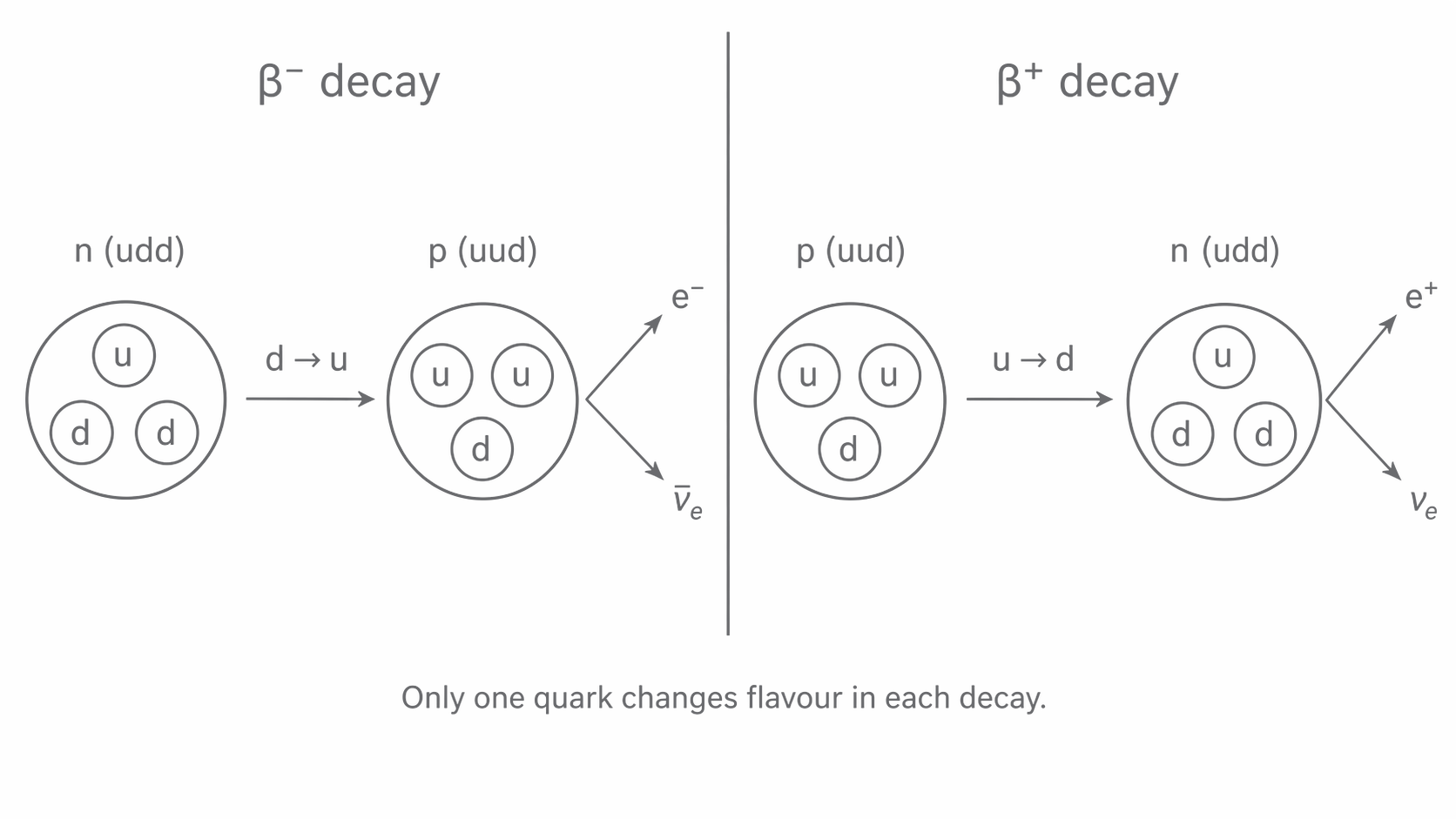
Beta decay is a weak interaction because one quark changes flavour.
In decay, a neutron becomes a proton:
One down quark changes into an up quark.
Beta-minus quark change
Charge is still conserved because
and baryon number is conserved because the quark still has baryon number before and after the change.
In decay inside a proton-rich nucleus, one proton changes into a neutron:
This time one up quark changes into a down quark.
Beta-plus quark change
Again, charge is conserved because
and the baryon number of the changing quark remains .
It is worth being precise here: this is a change inside a nucleus, not a description of a free proton spontaneously decaying in empty space. At A-level, the important idea is the quark flavour change and the conservation laws, not an isolated free-proton process.
The side-by-side quark sketch below shows the key feature to notice in both decays: only one quark changes flavour, while the other two quarks stay the same and the emitted lepton pair carries away the extra charge and lepton number.
[DIAGRAM: asset_name: 2.1.7 - Applications of Conservation Laws - Diagram 1; asset_slug: 2.1.7 - Applications of Conservation Laws - Diagram 1; recommended_method: retained_png; description: Two side-by-side quark diagrams. Left: neutron udd becoming proton uud, with one d quark changing to u and an electron plus electron antineutrino emitted. Right: proton uud becoming neutron udd, with one u quark changing to d and a positron plus electron neutrino emitted.]
Part 5: Allowed reactions and quark descriptions
A reaction is forbidden if any always-conserved quantity fails to balance. For example,
cannot occur because the baryon number changes from on the left to on the right.
By contrast,
is allowed because charge, baryon number, lepton numbers, and strangeness all balance.
When you are given a strange particle, strangeness is often the deciding test. Consider:
Charge is conserved: .
Baryon number is conserved: .
Strangeness is not conserved: before the interaction the contributes , but after the interaction both products have . That means the reaction can only proceed via the weak interaction.
At the quark level,
At A-level, the useful quark description is that the products are a neutron () and a pion (), and that the change in strangeness tells you a weak flavour change must occur somewhere in the process. You do not need a detailed intermediate-boson mechanism unless the question explicitly asks for one.
Reaction-Checking Method
This is the main exam pattern: total the quantum numbers, decide whether the reaction is allowed, then use quark language when the question asks for deeper explanation.