3.2.1.5 - Classification of Particles
The subatomic world contains a rich zoo of particles discovered through cosmic ray experiments and high-energy accelerator collisions. To make sense of this diversity, physicists classify particles into groups based on the fundamental interactions they experience. In this lesson you will learn the two main families — hadrons and leptons — and the quantum numbers that govern how particles are created and destroyed.
Part 1: Hadrons and Leptons
For the particles you meet on this AQA specification point, the first useful classification is into hadrons and leptons. The deciding factor is whether the particle experiences the strong nuclear force.
Hadron
A hadron is a particle or antiparticle that is subject to the strong interaction. Hadrons are not fundamental particles.
Examples of hadrons include protons, neutrons, pions, and kaons. Because they contain quarks, hadrons can also interact through the weak, electromagnetic (if charged), and gravitational interactions.
Lepton
A lepton is a fundamental particle or antiparticle that does not experience the strong interaction. Leptons interact through the weak interaction, and through the electromagnetic interaction if charged.
The leptons you need to know are the electron (), the muon (), the electron neutrino (), and the muon neutrino (), together with their antiparticles: the positron (), the antimuon (), the electron antineutrino (), and the muon antineutrino (). The classification tree below helps you sort these particles by interaction, so notice that baryons and mesons sit inside the hadron branch while the leptons form a separate family because they do not feel the strong force.
[DIAGRAM: asset_name: 2.1.5 - Classification of Particles - Diagram 1; asset_slug: 2.1.5 - Classification of Particles - Diagram 1; recommended_method: retained_png; description: A branching tree — "Particles on this spec point" splits into "Hadrons (feel strong force)" and "Leptons (do not feel strong force)". The Hadrons branch splits further into "Baryons" and "Mesons". Under Leptons list: electron, muon, electron neutrino, muon neutrino and their antiparticles.]
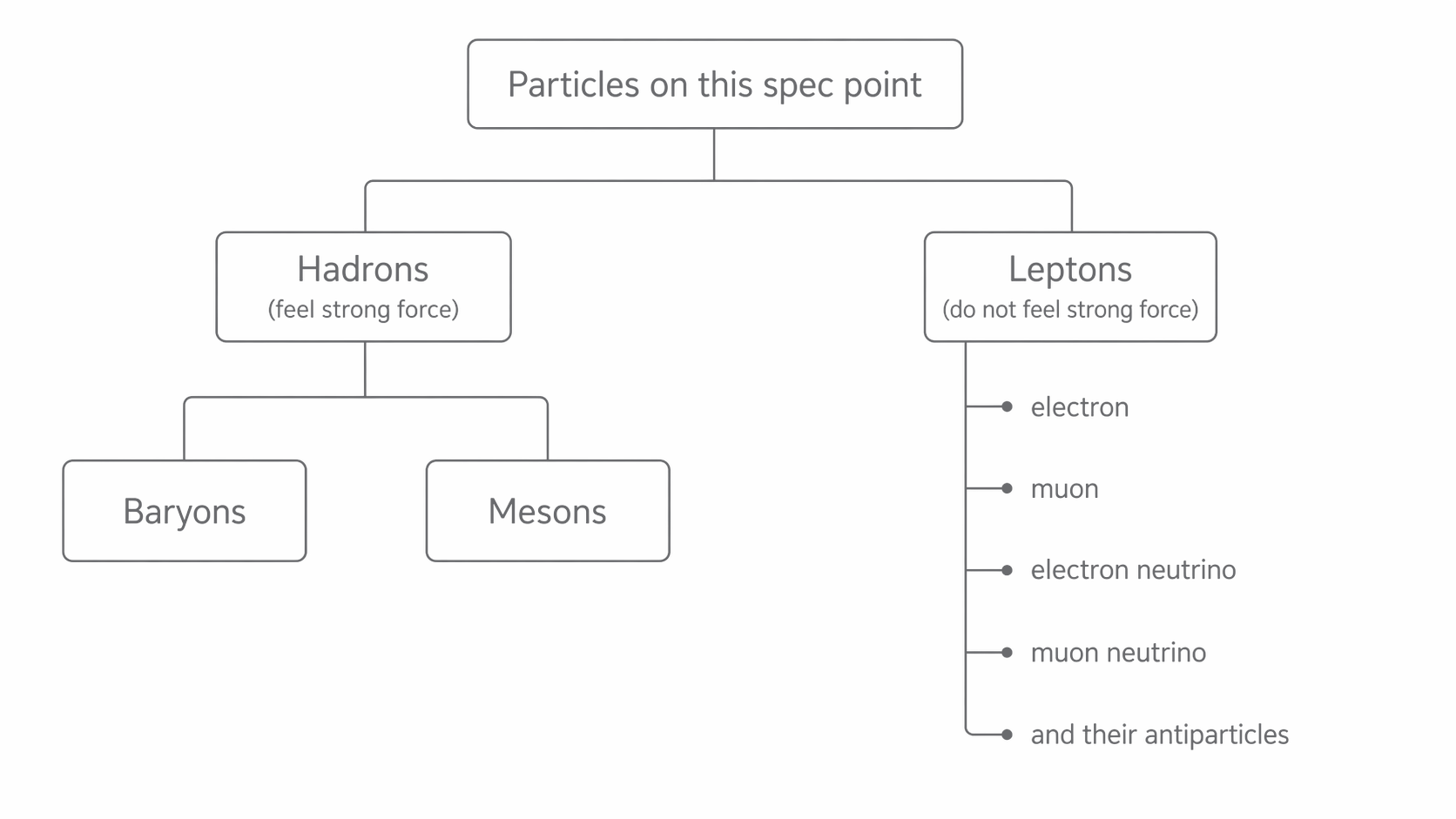
This is a classification by interaction, not by mass. A muon, for example, is much heavier than an electron but is still a lepton because it does not experience the strong interaction.
Part 2: Baryons and Mesons
Hadrons are further divided into two sub-groups based on their decay products.
Baryon
A baryon is a proton, or any other hadron that eventually decays into a proton, either directly or through a chain of decays. The proton is the only stable baryon. Baryons have a baryon number of ; antibaryons have a baryon number of .
The baryons you must know are the proton () and the neutron (), along with their antiparticles, the antiproton () and the antineutron ().
Meson
A meson is a hadron that does not include protons in its decay products. Mesons have a baryon number of .
The mesons you need to know are the pions (, , ) and the kaons (, , ). Pions act as the exchange particles of the strong nuclear force between nucleons. In 1935, Hideki Yukawa predicted that the strong force between protons and neutrons is mediated by the exchange of a virtual particle with a mass intermediate between the electron and the proton — hence the name "meson" (Greek for "middle"). Yukawa estimated its mass at around 200 times the electron mass from the known range of the strong force (~1 fm). The pion was experimentally discovered in 1947 in cosmic ray experiments, confirming his prediction.
Key properties to remember:
| Particle | Type | Rest energy / MeV | Charge / |
|---|---|---|---|
| Proton | Baryon | 938.3 | |
| Neutron | Baryon | 939.6 | |
| / | Meson | 140 | / |
| Meson | 135 | ||
| / | Meson | 494 | / |
| Meson | 498 |
Note that the and are particle–antiparticle pairs of each other, and the is its own antiparticle.
Part 3: Baryon Number and Its Conservation
Baryon Number ($B$)
Baryon number is a quantum number assigned to every particle:
- for any baryon (proton, neutron, etc.)
- for any antibaryon (antiproton, antineutron, etc.)
- for all other particles (mesons, leptons, photons)
Baryon number is always conserved — in every interaction, the total baryon number before equals the total baryon number after. This applies to strong, weak, and electromagnetic interactions alike.
Let us verify this with the beta-minus decay of a neutron:
Baryon number: LHS . RHS . Baryon number is conserved.
Now consider whether the following hypothetical reaction is allowed:
Baryon number: LHS . RHS . Baryon number is not conserved, so this reaction is forbidden.
The correct version would need a proton–antiproton pair to be created together:
Baryon number: LHS . RHS . This is permitted (provided enough energy is available).
Part 4: Leptons, Lepton Number, and Its Conservation
Lepton Number
There are two separate lepton numbers that must each be conserved independently:
Electron lepton number ():
- for the electron () and the electron neutrino ()
- for the positron () and the electron antineutrino ()
- for all other particles
Muon lepton number ():
- for the muon () and the muon neutrino ()
- for the antimuon () and the muon antineutrino ()
- for all other particles
Both and must be separately conserved in every interaction. This is why there are two distinct types of neutrino — if there were only one, experiments would produce equal numbers of electrons and muons in neutrino interactions, but they do not.
The muon () is sometimes called a "heavy electron" because it has the same charge as the electron but a rest mass over 200 times greater (rest energy 106 MeV compared to 0.511 MeV). The muon is unstable and decays into an electron:
Let us check all conservation laws for this decay:
- Charge: LHS . RHS . Conserved.
- : LHS . RHS . Conserved.
- : LHS . RHS . Conserved.
- Baryon number: LHS . RHS . Conserved.
Notice that the muon produces a muon neutrino (to conserve ) and an electron antineutrino (to conserve alongside the newly created electron).
Neutrino detection experiments such as the Super-Kamiokande detector in Japan use enormous tanks of ultra-pure water deep underground to detect neutrinos. When a neutrino interacts with a water molecule, it can produce a charged lepton that emits Cherenkov radiation — a faint cone of blue light. The type of charged lepton produced tells physicists what type of neutrino caused the interaction, since lepton number must be conserved. These experiments have demonstrated that neutrinos can oscillate between types, implying they have a tiny but non-zero mass.
Consider the proposed decay . Charge is conserved (−1 on each side), and total lepton number is conserved (+1 on each side). However, checking separately: : LHS , RHS . Muon lepton number is not conserved, so this decay is forbidden. This is precisely why we must conserve electron and muon lepton numbers independently.
Part 5: Strange Particles and Strangeness
When high-energy protons collide with nuclei, kaons can be created very quickly. Early physicists then found that these same particles decayed much more slowly than expected. That combination — strong production but weak decay — is the key idea behind strange particles.
Strange Particles
Strange particles are particles that are produced through the strong interaction but decay through the weak interaction. The kaon is the key example at A-Level.
Kaons can decay into pions. For instance:
Since kaon decay proceeds via the weak interaction, it is much slower than if the strong force were responsible — giving kaons a relatively long lifetime compared to particles that decay via the strong interaction.
To describe this behaviour, physicists introduced a new quantum number called strangeness.
Strangeness ($S$)
Strangeness is a quantum number assigned to particles. For AQA, the key values are:
- and have strangeness
- and have strangeness
- Pions, protons, neutrons, and leptons have strangeness
The conservation rule is the important part:
Strangeness is conserved in strong interactions, but in weak interactions it can change by , , or .
For an initially non-strange collision such as proton-proton interactions, the total strangeness starts at zero. If a strong interaction creates a particle with , it must also create another product with so that the total stays zero. This is what associated production means: strange particles are produced together in a way that keeps total strangeness conserved.
For example, when a high-energy proton collides with another proton:
Strangeness: LHS . RHS . Conserved — so this can be a strong interaction.
When a kaon decays into pions, however:
Strangeness: LHS . RHS . Change in strangeness . That change is not allowed in a strong interaction, but it is allowed in a weak interaction, so the decay is weak.
Particle physics and international collaboration. Investigating particles like kaons requires enormous accelerators such as the Large Hadron Collider (LHC) at CERN, a 27 km circumference ring near Geneva. The LHC accelerates protons to energies exceeding 7000 GeV and produces vast quantities of data. Building and operating such facilities requires collaborative efforts from thousands of scientists and engineers across many countries. The discovery of the Higgs boson at CERN in 2012 — predicted in 1964 — was a triumph of this international approach, involving teams from over 100 nations.
The two-panel sketch below shows the key idea of associated production, so notice that the and appear together and keep the total strangeness at zero before and after the collision.
[DIAGRAM: asset_name: 2.1.5 - Classification of Particles - Diagram 2; asset_slug: 2.1.5 - Classification of Particles - Diagram 2; recommended_method: retained_png; description: Associated production in two panels. Panel 1: two protons approach, each labelled , so total strangeness before is 0. Panel 2: products are two protons plus and . Label with , with , and show total strangeness after is still 0.]
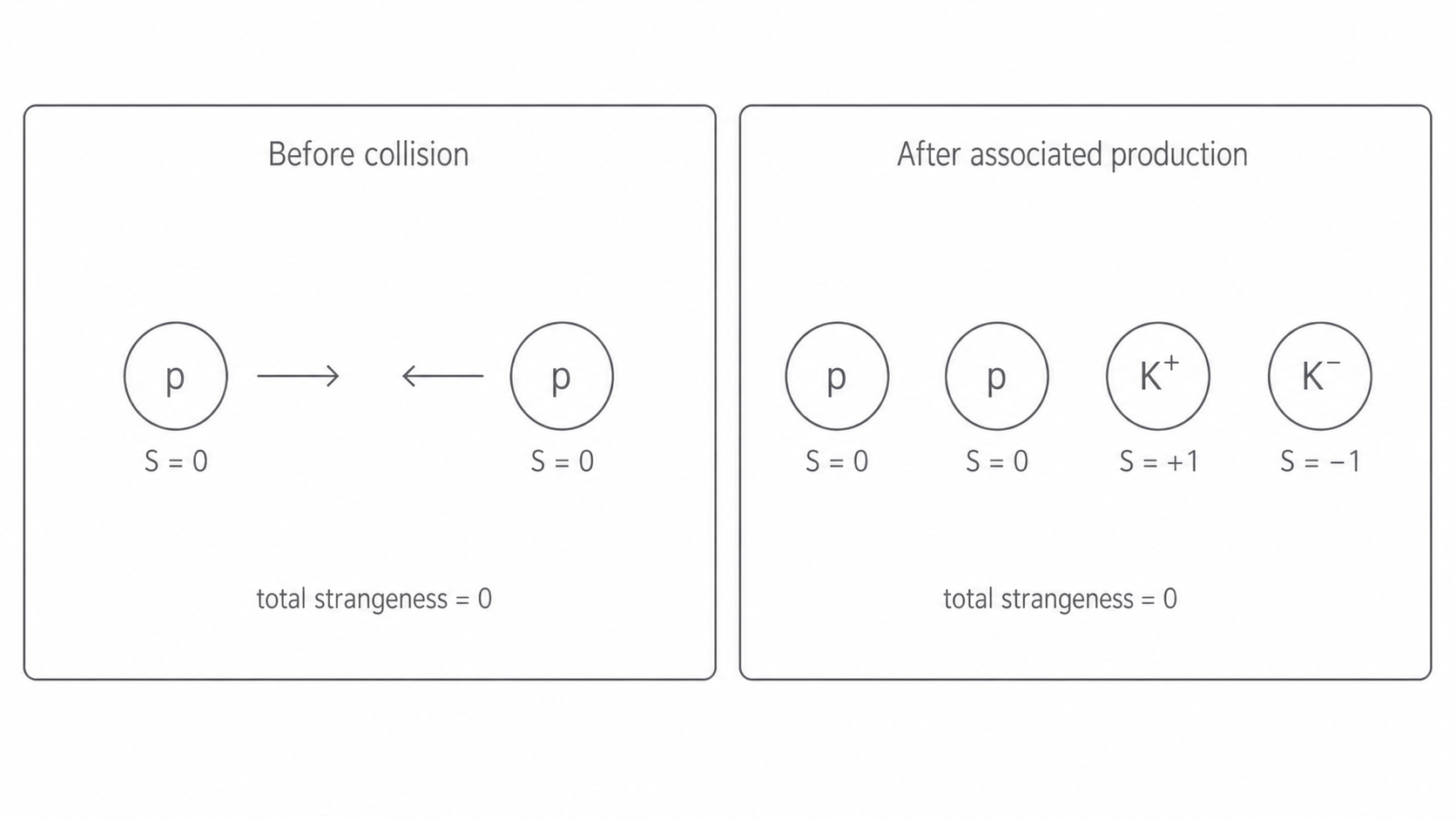
The exam habit to build here is simple: in a strong interaction, total strangeness before and after must match exactly. In a kaon decay, a change of points you toward the weak interaction.
Part 6: Applying Conservation Laws Together
In AQA exam questions, you will often need to apply several conservation laws simultaneously to determine whether a reaction is permitted or to identify unknown particles. The quantum numbers you must check are:
- Charge () — always conserved
- Baryon number () — always conserved
- Electron lepton number () — always conserved
- Muon lepton number () — always conserved
- Strangeness () — conserved in strong interactions; can change by , , or in weak interactions
When checking whether a particle interaction is allowed, systematically apply each conservation law in turn. If any law is violated, the interaction is forbidden. If all are satisfied, it is permitted (provided sufficient energy is available).
Worked example: Determine whether the following decay is permitted:
The (sigma minus) is a strange baryon with charge , , and . (Note: the sigma baryon is not a particle you need to memorise for the exam — it is used here to practise applying conservation laws to an unfamiliar particle when its properties are given.)
- Charge: LHS . RHS . Conserved.
- Baryon number: LHS . RHS . Conserved.
- Lepton numbers: No leptons involved. and on both sides. Conserved.
- Strangeness: LHS . RHS . Change .
Strangeness is not conserved, so this cannot be a strong interaction. However, the change in strangeness is , which is allowed for a weak interaction. Since the decay does proceed via the weak interaction, it is permitted.
To consolidate the conservation-law logic, it helps to explain the strange-particle story out loud from start to finish.