37.2 KT5 - Reunification: recreating a united Germany, 1989-90
German reunification was not simply the happy ending to the fall of the Berlin Wall. In autumn 1989, many East Germans first demanded travel rights, free elections and the end of Socialist Unity Party rule, not necessarily immediate merger with the Federal Republic. By 3 October 1990, however, the German Democratic Republic had disappeared and its territory had acceded to the Federal Republic of Germany.
This lesson explains how a refugee crisis, a peaceful revolution and rapid West German strategy reinforced one another, and why the Four Powers accepted unity once it was tied to democracy, settled borders and European security.
Enquiry Frame and Chronology
This is a Paper 3 depth topic. The enquiry is: why did the division of Germany, which had lasted since 1949, collapse so quickly in 1989-90, and how was a united Germany recreated without war or a general European crisis?
Do not treat the lesson as a simple story in which the Berlin Wall fell and unity naturally followed. In November 1989 there were several possible futures:
| Possible future in late 1989 | Why it seemed possible | Why it lost ground |
|---|---|---|
| A reformed socialist GDR | Opposition groups wanted free speech, free elections and an end to SED dictatorship. | The economy was weak, migration continued, and many voters preferred the security of the FRG. |
| A confederation of two German states | Kohl's Ten Point Plan and Modrow's proposals both included stages short of full unity. | Events moved faster than staged planning, especially after the March 1990 Volkskammer election. |
| A neutral united Germany | This might have reassured the Soviet Union and some Europeans. | The FRG, the USA and NATO resisted neutrality; Soviet acceptance was negotiated instead. |
| GDR accession to the FRG | Article 23 of the Basic Law offered a fast legal route. | It solved speed and stability, but created problems of unequal power, cost and eastern adjustment. |
The chronology is compressed, so keep the sequence clear.
| Date | Development | Why it matters |
|---|---|---|
| 2 May 1989 | Hungary began dismantling parts of its border barrier with Austria. | The Iron Curtain was becoming physically and politically weaker. |
| 10-11 September 1989 | Hungary allowed East Germans to cross into Austria and then the FRG. | The GDR could no longer reliably seal its citizens inside the Eastern bloc. |
| 25 September 1989 | Leipzig Monday demonstrations gathered momentum. | Public protest in the GDR became regular, visible and harder to contain. |
| 30 September 1989 | Hans-Dietrich Genscher announced in Prague that thousands of East German embassy refugees could travel to the FRG. | The refugee crisis became a public humiliation for the GDR. |
| 7 October 1989 | The GDR marked its 40th anniversary amid protests and Gorbachev's visit. | The contrast between Soviet reform language and East German rigidity was stark. |
| 9 October 1989 | Around 70,000 demonstrated in Leipzig and the state did not fire. | This was a decisive moment in the peaceful revolution. Fear began to change sides. |
| 18 October 1989 | Erich Honecker was replaced by Egon Krenz. | The SED tried a controlled change of leadership, but without real credibility. |
| 9 November 1989 | Schabowski's confused travel announcement helped trigger the opening of the Berlin Wall. | The border regime collapsed in front of the world. |
| 28 November 1989 | Helmut Kohl announced his Ten Point Plan. | The FRG seized the political initiative and framed unity as a staged, European process. |
| 7 December 1989 | The Central Round Table first met. | Opposition groups gained a public role in supervising transition, though not full state power. |
| 18 March 1990 | The GDR held its first free Volkskammer election. | Voters gave a mandate to parties promising fast unity. |
| 18 May 1990 | The FRG and GDR signed the Monetary, Economic and Social Union treaty. | The GDR was tied into the FRG's currency, market economy and welfare system. |
| 1 July 1990 | Monetary, economic and social union took effect. | The Deutsche Mark entered the GDR and the social market economy replaced the planned economy. |
| 15-16 July 1990 | Kohl, Genscher and Gorbachev negotiated in Moscow and the Caucasus. | Soviet acceptance of a united Germany in NATO became possible. |
| 23 August 1990 | The Volkskammer voted for GDR accession to the FRG from 3 October. | The constitutional route to unity was set. |
| 31 August 1990 | The Unification Treaty was signed. | German-German legal and administrative terms were settled. |
| 12 September 1990 | The Two Plus Four Treaty was signed in Moscow. | The external settlement with the Four Powers cleared the diplomatic path. |
| 3 October 1990 | The GDR acceded to the FRG. | Germany was legally united. |
[DIAGRAM: asset_name: Three tracks to German unity, 1989-90; asset_slug: p3_372_05_reunification_recreating_a_united_germany_1989_90__diagram_01; recommended_method: image_gen; description: White-background grey schematic showing three converging tracks - refugees leaving the GDR, the peaceful revolution, and FRG policy - feeding into Four Power settlement and unity on 3 October 1990]
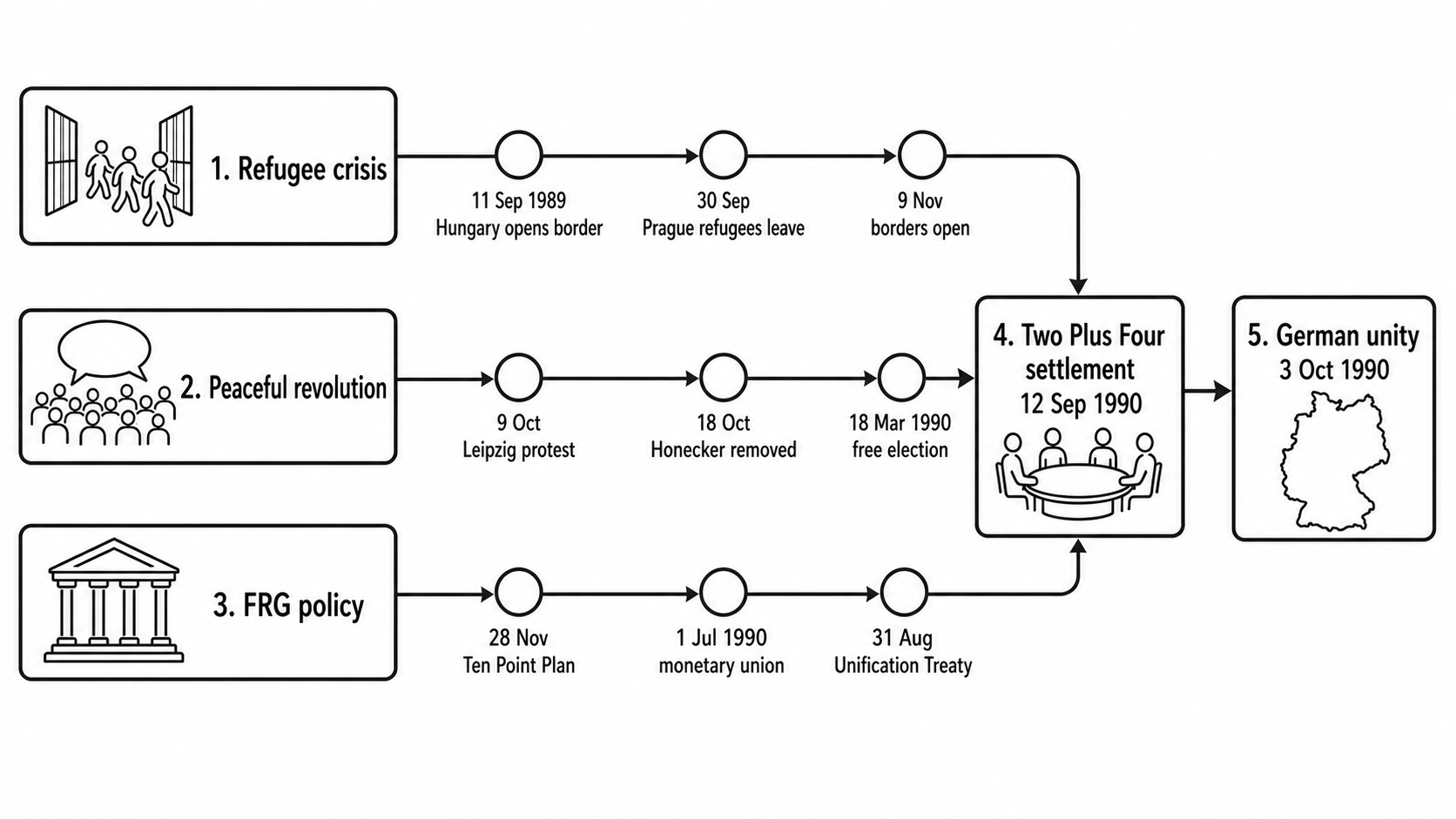
The diagram simplifies the chronology: 30 September marks Genscher's announcement, and 12 September marks the Two Plus Four signature rather than its later entry into force. Use it to notice that reunification was not caused by one event alone. Refugees weakened the GDR from below. Protest destroyed the SED's authority from within. FRG policy offered a route to absorb the collapse into existing West German institutions. The Four Powers still had to accept the result because Germany's division was also an international settlement from 1945.
Refugees and Revolution
The flood of refugees from the GDR in 1989 had deep causes. East Germans had lived for decades with restricted travel, censorship, political surveillance, shortage economies and limited consumer choice compared with the FRG. The Berlin Wall, built in 1961, had reduced mass flight, but it had not removed the wish to leave. By the late 1980s, the contrast between the two German states looked especially sharp. West German television, family links, parcels, visits and the visible strength of the Deutsche Mark all made the FRG a constant point of comparison.
International change made leaving more realistic. Mikhail Gorbachev's policies of perestroika and glasnost signalled that the Soviet Union was less willing to enforce rigid Stalinist rule across Eastern Europe. Hungary's reform communist leadership loosened border controls with Austria in 1989. Once Hungary opened the route westward in September, East Germans could travel through another socialist state and escape through Austria. Others occupied West German embassies in Prague, Warsaw and Budapest. Genscher's announcement from the West German embassy in Prague on 30 September, allowing thousands to travel west, became one of the emotional landmarks of the crisis. By the time the Wall opened on 9 November, more than 220,000 emigrants had already reached the FRG from the GDR.
The refugee crisis damaged the GDR in several ways.
| Effect of refugee movement | Explanation | Why it mattered for reunification |
|---|---|---|
| Loss of legitimacy | Citizens were voting with their feet against the SED state. | The GDR could no longer claim to embody a successful German socialism. |
| Loss of people and skills | Many refugees were young, active or economically valuable. | Continued migration threatened the viability of the GDR economy and services. |
| Public humiliation | Embassy occupations and special trains made failure visible. | The crisis weakened the authority of Honecker and the SED leadership. |
| Pressure on the FRG | West Germany had to receive, house and support refugees. | The FRG could not treat the GDR crisis as a purely foreign issue. |
| Encouragement to protest | Those who stayed saw that the regime was vulnerable. | The slogan "We are staying here" gained force alongside the wish to leave. |
The revolution inside the GDR was connected to the refugee crisis but not identical to it. Refugees challenged the state by leaving. Protesters challenged it by staying and demanding change. Leipzig was especially important. Churches such as the Nikolaikirche provided space for peace prayers, discussion and opposition networks. From September 1989, Monday demonstrations expanded from small gatherings into mass protests.
The key turning point was 9 October 1989. Around 70,000 people marched in Leipzig, while many feared a violent crackdown like the recent repression in Beijing. The security forces did not shoot. That did not mean the SED had suddenly become democratic. It meant the regime lacked confidence that repression would work, especially without clear Soviet backing. Once a crowd that large had marched peacefully and survived, the psychological balance shifted. More people were willing to protest; officials and police became less certain; the SED leadership looked brittle.
Honecker's removal on 18 October did not save the regime. Egon Krenz was too closely associated with the old system to seem like a new beginning. Hans Modrow, who became prime minister in November, appeared more reformist, but he inherited a collapsing state. The Stasi was hated. The SED's claim to a monopoly of power became indefensible. New opposition groups such as New Forum, Democratic Awakening and the Social Democratic Party in the GDR demanded free politics. The Central Round Table, first meeting on 7 December, showed that the regime now had to share public authority with groups it had previously tried to marginalise.
The opening of the Berlin Wall on 9 November was therefore both an accident and the result of deeper collapse. Gunter Schabowski's announcement of new travel rules was confused, and border guards had not been properly briefed. Yet the only reason that confusion could bring the Wall down was that the state had already lost control of events. Crowds went to the crossings and demanded passage. Border guards eventually opened the gates. The GDR's most powerful symbol of control failed without a war.
The revolution's meaning changed over time. In September and October 1989, many protesters shouted "We are the people", asserting democratic sovereignty against the SED. By winter, "We are one people" became more prominent, expressing the pull of national unity. This shift matters for judgement. Reunification was not the original demand of every protester, but the revolution created the freedom in which many East Germans could choose it.
Impact on the FRG and Kohl's Plan
The revolution in the GDR had an immediate impact on the FRG because West Germany did not regard East Germans as ordinary foreign migrants. The Federal Republic had long claimed a special responsibility for Germans in the GDR and offered citizenship rights to those who arrived. That meant the refugee crisis became a domestic West German problem: housing, welfare, employment, local services and public opinion all came under pressure.
The FRG also had to manage a diplomatic problem. West German leaders wanted to support freedom in the GDR, but they did not want to provoke Soviet fear or Allied suspicion. Since 1945, the German question had never been purely German. The USA, USSR, Britain and France still held rights and responsibilities relating to Germany and Berlin. A careless West German push for unity could have frightened neighbours and slowed reform in Eastern Europe.
Helmut Kohl's Ten Point Plan of 28 November 1989 was significant because it gave the FRG a strategy before events were completely taken over by others. Kohl did not begin with instant annexation. His plan moved from emergency help and cooperation towards confederative structures and, eventually, a federal order in Germany. It linked German unity to European integration, East-West cooperation and democratic reform in the GDR.
The plan's importance can be judged in several layers.
| Layer | What Kohl did | Significance |
|---|---|---|
| Humanitarian | Offered immediate support for refugees, travel and practical cooperation. | This answered the visible crisis and showed FRG responsibility. |
| Conditional | Connected larger economic help to irreversible political and economic reform in the GDR. | The FRG would not subsidise the old SED system. |
| Democratic | Supported free, equal and secret elections with non-socialist parties. | Unity was framed as self-determination, not simply West German pressure. |
| Constitutional | Suggested confederative structures before eventual federation. | Kohl gave a staged route that sounded orderly rather than reckless. |
| International | Placed unity inside European integration and East-West detente. | This was designed to reassure allies and the Soviet Union. |
The Ten Point Plan was not a complete blueprint for what actually happened. Events moved faster than its staged logic. It did not settle NATO membership, the Polish border, Soviet troop withdrawal, currency conversion or the exact legal route of accession. Its significance was political rather than technical. Kohl seized the initiative, made unity thinkable as policy, and ensured that the FRG would lead the process.
The plan also affected West German politics. Kohl's Christian Democratic Union could present itself as the party of national opportunity. The Social Democrats were more cautious, partly because they feared destabilising detente and partly because some still imagined a slower confederal path. In the GDR, parties linked to the West German CDU, especially within the Alliance for Germany, benefited from the promise of rapid unity, economic support and the Deutsche Mark. This mattered in the Volkskammer election of 18 March 1990.
There were limits and risks. Some East German opposition activists feared that the democratic revolution would be swallowed by West German party machines and economic power. Some West Germans worried about cost, inflation and the burden of absorbing a weaker planned economy. European leaders, especially in Britain and France, had memories of German power and wanted unity embedded in wider European and Atlantic structures. Kohl therefore had to do two things at once: move quickly enough to keep East German support, and reassure others that a united Germany would be peaceful, democratic and predictable.
Continue this lesson.
You’re previewing NovaLearn without an account. Create a free account to read the rest.
Create free account