1H Theme 1 - Changing political and economic environment, 1918-79
This lesson teaches the Pearson Edexcel 9HI0 Paper 1 theme topic A changing
political and economic environment, 1918-79. It is about how Britain moved
from post-First World War mass democracy and economic dislocation to wartime
planning, post-war consensus, and then the political and industrial breakdown of
the 1970s.
Keep one large question in view: did British politics change because voters
changed, because the economy changed, or because government and organised labour
changed their relationship?
The Enquiry Frame
This is a Paper 1 breadth theme. It is not asking you to memorise every prime
minister from Lloyd George to Callaghan. It is asking how the political and
economic environment changed across three connected strands:
| Official strand | What you must be able to explain | Core judgement problem |
|---|---|---|
| A changing political landscape | Changing party fortunes, 1918-31; the National Government, 1931-45; Labour government, consensus politics and political challenge, 1945-79 | Did Britain become a two-party democracy, or was party politics repeatedly reshaped by crisis? |
| Economic challenges and responses | Economic challenges in 1918; post-war boom, crisis and recovery, 1918-39; creating a managed economy, 1939-51; responses to economic challenges, 1951-79 | Did government learn to manage the economy, or did economic weakness keep defeating governments? |
| Change and challenge in the workplace | Industrial change and industrial relations, 1918-39; working opportunities and conditions, 1939-79; industrial relations, 1939-79, and reasons for breakdown in the 1960s and 1970s | Did stronger labour organisation make Britain fairer, harder to govern, or both? |
The central argument is that Britain became more democratic and more state-led,
but not steadily stronger. The 1918 franchise reform and the decline of the
Liberals helped create a Conservative-Labour party system. The slump of the
1930s and the Second World War then made central economic management more
normal. After 1945, Labour and Conservative governments shared enough assumptions
about welfare, full employment, nationalised industries and trade union
consultation for historians to speak of "consensus politics". Yet that consensus
rested on fragile foundations: slow productivity growth, balance of payments
problems, ageing staple industries, inflation, and industrial relations that
became harder to control.
Before anchoring that argument with dates, use the diagram below to keep the
three official strands together. Politics, the economy and the workplace should
not be revised as separate stories: they fed into the post-war consensus and
then helped produce the crisis of the 1970s.
[DIAGRAM: asset_name: Three strands from consensus to crisis; asset_slug: p1_1h_01_a_changing_political_and_economic_environment_1918_79__diagram_01; recommended_method: image_gen; description: A clean 16:9 schematic with three horizontal lanes labelled Politics, Economy and Workplace, flowing through short labels Mass vote, Managed state and Union power into a shared Consensus node, then pulling towards repeated 1970s strain labels and a final Crisis node.]
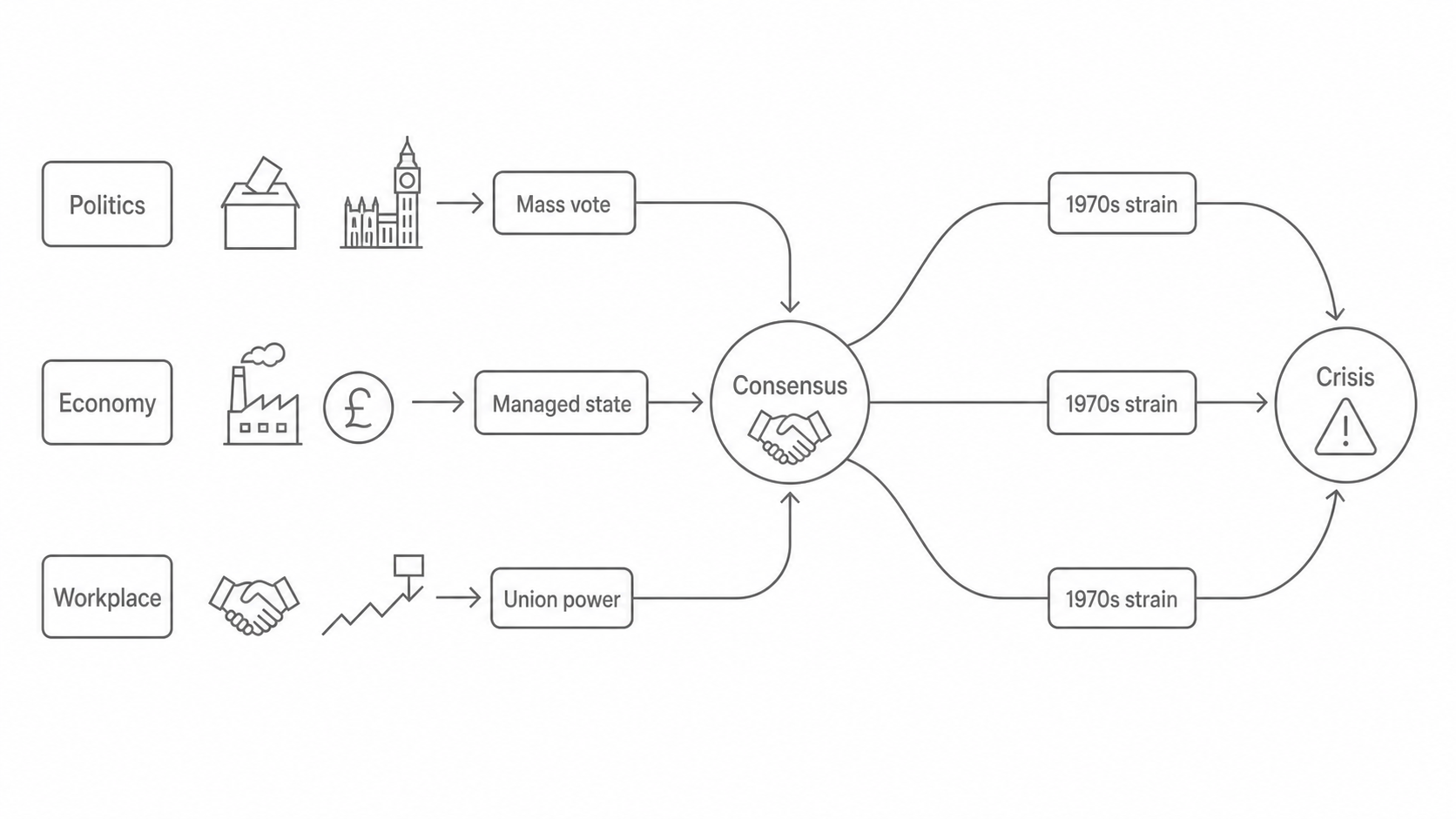
The takeaway is that a strong breadth answer should explain connection. Party
change mattered most when economic pressure or industrial relations made
governing harder; economic weakness mattered most when it forced political
choices; union power mattered most when governments could not reconcile wages,
prices and authority. These anchor dates supply the evidence for those links:
| Date | Why it matters |
|---|---|
| 1918 | Representation of the People Act greatly expanded the electorate; the coalition "coupon" election returned Lloyd George with Conservative support. |
| 1924 | Ramsay MacDonald formed the first Labour government, showing Labour had replaced the Liberals as the main alternative to the Conservatives. |
| 1925 | Britain returned to the gold standard at the pre-war parity, worsening pressure on export industries such as coal. |
| 1926 | The General Strike exposed the conflict between coal, organised labour and the state. |
| 1929-31 | Labour governed as a minority during the Wall Street Crash and world depression; the crisis destroyed MacDonald's Labour government. |
| 1931 | MacDonald formed the National Government; Britain left the gold standard in September and the National Government won a landslide in October. |
| 1939-45 | War economy, controls, rationing and coalition government made state direction of economic life normal. |
| 1945 | Attlee's Labour government won a landslide and built a managed mixed economy alongside welfare reform. |
| 1951-64 | Conservative governments accepted much of the post-war settlement, but relied on "stop-go" economic management. |
| 1967 | Wilson's government devalued sterling, showing persistent balance of payments weakness. |
| 1971-74 | Heath's Industrial Relations Act, miners' strikes and the Three-Day Week turned industrial relations into a crisis of authority. |
| 1976 | Callaghan's government sought an IMF loan and accepted public spending restraint. |
| 1978-79 | The Winter of Discontent and the March 1979 no-confidence defeat helped end the consensus era. |
A strong essay will avoid two traps. Do not write only a party-political story:
the economy and workplace matter just as much. Do not write a simple "decline"
story either: many people experienced higher living standards, fuller employment
and better workplace protections after 1945 than before. The sharper judgement
is that Britain became better at promising economic security than at reconciling
that promise with productivity, inflation and industrial conflict.
Party Realignment and Interwar Crisis, 1918-31
The starting point is the political shock of 1918. The Representation of the
People Act gave the vote to men aged 21 or over (and servicemen aged 19 or over), and to women aged 30 or over who met
property or household qualifications. It also abolished most remaining male property
qualifications and helped triple the electorate from about 7.7 million to about
21.4 million. This did not make Britain a fully equal democracy: women under 30
still lacked the parliamentary vote until the Equal Franchise Act of 1928. But
it did create a mass electorate very different from the pre-war one.
The 1918 election was a strange beginning for post-war democracy. Lloyd George
remained Liberal prime minister, but he governed through a coalition dominated by
Conservatives. Coalition candidates received the famous "coupon", a letter of
official endorsement from Lloyd George and Conservative leader Bonar Law. The
result left three problems for the old Liberal order:
| Problem | Why it mattered |
|---|---|
| The Liberal split | Lloyd George's coalition Liberals and Asquith's independent Liberals divided money, candidates, local organisation and political loyalty. |
| The Conservative recovery | Conservatives were the largest force behind the coalition and could abandon Lloyd George when he became a liability. |
| Labour's opportunity | Labour's 1918 constitution, trade-union base and appeal to working-class voters allowed it to grow as a national party. |
The coalition fell in October 1922 when Conservative MPs at the Carlton Club
meeting chose to fight the next election independently. This was crucial. Lloyd
George had looked like the dominant wartime leader, but after 1922 the
Conservatives became the main party of government, while Labour increasingly
became the main opposition. The Liberals never recovered their old position,
even though they briefly reunited and performed strongly in 1923.
Labour's rise was not smooth, but it was historically decisive. In January 1924,
Ramsay MacDonald formed the first Labour government after the Conservatives lost
their majority and the Liberals allowed Labour to govern. It lasted only ten
months, damaged by fears about socialism, the Campbell case and the Zinoviev
Letter scare. Yet its very existence proved that Labour was no longer merely a
pressure group attached to trade unionism. It could form a government.
The 1920s therefore produced a new party pattern:
| Election | Political meaning |
|---|---|
| 1918 | Coalition victory, Liberal split and Labour's limited but growing presence. |
| 1922 | Conservatives returned independently; Labour overtook the Liberals in seats. |
| 1923 | Baldwin's tariff gamble produced a hung parliament and opened the door to the first Labour government. |
| 1924 | Conservatives won heavily; Liberals collapsed to a small parliamentary force. |
| 1929 | Labour became the largest party but had to govern as a minority with Liberal support. |
Economic conditions help explain why this party system was unstable. Britain in
1918 faced war debt, inflation, demobilisation, a need to switch production from
war to peace, and weakening export markets. There was a short post-war boom in
1919-20 as demand revived, but it quickly gave way to the slump of 1920-21.
Unemployment became a structural problem in older export industries such as coal,
cotton, shipbuilding, iron and steel. These industries had been central to
Victorian and Edwardian economic power, but after 1918 they faced foreign
competition, lost markets, ageing equipment and weaker demand.
The post-war economy therefore had two faces. Newer industries such as electrical
goods, chemicals, light engineering and motor manufacturing grew, especially in
the Midlands and the South East. But the old staple regions of South Wales,
Clydeside, north-east England, Lancashire and parts of Yorkshire suffered much
more persistent unemployment. A national average can hide that regional divide.
For an exam answer, this matters because political discontent did not come
evenly from "the economy"; it came from the uneven geography of decline.
The return to the gold standard in 1925 made these pressures worse. Chancellor
Winston Churchill restored sterling at its pre-war value against gold. Supporters
believed this would restore London's financial prestige and price stability.
Critics argued that the pound was overvalued, making British exports expensive
and putting pressure on wages in industries such as coal. The gold standard did
not alone cause all interwar weakness, but it symbolised a political priority:
defending sterling and financial confidence often came before protecting jobs in
declining industrial regions.
Coal exposed the link between economic policy and industrial relations. Mine
owners wanted lower wages and longer hours to restore profitability; miners
insisted that they should not pay for the industry's structural problems. In
1925 the government subsidised coal wages temporarily, buying time through "Red
Friday". In 1926 the subsidy ended, negotiations failed, and the TUC called a
General Strike in support of the miners. Transport, printing, docks, iron, steel
and other workers joined, but the strike lasted only nine days, from 3 to 12 May
1926. The miners continued for months and returned defeated, with worse terms.
The consequences were deep. The government had prepared emergency powers and
volunteer services; many middle-class voters saw the strike as a challenge to
parliamentary government; many workers saw the state as siding with employers.
The Trade Disputes and Trade Unions Act 1927 then restricted sympathy strikes
and mass picketing and changed trade-union political levy rules. The General
Strike did not destroy trade unionism, but it made union leaders more cautious
and sharpened the idea that industrial conflict could become a constitutional
crisis.
By 1929, Labour returned to office as the largest party under MacDonald, but it
did so just before the world economy collapsed. The Wall Street Crash did not
create Britain's old industrial problems, but it intensified them. Exports fell,
unemployment rose and government finances came under strain. Labour's weakness
was that it had won office without a majority and without a convincing answer to
the central question of the interwar economy: should government prioritise
balanced budgets and sterling confidence, or use borrowing and public works to
fight unemployment?
National Government and Partial Recovery, 1931-45
The political crisis of 1931 was one of the most important turning points in the
whole topic. MacDonald's Labour government split over how to respond to the
financial crisis, unemployment and pressure on sterling. Proposed cuts to public
spending, including unemployment benefit, divided the Cabinet. In August 1931,
MacDonald resigned and then returned as prime minister of a National Government
with Conservative and Liberal support. Labour treated him as a traitor and
expelled him.
The National Government claimed to stand above party in a national emergency,
but in practice it became heavily Conservative-dominated. In the October 1931
election, the National Government won a huge majority and Labour was reduced to
52 seats. MacDonald remained prime minister until 1935, but Stanley Baldwin and
then Neville Chamberlain became increasingly central Conservative figures. The
National Government then continued under Baldwin and Chamberlain until the
Second World War transformed politics again.
Politically, the National Government did three things:
| Political effect | Explanation |
|---|---|
| It crushed Labour temporarily | Labour was associated with crisis and internal division, though it rebuilt in the later 1930s. |
| It finished the Liberals as a governing party | Liberals split over tariffs and participation in the National Government; Liberal Nationals moved closer to the Conservatives. |
| It strengthened Conservative authority | Conservatives could govern behind a national label while avoiding some blame for hard economic choices. |
Economically, the story after 1931 is more complicated than simple failure. On
21 September 1931 Britain left the gold standard. This allowed sterling to fall,
made exports more competitive and gave government and the Bank of England more
room for cheaper money. The National Government also moved towards tariffs,
especially through the Import Duties Act of 1932 and imperial preference at the
Ottawa Conference. This marked a major change from Britain's nineteenth-century
free-trade identity.
Recovery in the 1930s had real strengths. Low interest rates helped a private
housing boom. New consumer industries expanded in parts of southern and midland
England. Cars, electrical goods, road transport, chemicals and suburban
construction became more important. For many people in growing regions, the
mid-1930s did not feel like permanent depression.
But recovery was uneven and limited:
| Area of recovery | Limitation |
|---|---|
| Housebuilding and consumer durables | Growth was concentrated in newer regions and among households able to spend. |
| Cheap money | It helped mortgages and investment, but could not revive all old export industries. |
| Tariffs and imperial preference | They protected some producers but did not restore nineteenth-century export dominance. |
| Rearmament after 1935 | It reduced unemployment and stimulated heavy industry, but depended on the approach of war. |
| Special Areas policy | It recognised regional distress, but did not transform South Wales, Clydeside or north-east England before the war. |
The workplace in the interwar years reflected these divisions. Trade union
membership fell from wartime highs in the early 1920s, partly because
unemployment weakened bargaining power. Employers in distressed industries could
press for wage cuts and longer hours. The General Strike defeat encouraged
caution at TUC level, but it did not end conflict. In mining especially,
industrial relations remained bitter because coal combined old equipment,
regional dependence, falling exports and deep memories of 1926.
Industrial change had several consequences before 1939. First, it widened the
gap between "new" and "old" Britain: expanding light industry and suburbia in
some areas; long-term unemployment and community decline in others. Second, it
made economic policy a national political test. Governments were judged not only
by empire or constitutional stability, but by unemployment, exports and prices.
Third, it shaped Labour's later thinking. The party's commitment after 1945 to
full employment, planning and nationalisation cannot be understood without the
memory of interwar unemployment.
War then changed the meaning of economic management. In 1939, government again
took powers over production, labour, imports, rationing, prices and allocation
of raw materials. The Churchill coalition from May 1940 brought Conservatives,
Labour and Liberals into wartime government, with Labour figures such as Ernest
Bevin playing major roles. Bevin, as Minister of Labour, worked with employers
and unions to mobilise labour for war production. The state did not merely
regulate from a distance. It directed resources, controlled consumption and
treated full mobilisation as a national duty.
This mattered beyond 1945. Wartime controls made many voters more willing to
accept state planning in peacetime. The war also raised expectations: if the
state could organise sacrifice for victory, could it not organise security,
employment and reconstruction after victory? That question helps explain the
Labour landslide of 1945 and the rise of consensus politics.
Managed Economy, Labour and Consensus, 1939-64
The specification asks for creating a managed economy, 1939-51. This begins
with war, not with Attlee alone. The wartime state controlled prices, rationing,
imports, labour allocation, military production and key materials. It also used
central planning to decide which industries and factories mattered most. This
was not socialism in the full sense: private firms still existed and profits
still mattered. But the war made economic management ordinary.
Three wartime changes shaped the post-war settlement:
| Wartime change | Post-war significance |
|---|---|
| Full mobilisation | Unemployment on the scale of the 1930s became politically unacceptable. |
| State direction of resources | Planning, controls and national priorities looked practical rather than utopian. |
| Cooperation with unions | Organised labour gained legitimacy as a partner in national production. |
The Attlee Labour government of 1945-51 then tried to convert wartime lessons
into peacetime reconstruction. Labour's 1945 victory was the party's first
independent parliamentary majority. It was not simply a reward for Attlee as a
wartime deputy prime minister. It reflected a wider belief that the Conservatives
were too closely associated with interwar unemployment and that Labour was more
likely to deliver security and reconstruction.
For this topic, the key economic measures are those that made Britain a managed
mixed economy:
Continue this lesson.
You’re previewing NovaLearn without an account. Create a free account to read the rest.
Create free account