37.2 KT4 - Establishing and ruling the Federal Republic, 1949-60
Created from the western occupation zones in 1949, the Federal Republic had to build democratic legitimacy amid defeat, division and the legacy of Nazism. You will examine how the Basic Law, Adenauer and the CDU, western integration, party change, prosperity and social policy produced stability by 1960. The final question is what that stability achieved and what it left unresolved, especially in the reintegration of former Nazis and restitution for victims.
Enquiry Frame and Chronology
This Paper 3 depth topic asks how the new Federal Republic was created and ruled between 1949 and 1960. The best enquiry question is: how did West Germany become politically stable so quickly, and what did that stability leave unresolved?
The period needs a chronological spine because the FRG's stability was not present on day one. It developed through stages.
| Date | Development | Why it matters |
|---|---|---|
| 1 January 1947 | Bizonia linked the American and British zones economically. | Western Germany began to develop separate administrative and economic structures. |
| 20 June 1948 | Currency reform introduced the Deutsche Mark in the western zones. | Economic recovery was encouraged, but division from the Soviet zone deepened. |
| 24 June 1948-12 May 1949 | Berlin Blockade and Airlift. | The western Allies' commitment to West Berlin and a western German state became clearer. |
| 1 July 1948 | The western military governors issued the Frankfurt Documents. | West German minister-presidents were asked to create a body to draft a democratic constitutional framework. |
| 1 September 1948 | The Parliamentary Council opened in Bonn, chaired by Konrad Adenauer. | German politicians, under Allied supervision, began shaping the Basic Law. |
| 8 May 1949 | The Parliamentary Council adopted the Basic Law. | The constitutional foundation of the FRG was agreed. |
| 23 May 1949 | The Basic Law was promulgated. | The Federal Republic came into constitutional existence. |
| 14 August 1949 | First Bundestag election. | The new state gained an elected federal parliament, although the party system was still fragmented. |
| 12 September 1949 | Theodor Heuss was elected Federal President. | The presidency was deliberately weaker than Weimar's presidency. |
| 15 September 1949 | Adenauer was elected Federal Chancellor. | CDU/CSU, FDP and DP formed the first government, with a narrow parliamentary base. |
| 7 October 1949 | The German Democratic Republic was founded in the Soviet zone. | German division became institutional as well as military and ideological. |
| 1951 | The Federal Constitutional Court began work; the Article 131 law was passed. | Constitutional review strengthened the new order, while many former public servants were reintegrated. |
| 1952 | Luxembourg Agreement with Israel; Lastenausgleich law; Socialist Reich Party banned. | The FRG combined restitution, social integration and militant defence of democracy. |
| 1953 | CDU/CSU won a much stronger Bundestag position; a national 5 percent threshold operated. | Adenauer's authority grew and splinter-party politics became less dangerous. |
| 1955 | Paris Treaties took effect; the FRG joined NATO and regained substantial sovereignty. | Adenauer's Westintegration became the framework of the state. |
| 1956 | KPD banned; Bundeswehr development followed rearmament decisions. | Anti-communist constitutional defence and western alliance politics hardened. |
| 1957 | CDU/CSU won 50.2 percent of second votes; pension reform passed. | Prosperity, welfare and "no experiments" politics reinforced government legitimacy. |
| 1958 | Ulm Einsatzkommando trial; Ludwigsburg Central Office founded. | The weakness of earlier prosecution of Nazi crimes became harder to ignore. |
| November 1959 | SPD adopted the Bad Godesberg Program. | The main opposition moved towards a broader democratic people's-party identity. |
| 1959-60 | Antisemitic incidents followed the Cologne synagogue desecration. | Public debate exposed the incompleteness of coming to terms with the Nazi past. |
The diagram below is a judgement map. It does not contain every detail, but it helps you see the four main forces that made the FRG look stable by 1960. For each force, ask both how it stabilised the state and what limitation it carried. The SPD arrow is shorthand for its broader appeal and policy adaptation: the party already supported democracy before 1959 and remained the parliamentary opposition after Bad Godesberg.
[DIAGRAM: asset_name: Four forces stabilising the Federal Republic by 1960; asset_slug: p3_372_04_establishing_and_ruling_the_new_federal_republic_1949_60__diagram_01; recommended_method: image_gen; description: Monochrome four-panel schematic showing how the Basic Law, Adenauer and the CDU, the SPD shift, and management of the Nazi past all point toward a central box labelled Stable FRG by 1960, with simple icons for federalism, rights, constructive vote of no confidence, chancellor authority, elections, western integration, opposition to acceptance by 1959, and amnesty/restitution]
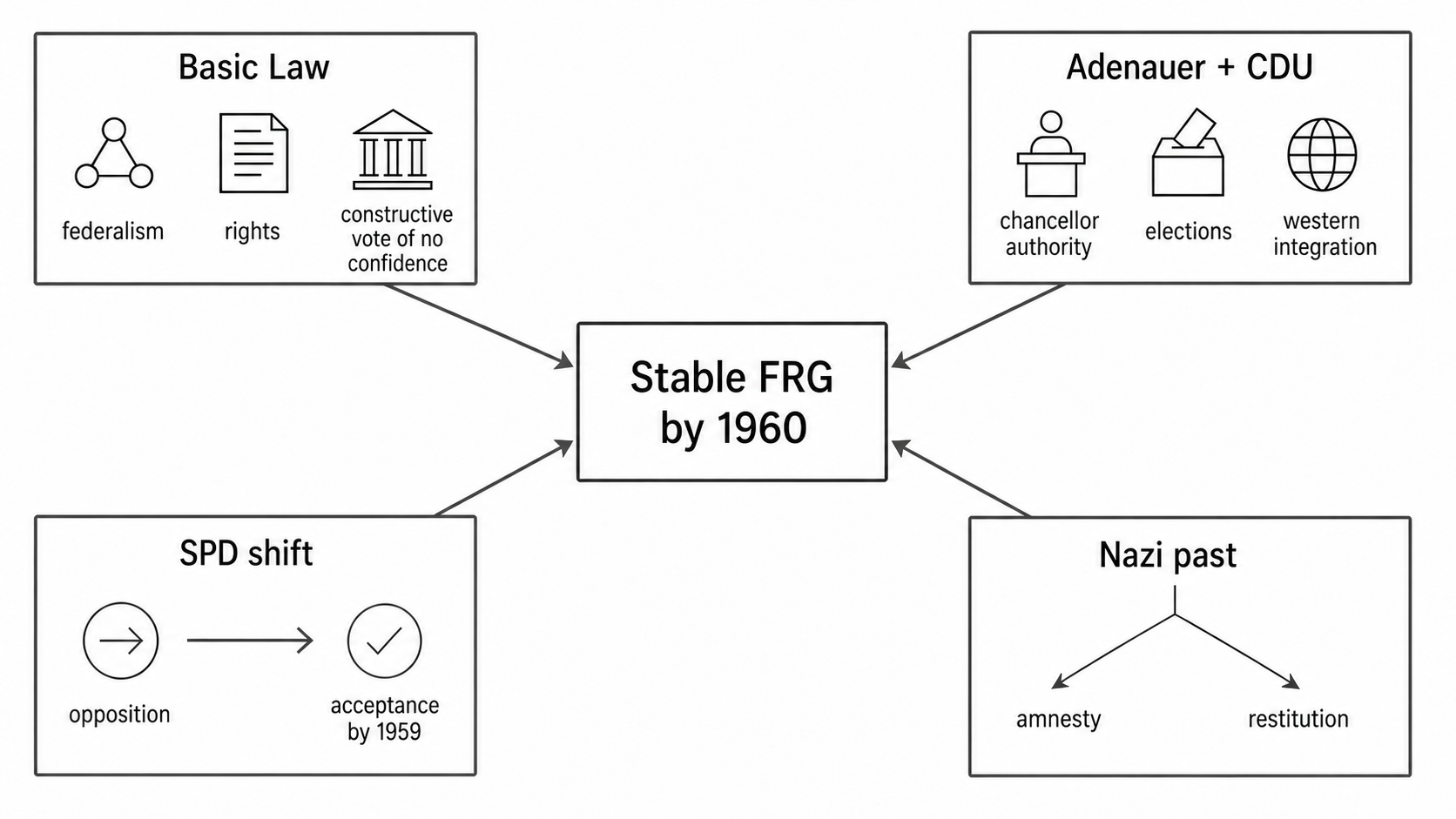
Keep two warnings in mind. First, the FRG was not simply an Allied puppet. German politicians made important choices about federalism, rights, social policy, party organisation and western integration. Second, the FRG was not a morally purified democracy by 1960. It had built real democratic institutions, but it also made compromises with former Nazi Party members, officials and social silence.
Creation, Basic Law and Liberty
The FRG was created because four-power cooperation after 1945 broke down. Germany had been divided into American, British, French and Soviet occupation zones. At first, the Allies formally shared broad aims such as demilitarisation, de-Nazification, decentralisation and democratisation. In practice, the Cold War pulled the zones apart. The western zones moved towards a market economy and parliamentary democracy; the Soviet zone moved towards a socialist one-party state under Soviet control.
The currency reform of June 1948 was a turning point. The Deutsche Mark helped revive exchange, production and confidence in the western zones, but it also made economic division obvious. The Soviet blockade of land routes to West Berlin, beginning on 24 June 1948, then turned division into crisis. The western Airlift did not by itself create the FRG, but it strengthened the argument that a western German state needed to be organised and protected.
The western Allies did not hand Germans a finished constitution. The Frankfurt Documents asked the western-zone minister-presidents to convene a body to draft a constitutional framework. Those minister-presidents were cautious. They feared that a separate western state would make German division permanent. This helps explain why the document was called the Basic Law, not simply a constitution. It was presented as provisional until Germans as a whole could decide freely on a united constitution.
The Parliamentary Council met in Bonn from September 1948. Its members were chosen by Land parliaments, not directly by a national election. Adenauer chaired it, gaining national status before he became chancellor. The Basic Law was adopted by the Parliamentary Council on 8 May 1949, approved by the western Allies on 12 May, ratified by the required Lander parliaments, and promulgated on 23 May. Bavaria rejected it because it wanted stronger federal safeguards, but accepted that it would apply if enough other Lander approved it.
The official wording asks about "the attempt to reconcile difference and liberty". This is the key concept. The new state had to allow difference: Catholics and Protestants, employers and workers, refugees and locals, conservative and socialist voters, Lander and federal institutions, and different memories of the Nazi past. But it also had to protect liberty after dictatorship: rights, courts, elections, parliamentary government, free parties and rule of law.
| Basic Law feature | How it protected liberty | How it managed difference |
|---|---|---|
| Human dignity and basic rights | Article 1 made dignity and enforceable rights the starting point of state authority. | Rights applied across religious, regional, political and social divisions. |
| Parliamentary government | The Bundestag elected the chancellor; government depended on parliamentary majority. | Party conflict was channelled through parliament rather than presidential rule. |
| Weak Federal President | The president had far less power than the Weimar president. | No single head of state could bypass parliamentary politics as easily as under Weimar. |
| Constructive vote of no confidence | A chancellor could be removed only if the Bundestag elected a successor. | Opposition could challenge government, but not create permanent negative majorities. |
| Federalism and Bundesrat | Lander retained powers and influence through the Bundesrat. | Regional identities and state traditions were built into the republic rather than crushed. |
| Federal Constitutional Court | Rights and institutional disputes could be defended through constitutional review. | Conflicts between citizens, parties, Lander and federal institutions had a legal forum. |
| Militant democracy | Anti-democratic parties could be banned by the Constitutional Court. | Pluralism was protected, but not for parties trying to abolish democracy itself. |
| Article 79(3) | Core principles such as democracy, federalism, rule of law and human dignity could not be abolished by ordinary amendment. | Majority rule was limited by permanent constitutional principles. |
| Article 146 | The Basic Law remained open to a future all-German constitution. | The FRG claimed not to abandon Germans excluded from participation in 1949. |
This was a deliberate answer to Weimar and Nazism. Weimar had rights, elections and parties, but it also had emergency presidential powers, unstable coalitions and no constructive vote of no confidence. Nazi dictatorship showed that law could be emptied of moral restraint if rights were not binding on the whole state. The Basic Law therefore made rights enforceable and placed constitutional review at the centre of the new order.
There were limits. The FRG was not fully sovereign in 1949. The Occupation Statute left the western Allies with powers over security, foreign policy, disarmament, the Ruhr and Berlin. West Berlin was linked to the FRG but remained under four-power status. The Basic Law also did not represent all Germans because the Soviet zone and Berlin could not freely take part. The new republic was democratic, but incomplete.
The strongest judgement is that the Basic Law was essential but not sufficient. It created a better democratic framework than Weimar, yet a constitution cannot make democracy work by text alone. Its success depended on parties accepting the rules, voters finding the state useful, courts defending the settlement and leaders choosing to work within parliament.
Adenauer, CDU and Western Integration
Konrad Adenauer was central to the shaping of the FRG. He was 73 when he became chancellor on 15 September 1949, but he had long political experience. Before 1933 he had been mayor of Cologne; the Nazis removed him from office; in 1948-49 he chaired the Parliamentary Council. This gave him credibility as both an anti-Nazi conservative and a founder of the new constitutional order.
Adenauer's first government was narrow. The CDU/CSU, FDP and German Party formed the coalition, and Adenauer was elected chancellor by the Bundestag with only the necessary majority. The new republic therefore did not begin with overwhelming support for one leader. Adenauer's achievement was to turn that narrow beginning into what historians often call chancellor democracy: a system in which the chancellor, supported by a disciplined parliamentary majority, became the clear centre of government.
Chancellor democracy
A system of government, associated with Adenauer, in which the chancellor, backed by a disciplined parliamentary majority, became the clear centre of decision-making.
The Basic Law helped him. Article 65 gave the chancellor authority to set general policy guidelines. The Federal President could not dominate government as Hindenburg had done under Weimar. Adenauer also controlled foreign policy directly between 1951 and 1955 by serving as his own foreign minister. His style could be controlling and dismissive of critics, but it operated through cabinet, coalition, party and Bundestag rather than dictatorship.
The CDU mattered as much as Adenauer's personality. It was not simply the old Catholic Centre Party reborn. It was a cross-confessional Christian democratic party, drawing in Catholics and Protestants, conservatives, Christian social reformers, liberal economic thinkers and anti-socialists. In a society long divided by religion, region and class, the CDU/CSU gave many voters a broad party of order, Christianity, anti-communism, social protection and economic recovery.
Adenauer and the CDU shaped the FRG through four linked choices.
| Choice | What it meant | Significance |
|---|---|---|
| Westintegration | The FRG bound itself to western Europe, the United States and Atlantic security. | It restored sovereignty and security, but made quick reunification less likely. |
| Social market economy | Market competition was combined with a social framework and welfare measures. | Prosperity became a source of democratic legitimacy. |
| Anti-communism | The FRG presented itself as the free German alternative to the Soviet-backed GDR. | It unified many voters, but narrowed the space for dissent on security and rearmament. |
| Coalition and party management | Adenauer used the CDU/CSU, FDP, DP and at times refugee-party politics to build majorities. | It stabilised government and gradually marginalised smaller parties. |
Westintegration was Adenauer's defining policy. He believed the FRG would regain sovereignty and security by becoming indispensable to the West. The Petersberg Agreement of 1949 gave modest early gains. The European Coal and Steel Community placed coal and steel under supranational control from 1951-52. The Paris Treaties, effective in 1955, ended the occupation regime in most areas, brought the FRG into NATO and allowed rearmament through the Bundeswehr. The Treaty of Rome in 1957 then made the FRG a founding member of the European Economic Community.
This policy was controversial. The SPD under Kurt Schumacher argued that Adenauer was hardening German division by tying West Germany too firmly to the western alliance. Many people also feared rearmament so soon after the Second World War. Adenauer replied that a neutral Germany would be vulnerable to Soviet pressure, while a prosperous, secure FRG could one day act as a magnet for Germans in the East. By 1960, Adenauer's view had shaped the state, although the Berlin crisis from 1958 showed that the German question was far from solved.
Election results show how Adenauer's position strengthened.
| Election | CDU/CSU result | SPD result | Judgement |
|---|---|---|---|
| 1949 | CDU 25.2 percent and CSU 5.8 percent; 141 seats together including Berlin deputies | 29.2 percent; 136 seats | The system was fragmented and Adenauer's government began narrowly. |
| 1953 | CDU 36.4 percent and CSU 8.8 percent of second votes; 249 seats together including Berlin deputies | 28.8 percent; 162 seats | Recovery, anti-communism and western integration strengthened the government. |
| 1957 | CDU 39.7 percent and CSU 10.5 percent of second votes; 277 seats together including Berlin deputies | 31.8 percent; 181 seats | CDU/CSU won 50.2 percent of second votes, the high point of Adenauer's electoral authority. |
The 1957 slogan "Keine Experimente" captured the mood. It promised not revolution but preservation: security, prosperity, western alliance and welfare improvement. That appealed to voters who had lived through war, bombing, defeat, occupation, currency collapse and ideological extremism.
The judgement must remain balanced. Adenauer and the CDU gave the FRG direction, international respect and a stable governing centre. Yet their success also had costs. Western integration entrenched the division with the GDR. Anti-communism could treat criticism of rearmament or NATO as suspect. Chancellor democracy reduced Weimar-style weakness, but it could also make politics look over-controlled by one dominant leader and party bloc.
Political Stability and SPD Change
The FRG's political stability was not only a product of Adenauer's leadership. It also depended on the party system becoming more manageable. In 1949 the Bundestag contained several parties beyond the CDU/CSU, SPD and FDP, including the KPD, Centre, Bavaria Party, German Party, refugee or regional interests and others. This reminded many people of Weimar fragmentation.
By 1960 the system looked much more stable. The main nationwide competitors were CDU/CSU, SPD and FDP, with the German Party declining and the refugee-party vote being absorbed into larger politics. Several developments explain this change.
| Stabilising development | Explanation | Limitation |
|---|---|---|
| 5 percent threshold | From 1953, party lists generally needed 5 percent of the vote to enter the Bundestag. | It reduced fragmentation, but also limited representation for smaller movements. |
| CDU/CSU dominance | Adenauer's bloc absorbed many conservative, Christian, regional and anti-socialist voters. | Dominance could blur the line between state stability and government advantage. |
| Federal Constitutional Court | The Court defended constitutional boundaries and rights. | Legal safeguards depended on political willingness to respect them. |
| Banning extremist parties | The neo-Nazi SRP was banned in 1952 and the KPD in 1956. | Militant democracy protected the system, but the KPD ban also reflected Cold War anti-communism. |
| Economic recovery | Rising employment and living standards made radical alternatives less attractive. | Prosperity did not automatically prove deep democratic conviction. |
| Social integration | Housing, compensation, welfare and pensions reduced resentment after war and displacement. | Integration sometimes meant avoiding moral confrontation with the Nazi past. |
| SPD adaptation | The SPD moved towards accepting the FRG's constitutional and economic framework. | This did not yet bring the SPD into federal government by 1960. |
Continue this lesson.
You’re previewing NovaLearn without an account. Create a free account to read the rest.
Create free account