30 Theme 1 - Crown and nobility: 'over-mighty subjects'
This lesson is about the changing relationship between English kings and great nobles from Henry IV's seizure of the crown in 1399 to Henry VII's more secure monarchy in 1509. The central argument is that the nobility were never simply enemies of the crown. They were the crown's main partners in government, war, justice, local order, and patronage. The problem was that the same land, offices, followers, and regional influence that made them useful also made them dangerous when royal authority was weak.
The Enquiry Frame
Edexcel's phrase 'over-mighty subjects' means subjects whose power was large enough to rival, intimidate, or redirect the crown. In this option, it mainly refers to major landowners: dukes, earls, barons, bishops, and the great regional families whose estates and affinities reached deep into local society.
Do not treat this topic as a simple story in which medieval nobles were bad and Tudor kings solved the problem. The better breadth argument is more subtle:
- Strong kings used nobles because nobles supplied land-based authority, military followings, local knowledge, church and household connections, and prestige.
- Weak kings were vulnerable because those same noble resources could be used for faction, rebellion, private feuds, intimidation of courts, or dynastic alternatives.
- By 1509 the crown had not abolished noble power, but it had become better at licensing, supervising, redirecting, and punishing it.
Use this chronological spine:
| Phase | Crown-nobility relationship | Why it matters |
|---|---|---|
| 1399-1413 | Henry IV depended on noble support after usurpation, especially from families such as the Percys, then faced noble rebellion. | The crown needed magnates, but a king with a contested title could not easily control them. |
| 1413-22 | Henry V projected strong kingship, crushed conspiracy in 1415, and redirected noble ambition into war in France. | Strong leadership could make nobles props to the crown rather than rivals. |
| 1422-53 | Henry VI's minority and later weakness made council politics aristocratic and competitive. | Noble government worked while consensus held, but faction grew when royal arbitration failed. |
| 1453-61 | Henry VI's incapacity, loss of France, and court faction allowed local rivalries to become national crises. | Private disputes such as Neville-Percy and Bonville-Courtenay showed how local disorder could feed civil war. |
| 1461-71 | Edward IV first depended heavily on Warwick and other Yorkist magnates, then was overthrown by Warwick's rebellion and Henry VI's readeption. | A kingmaker could become an over-mighty subject when his influence seemed greater than the king's. |
| 1471-83 | Edward IV's return after Barnet and Tewkesbury allowed firmer royal control, especially in troubled localities. | The 1470s showed that royal authority could recover when dynastic opposition was defeated. |
| 1485-1509 | Henry VII used law, finance, bonds, attainders, patronage, councils, and retaining controls to make noble power more dependent on royal permission. | By 1509 the balance had shifted towards the crown, though nobles still remained necessary governors. |
Before moving into the examples, use this relationship map to keep the main tension
straight. The same noble resources that made lords useful to the crown could become
dangerous when royal authority was contested or weak.
[DIAGRAM: asset_name: Crown and nobility balance of power map; asset_slug: p3_30_01_changing_relationships_between_crown_and_the_nobility_over_mighty_subjects__diagram_01; recommended_method: image_gen; description: 16:9 white-background two-panel schematic contrasting Reliance and risk in 1399 with Stronger control by 1509, showing Crown, Nobility, Service, Land, Office, Retainers, Over-mighty, Law, Finance and Licence]
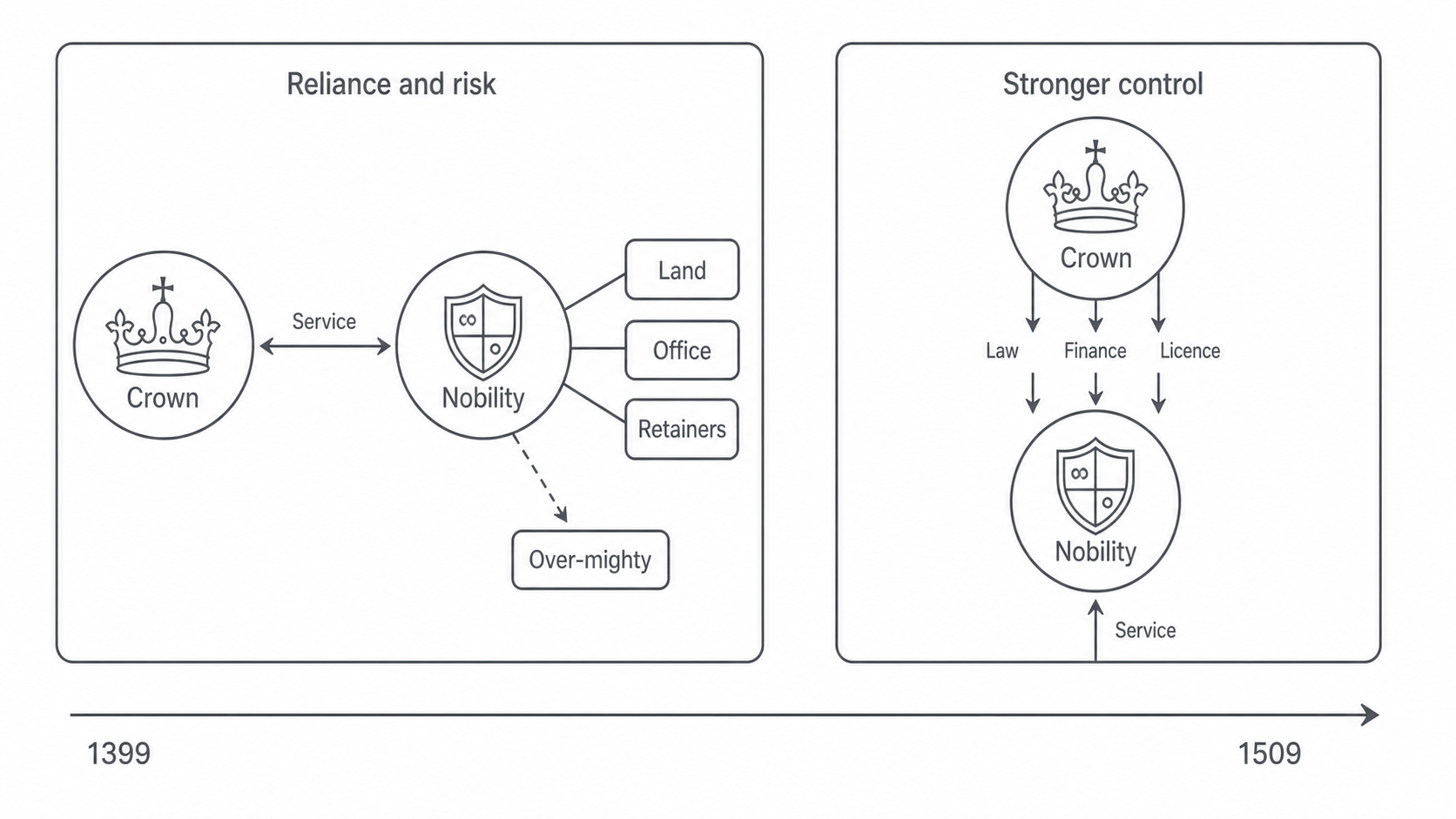
The important change was therefore not the disappearance of noble power. It was the
crown's growing ability to supervise, licence and punish noble power while still using it
for government.
The key judgement is about change within continuity. Major landowners remained essential to government throughout 1399-1509. What changed was the crown's ability to decide when noble power was legitimate service and when it was dangerous over-mightiness.
Major Landowners and Government
Late medieval England could not be governed from Westminster alone. The crown relied on major landowners because their power reached places where royal administration was thin. A king might issue orders, but sheriffs, justices of the peace, commissions of array, royal councils, local juries, and estate officials had to make those orders work. Great lords were therefore not an optional extra. They were part of the machinery of rule.
Their first resource was land. Land brought rents, tenants, local courts, castles, marriage alliances, and social prestige. A magnate with estates across several counties could influence elections, juries, local offices, military recruitment, and the behaviour of lesser gentry. This mattered in peaceful government and in crisis. Henry IV's Lancastrian inheritance made him a great landowner before he was king; Henry VII later understood that recovering crown lands after the Wars of the Roses would reduce the gap between royal and noble wealth.
Their second resource was office. Great nobles served as councillors, commanders, wardens of the marches, lieutenants, chamberlains, constables, admirals, captains of Calais, and local office-holders. Office gave a nobleman authority in the king's name. It also gave him patronage: the ability to recommend servants, reward allies, influence local justice, and display closeness to the crown. Warwick's captaincy of Calais and regional influence under Edward IV, Richard of Gloucester's northern authority in Edward IV's later reign, and Jasper Tudor's importance to Henry VII all show how royal service could turn noble power into royal strength.
Their third resource was church patronage. Great landowners influenced appointments to benefices, supported monasteries and collegiate churches, cultivated bishops and abbots, and used ecclesiastical connections to strengthen family prestige. The Church was not separate from politics. Bishops sat in the Lords, served on councils, held offices, and mediated disputes. Patronage over church livings also helped a family place educated dependants into useful positions.
This is why nobles were necessary props to the crown. Henry IV needed noble backing to make his seizure of the throne workable. Henry V needed noble commanders and financial-military support for the French war. Henry VI's minority government depended on aristocratic council rule. Edward IV needed Yorkist magnates to defeat Lancastrian resistance. Henry VII, although suspicious of over-mighty subjects, still needed peers, bishops, gentry, JPs, and regional councils to govern the realm.
Yet the same structure created danger. A major landowner could be a potential rival because he had money, men, regional loyalty, dynastic blood, and access to government. The danger increased when three conditions came together:
| Condition | Effect on crown-nobility relations |
|---|---|
| A contested or weak monarch | Nobles could claim to act for "good government", a rival heir, or the defence of the realm. |
| Powerful affinities and local offices | Noble quarrels could intimidate courts, dominate counties, and raise armed support quickly. |
| Dynastic uncertainty | A noble with royal blood, or access to someone with royal blood, could become the focus for opposition. |
The phrase "over-mighty" therefore needs careful use. A noble was not over-mighty merely because he was rich. The crown wanted rich and influential servants. He became over-mighty when his private authority became hard to distinguish from public authority, or when his followers could act as though loyalty to the lord mattered more than obedience to the king.
Retaining and Bastard Feudalism
The most important concept in this topic is retaining. To retain someone was to bind them into service. A retainer might receive a fee, an annuity, board and lodging, access to a lord's influence, a place in a household, or legal and political protection. In return, the retainer might serve as an estate official, household servant, legal agent, military follower, local supporter, or armed man in a crisis.
Two connected terms appear in the specification:
| Term | Meaning | Why it mattered |
|---|---|---|
| Livery | Clothing, badge, collar, or visible sign showing service to a lord. | It displayed a lord's following and could intimidate opponents, juries, or local officials. |
| Maintenance | A lord's support for followers in lawsuits or disputes, often by pressure on courts, witnesses, sheriffs, or juries. | It could corrupt justice and make ordinary legal remedies useless against powerful networks. |
The phrase bastard feudalism was coined much later by historians to describe this late medieval pattern of lordship.
Bastard feudalism
Historians' term for late medieval lordship in which service was secured through money, office, fees, livery, influence and contract, rather than through land held in return for service.
The word "bastard" is loaded and can mislead. This system was not simply corruption. It was one of the ways late medieval society worked.
Retaining had real advantages for the crown:
- Kings did not keep a modern standing army, so they depended on noble retinues for war and rebellion suppression.
- Lords used retainers to administer estates, keep local order, and carry royal commands into the counties.
- Affinities could connect the crown to local gentry who otherwise had little direct contact with central government.
- In border regions, Wales, the north, and the marches, powerful noble networks could provide defence and rapid response.
The danger was that retaining also gave nobles semi-private power. A lord with a large affinity could pack a court, overawe a sheriff, protect a violent follower, raid a rival's lands, or raise a force before the crown could react. The crown's problem was therefore not how to abolish retaining, but how to distinguish lawful service from dangerous maintenance.
This explains the statutes against retaining in 1468 and 1504. Edward IV's 1468 statute tried to restrict forms of retaining that looked too much like private military and political recruitment. It came in a reign where the Yorkist crown had reason to fear noble followings, even before Warwick's open rebellion. But legislation alone could not transform political society. Noble service was still needed, and enforcement depended on the crown's strength.
Henry VII's 1504 statute went further by tightening royal licensing. The point was not that no one could ever have retainers. The point was that retaining beyond accepted categories should depend on royal permission. This gave the king a powerful lever. If a noble kept too many men without licence, the crown could threaten penalties, bonds, recognisances, or prosecution. The famous case of Lord Bergavenny, fined heavily in 1507 for illegal retaining, shows how Henry VII's late policy could be used within the official period.
The long-term change is clear. In 1399 a king needed to bargain with aristocratic power that often looked semi-independent. By 1509 noble retaining still existed, but the crown had stronger legal, financial, and administrative tools to make it conditional. The relationship moved from reliance with limited supervision towards reliance with much sharper royal oversight.
Lancastrian Kings and Noble Risk
The Lancastrian period shows both sides of noble power. Henry IV came to the throne in 1399 by deposing Richard II. That made his relationship with the nobility unusually delicate. He had presented himself as a defender of inheritance and noble rights after Richard II confiscated the Lancastrian estates. Many nobles accepted him because Richard had alienated them, but Henry's title was still vulnerable. A king who owed his crown to political support from the nobility could not easily behave as though that nobility did not matter.
The Percys show the danger. Henry IV had benefited from Percy support in 1399, especially in the north where the family were crucial to border defence and regional authority. Yet by 1403 Henry Percy, known as Hotspur, rebelled. The rebellion drew on grievances about reward, ransom, Marcher and northern interests, and the wider instability created by Owain Glyndwr's revolt in Wales. Henry IV defeated Hotspur at Shrewsbury in July 1403, and later faced further northern conspiracy in 1405 and Northumberland's final challenge in 1408. The lesson for the crown was stark: a family useful enough to help make a king could also become dangerous enough to challenge him.
Henry V changed the tone. He inherited in 1413 and quickly presented himself as a king of authority, justice, piety, and warlike purpose. He did not end noble power. Instead, he disciplined it and redirected it. The Southampton Plot of 1415 is the key development named in the specification. Richard, earl of Cambridge, Henry, Lord Scrope of Masham, and Sir Thomas Grey were accused of conspiring to replace Henry V with Edmund Mortimer, earl of March, whose hereditary claim could be used against the Lancastrian line. Henry discovered the plot as he prepared to invade France; the conspirators were executed in August 1415.
The crushing of the 1415 conspiracy mattered for three reasons:
Continue this lesson.
You’re previewing NovaLearn without an account. Create a free account to read the rest.
Create free account