1H Theme 4 - The changing quality of life, 1918-79
This lesson is about how far Britain became a more comfortable, consumer-rich and mobile society between the end of the First World War and the election of 1979. The answer is not a smooth story of rising living standards. Some people gained better housing, higher real wages, more secure work, paid holidays, cinema, radio, television, cars and foreign travel. Others experienced unemployment, regional depression, bombing, rationing, housing shortages, inflation or declining industrial communities.
The strongest overall judgement is that quality of life improved most when economic growth, state action and new consumer technologies reinforced each other, especially from the 1950s to the early 1970s. But improvement remained uneven. Britain in 1979 was far more affluent and media-rich than Britain in 1918, yet the North-South divide, older industrial decline, class inequality and the economic shocks of the 1970s meant that comfort and choice were not shared equally.
Quality of Life Frame
In this Edexcel topic, quality of life means the lived experience of ordinary people. It includes income, prices, housing, food, work security, household goods, leisure time, popular culture, sport, holidays and travel. It is broader than the economy topic, but it cannot be separated from economic change. A family with stable wages, a council house, a radio, a week's paid holiday and access to cheap transport lived very differently from a family in a depressed coalfield facing unemployment and a means test.
Use this chronological spine:
| Period | Main pattern | Effect on quality of life |
|---|---|---|
| 1918-29 | Post-war disruption, then uneven recovery; older export industries struggled while some newer consumer industries grew | Living standards improved for some employed households, but unemployment, poor housing and regional imbalance limited the gains. |
| 1929-39 | World depression, then recovery through cheap money, housebuilding, light industry and consumer goods | The Midlands and South East often recovered faster than South Wales, Tyneside, Clydeside, Lancashire cotton and other "distressed areas". |
| 1939-51 | Total war, evacuation, bombing, rationing, full employment, then post-war austerity | War restricted consumption but equalised access to some essentials; after 1945, welfare and housing hopes coexisted with queues, shortages and rationing. |
| 1951-64 | Full employment, rising real incomes, consumer durables, television, private and council housebuilding | This was the clearest age of popular affluence, though many homes still lacked amenities and prosperity was stronger in some regions than others. |
| 1964-79 | Consumer society deepened, but inflation, strikes, oil shocks and deindustrialisation weakened security | More people owned cars, televisions, fridges and washing machines, yet the 1970s exposed the fragility of the post-war settlement. |
Read the diagram as a judgement map rather than a data graph. It captures the
main pattern you need to explain: quality of life rose overall, especially with
post-war affluence, but gains were uneven and the 1970s made comfort feel less
secure.
[DIAGRAM: asset_name: Improvement, unevenness and insecurity; asset_slug: p1_1h_04_the_changing_quality_of_life_1918_79__diagram_01; recommended_method: image_gen; description: A clean 16:9 schematic showing a single rising path from 1918 through War and Affluence to the 1970s, icons for home, television, car and suitcase under More comfort, a lower band labelled Uneven gains, and a final wobbling section labelled Insecurity.]
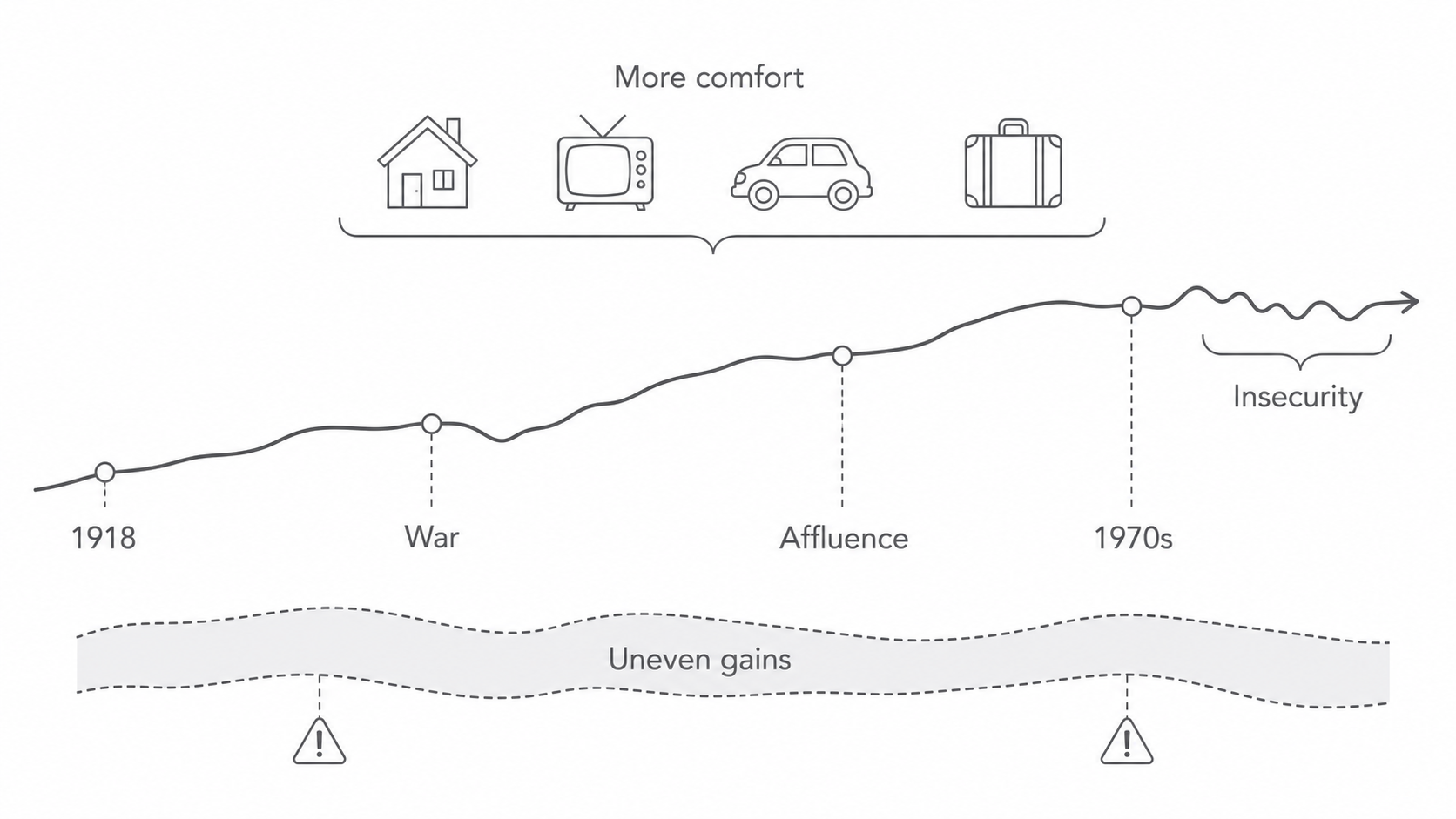
The point is not that living standards rose in a straight line. A good answer
must weigh visible gains in comfort and leisure against the regional, class and
employment differences that made those gains fragile or incomplete for many
households.
A strong Paper 1 breadth essay should avoid two mistakes. First, do not treat living standards as one national average. Region, class, age, gender and employment sector shaped what people actually experienced. Second, do not treat leisure and culture as decoration. Cinema, radio, music, television, spectator sport, seaside holidays, package tours and cars changed how people spent time, imagined status and judged whether life was getting better.
Interwar Living Standards
Britain emerged from the First World War with heavy debts, disrupted trade, inflation and a difficult transition from wartime production. There was a brief post-war boom in 1919-20, but it was followed by a sharp slump in 1920-21. Demobilised servicemen returned to a labour market that could not easily absorb them, while export industries struggled in a changing world economy.
The key interwar problem was not that all Britain was poor. It was that recovery was uneven. Older staple industries - coal, shipbuilding, iron and steel, and cotton textiles - faced falling international demand, foreign competition and outdated plant. These industries were concentrated in particular regions: South Wales coal, Tyneside and Clydeside shipbuilding, Lancashire cotton, parts of Scotland, the North East and the industrial north. When these sectors declined, whole communities suffered because work, housing, shops, local government finance and family life depended on the same industries.
Unemployment therefore had a regional geography. During the early 1930s, the worst-hit areas experienced long-term unemployment, poverty, debt and demoralisation. The means test, introduced in 1931, made hardship especially bitter because assistance could depend on the income of other household members. For families in the distressed areas, quality of life was shaped by insecurity: rent arrears, pawnshops, poor diet, delayed marriage, loss of status for male breadwinners and the emotional strain of repeated unemployment.
At the same time, the interwar years also brought important improvements. Prices fell during parts of the 1920s and 1930s, so some employed workers' real wages improved. Local authorities and private builders expanded housing, especially after the post-war "homes fit for heroes" promise and later suburban development. By the 1930s, the suburban semi-detached house became a symbol of comfort for lower-middle-class and better-paid working-class families in expanding areas. It might offer a garden, indoor bathroom, electricity, more privacy and distance from older overcrowded urban housing.
The 1930s recovery was strongest in the Midlands and South East. Cheaper mortgages, lower interest rates after Britain left the gold standard in 1931, private housebuilding, electrical goods, motor manufacture, light engineering, pharmaceuticals, processed foods and new retailing created jobs and consumption. For a clerk, skilled worker or lower-middle-class family in a growing suburb, the 1930s could mean a better home, a wireless set, cinema visits, a bicycle or motorbike, and perhaps a holiday. For an unemployed shipyard worker in Jarrow, that same decade looked very different.
This is why the phrase "boom, crisis and recovery" must be handled carefully:
| Interwar phase | Improvement | Limitation |
|---|---|---|
| 1918-21 | Wartime controls ended and some demand continued briefly after the war. | Inflation, demobilisation and slump weakened living standards. |
| 1922-29 | Some real wages rose; radio, cinema and new housing widened comfort for employed households. | Heavy industry and export regions remained vulnerable. |
| 1929-32 | The crisis forced public attention onto unemployment and poverty. | Unemployment rose dramatically, especially in distressed areas. |
| 1932-39 | Housebuilding, cheap money and light industries supported recovery. | Recovery was regionally uneven and did not solve structural decline. |
The historical judgement is therefore mixed. Interwar Britain did see a gradual rise in comfort for many employed people, especially in expanding regions and suburbs. But the same period also created one of the clearest regional divides in modern British history. A national average can hide the difference between a new semi in the South East and a depressed mining valley in South Wales.
Total War and Austerity
The Second World War changed quality of life more abruptly than any interwar policy. From 1939, Britain became a total-war society. The state controlled labour, food, fuel, transport, prices, production and information to an extent that would have seemed extraordinary in peacetime. This did not make life more comfortable in a simple sense. It meant disruption, danger and restriction. But it also changed access to essentials and gave many people full employment.
The immediate effects were severe. Evacuation separated many children from their families. The Blitz of 1940-41 and later bombing damaged homes, killed civilians and made urban life frightening and exhausting. Blackout rules, air-raid shelters, identity cards, censorship, conscription and civil defence duties brought the war into daily routine. Housing shortages worsened because bombing destroyed or damaged homes and building materials were diverted to war needs.
Rationing was central to wartime quality of life. Food rationing began in January 1940 with items such as bacon, butter and sugar, and then expanded. Clothes rationing began in 1941. Petrol, furniture and many household goods were tightly controlled. Rationing reduced choice and comfort, but it also tried to create fairness. A poor family with ration books and subsidised staples could sometimes receive a more regular diet than before the war. School meals, milk schemes, British Restaurants and communal feeding helped the state manage nutrition. This is an important exam point: wartime living standards could be materially restrictive yet socially equalising.
War work also changed living standards. Unemployment largely disappeared. Women entered factories, transport, munitions, clerical work, auxiliary services and civil defence in large numbers. Overtime and war wages gave some households more money than they had known in the 1930s, although there were fewer goods to buy. For young workers, women and people from depressed regions, war could mean wages and purpose. For bombed cities and separated families, it meant trauma and loss. The quality-of-life impact was therefore contradictory.
After 1945, expectations rose faster than living conditions. The Labour government promised reconstruction, full employment, better housing and social security. The NHS opened in 1948, and the wider welfare settlement matters as context, but this topic is mainly about everyday living standards. On that measure, post-war Britain remained austere. Rationing continued and in some cases widened: bread was rationed after the war from 1946 to 1948, and meat and all remaining food rationing did not end until July 1954. The winter fuel crisis of 1947 exposed how fragile recovery could be.
Housing was one of the sharpest post-war problems. Bomb damage, delayed repairs, shortage of labour and shortage of materials left many families overcrowded or living with relatives. Temporary prefabricated houses built under the Housing (Temporary Accommodation) Act 1944 helped relieve pressure; many prefabs had fitted kitchens and modern layouts that felt advanced, even if they were meant to be temporary. Council housebuilding and New Town planning pointed towards a better future, but by 1951 the lived reality for many households was still queues, ration books, shared accommodation and limited consumer choice.
The best judgement for 1939-51 is that total war and austerity did not raise comfort immediately, but they changed the basis on which quality of life was measured. Before the war, the fear was mass unemployment and regional abandonment. During and after the war, the expectation became that the state should guarantee work, nutrition, housing reconstruction and basic security. That expectation helped shape the consumer society that followed.
Consumer Society, 1951-79
The years after 1951 saw the growth of a consumer society. This did not mean everyone became wealthy. It meant that more households expected comfort, choice and private consumption as normal parts of life: a secure wage, a modern home, fitted appliances, a television, a car, a holiday and access to shops selling a wider range of goods.
Several forces made this possible. Full employment remained a central feature of the 1950s and 1960s. Real household incomes rose. Consumer credit and hire purchase allowed families to buy goods before paying the full price. Private housebuilding, council housing and New Towns improved many living environments. Electricity, gas and plumbing became more widespread. Supermarkets and self-service shopping changed food retailing. Advertising encouraged people to define a better life through branded goods and domestic comfort.
Harold Macmillan's famous 1957 claim that many people had "never had it so good" captured a real change in mood. Compared with rationing Britain, the late 1950s offered more jobs, higher real incomes and more goods. Yet it was also a political claim. A historian should ask: who was included, and what was being left out?
Consumer goods show both the scale and the limits of change. In Great Britain, official estimates recorded about 6.3 million households with refrigerators in 1964 and 11.2 million in 1969; washing machines rose from about 9.0 million households to 12.0 million over the same period; regular use of a car rose from about 6.4 million households to 9.7 million. These figures show rapid change, but also that not every household had these goods. Older people, poorer families, private renters, some council tenants and some regions could lag behind.
Television became the most important symbol of domestic consumer society. It changed leisure, politics, advertising, family routines and national culture. A television set was not only an object; it reorganised the living room. It encouraged people to stay at home, watch the same programmes, recognise the same celebrities and encounter national events at the same time. Commercial television after 1955 also brought advertising directly into the home, linking entertainment to consumption.
Housing improved overall, but unevenly. Many families moved from overcrowded or old housing into council estates, New Towns or owner-occupied suburbs. More homes had bathrooms, indoor lavatories, hot water and later central heating. However, slum clearance could break old communities; high-rise estates sometimes suffered from poor design or maintenance; and not all families gained access to good housing. By the early 1970s, home ownership was just under half of households, while council housing still housed a large share of the population. Quality of life rose, but tenure and place mattered.
Continue this lesson.
You’re previewing NovaLearn without an account. Create a free account to read the rest.
Create free account