1G Theme 3 - Economic development and policies, 1918-89
This lesson is about how German governments tried to manage economic danger across three very different systems: Weimar democracy, Nazi dictatorship, and the Federal Republic of West Germany. The central pattern is not a simple move from failure to success. Weimar governments restored stability after hyperinflation but built recovery on fragile foreign credit. The Nazi regime cut unemployment and increased production, but it did so by subordinating the economy to rearmament, racial exclusion, coercion and war. West Germany achieved the most durable growth through the social market economy and European integration, but after the mid-1960s it had to manage recession, inflation, structural change and persistent unemployment.
The strongest breadth judgement is therefore: economic policy worked best when it combined stable money, external integration and social consent; it worked worst when it tried to escape constraint through inflation, austerity, autarky, conquest or coercion.
Overview: Three Economic Regimes
For Edexcel Paper 1, this is a breadth theme. You are not being asked to remember isolated policies. You need to explain how economic priorities changed across time, why governments chose particular responses, and how far those responses improved living standards.
Keep the official three-part structure visible in your essays: reacting to economic challenges, 1918-32; controlling the economy, 1933-45; and creating a social market economy, 1945-89. The sub-periods matter because each one has a different policy logic: crisis management, recovery, depression, rearmament, command control, war exploitation, post-war reconstruction, miracle growth and later adjustment.
Use this chronological spine:
| Period | Main economic problem | Main policy response | Overall judgement |
|---|---|---|---|
| 1918-23 | Defeat, demobilisation, reparations, budget deficits, Ruhr occupation and hyperinflation | Emergency welfare, fulfilment of reparations, then passive resistance in the Ruhr, followed by Stresemann's ending of passive resistance and the Rentenmark | Weimar survived, but hyperinflation destroyed savings and trust. |
| 1924-28 | Restoring production, credit and confidence after collapse | Dawes Plan, foreign loans, Reichsmark stability, rationalisation, welfare and unemployment insurance | Real recovery, but dependent on American credit and uneven by class and region. |
| 1929-32 | Great Depression, loan withdrawal, banking crisis and mass unemployment | Bruning's deflation, spending cuts, tax rises, wage cuts and emergency decrees | Policy reduced reparations pressure but deepened unemployment and social misery. |
| 1933-36 | Depression and unemployment, plus Nazi desire for rearmament | Public works, Reich Labour Service, conscription, Schacht's New Plan and hidden rearmament finance | Unemployment fell, but recovery was tied to militarisation and exclusion. |
| 1936-45 | Raw-material shortages, rearmament demands and then total war | Four-Year Plan, command controls, autarky, rationing, plunder, forced labour and Speer's rationalisation | Production rose for war, but living standards and human freedom were sacrificed. |
| 1945-55 | Ruins, shortages, occupation, refugees, black markets and currency disorder | 1948 currency reform, Erhard's liberalisation, Marshall Aid, social market principles, FRG state-building | The basis of recovery was rebuilt, though hardship remained severe at first. |
| 1955-66 | Sustaining rapid growth and labour demand | Export-led growth, European integration, investment, guest workers and social welfare expansion | The "economic miracle" transformed living standards and political legitimacy. |
| 1966-89 | Recession, oil shocks, inflation, structural unemployment and industrial change | Stability and Growth Law, Keynesian management, then more market-oriented adjustment, continued European integration | West Germany stayed prosperous, but the miracle years had ended. |
Use the visual below as a quick way of holding the three economic logics together. It is not a replacement for the chronology; it is a reminder that each regime solved some problems by accepting or rejecting different constraints.
[DIAGRAM: asset_name: Three Economic Models and Limits; asset_slug: p1_1g_03_economic_development_and_policies_1918_89__diagram_01; recommended_method: image_gen; description: 16:9 white-background grey schematic with three panels comparing Weimar fragile credit, Nazi command, and the FRG social market, using a cracked coin, control gear, and balanced market symbol to show different economic logics]
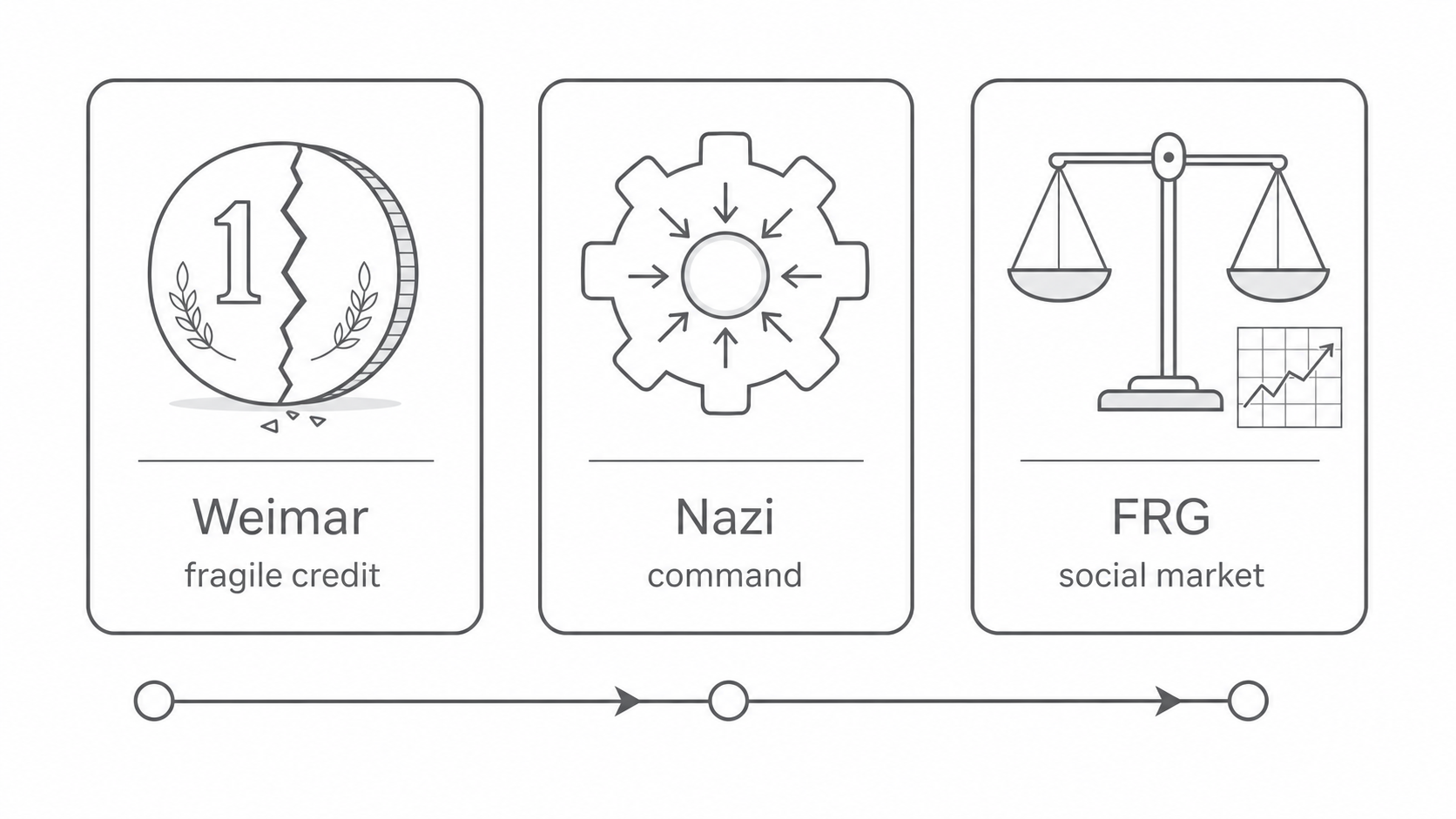
The judgement the diagram supports is that apparent recovery must always be tested against durability, consent and human cost. Weimar stabilisation was real but credit-dependent; Nazi recovery was dramatic but coercive and militarised; West German growth proved more durable because it linked markets, welfare, stable money and external integration.
The recurring exam issue is constraint. Weimar was constrained by reparations, foreign loans and coalition politics. The Nazi regime tried to break economic constraint by dictatorship, rearmament and conquest. West Germany accepted constraints of stable money, competition, welfare compromise and European markets, and that made its system more durable.
The phrase living standards also needs careful use. It includes wages, employment, prices, food, housing, welfare, consumer goods, leisure, security and social dignity. A person in work can still have poor living standards if wages are controlled, goods are scarce, working hours lengthen, or political and racial persecution removes basic rights.
Weimar Crisis, Recovery and Depression, 1918-32
The Weimar Republic inherited an economy damaged by war before it faced the Treaty of Versailles. The imperial government had financed much of the First World War through borrowing rather than taxation, expecting victory to make enemies pay. Defeat in 1918 left the new republic with war debt, inflationary pressure, demobilised soldiers, disrupted trade, food shortages, political violence and the problem of reparations. The economy was already fragile before the London Schedule of Payments in 1921 fixed Germany's reparations bill at 132 billion gold marks.
Early Weimar governments tried to keep the republic alive through compromise. The Stinnes-Legien agreement of November 1918 recognised trade unions and accepted the eight-hour day in return for labour cooperation. This helped reduce revolutionary pressure, but it also increased employer resentment and did not solve the fiscal problem. Governments spent heavily on social support and reconstruction while tax income was weak. The mark continued to lose value.
The crisis became catastrophic in 1923. When Germany fell behind on deliveries, French and Belgian troops occupied the Ruhr in January. Chancellor Wilhelm Cuno's government encouraged passive resistance: Ruhr workers were told not to cooperate with the occupiers, while the government paid wages and subsidies to support them. This was politically popular for a time, but it was economically disastrous. The state paid for resistance by issuing more money, and inflation became hyperinflation.
Hyperinflation destroyed the normal rules of economic life. Prices changed during the day. Wages could be paid daily and spent immediately before they lost value. People with savings, pensions or fixed incomes were devastated; people with debts or physical assets could sometimes benefit. The deepest consequence was psychological as well as material: many Germans associated Weimar with humiliation, chaos and the loss of hard-earned security.
Gustav Stresemann's government changed course in autumn 1923. Passive resistance ended in September. In November, Finance Minister Hans Luther and currency commissioner Hjalmar Schacht helped introduce the Rentenmark, backed not by gold reserves but by mortgages on land and industrial assets. The new currency worked because it was issued in limited quantities and because the government stopped financing spending through the printing press. In 1924, the Reichsmark was introduced alongside the Rentenmark, and the Dawes Plan reorganised reparations. It began payments at a more manageable level, placed the Reichsbank under stronger independent control, and opened the way for American loans.
The recovery of 1924-28 was real. Foreign credit supported investment, industry rationalised production, exports revived, and large cities invested in housing, transport and welfare. The 1927 unemployment insurance law was an important social reform because it treated unemployment as an insurable risk rather than simply a moral failing. Workers' real wages improved by the late 1920s, and urban life for some Germans became more secure and modern.
Yet the "golden years" were fragile. Germany depended heavily on short-term foreign loans, especially from the United States. Agriculture remained depressed, small businesses felt pressure from modern firms and department stores, and many middle-class savers never recovered emotionally from 1923. The political argument over reparations did not disappear either. The Young Plan of 1929 reduced and rescheduled reparations, but the nationalist right attacked it because it still accepted long-term payment.
The Great Depression exposed this weakness. After the Wall Street Crash in October 1929, American lenders recalled loans and world trade contracted. German firms cut production and dismissed workers. The banking crisis of 1931, including the collapse of the Danatbank, made confidence worse. Registered unemployment rose from about 1.9 million in 1929 to about 5.6 million in 1932.
Chancellor Heinrich Bruning, in office from 1930 to 1932, responded with deflation: cuts in public spending, higher taxes, reductions in wages and prices, and reductions in welfare support. His aims were partly economic and partly diplomatic. He wanted to balance the budget, defend the currency, restore foreign confidence and show that Germany could not pay reparations. This strategy helped create the conditions for the effective end of reparations at Lausanne in 1932, but at terrible social cost. It reduced demand when the economy needed spending, weakened parliamentary politics through emergency decrees, and left millions dependent on inadequate relief.
Changing living standards between 1918 and 1932 therefore moved in waves. The early republic brought hunger, inflation and insecurity. The mid-1920s brought stabilisation, welfare reform and some urban improvement. The Depression then produced unemployment, eviction, hunger, family stress and political radicalisation. A strong essay should not say simply that Weimar "failed economically". It should argue that Weimar could stabilise crisis when international credit and political compromise existed, but it could not survive a global depression when its recovery was externally financed and its policy response was deflationary.
Nazi Recovery, Command and War Economy, 1933-45
When Hitler became chancellor in January 1933, the German economy was already beginning to move away from the deepest point of the Depression. That matters for judgement: the Nazis did not create recovery from nothing. However, they accelerated and redirected recovery by using dictatorship. Economic policy became inseparable from the regime's wider aims: destroying independent labour, preparing for war, excluding Jews and other persecuted groups, and making society obedient.
The first phase, 1933-36, was an attempt at recovery through job creation and rearmament. The regime expanded public works, including road building and the autobahn programme. It supported construction, gave tax incentives to employers, increased state orders and developed the Reich Labour Service. Rearmament became increasingly important, especially after open conscription was announced in 1935. Young men taken into the armed forces or labour service disappeared from unemployment statistics, while women and Jews were pushed out of many areas of public and professional life.
Hjalmar Schacht, Reichsbank President and later Economics Minister, helped finance expansion without immediate open inflation. The regime used devices such as Mefo bills, a system of hidden credit for arms orders, to fund rearmament outside normal budget limits. Schacht's New Plan of 1934 tightened control over foreign exchange and imports. Germany lacked enough hard currency to buy all the food and raw materials it wanted, so the state rationed foreign exchange, prioritised strategic imports and used bilateral trade agreements.
Official unemployment fell dramatically, from roughly six million in early 1933 to under one million by the later 1930s. For many Germans who were included in the Nazi racial community, this felt like recovery. Work returned. Public ceremonies, uniforms, parades and propaganda connected employment with national revival. But this was not a normal market recovery. Independent trade unions were destroyed in May 1933 and replaced by the German Labour Front. Wages were controlled, strikes were illegal, working hours rose, and workers had little bargaining power. The state did not primarily ask how to raise household welfare; it asked how to mobilise labour for the regime.
By 1936, the recovery had created serious bottlenecks. Rearmament demanded steel, rubber, oil, skilled labour and foreign exchange faster than Germany could supply them. Schacht wanted to slow arms spending and protect exports. Hitler chose the opposite. His secret memorandum of August 1936 argued that the army and economy had to be ready for war within four years. Hermann Goring was placed in charge of the Four-Year Plan. This is the key shift from attempting economic recovery, 1933-36, to creating a command economy, 1936-39.
The Four-Year Plan created a more command-driven economy. Private property formally remained, and major firms such as Krupp, IG Farben, Siemens and Daimler-Benz still mattered. But the state increasingly directed what should be produced, which imports would be approved, where investment should go and which sectors had priority. Autarky became a key aim. Germany invested in synthetic rubber (Buna), synthetic fuel from coal, aluminium and iron ore production, and state-backed heavy industry such as the Reichswerke Hermann Goring. The goal was not consumer comfort. The goal was to make Germany harder to blockade and more capable of war.
Changing living standards from 1933 to 1939 were therefore contradictory. Employment improved and some families gained regular income after years of Depression misery. The Strength Through Joy programme offered subsidised leisure, holidays and cultural activities, while propaganda promised consumer goods such as the Volkswagen. But the gains were limited by wage controls, longer working hours, shortages, pressure to conform and the diversion of resources from consumption to arms. Consumer choice remained weaker than in other advanced economies, and the promised Volkswagen was not delivered to ordinary subscribers before war began.
The deepest limitation is moral and analytical. Nazi recovery excluded those the regime persecuted. Jews were pushed out of jobs, businesses and professions, then robbed through "Aryanisation" and later deportation and murder. Political opponents, disabled people, Roma and Sinti, and other targeted groups cannot be treated as outside the economic story. Nazi economics created work and profits for some by stripping rights, property and life from others.
For exam judgement, avoid the trap of saying "Hitler solved unemployment" as if this were a neutral achievement. A better judgement is: Nazi economic policy reduced unemployment impressively in official terms, but it did so by militarising demand, suppressing workers, reducing recorded unemployment through conscription and labour service, excluding persecuted groups and building a system that required further expansion or war to survive.
The impact of war from 1939 to 1945 revealed both the strengths and weaknesses of the Nazi economic system. Germany entered the Second World War with a large armaments sector and tight state controls, but it was not fully prepared for a long world war. Hitler and many military planners expected short, decisive campaigns. That assumption shaped the early war economy: the regime tried to keep civilian morale stable while using conquest to gain resources.
Rationing began in 1939, but the regime initially tried to protect the living standards of the German home front more than had been possible in the First World War. One reason was political memory: hunger and exhaustion had helped undermine Germany in 1918. Another reason was conquest. Occupied Europe was forced to supply food, raw materials, industrial goods, taxes and labour. The Nazi war economy therefore cannot be separated from occupation, exploitation and racial violence.
In the early war years, victories in Poland, western Europe and the Balkans expanded German control over resources. But the invasion of the Soviet Union in 1941 turned the war into a vast struggle of attrition. Germany now faced immense demands for weapons, fuel, transport, food and labour. The labour shortage became severe because millions of German men were in the armed forces. The regime filled the gap through forced labour: prisoners of war, civilians deported from occupied territories, concentration camp prisoners and Jewish forced labourers were compelled to work in agriculture, construction, armaments and other industries.
Forced labour was not an accidental addition to the economy. It became central to German war production. Millions of foreign workers were in the Reich by the later war years, often living under brutal conditions, with different rations and rights according to Nazi racial hierarchy. For Jewish prisoners and many concentration camp inmates, work could be part of a policy of destruction. An economic answer must therefore treat wartime "production" and "efficiency" with moral precision: higher output was often achieved through terror.
There was also a major shift in economic management after the crisis of 1941-42. Fritz Todt had already expanded armaments organisation before his death in February 1942. Albert Speer then became Minister of Armaments and Munitions; his remit was broadened and the ministry renamed Armaments and War Production in 1943. Speer rationalised production, reduced some duplication, standardised designs, concentrated resources on priority weapons and used the Central Planning Board to allocate labour and materials. Armaments output rose significantly between 1942 and 1944, even while Allied bombing intensified.
Continue this lesson.
You’re previewing NovaLearn without an account. Create a free account to read the rest.
Create free account