2H.2 KT1 - Affluence and conformity, 1955-63
This lesson explores why affluence and conformity grew together in the USA between 1955
and 1963, and why both came under pressure.
The central argument is that the United States in 1955-63 looked unusually confident:
more families bought homes, cars and domestic technology; suburbs expanded; television and
advertising sold a common image of the good life; and Kennedy promised a New Frontier of
national purpose. Yet that confidence was selective. Cities were reshaped by highways and
suburban flight, consumer prosperity was uneven, suburban conformity created pressures as
well as comfort, youth and Beat culture challenged adult values, and civil rights activists
forced the nation to confront the gap between democratic language and racial reality.
The Enquiry Frame
This is a Paper 2 key topic. You need enough depth for an AO1 essay on causation,
change, consequence or significance, and enough source awareness for AO2 work on
contemporary evidence such as speeches, television reports, adverts, civil rights
photographs, government publicity or segregationist material.
The topic is not just "the 1950s were prosperous". It asks how affluence, conformity and
challenge existed at the same time. The strongest answers keep three tensions in view.
| Tension | What it means | How to use it in judgement |
|---|---|---|
| Affluence and exclusion | Many white middle-class Americans gained homes, cars, appliances and stable jobs, while many Black Americans, the urban poor and workers in declining areas were left outside the full consumer promise. | Prosperity was real, but unevenly distributed and often racially structured. |
| Conformity and challenge | Suburbs, television, advertising and Cold War politics encouraged respectability and consensus; teenagers, rock and roll, films and Beat writers exposed dissatisfaction. | Conformity was powerful because it was attractive, not only because it was imposed. Challenge mattered because it revealed cracks before the later 1960s. |
| Federal ambition and limits | Kennedy used activist language in welfare, unemployment, parks, Peace Corps and space policy, but Congress, conservative Democrats, Republicans and Cold War priorities limited many domestic achievements. | The New Frontier was significant as a direction of travel, but less transformative than Johnson's later Great Society. |
Before you use the chronology, keep the relationship map in mind. Affluence did not push
the USA in one direction only: it helped make suburban conformity attractive, while the
groups excluded from that ideal helped create some of the strongest challenges to it.
[DIAGRAM: asset_name: Affluence, conformity and challenge map; asset_slug: p2_2h2_01_affluence_and_conformity_1955_63__diagram_01; recommended_method: image_gen; description: 16:9 white-background schematic showing Affluence branching to Suburbs, Cars and TV / Ads feeding Conformity, while Exclusion leads through Civil rights to Challenge, with New Frontier shown as a limited federal response to the overall tension]
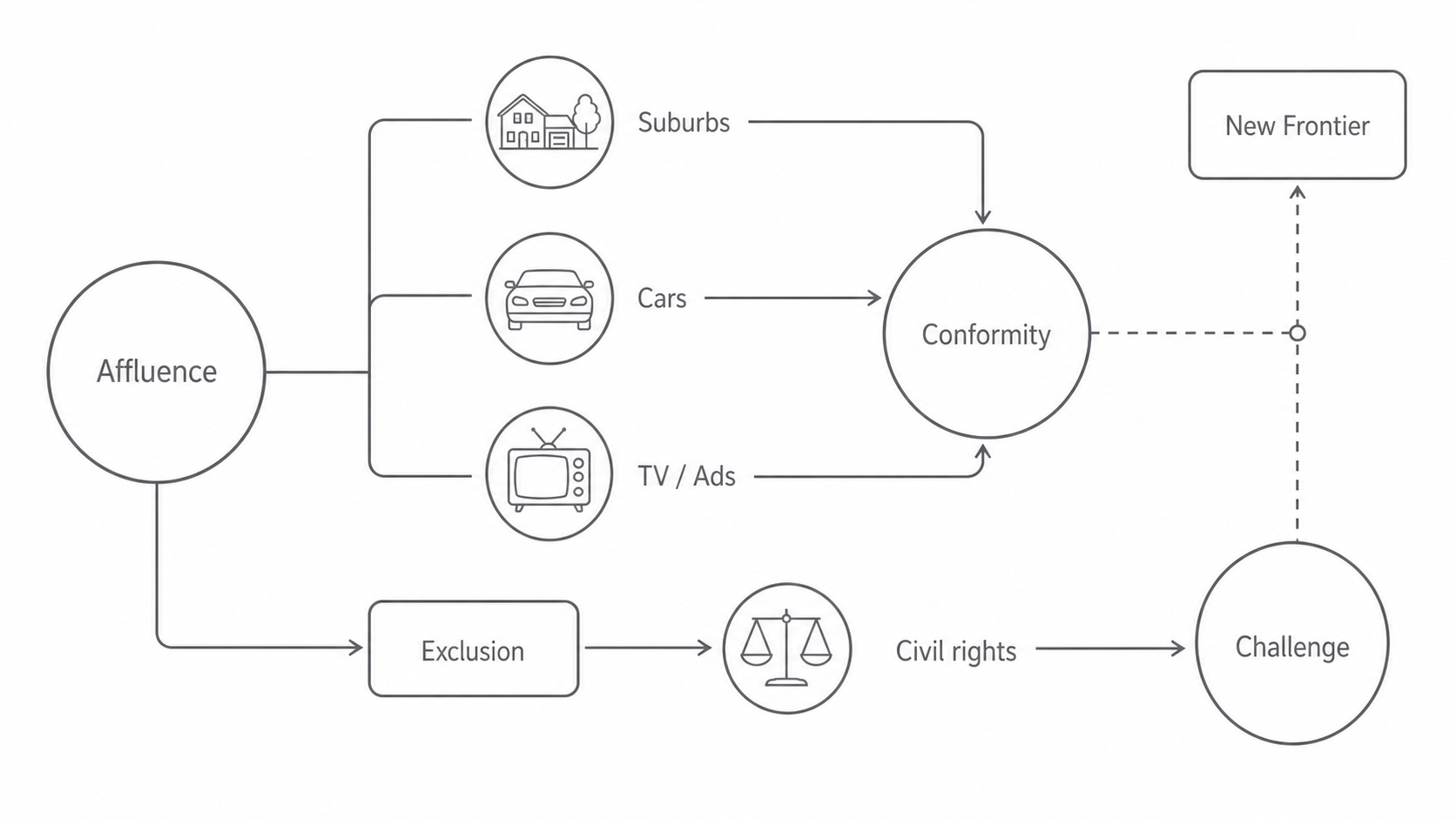
The visual matters because it prevents a one-sided argument. In this topic, prosperity,
consumer culture and Kennedy's reform language all need to be weighed against exclusion,
civil rights pressure and cultural dissatisfaction.
Use the chronology carefully:
| Date | Event | Why it matters |
|---|---|---|
| 1955-56 | Montgomery Bus Boycott | Made mass nonviolent direct action a national civil rights model. |
| 1955-57 | Rebel Without a Cause, Ginsberg's Howl, Kerouac's On the Road, Elvis Presley's national breakthrough | Shows cultural challenge inside a society that valued respectability. |
| 1956 | Federal-Aid Highway Act | Expanded the interstate system and helped lock in car-based suburban growth. |
| 1957-60 | Civil Rights Acts under Eisenhower; sit-ins began in Greensboro in February 1960 | Federal civil rights legislation reopened, but local direct action remained crucial. |
| 1960-61 | Kennedy elected; 1960-61 recession; Area Redevelopment Act; Peace Corps established | New Frontier rhetoric met economic and congressional constraints. |
| 1961-62 | Kennedy committed to a moon landing; Manpower Development and Training Act; Cape Cod National Seashore | Shows federal activism in space, unemployment and environmental/recreational policy. |
| 1963 | Birmingham campaign, Kennedy's civil rights address, March on Washington, 16th Street Baptist Church bombing, Kennedy's assassination | Civil rights became a national political crisis before the major 1964 legislation. |
The best overall judgement is that 1955-63 was a period of confident consensus under
pressure. Affluence made conformity look natural to many Americans, but the same society
contained challenges that could not be contained by suburban comfort, television optimism
or moderate federal reform.
Affluence, Suburbs and Cars
Affluence in the late 1950s and early 1960s rested on postwar economic strength. The
United States had emerged from the Second World War with enormous industrial capacity, a
strong dollar, high consumer demand and a growing population. The baby boom, usually dated
from 1946 to 1964, expanded demand for houses, schools, cars, food, clothing, toys and
household goods. The GI Bill, Veterans Administration mortgages, Federal Housing
Administration mortgage insurance, union wages in many industries and a widening white
collar sector helped many families imagine a stable middle-class life.
Affluence did not mean every American became wealthy. It meant that more Americans,
especially white middle-class and skilled working-class families, could buy goods and
services that had previously seemed out of reach. The important historical point is that
consumer choice became a public language of success. A family home, a car in the driveway,
a television in the living room, a washing machine, refrigerator, vacuum cleaner and
processed food in the kitchen could all be presented as proof that American capitalism
delivered freedom and comfort.
Suburban expansion was the clearest social expression of this prosperity. New developments
such as Levittown, New York, and Park Forest, Illinois, had begun before 1955, but the
pattern accelerated across the period. Suburbs promised space, safety, modern schools,
private gardens and similar neighbours. They also changed everyday geography. Work,
shopping, church, school, leisure and politics were increasingly arranged around the
suburban household rather than the old city neighbourhood.
The changing nature of cities followed from this. Central cities did not simply decline in
the same way everywhere, and many remained powerful centres of finance, government,
industry, transport and culture. But the balance shifted. As white middle-class residents,
retail investment and some businesses moved outward, many city governments were left with
older housing, poorer tax bases, overcrowded schools, traffic problems and larger poor and
minority populations. Urban renewal and highway construction often claimed to modernise the
city, but they also demolished neighbourhoods and displaced people with limited political
power.
The car was both a consumer good and a structure of life. By the 1950s, car ownership was
no longer only a luxury for the rich. It became central to commuting, shopping, tourism,
dating, family holidays and suburban independence. The Federal-Aid Highway Act, signed by
Eisenhower on 29 June 1956, authorised a huge interstate system, expanding the planned
network to 41,000 miles and tying road-building to national defence, commerce and
mobility. Highways made suburbs more practical, encouraged motels, service stations,
drive-in restaurants and shopping plazas, and reinforced the idea that freedom meant
movement by private car.
That freedom had costs. Highways cut through many urban neighbourhoods, often poor, Black,
Mexican American or immigrant areas. Public transport lost riders as car ownership grew.
Those who could not afford a car, or who were excluded from suburban housing, were often
left with poorer access to jobs and services. A sharp essay should therefore treat the car
as both a symbol of affluence and a cause of new inequalities.
White collar jobs and service industries also mattered. The postwar economy still included
major manufacturing employment, especially in cars, steel, aircraft, chemicals and
consumer goods. But clerical, professional, managerial, sales, education, health, finance
and government work became more visible. Office parks, insurance firms, banks,
universities, hospitals, shopping centres and public administration drew workers into jobs
that seemed cleaner, more secure and more middle-class than manual labour. For women, the
growth of clerical, teaching, sales and service work created paid opportunities, although
often within gendered assumptions about "women's work".
Consumerism and domestic technology reshaped home life. Washing machines, dryers,
refrigerators, freezers, vacuum cleaners, electric mixers, television sets, hi-fi record
players and prepared foods were sold as labour-saving and modern. Advertising presented
them as rational purchases and emotional rewards: a good wife, a happy family, efficient
housework, healthy children and patriotic abundance could all be folded into the same
image. Hire purchase, instalment plans, charge accounts and credit cards made consumption
feel immediate, though they also normalised household debt.
The key limitation is that domestic technology did not simply liberate women. Appliances
reduced some physical labour, but standards of cleanliness, cooking, childcare and
appearance rose at the same time. Television and advertising often measured women by their
ability to create an attractive home. Suburban affluence therefore mixed comfort with
pressure: the good life could become a performance that families were expected to sustain.
Conformity and Cultural Challenge
Conformity in 1955-63 was not simply obedience. It was a set of social rewards. A stable
job, marriage, children, church attendance, a mortgage, a car, a television and a modern
kitchen could all be presented as evidence of maturity and success. In the Cold War, the
American family home was also political propaganda: it suggested that capitalism produced
comfort, privacy and freedom, unlike the state-centred communism the United States opposed.
Suburban conformity had several roots. New suburbs often housed young families at similar
life stages, especially white veterans and their wives. Local schools, parent-teacher
associations, churches, sports leagues and neighbourhood groups encouraged community life,
but also made difference visible. Many subdivisions looked physically uniform, with similar
houses, lawns and cars. Developers, lenders and residents frequently excluded Black
families, even when formal racial covenants had been weakened by the Supreme Court's
Shelley v. Kraemer decision in 1948. The result was a suburban world that could feel
secure to insiders and closed to outsiders.
Film and television both reinforced and questioned this order. Television sitcoms and
advertisements often idealised the white nuclear family, the male breadwinner, the
cheerful housewife and obedient children. Shows such as Father Knows Best, Leave It to
Beaver and The Adventures of Ozzie and Harriet did not simply reflect life; they helped
define what normality was supposed to look like. Commercial television also turned
domestic life into a market. The home became a place where national brands competed for
attention, and children became consumers as well as viewers.
At the same time, film revealed anxiety beneath the surface. Rebel Without a Cause
(1955), starring James Dean, presented youth alienation inside apparently comfortable
families. The Man in the Gray Flannel Suit (1956) explored the pressures of corporate
work and suburban respectability. The Blackboard Jungle (1955) linked schools, juvenile
delinquency and rock and roll in a way that alarmed many adults. These films did not
overthrow conformity, but they showed that prosperity could produce emptiness, rebellion
and generational conflict as well as contentment.
Advertising deserves separate attention because it taught Americans how to desire. In the
1950s and early 1960s, advertisers sold more than soap, cereal, cars or appliances. They
sold identity. A product could promise efficiency, sex appeal, scientific modernity,
motherly care, masculinity, social status or patriotism. The "good life" was made visual:
clean kitchens, shining cars, smiling children, relaxed fathers and attractive mothers.
Critics such as Vance Packard, whose The Hidden Persuaders appeared in 1957, argued that
advertising used psychology to manipulate consumers. Even when that criticism exaggerated,
it captured a real fear: mass prosperity might make people conform by persuading them that
freedom meant buying the right things.
Teenage culture was one of the most important challenges. The word "teenager" had become
more common before 1955, but the late 1950s gave it stronger economic and cultural force.
More young people stayed in high school, had pocket money from part-time work or parental
allowances, listened to portable radios, bought 45 rpm records and formed tastes separate
from their parents. Youth was increasingly a market.
Rock and roll made that market loud. It drew on rhythm and blues, gospel, country and
Black musical traditions, then crossed into national white teenage consumption through
performers such as Chuck Berry, Little Richard, Fats Domino, Bill Haley and Elvis Presley.
Presley's 1956 television appearances made him a national symbol of excitement and adult
alarm. Rock and roll challenged conformity because it suggested bodily freedom, racial
crossover, sexual energy and youth independence. Yet it was also commercialised quickly:
record companies, radio stations and television programmes such as American Bandstand
could package rebellion into a profitable and sometimes sanitised form.
Beatnik culture was a smaller but sharper challenge. The Beat movement developed in
bohemian communities such as New York's Greenwich Village and San Francisco's North Beach.
Allen Ginsberg's Howl was first performed in 1955 and published in 1956; Jack Kerouac's
On the Road appeared in 1957. Beats rejected materialism, careerism, suburban routine
and conventional sexual or religious respectability. They valued spontaneity, jazz,
travel, intense experience and literary experiment. The popular stereotype of the
"beatnik" could be comic or hostile, but it mattered because it gave visible form to
anti-conformity before the larger counterculture of the later 1960s.
The best judgement is that cultural challenge before 1963 was real but limited. Most
Americans did not become Beats, and many teenagers who loved rock and roll still expected
jobs, marriage and consumer comfort. But the challenges mattered because they exposed the
emotional and moral limits of consensus. They showed that the affluent society could be
criticised from inside: by bored teenagers, anxious workers, dissatisfied housewives,
Black musicians, bohemian writers and consumers who suspected they were being sold an
image rather than a full life.
Civil Rights and White Resistance
Civil rights is central to this topic because it tested the moral claims of affluence and
conformity. A country that presented itself as democratic, prosperous and free still
allowed legal segregation, voter suppression, racist violence and economic exclusion.
Civil rights activists made that contradiction impossible to ignore.
The Montgomery Bus Boycott began after Rosa Parks was arrested on 1 December 1955 for
refusing to give up her bus seat to a white passenger. Parks was not a random or passive
figure: she was connected to the NAACP and local activism. The boycott also depended on
Black women's organising, especially Jo Ann Robinson and the Women's Political Council,
which rapidly spread boycott leaflets. E.D. Nixon, local ministers and community leaders
helped create the Montgomery Improvement Association, with Martin Luther King Jr. as its
president.
Continue this lesson.
You’re previewing NovaLearn without an account. Create a free account to read the rest.
Create free account