2G.1 KT2 - Mussolini's rise and the fascist dictatorship, 1919-26
Mussolini's appointment in 1922 and the creation of dictatorship by 1926 were connected, but they were not the same event. You will trace how fascist violence, liberal weakness, elite support, royal choice, electoral manipulation and legal repression interacted, judging why institutions that could have resisted fascism instead helped convert a minority movement into a one-party state.
The Enquiry Frame
Mussolini did not come to power because most Italians calmly voted for fascism, and he did not create dictatorship in a single dramatic moment. The central enquiry is: how did a weak post-war movement founded in 1919 become the head of government in 1922, and how did that government become a fascist dictatorship by 1926?
The answer is an interaction. The liberal state was already under pressure from war, nationalist disappointment, economic crisis, mass politics and social conflict. Mussolini then adapted fascism from a confused radical movement into an anti-socialist, nationalist force that could win protection from property owners and toleration from state officials. Fascist violence destroyed Socialist and trade-union power in many localities, while Mussolini built parliamentary respectability and reassured conservative elites. In October 1922 the March on Rome worked because it combined threat with negotiation and because King Victor Emmanuel III chose appointment over confrontation. From 1922 to 1926 Mussolini did not abolish liberal Italy at once: he governed through compromise, emergency powers, intimidation, electoral manipulation, party control and finally open repression.
| Date | Event | Why it matters for argument |
|---|---|---|
| 18 January 1919 | Luigi Sturzo founded the Italian Popular Party (PPI) | Catholics entered mass politics as an organised party, weakening old liberal methods. |
| 23 March 1919 | Mussolini founded the Fasci di Combattimento in Milan | Fascism began as a small, radical, nationalist movement, not as an obvious future ruling party. |
| 12 September 1919 | D'Annunzio occupied Fiume | Nationalist extra-parliamentary action exposed the weakness of the liberal state. |
| 16 November 1919 | First post-war general election under proportional representation | The Socialists and Popolari became mass parliamentary forces; the liberals lost easy control. |
| 1919-20 | Biennio rosso, the "two red years" | Strikes, land occupations and factory occupations frightened property owners and conservatives. |
| May 1921 | Fascists entered parliament through Giolitti's National Bloc | Mussolini gained legitimacy while squad violence continued outside parliament. |
| November 1921 | National Fascist Party (PNF) founded | Fascism became a formal party with a more conservative "New Programme". |
| August 1922 | Socialist-led general strike failed | Fascists claimed to be defenders of order and strengthened their bargaining position. |
| 28-30 October 1922 | March on Rome and royal invitation to Mussolini | Violence, elite fear and the king's decision brought Mussolini to office. |
| 31 October 1922 | Mussolini became prime minister | He headed a coalition, not yet a one-party dictatorship. |
| December 1922-January 1923 | Fascist Grand Council and MVSN created | Mussolini tried to discipline the PNF and legalise paramilitary force. |
| November 1923 | Acerbo Law passed | Electoral rules were changed to manufacture a parliamentary majority. |
| 6 April 1924 | Elections under the Acerbo Law | Fascist-dominated lists won a large majority amid intimidation and violence. |
| 30 May-10 June 1924 | Matteotti denounced the election and was murdered | The regime faced its greatest crisis before dictatorship. |
| 3 January 1925 | Mussolini's Matteotti speech | He chose repression rather than retreat and dared opponents to stop him. |
| 1925-26 | Fascist laws and constitutional changes | Opposition, press freedom, elected local government, parliamentary checks and trade-union freedom were dismantled. |
For Edexcel Paper 2, use this topic in two ways. In AO1 essays, rank causes and consequences: liberal weakness, fascist violence, Mussolini's strategy, elite support and royal choice. In AO2 source questions, test source content against provenance. A Socialist speech, a Fascist newspaper, a police report, a landowner complaint, a royal statement or a government law will each reveal something different about fear, coercion, legitimacy and calculation.
The Liberal State Under Pressure
Italy emerged from the First World War as a victor, but victory did not stabilise the liberal state. The old liberal system had already been weakened by the pre-war strains covered in the previous topic: narrow elite politics, regional divisions, industrial conflict, nationalism, the difficult relationship with the Catholic Church, and the divisive decision to enter the war in 1915. After 1918 these weaknesses became more dangerous because mass politics had arrived.
The phrase "mutilated victory" captured nationalist anger at the peace settlement. Italy had fought on the Allied side after the Treaty of London in 1915 promised territorial gains. After the war, Italy did gain Trentino, South Tyrol, Trieste and Istria, but nationalists argued that the settlement fell short, especially over Dalmatia and Fiume. The phrase was not a neutral description of diplomacy. It was a political myth: it taught veterans, students and nationalists to see liberal politicians as weak men who had failed to cash in the sacrifices of war. This mattered because fascism later presented itself as the movement that would redeem victory and restore national dignity.
The occupation of Fiume made that nationalist pressure dramatic. On 12 September 1919, the poet-soldier Gabriele D'Annunzio led armed volunteers, including veterans, into the Adriatic city of Fiume, now Rijeka. Fiume had not been included in the Treaty of London, but many Italian nationalists claimed it because of its Italian-speaking population and symbolic value. The liberal government did not simply accept D'Annunzio's seizure. Giolitti eventually used the Treaty of Rapallo in November 1920 to make Fiume a free state, and Italian forces expelled D'Annunzio in December 1920. Yet the damage had been done. Fiume showed that a charismatic nationalist could defy parliament, use war veterans as a political militia, stage politics as theatre and win public sympathy while doing so. Mussolini watched and learned, even though D'Annunzio remained a rival rather than a subordinate.
The post-war economic crisis made politics more explosive. The war had left Italy with heavy public debt, inflation, disrupted trade, damaged agriculture and transport problems. Demobilisation returned large numbers of men to civilian life at a time when jobs were uncertain. Many veterans felt that they had earned a new status but had returned to unemployment, inflation and insults from anti-war Socialists. Industrial firms that had prospered on wartime contracts now faced conversion to peacetime conditions. Workers saw real wages under pressure and demanded protection. Peasants and landless labourers expected land and better contracts after years of sacrifice.
Social discontent reached its height in the biennio rosso, or "two red years", of 1919-20. In rural areas, land occupations and agricultural strikes challenged landowners, especially in parts of the Po Valley and the south. In towns, cost-of-living riots broke out in 1919, followed by major industrial strikes in 1920. In September 1920, metalworkers occupied factories in northern industrial centres. To many Socialists and workers, this looked like the possibility of a new social order inspired partly by the Russian Revolution. To many landowners, industrialists, shopkeepers and middle-class voters, it looked like the state was failing to defend property and order.
Political reforms widened participation but also exposed liberal weakness. The 1918 franchise reform expanded the electorate by including adult men and younger men who had served in the war. The 1919 electoral reform introduced proportional representation and party lists. In principle, these reforms made Italy more democratic. In practice, they hurt the old liberal notables, whose power had rested on local influence, personal patronage and shifting parliamentary groupings. Mass parties were better suited to the new system because they had organisation, newspapers, branches and disciplined identities.
Two mass parties transformed parliamentary politics. The Italian Socialist Party (PSI) grew sharply after the war. Its maximalist language, association with class struggle and sympathy among some activists for Bolshevism frightened property owners, even though the party itself was divided between revolutionary maximalists and more reformist Socialists such as Filippo Turati. The Italian Popular Party (PPI), founded by the priest Luigi Sturzo in January 1919, brought Catholics into organised national politics. Its programme included local autonomy, agrarian reform, workers' rights, an elected Senate and women's suffrage. The PPI was not fascist and not socialist; its importance is that it broke the old assumption that liberal politicians could manage Catholic support informally.
The 1919 election exposed the crisis. The PSI won about 32.3 percent of the vote and 156 seats. The PPI won about 20.5 percent and 100 seats. Liberal lists together remained important but no longer commanded the Chamber in the old way. Mussolini's own Fascist list in Milan performed disastrously and won no seats. The impact was therefore paradoxical: fascism failed electorally, but liberal Italy was weakened by the same election. Parliament now contained strong anti-liberal or non-liberal mass parties, while the old ruling class lacked the unity, party discipline or imagination to form a stable democratic response.
The liberal state was not doomed in 1919. It still had the monarchy, army, police, bureaucracy and many moderate voters. Its weakness was political adaptation. It struggled to integrate the PSI or PPI into stable government, failed to reassure conservatives that property would be protected without lawless violence, and failed to convince radicals that parliament could deliver social change. Fascism grew in the space created by that failure.
Mussolini and Early Fascism
Mussolini's advantage was not a fixed ideology in 1919. It was adaptability. He had been a Socialist journalist before the war and had edited Avanti!, the Socialist newspaper. In 1914 he broke with the PSI over intervention, arguing that Italy should enter the war. After serving briefly and being wounded, he returned to politics as a nationalist ex-Socialist with a newspaper, Il Popolo d'Italia, a talent for agitation and a willingness to mix left-wing language with nationalist violence.
On 23 March 1919, Mussolini founded the Fasci di Combattimento in Milan. "Fasci" meant bundles or leagues, and the movement later used the fasces, an ancient Roman symbol of authority, as part of its imagery. The early movement was small and unstable. It attracted ex-servicemen, arditi, futurists, interventionist syndicalists, nationalists, anti-socialists and some radicals who wanted a new politics after the war. Its first programme, often called the San Sepolcro programme, was not yet a conservative dictatorship blueprint. It included republicanism, anti-clericalism, votes for women, an eight-hour day, worker participation in industrial management, taxation of war profits and seizure of some Church property. It also exalted the war, nationalism, violence and the right of a militant minority to act.
That mixture helps explain the first failure of fascism. In 1919, the movement was too radical for many conservatives, too nationalist and violent for Socialists, too anti-clerical for many Catholics and too small to command mass loyalty. In the November 1919 election Mussolini's Milan list was humiliated. This is crucial: Mussolini did not rise because fascism was naturally popular from the beginning. He rose because he changed its appeal after 1919 and because circumstances changed around him.
The turning point was the relationship between fascism and anti-socialist violence. On 15 April 1919, Fascists and nationalist allies attacked the Milan offices of Avanti!. This was an early sign of what fascism would become: a movement that treated Socialist newspapers, cooperatives, union offices, local councils and activists as enemies to be physically destroyed. At first, this violence remained limited. It expanded sharply after the factory occupations and rural conflicts of 1920, when landowners, employers and local conservatives increasingly looked for a force willing to break Socialist organisation.
This is where squadrismo matters.
Squadrismo
The violence of the squadre d'azione (action squads): local fascist paramilitary groups whose members were often called Blackshirts.
Their members were often called Blackshirts. They used beatings, forced castor-oil humiliations, intimidation, arson and murder against Socialist, trade-union, Catholic labour and peasant organisations. They attacked labour exchanges, cooperatives, municipal buildings and newspaper offices. They also presented themselves as patriotic veterans restoring national order against Bolshevism. In practice, squadrismo was both political violence and social counter-revolution: it helped property owners recover local power where Socialist councils, leagues or unions had become strong.
The move to the right was therefore not a sudden conversion of ideas only; it was a change in social function. Fascism became useful to landowners in the Po Valley, industrialists worried by strikes, shopkeepers angry at disorder, veterans resentful of anti-war politics, students drawn to nationalist adventure and conservative officials who disliked socialism more than they feared fascism. Police, army officers and prefects did not always actively support Fascists, but many tolerated them, underestimated them or treated them as a rough antidote to the left.
Mussolini's problem was that squadrismo gave fascism power but also threatened his control. Local squad leaders, known as ras, such as Italo Balbo and Dino Grandi in parts of Emilia and the Po Valley, built their own bases. They did not always care about Mussolini's parliamentary tactics. Some wanted permanent violent revolution from the right. Mussolini needed their force, but he also needed to convince elites that he could discipline them.
In May 1921, Prime Minister Giovanni Giolitti included Fascists in his National Bloc electoral alliance. Giolitti hoped to absorb or tame fascism and use it against socialism. The result gave fascism legitimacy: 35 Fascists, including Mussolini, entered parliament. Giolitti had not mastered fascism; he had helped normalise it. Mussolini now had a double position. He was a parliamentary deputy able to negotiate with liberals, and he remained leader of a movement whose local squads were destroying opponents.
Mussolini experimented with respectability in the Pact of Pacification of August 1921, an attempted truce with Socialists. This was meant to show that he could act as a national statesman and restrain violence. Many ras hated it because their local power depended on continued squad action. The pact soon collapsed, but the episode is important because it reveals Mussolini's method: he was not simply dragged along by violence; he tried to convert violence into bargaining power.
In November 1921, the movement became the Partito Nazionale Fascista (PNF), the National Fascist Party. Its "New Programme" marked the move to the right. Fascism dropped much of the early republican and anti-clerical radicalism and now stressed nationalism, order, private property, anti-socialism, a stronger state and respect for the monarchy and Catholic influence. This did not make fascism moderate. It made it more acceptable to conservative Italy. The PNF could now appeal to people who did not necessarily want a fascist revolution but wanted someone to smash socialism and stabilise the state.
The nature and extent of fascist support by 1922 must be judged carefully. It was not a normal mass-majority party. It remained uneven geographically and socially. It was strongest in areas where Socialist organisation had frightened landowners and employers, especially parts of northern and central Italy, and it was weaker in much of the south. Its support included veterans, students, lower-middle-class men, local elites, agrarian interests, industrial backers and anti-socialist conservatives. It also attracted opportunists who saw that fascism was becoming powerful. It had little reason to rely on a clean electoral majority, because intimidation and elite collaboration gave it leverage beyond its votes.
That is the key judgement. Fascism grew because it offered different things to different groups: revolution to violent squadristi, order to conservatives, national pride to veterans, anti-Bolshevism to property owners, career openings to ambitious young men and political power to Mussolini. Its strength lay in that coalition. Its weakness was that Mussolini had to keep a violent movement, conservative allies and his own personal ambition moving in the same direction.
Gaining Power, 1920-22
Mussolini gained power by taking advantage of political unrest, but "taking advantage" does not mean he simply waited for events. He actively shaped the crisis. Between 1920 and 1922 he followed a dual policy: legality and illegality, parliament and violence, reassurance and threat.
The process diagram below shows why that dual policy mattered. Fascism did not move from violence to dictatorship in a single leap; Mussolini converted crisis into office by combining legal tactics with squad violence, then converted office into dictatorship through laws and repression.
[DIAGRAM: asset_name: Mussolini's Dual Path to Dictatorship; asset_slug: p2_2g1_02_the_rise_of_mussolini_and_the_creation_of_a_fascist_dictatorship_1919_26__diagram_01; recommended_method: image_gen; description: 16:9 white-background grey left-to-right process schematic where Crisis splits into legal tactics and squad violence, converges at office 1922, then moves through laws and repression to dictatorship]
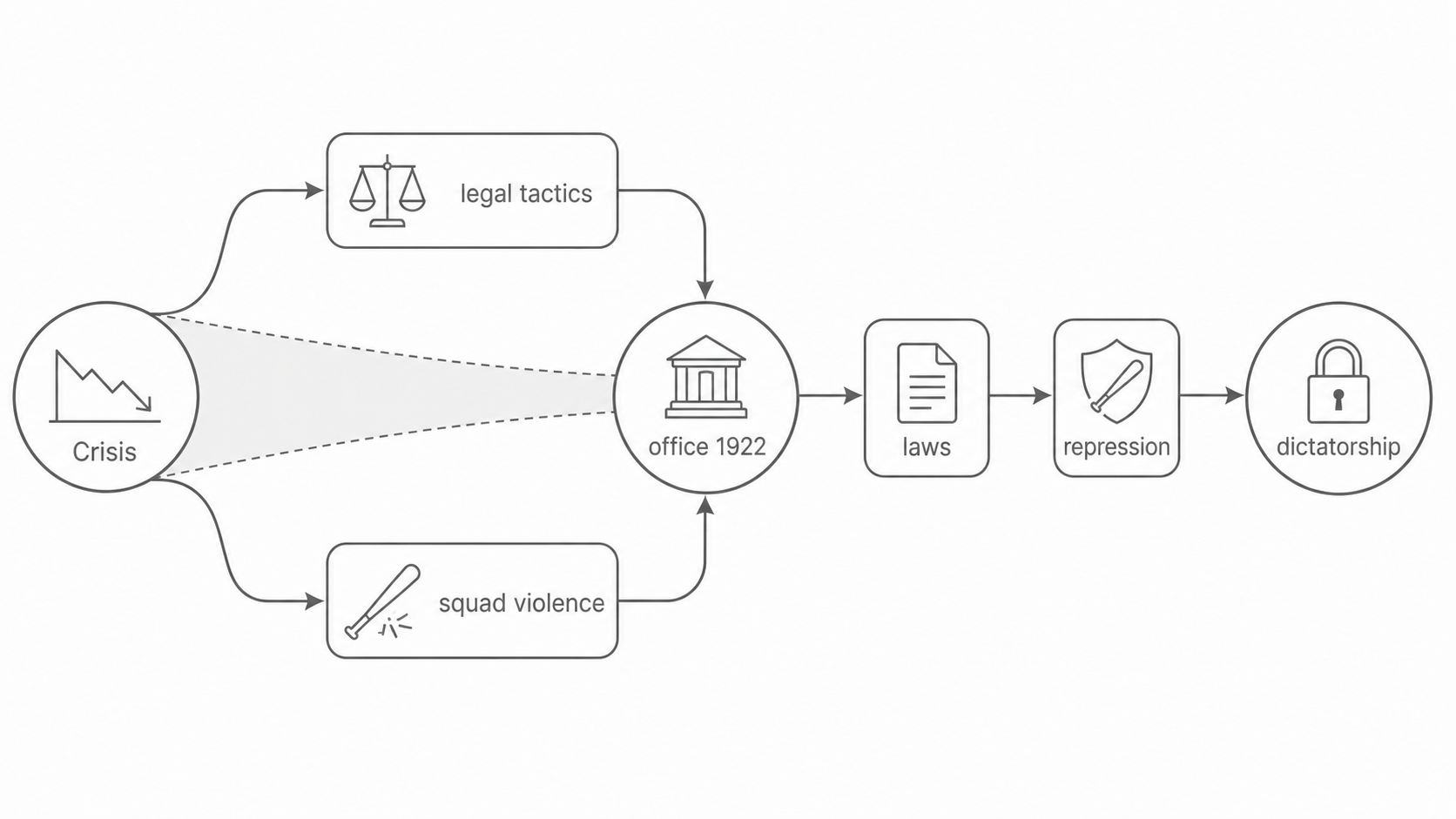
That is the lesson's central causal pattern: Mussolini's strength came from making different audiences see different things in fascism, while using each concession from the liberal state to narrow the space for opposition.
The legal side was aimed at elites. Mussolini spoke as a deputy, negotiated with liberal politicians, reassured the monarchy, toned down republicanism, accepted private property and signalled that fascism could defend the nation without abolishing every existing institution. He understood that the army, king, civil service, police, industrialists, landowners and conservative liberals would not hand power to a movement they believed they could not control.
The illegal side was the continued use of squads. Fascists smashed Socialist and trade-union organisation in one locality after another. They forced councils to resign, occupied town halls, beat opponents and created a climate in which anti-Fascist politics became dangerous. This violence mattered nationally because it changed political expectations. By 1922, many moderate politicians were not choosing between stable liberalism and fascism. They were choosing between different forms of breakdown: socialist unrest, fascist violence, weak coalition government or a deal with Mussolini.
The liberal governments of 1921-22 made the problem worse. Giolitti, Bonomi and Facta all struggled to create stable majorities. The old liberal world was divided; the PSI was split and isolated; the PPI was internally divided between anti-Fascist Catholics and those willing to cooperate with Mussolini; conservatives feared socialism more than fascism. State officials often failed to suppress squad violence decisively. That failure was not simply incompetence. In many places, local authorities preferred fascist anti-socialism to left-wing power.
The August 1922 general strike was a major opportunity for Mussolini. The strike was called by the Socialist-led labour movement as an anti-Fascist protest and a defence of legality. It backfired. Fascists helped keep services running, attacked strikers and presented themselves as defenders of order where the liberal state seemed weak. The strike's rapid collapse damaged the left and strengthened Mussolini's claim that fascism, not parliament, could restore national authority.
By autumn 1922 Mussolini was bargaining from strength, but he still needed the state to invite him in. Fascist squads could threaten Rome, but they were not strong enough to defeat the regular army in a determined fight. That is why the March on Rome was not a simple military conquest. It was a pressure tactic designed to force a political decision.
Continue this lesson.
You’re previewing NovaLearn without an account. Create a free account to read the rest.
Create free account