31 KT4 - The revolt of the northern earls, 1569-70
This lesson explains why the revolt of the northern earls posed a severe armed challenge to Elizabeth I. You will examine how Mary, Queen of Scots, connected succession anxiety, court faction, northern noble frustration and Catholic resistance, then trace the rebels' actions at Durham and Barnard Castle and the Crown's response. You will assess why those dangerous pressures never became a coordinated national coup and how the aftermath changed the political position of English Catholics.
The Enquiry Frame
This is a Paper 3 depth enquiry, so the lesson turns on close causation, chronology and
source judgement rather than broad change over the whole Tudor period. Keep three linked
questions in view.
| Question | Why it matters |
|---|---|
| Why did Mary, Queen of Scots, make 1569 more dangerous than earlier Elizabethan discontent? | She gave Catholic and conservative nobles a living dynastic alternative to Elizabeth. |
| Why did the northern earls rebel? | Their motives mixed religion, honour, office, local authority, fear of arrest and court politics. |
| Why did the revolt fail so quickly? | It had serious regional support but lacked timing, leadership, strategy, outside help and control of Mary. |
The chronology is short but dense.
| Date | Event | Significance |
|---|---|---|
| 13 May 1568 | Mary, Queen of Scots, was defeated at Langside in Scotland. | Mary's Scottish enemies kept power in Scotland; Mary needed help from outside. |
| 16 May 1568 | Mary crossed into England. | Elizabeth inherited a dynastic, diplomatic and religious problem. |
| 1568-69 | English and Scottish politicians discussed possible settlements for Mary, including a Norfolk marriage. | Mary's future became part of English court faction and succession politics. |
| October 1569 | Norfolk was arrested after his secret marriage dealings with Mary became known. | The highest-ranking English noble was removed from the crisis, leaving northern conspirators exposed. |
| 9-14 November 1569 | Northumberland and Westmorland refused to come south when summoned and gathered at Brancepeth. | Fear of arrest helped turn plotting into open action. |
| 14 November 1569 | The rebels occupied Durham and restored Catholic mass in the cathedral. | The rising made a public religious statement, not just a private noble conspiracy. |
| Mid-late November 1569 | Rebels moved through parts of Yorkshire, including Richmond, Ripon, Wetherby and Boroughbridge. | The threat looked serious because royal forces were initially short of reliable horsemen and local support. |
| Early December 1569 | Sir George Bowes was besieged at Barnard Castle; the castle surrendered after mutiny and desertion inside. | The capture gave the rebels a local success but cost time and exposed their lack of strategic direction. |
| Mid-December 1569 | Sussex, Hunsdon, Sadler, Warwick and Clinton coordinated royal forces. | The government gained the numbers and confidence to move from containment to pursuit. |
| 20-22 December 1569 | The rebel leaders fled towards the border and into Scotland; their followers dispersed. | The revolt collapsed before it could release Mary, seize York, or draw in foreign aid. |
| February 1570 | Leonard Dacre's related border rising was defeated near the River Gelt. | The northern crisis continued briefly, but it did not revive the earls' rebellion. |
| 1570-72 | Repression, attainders, executions and later Norfolk's execution followed. | Catholic resistance became more closely linked with treason in government thinking. |
The best judgement is not that the rising was either a hopeless local disturbance or a
near-successful revolution. It was a severe regional and confessional challenge that
Elizabeth's government took very seriously. Its danger lay in what it might have become:
a Catholic noble rising linked to Mary, Norfolk, Scotland, Spain or the papacy. Its actual
course showed the limits of that danger. The rebels could mobilise several thousand people,
but they could not control the capital, the queen, the succession, or the machinery of
government.
Mary, Norfolk and Court Politics
Mary, Queen of Scots, turned English discontent into a succession crisis. She was a
granddaughter of Margaret Tudor, Henry VIII's sister, and therefore had a strong dynastic
claim through the Tudor line. To many Protestants, Elizabeth was Henry VIII's lawful
daughter and God's chosen Protestant queen. To many Catholics, Elizabeth's legitimacy was
weaker because they rejected Henry VIII's annulment from Catherine of Aragon and his
marriage to Anne Boleyn. That made Mary more than a foreign refugee. She could be imagined
as the rightful Catholic queen.
Mary's arrival in England in May 1568 was therefore a political accident with enormous
consequences. She expected Elizabeth to help restore her to the Scottish throne after her
defeat at Langside. Elizabeth could not simply do that. Restoring Mary by force would
alienate Scotland's Protestant regency and might strengthen Catholic power. Releasing Mary
to France or Spain could create a foreign-backed claimant. Keeping Mary in England created
a permanent focus for Catholic hopes. Elizabeth chose custody, moving Mary between secure
houses such as Carlisle, Bolton and Tutbury, but custody did not remove Mary's symbolic
power.
The Duke of Norfolk made the problem worse. Thomas Howard, fourth Duke of Norfolk, was the
premier peer of England. He was not a straightforward Catholic rebel in 1569, but he had
family links with conservative and Catholic nobility, and his rank made him attractive to
those who wanted a respectable settlement. A marriage between Norfolk and Mary seemed to
some politicians to offer a solution: Mary might be restored in Scotland, the English
succession might be stabilised, and Catholic nobles might be reassured.
The scheme was also explosive. If Norfolk married Mary without Elizabeth's clear consent,
he would become husband to a rival claimant. If the marriage attracted northern Catholic
support, it could look like the beginning of a replacement monarchy. The problem was made
sharper by court politics. Some nobles disliked William Cecil's influence and could present
themselves as defenders of the queen against "evil counsellors". That language mattered:
rebels in Tudor England often claimed loyalty to the monarch while attacking advisers,
religious innovators or local officials.
Norfolk's role was therefore important but limited. He gave the crisis aristocratic glamour,
but he did not lead the northern revolt. When Elizabeth discovered enough of the marriage
scheme, Norfolk drew back, submitted, and was arrested in October 1569. This left the
northern earls in a terrible position. They had been linked to a high-political scheme, but
the great duke on whom some hopes rested was no longer free. When Elizabeth summoned
Northumberland and Westmorland to come south, they feared they would follow Norfolk into
custody. Their rebellion was partly a planned rising and partly a panic response to the
threat of arrest.
Mary herself was crucial even though she did not command the rebels. Her presence made the
rising potentially dynastic. The rebels might restore Catholic worship and claim to defend
Elizabeth from bad advisers, but outside observers could reasonably ask: if the rising
succeeded, what would happen to Mary? Would she be freed? Married to Norfolk? Named
successor? Placed on Elizabeth's throne? That uncertainty was exactly why Elizabeth's
government treated the danger as more than a local disturbance.
Before moving to the northern causes, use the diagram to separate the actors in this
dangerous chain. Look especially at how Mary supplied the dynastic focus, Norfolk linked
that focus to court politics, and the earls tried to turn uncertainty into regional
action.
[DIAGRAM: asset_name: Mary, Norfolk and northern pressure network; asset_slug: p3_31_04_queen_takes_queen_the_revolt_of_the_northern_earls_1569_70__diagram_01; recommended_method: image_gen; description: Monochrome schematic linking Mary, Norfolk, the northern earls, Durham, Barnard Castle and the royal response to show how dynastic, court, regional and religious pressures interacted]
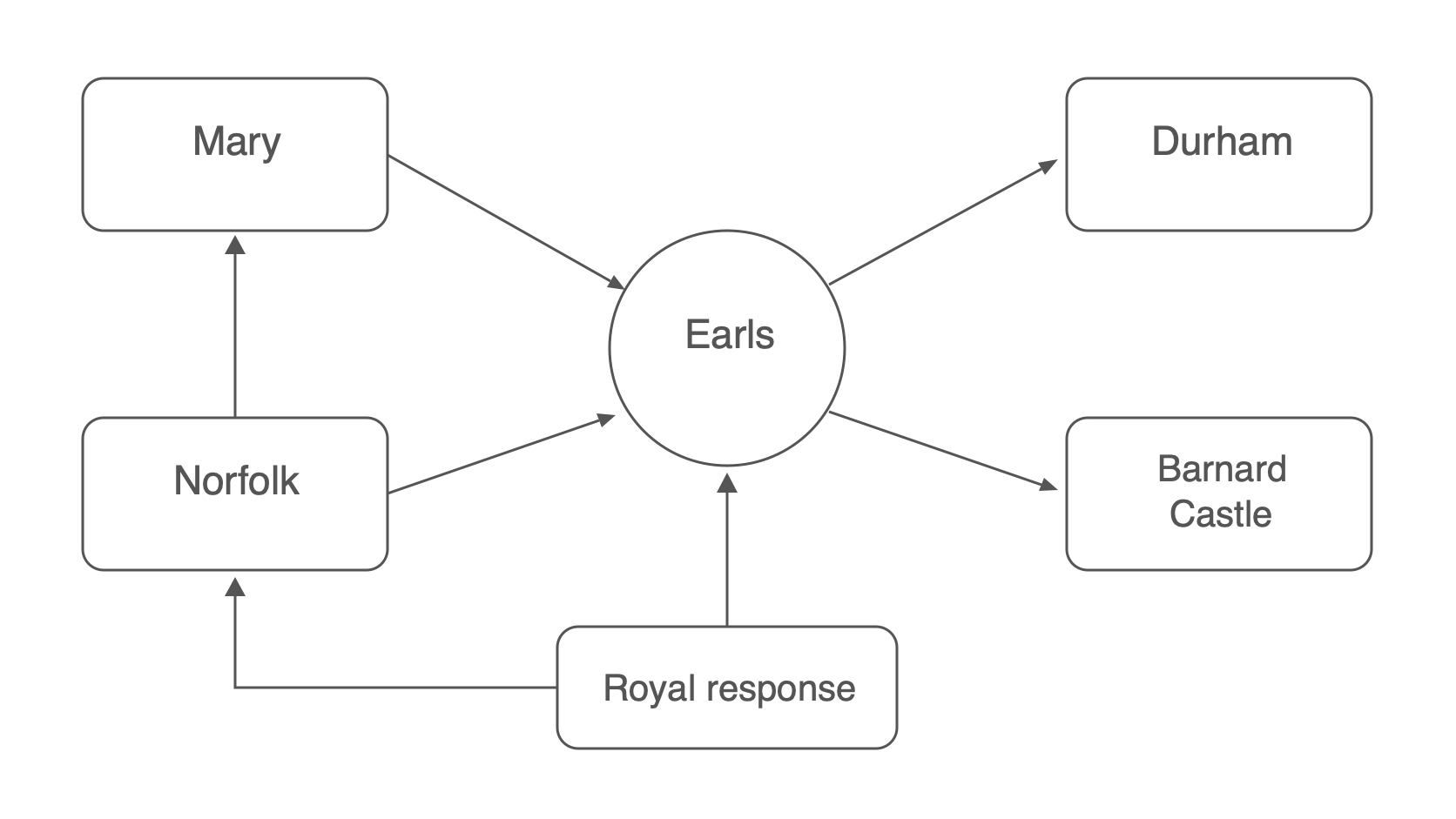
The arrows show connections and pressures, not operational command: Mary did not lead the rebels, and Norfolk was under arrest. The takeaway is that Mary's danger was relational. She did not need to lead an army to
make rebellion more serious; her claim made Norfolk's marriage scheme, northern Catholic
action and Elizabeth's security response part of the same crisis.
Northern Insecurity
The northern earls did not rebel only because Mary existed. Their local world was already
under strain. The north of England had long been governed through great noble families,
regional councils, border offices, household affinities and local religious traditions. By
1569, Elizabeth's regime had good reasons to distrust that world. The north was distant
from London, close to Scotland, socially conservative and religiously mixed. A Catholic
noble rising there could draw on regional identity as well as religion.
Thomas Percy, Earl of Northumberland, and Charles Neville, Earl of Westmorland, both came
from families with deep northern prestige. That prestige did not automatically give them
secure power under Elizabeth. Office, wardenship, local command and royal trust mattered.
When these shifted towards reliable Protestant servants, councillors and gentry, noble
status became less useful. This was an economic issue as well as an honour issue. Offices
and local authority helped sustain households, patronage, rents, legal influence and armed
following. If the earls lost access to those resources, their social standing and practical
power declined.
The Council of the North was part of this tension. It was meant to strengthen royal
government in a region that had produced the Pilgrimage of Grace in 1536. From Elizabeth's
viewpoint, this was sensible: the crown needed loyal officers to enforce law, religion and
security. From the perspective of some northern nobles, it could look like displacement.
Men who had once expected to dominate their localities now faced royal officials, Protestant
bishops, trusted gentry and councillors who did not depend on the earls.
Religious insecurity gave these grievances emotional force. Elizabeth's 1559 settlement
had restored royal supremacy and Protestant worship, but enforcement varied by region and
over time. In some northern communities, traditional Catholic belief and practice remained
strong. Noble households, parish habits, old images, local saints, Latin worship and
attachment to the mass did not disappear instantly because Parliament changed the law.
However, by the late 1560s Protestant enforcement was becoming more visible. In Durham,
Bishop James Pilkington represented a more determined Protestant reforming presence. For
conservative Catholics, this could feel like the old religion was being driven out after a
period of uneasy survival.
The rebels' religious actions show how central this was. At Durham on 14 November 1569
they restored Catholic mass in the cathedral and attacked Protestant prayer books and
worship. Across the region, supporters also damaged Protestant books and church furniture.
These actions were symbolic. They announced that the rising was not merely about offices
or Norfolk's marriage. It was about reversing religious change and defending what rebels
called the ancient faith.
Yet religion should not be separated too neatly from politics. Catholic worship, noble
honour, local liberties and obedience to the queen were all connected in rebel language.
The earls could argue that they were not attacking Elizabeth herself but rescuing the realm
from bad advisers, false religion and the threat of foreign intervention. That claim was
useful because open treason was dangerous. It also reveals the problem at the heart of the
rising. A rebellion that claimed loyalty to Elizabeth while destroying Protestant worship
and gathering around Mary's cause was bound to look deeply suspect.
The rank-and-file support also needs careful judgement. Older accounts sometimes treated
the rising as the last gasp of feudal loyalty, as if tenants simply followed their lords.
More recent scholarship gives greater weight to religious agency among ordinary rebels.
The earls' status mattered, but many followers were not passive. They chose to support a
cause that promised restoration of Catholic worship, protection of custom and resistance to
religious change. This makes the rising more serious, not less: it had a genuine Catholic
popular dimension, even if it still depended on noble leadership.
Durham and Barnard Castle
The revolt began with hesitation and fear. In early November 1569 Northumberland and
Westmorland were under pressure to come south and explain themselves. Instead they
gathered at Brancepeth Castle with armed servants, tenants and allies, including figures
such as Richard Norton and Thomas Markenfield. Northumberland seems to have been anxious
and reluctant at points; Westmorland was more firmly connected to the Howard and Catholic
noble world. Their wives, Anne Percy and Jane Howard, also mattered as political actors in
the noble networks behind the rising. The movement was therefore not simply two earls
giving orders. It was a cluster of northern Catholic and conservative families acting under
pressure.
Continue this lesson.
You’re previewing NovaLearn without an account. Create a free account to read the rest.
Create free account