2F.2 KT1 - The response to apartheid, c1948-59
Between c1948 and 1959, the National Party turned older segregation into a more
systematic apartheid state while African resistance revived and diversified. You will
examine why the National Party won, how its laws controlled classification, movement,
education and political activity, and how the ANC, rural protesters and the PAC
responded. The period shows how stronger coercive control could develop alongside
broader organised opposition.
Enquiry Frame
The specification covers four connected strands:
- life in South Africa around 1948: race, segregation, discrimination, urbanisation, industrialisation, township life, rural society, Afrikaner culture and politics, and the influence of Britain
- reasons for the National Party victory in 1948, including the impact of the Second World War, the growth of Afrikaner nationalism and international pressures for change
- codifying and implementing apartheid between 1948 and 1959: strengthening the National Party, apartheid laws, pass laws, education, the Tomlinson Report, Bantustans, political suppression and the Treason Trial
- African nationalism between 1948 and 1959: political opposition in 1948, the revival of the ANC, the Youth League, the Defiance Campaign, rural resistance, the Freedom Charter and the PAC
The enquiry question is: how did apartheid become more powerful between 1948 and 1959, and why did resistance revive rather than disappear?
The diagram below gives the simplest shape of that enquiry. The National Party victory opened one lane towards a more systematic apartheid state and another towards renewed resistance.
[DIAGRAM: asset_name: Apartheid state and resistance, c1948-59; asset_slug: p2_2f2_01_the_response_to_apartheid_c1948_59__diagram_01; recommended_method: image_gen; description: A clean 16:9 grey-on-white schematic showing the National Party victory splitting into two lanes, one towards apartheid state control and the other towards resistance and revival.]
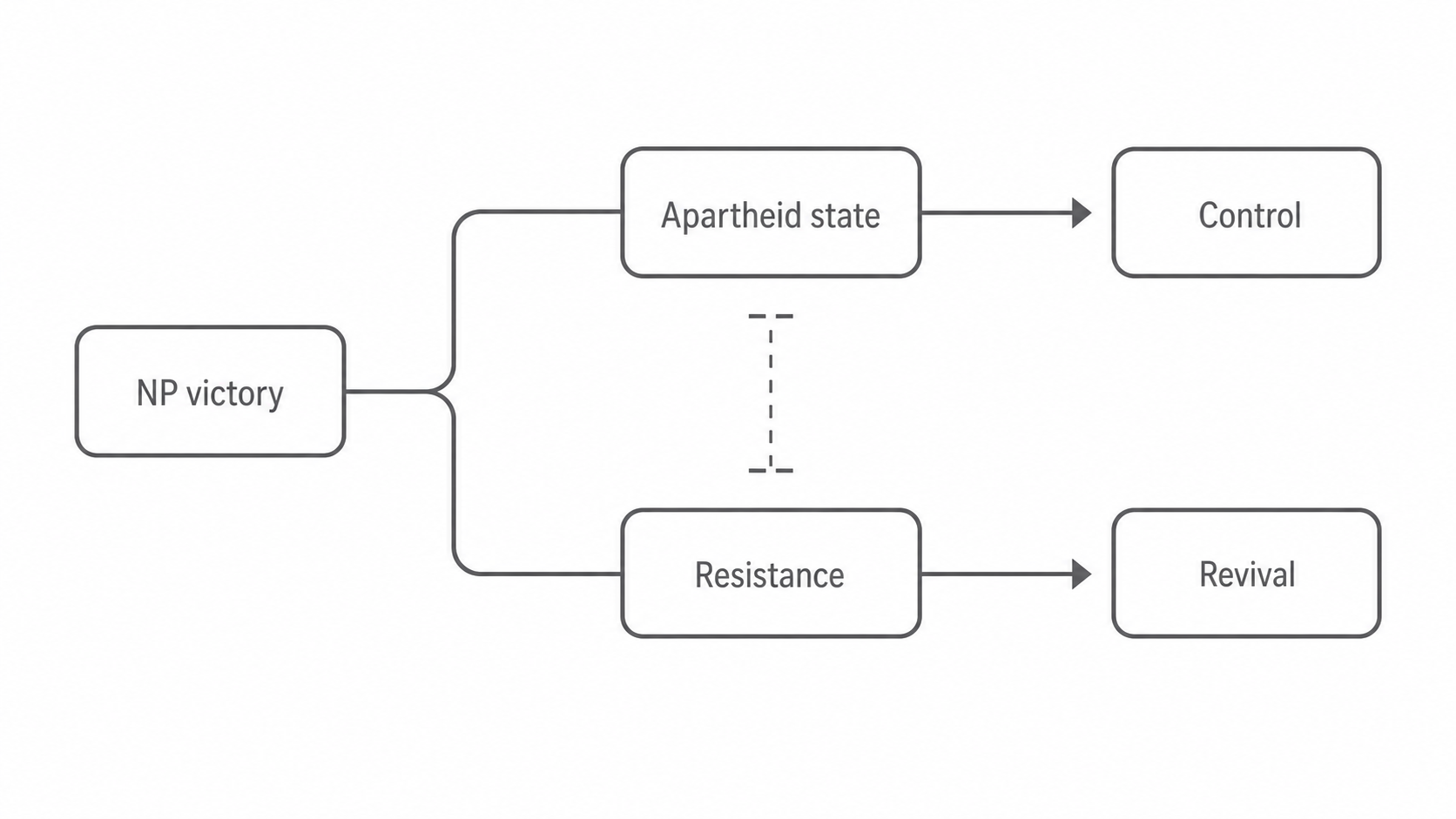
The important judgement is that these lanes developed together. The state became more coercive, but each extension of control created grievances, networks and arguments that helped resistance revive.
| Date | Event | Why it matters |
|---|---|---|
| 1910 | Union of South Africa created under white parliamentary control | Built a state in which most Africans had no national vote. |
| 1913 | Natives Land Act | Restricted African land ownership and helped create the reserve and migrant-labour system. |
| 1936 | Native Trust and Land Act and Representation of Natives Act | Expanded the reserve framework in theory, but removed Cape African voters from the common roll. |
| 1939-45 | Second World War | Accelerated manufacturing, African urbanisation, labour unrest and Afrikaner resentment over Smuts's pro-British war policy. |
| 1944 | ANC Youth League founded | Brought a more militant Africanist generation into ANC politics. |
| 1946 | African mineworkers' strike; India raised South African racial discrimination at the UN | Showed internal labour militancy and external scrutiny before the NP came to power. |
| 26 May 1948 | National Party and Afrikaner Party won the white general election | Gave Malan a parliamentary route to apartheid despite the United Party winning more votes. |
| 1949 | ANC Programme of Action adopted | Marked the ANC's shift towards boycotts, strikes, civil disobedience and non-cooperation. |
| 1950 | Population Registration, Group Areas and Suppression of Communism Acts | Created core mechanisms of racial classification, spatial segregation and repression. |
| 1951 | Bantu Authorities Act | Began turning reserves into ethnically defined authorities under state-approved chiefs. |
| 1952 | Reference-book pass law and Defiance Campaign | The state tightened movement control; the ANC and SAIC answered with mass civil disobedience. |
| 1953 | Public Safety, Criminal Law Amendment, Bantu Education and Separate Amenities Acts | Repression, schooling and everyday segregation became more systematic. |
| 1955 | Congress of the People adopted the Freedom Charter; Tomlinson Report published | Resistance offered a non-racial democratic vision; the state developed the logic of "separate development". |
| 1956 | Cape Coloured voters removed from the common roll; women's anti-pass march; Treason Trial arrests | The NP strengthened white electoral control while trying to criminalise opposition leadership. |
| 1958 | Hendrik Verwoerd became prime minister | The main architect of "separate development" took the premiership. |
| 1959 | Promotion of Bantu Self-Government Act; PAC founded | Bantustan policy was formalised and African nationalism split between Congress and Africanist strategies. |
For Paper 2, this topic can support AO1 depth essays and AO2 source questions. In AO1, avoid a simple list of apartheid laws. Build a judgement about how social change, white politics, state power and resistance interacted. In AO2, sources from this topic often have strong purposes: National Party speeches, ANC statements, police reports, court records and UN debates all reveal something valuable, but none is neutral.
South Africa in 1948
South Africa in 1948 was already a racially ordered society. The National Party did not create white supremacy; it inherited and intensified it. The Union of South Africa had been created in 1910 as a self-governing dominion inside the British Empire, but national political power belonged overwhelmingly to whites. Africans were the majority of the population, yet they had no normal national vote. Cape African voters had been removed from the common roll in 1936 and represented instead through white representatives. Cape Coloured voters still remained on the common roll until the 1950s, which is why the National Party later targeted them. Indians had no effective national parliamentary representation.
The 1946 census gives the scale of the imbalance. In the state's racial categories there were roughly 7.8 million Africans, 2.4 million whites, 0.9 million Coloured people and 0.3 million Indians or Asians. The political system therefore gave a white minority control over a Black majority and other non-white minorities. A strong exam answer should keep that imbalance visible: "South Africa" was not voting for apartheid in 1948; a limited and racially restricted electorate was.
Older segregation touched land, movement, work, education and social life. The 1913 Natives Land Act and the 1936 Native Trust and Land Act confined African land ownership to reserves that made up only a small proportion of the country, while most fertile and mineral-rich land was treated as white land. Pass controls restricted African movement. The 1923 Natives (Urban Areas) Act treated Africans in towns as temporary sojourners whose presence should depend on white labour needs. In industry, colour bars and job reservation protected many white workers from African competition. Segregation was therefore not only about prejudice; it was built into the distribution of land, wages, housing and legal rights.
The Second World War made this older system harder to hold together. Manufacturing expanded because imports were disrupted and war production increased. White men serving in the forces created a greater demand for African labour. The urban African population grew rapidly: from about 1.1 million in 1936 to about 2.5 million by 1950. More Africans came to cities not just as single male migrant workers but as families seeking permanent lives. This frightened many whites because the older language of temporary African labour no longer matched reality.
Township life showed both hardship and political energy. Around Johannesburg, places such as Orlando, Alexandra and Sophiatown contained overcrowding, inadequate sanitation, long journeys to work, police harassment and rent pressure. Shanty towns and squatter settlements expanded because legal housing did not keep pace with migration. Yet townships were not passive spaces. Churches, burial societies, trade unions, shebeens, music, local committees and bus boycotts created networks of community action. The state saw urban African settlement as a problem of control; many residents saw it as the making of a modern urban life.
Rural society was equally important. The reserves were overcrowded and often environmentally exhausted. Soil erosion, limited grazing, low incomes and tax pressure pushed people towards migrant labour on mines, farms and in cities. On white farms, African labour tenants and farm workers faced dependency and coercion. Many households survived only by combining rural land use with wages earned elsewhere. This means apartheid's later Bantustan policy was not a generous promise of African self-government. It was an attempt to make poor rural reserves carry the social cost of an economy that still needed African labour in white-owned areas.
Afrikaner culture and politics also shaped the situation. Afrikaners were not all identical, but many shared memories of British conquest, the South African War, concentration camps and cultural subordination to English-speaking power. Afrikaans language movements, Dutch Reformed churches, Afrikaner newspapers, the Broederbond and Afrikaner economic organisations helped create a sense of a threatened volk, or people. Many poorer Afrikaners had moved into towns and feared competition in jobs and housing. National Party politics offered them racial protection, cultural pride and a route to state power.
Britain's influence worked in two directions. On one hand, South Africa's Commonwealth connection, Westminster-style parliament, English-speaking business elite and Jan Smuts's international prestige kept the country tied to British imperial and diplomatic networks. On the other hand, that connection helped the National Party mobilise anti-British Afrikaner feeling. Smuts had taken South Africa into the Second World War on Britain's side in 1939 after a bitter parliamentary split. By 1948, Malan could present the United Party as too British, too liberal and too weak to defend white South Africa from internal and international pressure.
The key point is that life in South Africa around 1948 was already unstable. Industrialisation was pulling Africans into cities. Rural poverty was pushing them out of reserves. International language after 1945 increasingly condemned racial discrimination. Afrikaner nationalism was becoming better organised. Apartheid was the National Party's hard answer to these pressures.
Why the National Party Won
The National Party victory of 1948 must be explained carefully. It was not a majority vote by South Africans as a whole, and not even a simple popular-vote victory within the white electorate. In the House of Assembly election on 26 May 1948, the Herenigde Nasionale Party under D. F. Malan won 70 seats and its ally, the Afrikaner Party, won 9. The United Party won 65 seats and Labour 6. Yet the United Party won more votes than the National Party alliance. The result was possible because rural constituencies, where the National Party was strongest, had fewer voters than urban constituencies.
That electoral structure mattered, but it did not act alone. The National Party also ran a sharper and more emotionally powerful campaign. It presented apartheid as a way to protect white civilisation, defend Afrikaner identity and prevent racial integration. The United Party under Smuts seemed tired, urban, elite and uncertain. Its leaders still supported white rule, but they appeared less able to offer a clear answer to African urbanisation.
The Second World War was one major cause. In 1939 Smuts had replaced J. B. M. Hertzog as prime minister after Parliament chose to support Britain and the Allies. Many Afrikaner nationalists regarded this as a betrayal of South African independence and an insult to Afrikaner memories of British rule. Some Afrikaners opposed the war openly, and the issue helped reunite anti-Smuts Afrikaner politics. By 1948, the war itself was over, but the resentment and political organisation it had produced remained.
The war also created domestic grievances that the National Party exploited. Wartime and post-war South Africa experienced inflation, housing shortages, food complaints and anxiety about immigration. White voters heard claims that British immigrants were taking jobs and homes, and that Smuts's government cared more about international statesmanship than ordinary white South Africans. These complaints were not separate from race. Housing shortages and African urbanisation could be turned into a single warning that the United Party was losing control.
Afrikaner nationalism gave the National Party a disciplined base. Cultural institutions, newspapers, churches and secret or semi-secret networks such as the Broederbond helped to coordinate Afrikaner politics. The National Party brought together different interests: rural farmers wanting labour control, poorer whites wanting job protection, Afrikaner professionals wanting state opportunities, and cultural nationalists wanting recognition of Afrikaans identity and a future republic. Malan tactically softened the republican issue in 1948 so as not to frighten moderate whites or break the alliance with the Afrikaner Party. The immediate campaign was apartheid, not an instant republic.
The race-policy debate was sharpened by two commissions. The United Party was associated with the Fagan Commission, appointed in 1946, which accepted that many Africans were becoming permanent urban workers and suggested a more realistic, though still discriminatory, system of controlled urbanisation. The National Party answered through the Sauer Commission, which argued for stricter separation, tighter influx control and the defence of white supremacy through apartheid. In simple campaign terms, Fagan could be attacked as the first step towards integration; Sauer could be sold as the promise that whites would remain in command.
International pressure also influenced the result, but not by making white voters more liberal. Before the May 1948 election, the United Nations, post-war human-rights debates and Indian independence in 1947 had made racial hierarchy harder to defend internationally. The Universal Declaration of Human Rights was adopted only in December 1948, so it was part of the later international challenge to apartheid, not a cause of the election result. India had already raised the treatment of Indians in South Africa at the UN in 1946. For National Party supporters, this was not a reason to change. It was a reason to insist that outside critics had no right to dictate South Africa's racial policy. The early Cold War also helped the NP because Western governments were often more concerned with anti-communism, minerals and strategy than with forcing racial reform.
The best judgement is that the National Party won because it connected social anxiety to a clear racial programme. The electoral system converted a minority of votes into a parliamentary majority. Afrikaner nationalism supplied organisation and identity. The war supplied grievances. African urbanisation supplied fear. International criticism supplied a language of white defensiveness. Apartheid was therefore not only a policy; it was an election answer to a crisis in white rule.
Codifying Apartheid, 1948-59
Once in office, the National Party strengthened itself before and while it built apartheid. Malan was prime minister from 1948 to 1954. The Herenigde Nasionale Party and the Afrikaner Party fused in 1951 as the National Party, reducing the danger of division among Afrikaner conservatives. The NP increased its parliamentary majority in the 1953 election. J. G. Strijdom, prime minister from 1954 to 1958, pushed harder against remaining non-white voting rights and Commonwealth ties. Hendrik Verwoerd, Minister of Native Affairs from 1950 and prime minister from 1958, became the main architect of "separate development".
Strengthening the party also meant strengthening white political control. The Separate Representation of Voters Act of 1951 aimed to remove Cape Coloured voters from the common roll and place them on a separate roll electing white representatives. Court challenges delayed the policy because the constitution required special procedures for altering entrenched voting rights. The government responded by manipulating parliamentary machinery, including enlarging the Senate, until it could revalidate the change in 1956. This episode matters because it shows the NP was willing to bend constitutional practice to secure racial power.
Apartheid law worked as a system. One group of laws classified people. The Prohibition of Mixed Marriages Act of 1949 and the Immorality Amendment Act of 1950 policed intimacy across racial lines. The Population Registration Act of 1950 classified every South African into racial categories. Classification was not just a label. It determined where a person could live, which school they could attend, whom they could marry, what political rights they had and how police treated them.
A second group of laws controlled space and movement. The Group Areas Act of 1950 allowed the state to declare areas for particular racial groups and remove those who did not fit the designation. The Prevention of Illegal Squatting Act of 1951 gave the state stronger powers to destroy informal settlements. The Natives Laws Amendment Act of 1952 narrowed the right of Africans to remain legally in towns. Section 10 allowed residence beyond 72 hours only for specified categories: people born and permanently resident in the area; those with ten years of continuous work there for one employer or fifteen years of lawful continuous residence, subject to further restrictions; certain wives and children living with a qualifying person; or those granted official permission. This turned urban residence into a conditional privilege rather than a right.
Continue this lesson.
You’re previewing NovaLearn without an account. Create a free account to read the rest.
Create free account