2H.2 KT2 - Protest and reaction, 1963-72
This lesson explains why protest and reaction both reshaped the USA between 1963 and
1972. Federal liberal reform reached a high point in the mid-1960s, but legal victories
did not remove everyday conflicts over race, poverty, war, gender, sexuality and
authority. As protest widened, many Americans associated it with disorder, moral
breakdown or an intrusive federal state, helping reaction grow after 1968. Comparing
reform, unresolved inequality and backlash will help you judge how freedom and political
power changed by 1972.
The Enquiry Frame
This topic is about a hinge in modern American history. It starts after the
optimism of the March on Washington and Kennedy's New Frontier, and it ends with
Nixon's 1972 landslide. In between came the Civil Rights Act, the Voting Rights
Act, the Great Society, Black Power, the Black Panthers, farm-worker organising,
student protest, the counter-culture, second-wave feminism, sexual liberalisation,
the origins of modern gay rights, Vietnam, Kent State and the "silent majority".
Use the period as a single argument:
| Phase | Main pattern | Why it matters |
|---|---|---|
| 1963-65 | Federal liberalism looked powerful. Johnson used Kennedy's civil rights legacy, his own congressional skill and the 1964 Democratic landslide to pass major civil rights, welfare, health and education measures. | This is the clearest evidence that protest could force government action. |
| 1965-68 | Protest widened and radicalised. Selma produced voting rights, but Watts, Chicago, Black Power, the Panthers and King's anti-poverty turn showed that formal law had not solved urban, economic or policing issues. | This is where the topic moves from civil rights victory to arguments about power, poverty and personal freedom. |
| 1968-72 | Reaction became electorally powerful. Assassinations, urban unrest, anti-war protest, campus conflict and counter-cultural visibility helped Nixon appeal to order, patriotism and "Middle America". | This is the political consequence: liberal reform survived, but it no longer controlled the national mood. |
The simplest way to hold the topic together is as a chain that bends back on itself.
Protest helped force reform, but unresolved problems widened protest and made reaction
more politically useful to Nixon.
[DIAGRAM: asset_name: Protest reform and reaction chain; asset_slug: p2_2h2_02_protest_and_reaction_1963_72__diagram_01; recommended_method: image_gen; description: 16:9 white-background schematic showing Protest leading to Reform, then to Unresolved issues, splitting into Radicalisation and Reaction, with Reaction feeding Nixon and looping back to Protest to show polarisation]
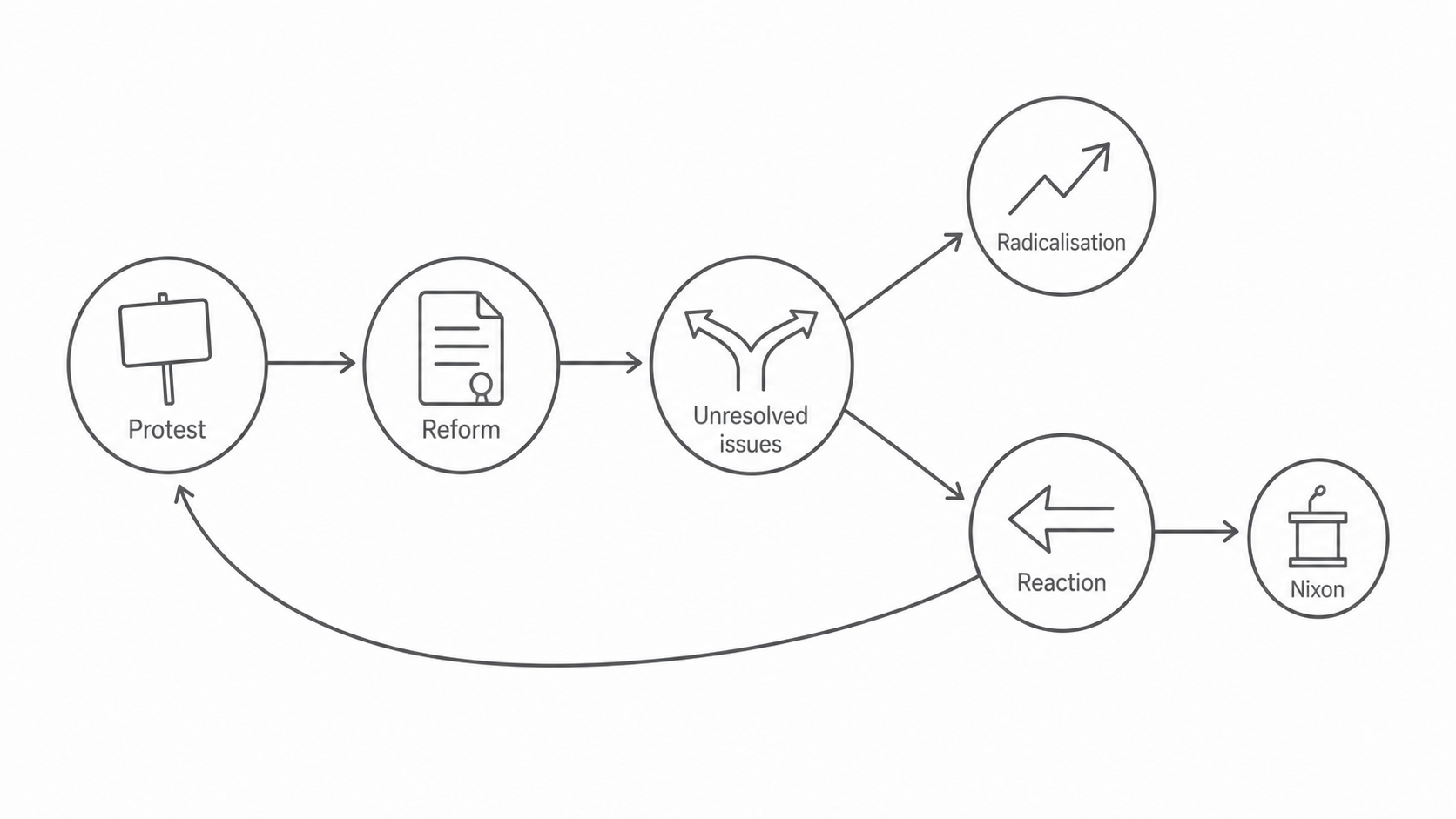
Use the diagram as an argument frame, not as a complete timeline. The strongest answers
explain why achievement and backlash grew from the same mid-1960s pressures.
Four questions hold the lesson together:
- How far did civil rights change after 1963? The answer must include King's
Selma and Chicago campaigns, Malcolm X, Black Power, the Black Panthers,
King's assassination and Cesar Chavez. - Why did protest expand into personal freedom? Student protest,
counter-cultural lifestyles, feminism, sexual liberalisation and gay rights all
challenged older ideas of authority, family, gender and citizenship. - How successful was Johnson's Great Society? It made the federal government
a much more active force against poverty, ill health, poor education and racial
discrimination, but it also generated administrative problems and political
backlash. - Why did reaction grow by 1972? The answer must connect the silent majority,
media coverage, Vietnam, Kent State and Nixon's attack on Great Society
liberalism.
For an essay, avoid two weak stories. Do not write as if America moved smoothly
from prejudice to liberation. Do not write as if the 1960s were only chaos. A
better line is: the mid-1960s enlarged American freedom through federal law and
mass mobilisation, but the very breadth of that challenge exposed limits in
liberal reform and made conservative reaction more politically effective.
Black Civil Rights After 1963
By 1963, the civil rights movement had already won national attention through
Birmingham and the March on Washington. The problem after 1963 was different:
could national moral pressure become enforceable law, and could legal equality
solve problems that were not simply written into Jim Crow statutes?
King's changing priorities show the shift clearly. In Selma, Alabama, in
1965, King and the Southern Christian Leadership Conference joined local Black
activists, the Dallas County Voters League and SNCC in a voting-rights campaign.
Selma mattered because the injustice was precise: despite repeated registration
attempts, only a tiny proportion of local Black adults were on the voting rolls.
The violence on Bloody Sunday, 7 March 1965, when state troopers attacked
marchers at the Edmund Pettus Bridge, turned local disfranchisement into a
national crisis. Television coverage made the brutality visible. Johnson then
identified his administration with voting rights, and the Voting Rights Act of
6 August 1965 suspended literacy tests in covered areas, allowed federal
examiners and required federal preclearance of voting changes in places with a
record of discrimination.
Selma was one of King's greatest achievements because it joined local courage,
nonviolent discipline, media pressure and presidential action. It also showed the
limits of earlier civil rights law. The Civil Rights Act of 1964 had attacked
segregation in public accommodations, education and employment, but without the
vote many Black southerners still lacked the political power to protect those
rights locally.
After Selma, King turned more openly towards the North, poverty and economic
justice. The Chicago Freedom Movement of 1966 campaigned against slum
housing, de facto segregation, unequal employment and discriminatory real-estate
practices. This was much harder than challenging a segregated bus station or a
literacy test. Northern inequality often operated through landlords, banks,
school districts, neighbourhood resistance and city politics. When King marched
in white Chicago neighbourhoods, he met fierce hostility. The campaign produced a
summit agreement on fair housing, but enforcement was weak.
The significance of Chicago is that it exposed the boundary of the southern
strategy. Nonviolent protest could dramatise injustice, but northern segregation
was less obviously illegal, more economically embedded and less easily solved by
one federal statute. King's later support for the Poor People's Campaign and
for striking sanitation workers in Memphis in 1968 extended this logic: civil
rights had to include wages, housing, dignity and economic power.
King's assassination on 4 April 1968 had several effects. It produced grief
and anger across the country, with unrest in many cities. It helped push Congress
to pass the Civil Rights Act of 1968, including fair housing provisions. It
also removed the most famous advocate of interracial, Christian, nonviolent
reform at exactly the moment when the movement was divided over methods, Vietnam,
poverty and Black Power. King became a martyr, but martyrdom did not provide a
strategy for the problems he had begun to confront.
Malcolm X helps explain why many Black activists were dissatisfied before and
after King's death. Malcolm X, assassinated in February 1965, had been a
prominent voice of Black nationalism, race pride and self-defence. His
significance lies less in a legislative programme than in his language of dignity
and anger. He rejected the idea that Black Americans should have to prove their
humanity through patient suffering, and he criticised white liberalism as too
slow and too patronising. After leaving the Nation of Islam in 1964, his outlook
became more international and more open to alliances, but his influence after
death was especially strong among young Black activists who felt that integration
had not produced power.
Black Power made that frustration public. During the Meredith March Against
Fear in Mississippi in June 1966, Stokely Carmichael of SNCC popularised the
slogan. Black Power could mean different things: racial pride, community control,
economic power, independent political organisation, self-defence, rejection of
white paternalism, or separatism. That ambiguity explains why it was powerful and
controversial. For supporters, it named the missing ingredient in civil rights:
the ability of Black communities to control their own lives. For critics,
including King, it risked suggesting violence or racial separation and could
frighten white allies.
The Black Panther Party, founded in Oakland in October 1966 by Huey P.
Newton and Bobby Seale, gave Black Power a distinctive urban form. The Panthers
began with armed patrols monitoring police behaviour, but they were not only an
armed image. Their Ten-Point Program demanded employment, housing, education,
exemption of Black men from military service, an end to police brutality and
freedom for Black prisoners. Their community "survival" programmes included free
breakfasts, health clinics and other local services.
The Panthers mattered because they linked civil rights to police power, poverty,
urban neglect and capitalism. Their black berets and guns attracted media
attention, but that attention often narrowed the public image of the party to
militancy alone. Police confrontation, internal conflict and FBI COINTELPRO
surveillance weakened the Panthers, while their community programmes showed how
far some activists had moved beyond the older goal of formal integration.
The best judgement is that Black civil rights became broader and more divided
between 1963 and 1968. King achieved huge legal gains through nonviolent
campaigning, especially at Selma, but his Chicago and anti-poverty work showed
that law had not solved economic or residential inequality. Malcolm X, Black
Power and the Panthers exposed that frustration and gave it new language. They
did not replace King, but they changed what "civil rights" meant.
Cesar Chavez and Farm-Worker Rights
Cesar Chavez belongs in this topic because civil rights in the 1960s was not only a
Black-white southern question. It was also about labour, ethnicity, language,
migration and dignity. Chavez's work among farm workers showed how protest
tactics associated with Black civil rights could be adapted to Mexican American,
Filipino American and migrant labour struggles.
Farm workers faced a harsh combination of low wages, seasonal insecurity, poor
housing, exposure to pesticides, weak political power and limited legal
protection. Agricultural workers had been excluded from the National Labor
Relations Act, so collective bargaining rights were weaker than in many
industrial workplaces. That made the struggle about both civil rights and labour
rights: farm workers wanted to be treated as full citizens and as workers with
the power to bargain.
Chavez, with Dolores Huerta and others, founded the National Farm Workers
Association in 1962. The most important confrontation began in Delano,
California, in September 1965, when Filipino workers in the Agricultural
Workers Organizing Committee, led by Larry Itliong and others, struck grape
growers for better pay and conditions. Chavez and the mostly Mexican American
NFWA joined the strike rather than undercut it. In 1966 the organisations merged
into what became the United Farm Workers.
Chavez's methods were deliberately moral and public. The UFW used:
| Method | Example | Significance |
|---|---|---|
| Strike action | Delano grape strike, 1965-70 | Challenged growers directly, despite the vulnerability of seasonal workers |
| Marches | Delano to Sacramento pilgrimage, 1966 | Borrowed religious symbolism and civil rights tactics to gain state-wide attention |
| Consumer boycott | National and international grape boycott | Turned shoppers, churches, students and unions into pressure points on agribusiness |
| Fasting and nonviolence | Chavez's 25-day fast in 1968 | Presented the movement as disciplined, sacrificial and morally serious |
| Community services | Forty Acres service centre, clinic, co-op and retirement support | Showed that the movement was building a community, not only bargaining over wages |
The grape boycott was especially important because farm workers themselves had
little economic power against large growers. A boycott shifted the battlefield to
cities, campuses, churches and supermarkets. It also made middle-class consumers
ask whether their comfort depended on hidden exploitation.
The achievements were real. In 1970, major table-grape growers signed
contracts with the UFW, improving wages, conditions and union recognition for
tens of thousands of workers. The campaign also made Latino and Filipino
farm-worker struggles nationally visible and showed that civil rights could be
about economic justice as well as legal equality.
The limits were equally important. UFW success was hard to sustain because
growers resisted, farm labour was seasonal and mobile, and legal protections were
weak. Not all farm workers joined the union, and not all Latino activism followed
Chavez's religious, nonviolent style. The later California Agricultural Labor
Relations Act of 1975 lies outside this topic, but it shows why the 1965-70
campaign was not enough by itself: moral protest still needed legal structures to
protect bargaining power.
For exam judgement, Chavez is useful because he broadens the meaning of protest
and reaction. His campaign was less threatening to some white Americans than the
Black Panthers, because it stressed nonviolence, Catholic symbolism and consumer
morality. Yet it still challenged powerful employers and exposed the limits of
American affluence. It showed that the 1960s rights agenda was spreading into
work, food production and ethnic minority politics.
Johnson's Great Society
Great Society
Lyndon Johnson's programme of federal domestic reform - the most ambitious since the New Deal - against poverty, racial injustice, poor education, ill health and urban decay.
The Great Society rested on three conditions: Kennedy's assassination had
created pressure to complete unfinished liberal measures; Johnson had unusually
strong congressional skill; and the 1964 election gave Democrats large
majorities in Congress. Johnson used that moment to argue that government should
fight poverty, racial injustice, poor education, ill health and urban decay.
The Great Society was not one programme. It was a cluster of laws and agencies.
For this topic, the main strands are poverty and unemployment, housing and
education, Medicare and Medicaid, civil rights laws, and Johnson's overall
achievements.
| Problem | Major measures | What they tried to do |
|---|---|---|
| Poverty and unemployment | Economic Opportunity Act, 1964; Office of Economic Opportunity; Job Corps; VISTA; Community Action; Head Start | Attack poverty through job training, early education, local participation and social services |
| Education | Elementary and Secondary Education Act, 1965; Higher Education Act, 1965 | Send federal money into poorer school districts and expand college opportunity |
| Health care | Social Security Amendments, 1965 | Create Medicare for older Americans and Medicaid for people with limited income |
| Housing and cities | Housing and Urban Development Act, 1965; Department of Housing and Urban Development, 1965; Model Cities, 1966; Fair Housing, 1968 | Expand federal responsibility for urban redevelopment, public housing, rent support and discrimination in housing |
| Civil rights | Civil Rights Act, 1964; Voting Rights Act, 1965; Civil Rights Act/Fair Housing Act, 1968 | Dismantle formal segregation, protect voting rights and challenge discrimination in housing |
The War on Poverty tried to do more than hand out relief. It aimed to change
the conditions that produced poverty: poor schooling, weak skills, lack of legal
help, ill health and exclusion from decision-making. Head Start gave young
children early educational support. Job Corps provided training. VISTA sent
volunteers into poor communities. Community Action Programmes were meant to give
poor residents a voice in programmes that affected them.
That last aim was both radical and problematic. "Maximum feasible participation"
could empower local residents, but it also threatened city officials and existing
Democratic machines. Conservatives attacked anti-poverty agencies as wasteful or
politically radical. Some liberals argued that the funding was too small to meet
the scale of poverty. The strongest evaluation is therefore mixed: the War on
Poverty built lasting programmes and coincided with a sharp fall in poverty in
the later 1960s, but it did not remove the structural causes of inequality.
Education was one of Johnson's more durable successes. The Elementary and
Secondary Education Act of 1965 sent federal aid to schools, especially through
Title I funding for poorer districts. This mattered because education had
traditionally been a state and local responsibility. Johnson made federal aid to
education part of citizenship and opportunity. The Higher Education Act of
1965 widened access through grants, loans and support for colleges.
Health care was the clearest long-term achievement. The Social Security Amendments of
1965, signed on 30 July 1965, created Medicare for the elderly and Medicaid
for people with limited income. These programmes survived political backlash
because they met obvious needs and created large constituencies. They also show
the scale of Johnson's federal liberalism: the national government now accepted
responsibility for health security in a way earlier presidents had failed to
achieve.
Housing was more difficult. The Department of Housing and Urban Development was
created in 1965, and Robert Weaver became the first Black cabinet member when he
led it. Housing laws provided rent supplements, urban redevelopment support and
public housing measures. The Fair Housing Act of 1968 banned discrimination
in sale, rental and financing. Yet housing reform was weaker than health reform.
Residential segregation involved private sellers, landlords, banks, suburbs,
local zoning and white resistance. Urban renewal could also destroy communities
as well as improve housing. That is why the Great Society made the federal
government more active in housing without solving the urban crisis.
Continue this lesson.
You’re previewing NovaLearn without an account. Create a free account to read the rest.
Create free account