2H.2 KT3 - Social and political change, 1973-80
This lesson explores social and political change in the USA from 1973 to 1980. The
central argument is that the later 1970s did
not simply continue the protest politics of the 1960s. Americans still argued
over rights, culture and federal power, but those arguments now took place in a
more anxious setting: Watergate, inflation, energy shortages, foreign
competition and the Iranian hostage crisis made many voters doubt whether
government could either behave honestly or solve practical problems.
The Enquiry Frame
The specification has four strands. They are separate enough to revise clearly,
but in history they overlapped. Economic trouble weakened presidents. Popular
culture made political distrust visible. Rights campaigns won legal gains while
also provoking backlash. Environmentalism joined moral reform to everyday
questions about petrol, jobs, health and regulation.
| Strand | What you must be able to explain | Judgement problem |
|---|---|---|
| Political leadership | Watergate; Ford and Carter's leadership styles; disillusion; the Iranian hostage crisis; environmentalism | Was the crisis mainly about weak presidents, or about a wider loss of confidence in institutions? |
| Economic change and society | Inflation and family incomes; homelessness; oil crises; foreign competition; government responses | Did economic change damage ordinary Americans more through prices, jobs or expectations? |
| Popular culture | Commercial sport; fragmented music; film and TV's mix of social tension and escapism; news media | Did culture challenge the mood of crisis, reflect it, or help people escape from it? |
| Rights | Roe v. Wade; women's, workers', gay and Native American rights; Red Power; the status of Black Americans | Was 1973-80 a period of progress, stalemate or backlash in civil rights? |
These strands are easiest to connect if you see them as pressures converging on public
confidence. Watergate, inflation, energy problems and rights disputes were different
issues, but together they made government look less honest, less effective or more
controversial.
[DIAGRAM: asset_name: 1970s pressures and disillusion map; asset_slug: p2_2h2_03_social_and_political_change_1973_80__diagram_01; recommended_method: image_gen; description: 16:9 white-background schematic with Watergate, Inflation, Energy and Rights nodes converging on Disillusion, surrounded by a Media culture ring to show how culture reflected and amplified the mood]
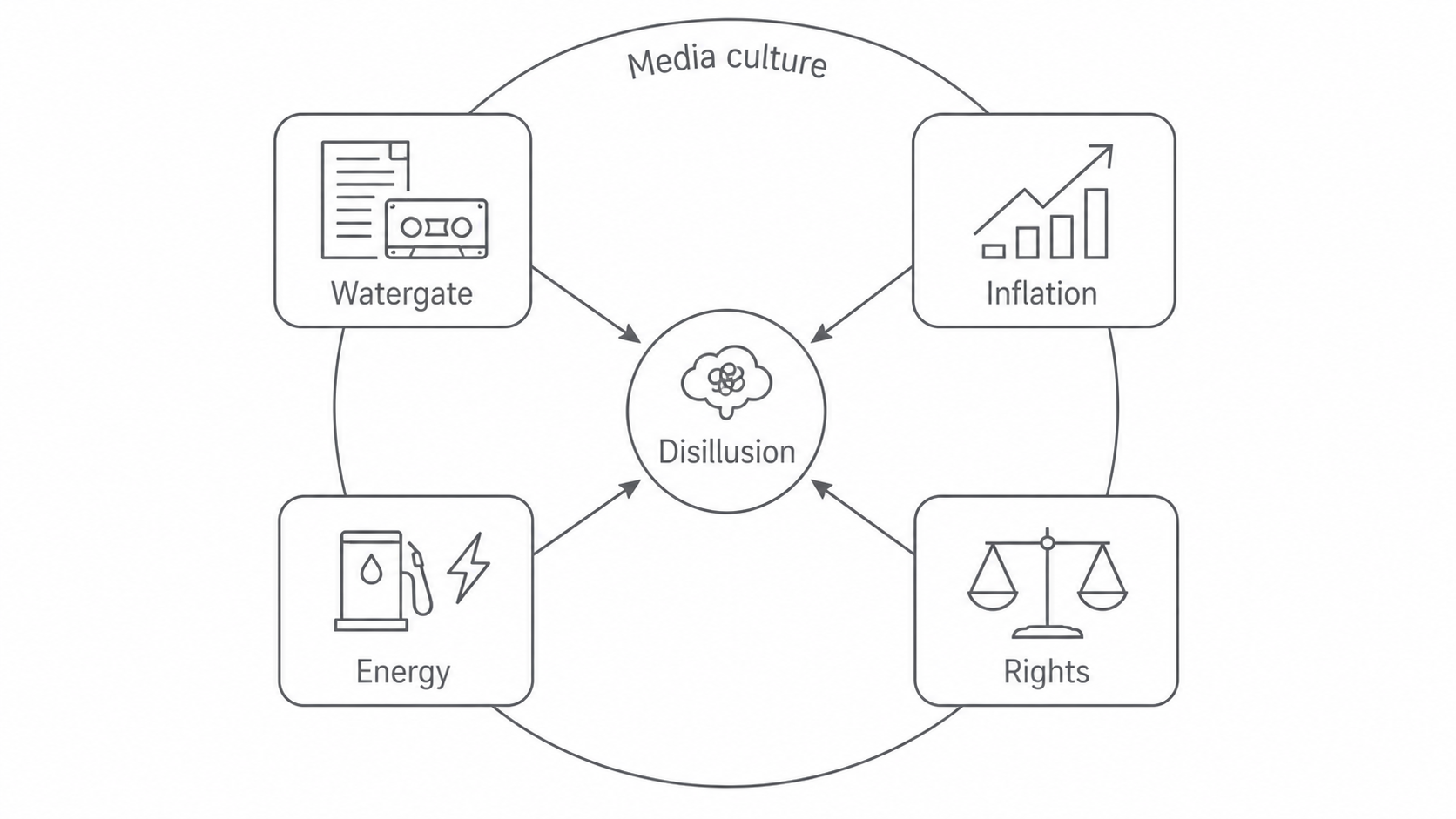
That is why 1973-80 should not be treated as just a quieter continuation of the 1960s.
Rights campaigns still made gains, but they did so inside a more anxious political and
economic climate.
Use these dates as anchors:
| Date | Event | Why it matters |
|---|---|---|
| January 1973 | Roe v. Wade decided by the Supreme Court | Abortion became a constitutional rights issue and a major source of political mobilisation. |
| October 1973 | Arab oil embargo began after the Yom Kippur War | Energy ceased to look cheap, secure and separate from foreign policy. |
| August-September 1974 | Nixon resigned; Ford pardoned him | Watergate ended one presidency but left distrust of the presidency itself. |
| 1975 | Recession, high unemployment and inflation; Wounded Knee trials and continuing Native activism; baseball free agency breakthrough | Economic strain, rights conflict and commercial sport all showed older post-war assumptions weakening. |
| 1976 | Carter elected as an outsider promising honest government | The election showed public desire for moral renewal after Watergate. |
| 1977 | Department of Energy created; National Women's Conference held in Houston; Harvey Milk elected in San Francisco | Carter's reform language met energy crisis, women's rights activism and new gay political visibility. |
| 1978 | Bakke decision; Briggs Initiative defeated; Pregnancy Discrimination Act; Love Canal emergency | Rights and environmental politics became more legally complex and more polarising. |
| July-November 1979 | Carter's "crisis of confidence" speech; Iranian hostage crisis began | Economic anxiety and foreign-policy humiliation fused into political disillusion. |
| 1980 | Failed hostage rescue; Superfund law; Reagan defeated Carter | The decade closed with an argument that liberal government had lost authority. |
For exam answers, avoid two weak stories. One weak story says the USA simply
"became conservative" after 1973. Another says the 1970s were only a decade of
failure. A stronger argument is that the period brought real extension of
rights and regulatory power, but in conditions that made federal action look
costly, intrusive or ineffective to many Americans.
Leadership and Disillusion
Watergate was the central political trauma of the mid-1970s. The original
break-in at Democratic National Committee headquarters in June 1972 became a
larger investigation into abuse of presidential power: illegal surveillance,
campaign sabotage, hush money, the misuse of federal agencies and the cover-up.
The televised Senate Watergate hearings in 1973, the Supreme Court's order that
Nixon release tapes in United States v. Nixon in July 1974, and the "smoking
gun" tape exposed a president using the powers of office to obstruct justice.
Richard Nixon resigned on 9 August 1974 rather than face near-certain
impeachment.
The impact went beyond Nixon himself. Watergate strengthened the idea that the
"imperial presidency" had become dangerous after years of Cold War secrecy,
Vietnam and executive centralisation. Congress became more assertive. The War
Powers Act of 1973, the Budget and Impoundment Control Act of 1974, campaign
finance reforms and later ethics legislation all reflected a desire to restrain
executive power and make government more accountable. The press also gained
prestige as a watchdog, although that could deepen the adversarial mood between
politicians and journalists.
Gerald Ford's presidency showed both the need for healing and the difficulty of
achieving it. Ford had not been elected vice president or president: he replaced
Spiro Agnew in 1973 under the Twenty-fifth Amendment and then became president
when Nixon resigned. His first message, that the country's "long national
nightmare" was over, was meant to restore calm. His personal style was plain,
congressional and untheatrical. That was a deliberate contrast with Nixon's
secretive White House.
Yet Ford's pardon of Nixon on 8 September 1974 damaged him badly. Ford argued
that a prolonged prosecution would trap the country in Watergate. Many Americans
suspected a bargain or at least thought Nixon had escaped ordinary justice. The
pardon therefore revealed a key feature of the leadership crisis: even an act
presented as national healing could be read through distrust. Ford also governed
during recession, inflation and energy trouble. His early Whip Inflation Now
campaign asked citizens to save, conserve and restrain spending, but the economy
soon forced him towards tax cuts and anti-recession measures. The presidency
looked morally cleaner than under Nixon, but not obviously more powerful.
Jimmy Carter won the 1976 election partly because he seemed to be the opposite
of Washington politics. He was a southern Democratic governor, a Baptist, an
engineer by training, and an outsider who promised honesty, human rights and
open government. His style was unusually informal: walking part of the inaugural
parade, using fireside-chat language, wearing a cardigan in a televised energy
speech, and presenting sacrifice as a civic duty. This was a new style of
leadership because it treated personal morality and public trust as political
resources.
Carter's problem was that moral candour did not always look like command. He
struggled with Congress even though Democrats controlled it. His detailed,
technocratic approach could seem fussy rather than inspiring. In July 1979, after
another energy panic, he gave his famous "crisis of confidence" speech. He did
not use the word "malaise", but critics attached it to the speech because it
appeared to diagnose the American people as much as government policy. Carter
identified a real problem - declining faith in institutions and community - but
the politics were risky. In a period of inflation, petrol queues and foreign
policy setbacks, many voters wanted competence before moral diagnosis.
The Iranian hostage crisis then turned disillusion into daily drama. On 4
November 1979, Iranian militants seized the US embassy in Tehran and took
American hostages. The crisis followed the Iranian Revolution, resentment of US
support for the Shah, and Carter's decision to admit the Shah to the United
States for medical treatment. For Carter, the issue became a test of national
honour and presidential effectiveness. The failed rescue attempt, Operation
Eagle Claw, on 24-25 April 1980 killed eight US servicemen and made the
administration look helpless. The hostages were not released until 20 January
1981, after Carter had lost the election.
Environmentalism also had a political impact in these years. It had entered
national politics by 1973 through Earth Day, the creation of the
Environmental Protection Agency, and major legislation such as the Clean Air Act,
Clean Water Act and Endangered Species Act. After 1973, environmentalism became
more entangled with energy, jobs and regulation. Conservation could be presented
as patriotic after the oil shock, but regulation could also be attacked as a
burden on business and local development. The Love Canal emergency in 1978 made
toxic waste a national issue and helped produce the Superfund law in 1980. The
Alaska National Interest Lands Conservation Act in 1980 expanded protected land
on a huge scale. These measures show environmentalism's success, but also why it
became politically divisive: it asked Americans to accept federal limits on
industry, land use and consumption at the very moment many were worried about
prices and jobs.
For Paper 2 source work, leadership sources from this period need careful
handling. A Ford speech defending the Nixon pardon is valuable for motive and
self-presentation, but limited on public suspicion. A Carter energy speech is
valuable for the language of sacrifice and confidence, but also shaped by a
president trying to regain authority. A newspaper or TV source on Watergate may
capture public scandal, but it may also reflect the new prestige and assumptions
of investigative journalism.
Economic Strain and Social Consequences
The economic setting of 1973-80 is often summarised as stagflation.
Stagflation
High inflation combined with slow growth and unemployment.
This was disturbing
because post-war Americans had become used to a different expectation: rising
productivity, expanding consumption, cheaper energy, strong manufacturing and a
government that seemed able to manage the economy. In the 1970s, prices rose
fast while traditional remedies looked inadequate.
Inflation had a direct effect on family incomes. Prices rose sharply in 1974-75
and again in 1979-80. Food, fuel, rent, mortgage costs and everyday household
goods absorbed a larger share of income. Some workers won cost-of-living pay
increases through union contracts, but many families found that wage rises lagged
behind prices. Those on fixed incomes, low wages or welfare were hit hardest.
More married women entered paid work during the wider period, which could
increase family income and independence, but it also reflected the pressure on
household budgets. When a family needed two incomes to preserve a standard of
living once associated with one secure industrial wage, many Americans felt that
the post-war bargain had weakened.
The growth of homelessness should be treated carefully. The modern homelessness
crisis became most visible in the late 1970s and early 1980s, not as a neat
overnight event in 1973. Its causes included recession, deindustrialisation,
unemployment, urban redevelopment, reduced availability of cheap single-room
housing, deinstitutionalisation of people with mental illness without adequate
community support, and the shortage of affordable housing. This matters because
homelessness was not only personal misfortune. It exposed the limits of welfare,
mental-health policy, urban housing markets and local government at a time when
federal social spending was politically contested.
The oil crisis made economic insecurity visible in daily life. In October 1973,
Arab oil exporters in OAPEC imposed an embargo after the Yom Kippur War, and prices
rose dramatically. Americans saw petrol queues, Sunday petrol-station closures,
lower speed limits and appeals to conserve energy. The 1979 crisis, caused by
disruption around the Iranian Revolution, revived queues and panic buying. Cheap
energy had underpinned suburbs, car culture, long commutes, air conditioning,
consumer confidence and industrial growth. The end of cheap energy therefore
felt like a challenge to a whole way of life, not merely an increase in petrol
prices.
Foreign competition added another layer. By the 1970s, Japanese and West German
manufacturers were producing fuel-efficient cars and modern steel more
effectively than many American firms. US auto and steel companies faced high
labour costs, older plants, management complacency, quality problems and the
shock of consumers suddenly preferring smaller, more efficient cars. The social
impact was concentrated in industrial regions: layoffs, plant closures, weaker
unions, falling tax bases and a sense that the "Rust Belt" was being left behind.
This economic change helped alter politics because it weakened older Democratic
industrial loyalties and made protectionism, deregulation and tax policy more
contested.
Government responses show the limits of 1970s liberal management. Ford first
emphasised voluntary anti-inflation discipline through WIN, then accepted that
recession required tax cuts and stimulus. Carter created the Department of
Energy in 1977 and signed the National Energy Act in 1978, which promoted
conservation, fuel efficiency, natural-gas reform and alternatives to oil. He
also backed deregulation in areas such as airlines and trucking, partly to
increase competition and reduce prices. The Humphrey-Hawkins Act of 1978 set
ambitious goals for employment and price stability, but the economy did not obey
legislative aspiration. Carter appointed Paul Volcker as chair of the Federal
Reserve in 1979; Volcker's anti-inflation policy would become associated with
very high interest rates and recession after this topic's end.
There were also sector-specific interventions. Import restraints and adjustment
policies were used in steel, while the Chrysler bailout of 1979-80 showed that
government was still willing to rescue a major employer when collapse threatened
jobs and communities. Yet each response created a different criticism. Too much
spending could worsen inflation; too much austerity could worsen unemployment;
too much regulation could burden business; too much deregulation could threaten
workers. The key judgement is that the government did respond, but the problems
were structural and international as well as presidential. This made Ford and
Carter appear weaker than they really were.
Continue this lesson.
You’re previewing NovaLearn without an account. Create a free account to read the rest.
Create free account