2G.1 KT1 - The liberal state, c1911-18
This lesson investigates how Italy's liberal state combined real adaptability with growing fragility before and during the First World War. You will examine Giolitti's reforms and political bargains alongside nationalism, socialism, Catholic mobilisation, expanded suffrage and wartime pressures, asking why methods that had managed elite politics struggled once participation and conflict moved onto a mass scale.
The Enquiry Frame
This lesson asks why the Italian liberal state looked adaptable in 1911 but became much less stable by the end of the First World War. The answer is not that liberal Italy was already doomed. Giovanni Giolitti's system had real strengths: economic growth, parliamentary management, cautious reform, wider suffrage and an ability to negotiate with Socialists and Catholics who had once stood outside the state. Yet those strengths also carried risks. Giolitti managed conflict through deals, patronage and temporary alliances rather than through disciplined parties, shared national loyalty or a genuinely democratic culture.
The central argument is therefore about controlled inclusion becoming uncontrolled mass politics. The liberal state tried to absorb Socialists, Catholics and nationalists. It tried to win prestige in Libya. It extended the vote. It declared neutrality in 1914 to avoid a war for which the country was not ready. Each move was intended to preserve the state. Each move also widened the gap between parliamentary manoeuvre and a society increasingly organised around mass parties, street mobilisation, anti-parliamentary nationalism, class conflict and wartime sacrifice.
The pressure diagram below gives you a compact way to read that argument. It shows the liberal state still standing, but increasingly strained by forces that Giolitti's methods could manage only temporarily.
[DIAGRAM: asset_name: Pressures on the Italian Liberal State; asset_slug: p2_2g1_01_the_liberal_state_c1911_18__diagram_01; recommended_method: image_gen; description: 16:9 white-background grey radial schematic with Liberal state at the centre and inward arrows from Socialists, Catholics, Nationalists, War, and South, with subtle strain marks on the central state]
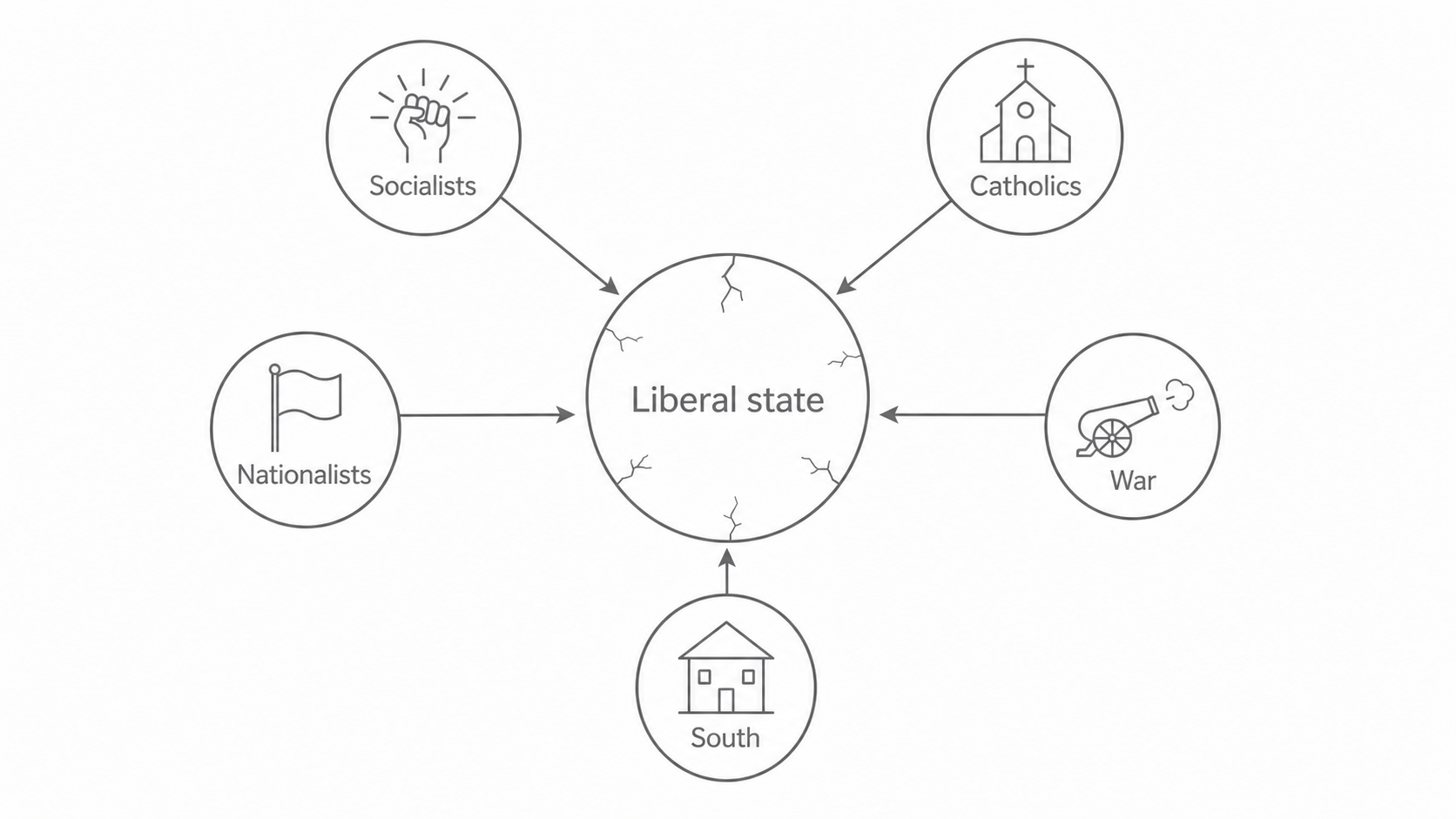
The point is not that any one pressure made collapse inevitable by 1911. The point is that liberal survival depended on balancing groups whose demands became harder to reconcile once mass politics, nationalism and war entered the same system.
Keep the chronology tight:
| Date | Event | Why it matters |
|---|---|---|
| 1848 | Statuto Albertino granted in Piedmont | It became the constitutional basis of the Kingdom of Italy after unification. |
| 1861 | Kingdom of Italy proclaimed | The new state inherited regional inequality, weak national identity and conflict with the papacy. |
| 1882 | Italy joined the Triple Alliance with Germany and Austria-Hungary | Italy sought great-power status but remained uneasy about Austria's control of Italian-speaking lands. |
| 1896 | Defeat at Adowa | The Ethiopian defeat damaged Italy's imperial prestige and haunted later nationalist politics. |
| 1901-14 | Giolittian era | Giolitti dominated liberal politics through reform, compromise and parliamentary management. |
| 1910 | Italian Nationalist Association founded | Nationalists attacked liberal parliamentarianism and demanded imperial expansion. |
| March 1911 | Giolitti formed his fourth government | His final pre-war ministry faced suffrage reform, Libya and sharper mass politics. |
| 29 September 1911 | Italy declared war on the Ottoman Empire | The invasion of Libya won nationalist and Catholic support but exposed costs and divisions. |
| 18 October 1912 | Treaty of Ouchy/Lausanne | Italy gained Tripolitania and Cyrenaica, though effective control remained limited. |
| 1912 | Franchise reform passed | The electorate rose from about 3.3 million to about 8.6 million men. |
| October-November 1913 | First election under enlarged male suffrage | Liberals survived but relied more openly on Catholic anti-socialist support. |
| March 1914 | Giolitti resigned; Salandra became prime minister | The liberal right gained control just before the war crisis. |
| June 1914 | Red Week | Anti-militarist protest showed the depth of socialist and republican unrest. |
| 2 August 1914 | Italy declared neutrality | Neutrality revealed divisions among liberals, Catholics, Socialists and nationalists. |
| 26 April 1915 | Secret Treaty of London | Salandra and Sonnino committed Italy to the Entente in return for territorial promises. |
| 23-24 May 1915 | Italy declared war on Austria-Hungary and entered combat | Intervention happened despite the earlier neutralist majority in parliament and country. |
| 1915-16 | Isonzo offensives and Trentino crisis | The war became a costly stalemate, weakening faith in liberal leadership. |
| 24 October 1917 | Caporetto | A disastrous defeat exposed military, political and home-front fragility. |
| 24 October-3 November 1918 | Vittorio Veneto | Victory gave Italy prestige, but it did not heal the fractures created by war. |
For Edexcel Paper 2, this topic supports both AO1 essays and AO2 source work. A strong answer should not merely narrate Giolitti, Libya and the war. It should explain how the liberal state handled pressure, why that handling became less effective, and how victory in 1918 could be both significant and destabilising.
Liberal Italy Before 1911
Italy in the early twentieth century was a constitutional monarchy, but not a modern mass democracy. Its constitutional framework came from the Statuto Albertino, granted in Piedmont in 1848 and extended to the Kingdom of Italy after unification. The king appointed ministers, commanded the armed forces and had important influence over foreign policy. Parliament contained an elected Chamber of Deputies and a Senate appointed for life by the Crown. In practice, governments normally needed support in the Chamber, but the Crown still mattered. This became crucial in 1915, when war policy was pushed through by the government and king despite the strength of neutralist feeling.
The political system was liberal in the sense that it had a parliament, elections, civil liberties and constitutional government. It was limited in several ways. Before the 1912 reform, the electorate was restricted by age, literacy, tax and service qualifications. Deputies were often local notables rather than members of disciplined national parties. Liberal politics relied on trasformismo.
Trasformismo
The building of flexible centre coalitions through personal deals, patronage, local influence and the absorption of moderate opponents.
This could make government adaptable, but it also made parliament look cynical and unprincipled to critics.
The main weakness was that the liberal state did not command deep loyalty from all major political forces.
| Force | Relationship with the liberal state before 1911 |
|---|---|
| Socialists | The Italian Socialist Party, founded in 1892, represented workers, peasants and socialist intellectuals; reformists could work with Giolitti, but revolutionaries rejected liberal capitalism. |
| Catholics | The papacy had never fully accepted the loss of Rome in 1870; the old papal discouragement of Catholic participation weakened, but Catholics still could not simply become a normal governing party. |
| Nationalists | Nationalists wanted expansion, military strength and a more disciplined state; they despised Giolitti's bargaining politics. |
| Southern elites | Many accepted the state because it gave them patronage and local power, not because it solved southern poverty. |
| Workers and peasants | Some benefited from reform and toleration of unions, but many experienced the state through taxes, conscription, police and local employers. |
Economic change made the picture more complicated. Italy was growing quickly after the mid-1890s. Industrial production probably doubled between 1896 and 1913. The north-western industrial triangle of Milan, Turin and Genoa developed steel, engineering, shipbuilding, automobiles and hydroelectric power. Fiat, founded in Turin in 1899, became a symbol of the new industrial Italy. Railways were nationalised in 1905, which stimulated demand for engineering and rolling stock. This economic growth helped Giolitti because it gave the state more confidence and made reform easier to fund.
Yet growth was uneven. Agriculture still employed almost 60 percent of working adults in 1911. The north-south divide remained fundamental. Northern Italy had more industry, stronger municipal government, better access to credit, more trade unions and more organised Socialist and Catholic institutions. The south, or Mezzogiorno, remained poorer, more rural and more dependent on local landlords, clientelism, emigration and state favour. Southern incomes and living standards remained substantially below those in the industrial north. Illiteracy, land hunger, disease, poor infrastructure and local corruption were not only social problems. They were political problems because they meant many Italians experienced "liberal Italy" as distant, northern, tax-raising and repressive.
Italy also wanted to be treated as a great power. It had joined the Triple Alliance with Germany and Austria-Hungary in 1882, but this alliance was awkward. Austria-Hungary controlled Trentino, Trieste and other territories claimed by Italian irredentists as "unredeemed" Italian lands. Italy also had colonial ambitions. It already held Eritrea and Italian Somaliland, but the defeat at Adowa in 1896 by Ethiopia had humiliated Italian imperial pride. Nationalists argued that a real nation should have colonies, a powerful army and a foreign policy worthy of Britain, France or Germany.
The problem was the gap between ambition and capacity. Italy wanted recognition as a great power, but its military, finances, industry, national unity and colonial position were weaker than those of the older imperial powers. That gap helps explain both Libya in 1911 and the later temptation to enter the First World War for territorial rewards.
The best judgement is that liberal Italy before 1911 was not a failed state. It had growth, a constitution and reforming capacity. But it was a narrow state: narrow in its electorate, narrow in its parliamentary elite, narrow in its regional base, and narrow in the depth of loyalty it inspired among Socialists, Catholics, nationalists and many southern Italians.
Giolitti In 1911
Giovanni Giolitti was the dominant liberal politician of the years before the First World War. He was prime minister several times, most importantly from 1903 to 1905, 1906 to 1909 and again from March 1911 to March 1914. His influence came from his ability to manage the Chamber of Deputies, his readiness to compromise with moderate opponents, and his belief that the state should not automatically repress every strike or social movement.
Giolitti's method was pragmatic. He did not try to build a disciplined liberal mass party. Instead, he used a broad centre, local notables, ministerial influence and tactical reform. Supporters saw this as practical government in a fragmented country. Critics saw it as giolittismo: corruption, electoral pressure, bargains with local bosses and deals that kept Giolitti personally powerful while leaving deeper problems unsolved.
His relations with the Socialists were central. Giolitti understood that the socialist movement could not simply be crushed. Trade unions, cooperatives, Socialist councils and workers' organisations had grown rapidly after 1900. Giolitti generally avoided state intervention in private-sector labour disputes, allowing unions to operate with more freedom than under earlier repressive governments. He also encouraged social reform, municipal welfare and public works. His aim was to draw moderate Socialists, especially reformists around Filippo Turati, into legal politics and away from revolution.
This strategy had partial success. Reformist Socialists could support particular measures and some Socialist local councils benefited from state toleration. But Giolitti could not fully domesticate socialism. The PSI membership was often more militant than its parliamentary leaders. Revolutionary syndicalists and maximalists denounced compromise. Many middle-class Italians resented Giolitti's tolerance of labour organisation, seeing it as weakness before class conflict. Giolitti's Socialist strategy therefore widened his parliamentary options but alarmed conservative liberals, employers and nationalists.
His relations with the Catholic Church were equally delicate. Since the capture of Rome in 1870, church-state relations had been tense. The papal non expedit policy had discouraged Catholics from participating fully in Italian parliamentary politics. By the early twentieth century this barrier was being relaxed in practice, especially where Catholic votes could prevent Socialist victories. Catholic unions, cooperatives, rural banks and mutual-aid societies were strong in parts of the north, especially Lombardy, Piedmont and Veneto.
Giolitti saw Catholic voters as a counterweight to socialism. Catholics saw liberal anti-socialism as useful, even if they did not fully accept the liberal state. The relationship became more open in the 1913 election through the Gentiloni Pact, in which many Catholic voters backed anti-socialist liberal candidates who were willing to defend Catholic interests. The importance of this development is not just electoral. It showed that mass Catholic politics could no longer be ignored, but also that liberal survival increasingly depended on deals with forces outside traditional liberalism.
Nationalists were harder to manage. The Italian Nationalist Association, founded in 1910, rejected Giolitti's cautious liberalism. Nationalists such as Enrico Corradini wanted imperial expansion, national discipline, a stronger army and a more authoritarian state. They believed Italy had to become a "proletarian nation" struggling against richer powers for colonies and prestige. Giolitti did not share all their assumptions, but he knew nationalist pressure mattered. The invasion of Libya in 1911 was partly a response to that pressure.
Giolitti's foreign policy was cautious but opportunistic. Italy remained formally in the Triple Alliance, but it also improved relations with Britain and France and sought colonial opportunities in the Mediterranean. Libya seemed attractive because it was close to Italy, still under Ottoman rule, and not already controlled by Britain or France. Giolitti hoped the war would be quick, popular and politically useful. It would win nationalist prestige, reassure Catholics, and show that liberal Italy could act as a great power.
The deeper problem was that Giolitti's system depended on balancing groups whose aims were becoming less compatible. He wanted Socialists to accept legal reform, Catholics to vote against socialism, nationalists to be satisfied by limited imperial success, and liberal deputies to keep following his lead. By 1911 this was still possible. By 1914 it was much harder.
Instability, 1912-14
The invasion of Libya began as an attempt to strengthen the liberal state. On 29 September 1911 Italy declared war on the Ottoman Empire. Italian forces quickly occupied coastal towns such as Tripoli, Derna and Benghazi, but resistance by Libyan forces and Ottoman officers made the war longer and harder than expected. In May 1912 Italy occupied Rhodes and other Dodecanese islands to increase pressure on the Ottoman Empire. The Treaty of Ouchy, also called the Treaty of Lausanne, was signed on 18 October 1912. The Ottoman Empire conceded Tripolitania and Cyrenaica to Italy, though Italy's effective control inland remained limited.
Libya mattered because it had contradictory effects.
| Effect of the Libyan War | How it strengthened Giolitti | How it weakened the liberal state |
|---|---|---|
| National prestige | Italy gained territory and appeared to recover from earlier colonial humiliation. | Nationalists learned that pressure could force expansion and still complained that liberal methods were too cautious. |
| Catholic support | Many Catholics supported the war as a civilising or anti-Ottoman campaign. | This deepened the political use of Catholic anti-socialism and unsettled anticlerical liberals. |
| Socialist division | Some reformist Socialists were tempted by patriotic arguments. | The PSI radicalised against colonialism; reformists such as Bissolati and Bonomi who supported the Libyan War were expelled in 1912. |
| Foreign-policy confidence | Italy appeared to act as a great power in the Mediterranean. | The war was more costly and difficult than promised, and Italy still lacked deep military strength. |
| Parliamentary management | Giolitti could rally a temporary coalition. | The war encouraged anti-parliamentary nationalism and sharpened mass ideological conflict. |
The 1912 franchise reform was even more important. Men aged 30 and over gained the vote; men aged 21–29 qualified through literacy, military service or retained tax qualifications. This raised the electorate from about 3.3 million to about 8.6 million. The reform was intended partly to modernise the state and partly to outflank democratic pressure. Giolitti hoped that by extending the vote he could make the liberal system more legitimate while still managing elections through local influence and broad alliances.
The first election under the new system came in October-November 1913. It did not destroy the liberals, but it changed the rules of politics. The old liberal groups survived only by cooperating more openly with Catholic anti-socialist voters in many constituencies. Socialists increased their strength and became a more visible national force. Competition increased, especially in areas where old uncontested notables had once dominated. The electorate was now too large and too politicised for the old system of elite management to operate as smoothly as before.
This is why suffrage reform should not be treated simply as a liberal success or a liberal mistake. It was both. It made Italy more democratic, but it also exposed the fact that the liberal ruling class had not built a mass liberal party capable of competing with Socialists, Catholics and nationalists on equal terms. A wider electorate demanded more organisation, clearer programmes and stronger political identities. Giolitti's system had been built on flexibility, not ideological mobilisation.
Nationalism and socialism both grew sharper between 1912 and 1914. Nationalists celebrated Libya but wanted a stronger imperial and military state. They attacked Giolitti's parliamentary bargaining as weak and corrupt. Their politics mattered not because they were already a majority, but because they gave a new language to anti-liberal impatience: discipline against compromise, empire against caution, national will against parliamentary deals.
Socialism also became more difficult for Giolitti to contain. The PSI moved left after the Libya dispute. Benito Mussolini, still a Socialist at this point, became editor of the party newspaper Avanti! in 1912 and represented a more militant, anti-war, anti-liberal mood. Socialist strength was greatest in parts of the industrial north and in agricultural labour areas such as the Po valley, but the movement had national significance because it offered an organised alternative to liberal capitalism.
Continue this lesson.
You’re previewing NovaLearn without an account. Create a free account to read the rest.
Create free account