36.2 Theme 1 - Irish nationalism: from agitation to civil war
From c1774 to 1923, Irish nationalism used constitutional agitation, mass politics
and physical force to pursue changing forms of self-government. You will trace
how these methods coexisted from the Volunteers and United Irishmen through
O'Connell, Fenianism and Home Rule, before unionist resistance, revolution,
partition and the Treaty produced civil war. This long view helps explain why
the outcome was neither a simple march to independence nor a straightforward
victory of one method.
The Enquiry Frame
The specification has three linked movements across time:
| Phase | Main nationalist method | Core demand | Why it matters |
|---|---|---|---|
| c1774-1801 | Patriot pressure, volunteers and republican conspiracy | Irish legislative independence, reform, Catholic rights, and in some circles separation from Britain | Nationalism began among Protestant Patriots and radicals as much as Catholics; 1798 made rebellion and union central problems. |
| c1820s-1870 | Mass agitation, moral force and periodic physical-force revolt | Catholic rights, repeal of the Act of Union, religious/economic redress, and an Irish parliament | O'Connell showed that mass constitutional mobilisation could change politics, while Young Ireland and the Fenians kept republican separatism alive. |
| c1870-1910 | Parliamentary Home Rule | Devolved Irish self-government within the United Kingdom or Empire | Butt and then Parnell made Westminster tactics central, but Home Rule depended on British parties and was vulnerable to unionist opposition. |
| 1910-23 | Armed pressure, rival claims to legitimacy, treaty politics and partition | Unionist resistance to Home Rule; nationalist demands ranging from Home Rule to full republic | The crisis became militarised. Sinn Fein and the IRA displaced the Irish Parliamentary Party, and the Treaty split nationalists themselves. |
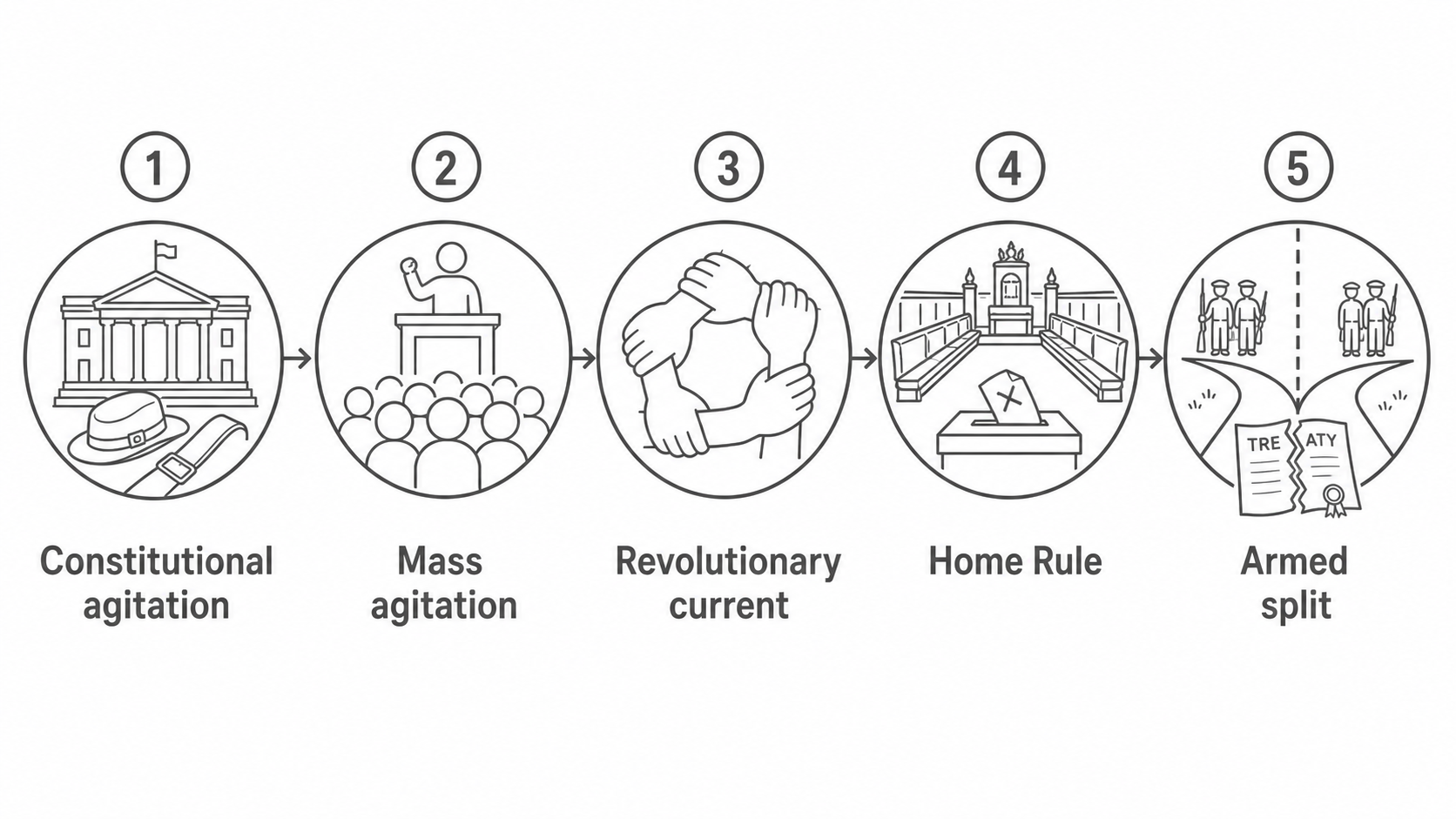
The diagram below helps you keep the changing methods straight. Notice that the arrows do not mean one method simply replaced the previous one. Revolutionary nationalism survived beneath constitutional politics, and constitutional politics still mattered during the final crisis.
[DIAGRAM: asset_name: Changing methods of Irish nationalism, 1774-1923; asset_slug: p3_362_01_irish_nationalism_from_agitation_to_civil_war__diagram_01; recommended_method: image_gen; description: A clean 16:9 grey-on-white schematic showing five left-to-right stages in Irish nationalism: constitutional agitation, mass agitation, revolutionary current, Home Rule, and armed split, with simple icons for parliament, crowd mobilisation, secret organisation, parliamentary devolution, and partition/civil war division.]
Use one long question to hold the lesson together: why did Irish nationalism move from demands for reform and self-government to a civil war over the meaning of independence?
For a Paper 3 breadth essay, avoid two weak answers. One weak answer says Irish nationalism was always the same: anti-British and Catholic. That misses Protestant Patriotism, Presbyterian radicalism, constitutional Home Rule, unionism in Ulster, and class/land issues. The other weak answer says nationalism simply became more violent over time. That misses O'Connell's moral force, Butt's federalism, Parnell's parliamentary discipline, Redmond's Home Rule strategy, and the fact that violence repeatedly followed failed constitutional expectations.
Volunteers and United Irishmen
The story begins before the Act of Union. In the late eighteenth century Ireland had its own parliament in Dublin, but it was not a democratic national parliament. It was dominated by the Protestant Ascendancy, tied to the Crown, and restricted by British influence. Catholics were excluded from Parliament and most public offices, and the Irish parliament's independence was limited by earlier constitutional controls.
The Irish Volunteers emerged from the American War of Independence. Many regular troops had been withdrawn from Ireland, and volunteer corps were formed from 1778 to defend Ireland against possible French attack. They were armed, largely Protestant, and often drawn from the political nation of landowners, professionals and merchants. Yet they became more than a defence movement. They demanded freer Irish trade, legislative independence, and reform. Their pressure mattered because it showed that a mobilised Irish public, even one led mainly by Protestants, could force Westminster to pay attention.
The key development was the constitution of 1782, often linked with Henry Grattan and the Patriot movement. Britain repealed the Declaratory Act of 1720 and accepted that the Irish parliament had the right to legislate for Ireland without direct subordination to Westminster; the Irish parliament also gained more control over initiating legislation as Poynings' Law was amended. This was a serious constitutional gain. It allowed nationalists later to look back to "Grattan's Parliament" as proof that Ireland had once possessed legislative independence.
Its limitations were just as important:
| Gain in 1782 | Limitation |
|---|---|
| The Irish parliament gained much greater legislative independence. | It remained socially narrow, Protestant and unreformed. |
| Patriot leaders could claim that Ireland was not merely a dependent province. | Catholics still lacked full political rights. |
| Volunteer pressure showed the power of extra-parliamentary mobilisation. | Volunteer unity weakened when reform and Catholic inclusion were raised. |
| The idea of an Irish constitutional tradition became stronger. | The executive in Dublin Castle and wider imperial connection still limited Irish autonomy. |
This is why 1782 was a turning point but not a solution. It strengthened constitutional nationalism but left the central questions of representation, religion and sovereignty unresolved.
The United Irishmen pushed those unresolved questions further. Founded in Belfast in 1791 and then in Dublin, the Society of United Irishmen drew on the American and French revolutions. Its early demands included parliamentary reform, Catholic emancipation and a union of Catholic, Protestant and Dissenter in a single Irish political nation. That cross-sectarian language was radical because Irish politics had often been organised through religious privilege and distrust.
The movement then changed. Repression, war with revolutionary France from 1793, agrarian unrest and the failure of reform pushed the United Irishmen towards secrecy and military planning. The demand was no longer only to reform the existing constitution. For many radicals, the aim became an independent Irish republic, with French assistance if possible. Wolfe Tone's mission to France and the failed French landing at Bantry Bay in 1796 show how Irish nationalism had entered an international revolutionary world.
The rebellion of 1798 was the result. It broke out in May 1798 after the government had arrested leading conspirators and tried to break the organisation. The rising was strongest in parts of eastern Ulster and Wexford. It failed militarily: the rebels could not coordinate a national uprising, French help arrived too late and in too small a force, and government troops defeated the Wexford rebels at Vinegar Hill on 21 June 1798. The rebellion also damaged the ideal of non-sectarian unity. In Wexford, sectarian violence against Protestants and brutal government repression deepened communal fear.
The consequence was enormous. William Pitt's government argued that the separate Irish parliament could not maintain order or security. The Act of Union was passed in 1800 and came into force on 1 January 1801, abolishing the Irish parliament and sending Irish MPs to Westminster. For later nationalists, this meant the 1798 rebellion had two opposite legacies. It inspired republican memory, but it also helped produce the Union that nationalists spent the next century trying to undo.
O'Connell, Repeal and Tithes
After 1801, Irish nationalism had to work inside the United Kingdom. Daniel O'Connell was the crucial figure in turning Catholic grievance into organised mass politics. His experience of revolutionary bloodshed left him suspicious of insurrection, and he rejected the 1798 rebellion. His later politics were built on legal pressure, public meetings, disciplined organisation and moral force rather than insurrection.
O'Connell's first great achievement was Catholic emancipation in 1829, but this topic is mainly concerned with what came next: the campaign to repeal the Union. O'Connell believed that Westminster could not truly represent Ireland, especially if Catholic Ireland remained politically subordinate. In 1840 he founded the Repeal Association, formally the Loyal National Repeal Association, to campaign for the restoration of an Irish parliament.
O'Connell's role mattered in four ways:
| O'Connell's method | Significance |
|---|---|
| Mass meetings and popular subscription | National politics reached far beyond elite parliamentary circles. |
| Catholic clerical and middle-class organisation | Local networks gave constitutional nationalism discipline and reach. |
| Moral force | O'Connell insisted that violence would strengthen the enemy and discredit the cause. |
| Historical memory | He used Grattan's Parliament and the Volunteers of 1782 as proof that Irish legislative independence had precedent. |
The Repeal campaign reached its height in 1843, O'Connell's "Repeal Year". Huge "monster meetings" were held across Ireland. These were not just rallies. They displayed numbers, discipline, Catholic confidence and national identity. Yet the Clontarf crisis exposed the limits of moral force. The government banned the planned meeting at Clontarf in October 1843 and deployed troops and police. O'Connell cancelled the meeting to avoid bloodshed. That decision preserved his non-violent principles but damaged the movement's momentum. If he defied the state, he risked violence and repression. If he obeyed the ban, he showed that the British government could still set the limits of agitation.
The Tithe Wars, c1830-38, show another kind of agitation. Tithes were payments to support the established Church of Ireland, even though most Irish people were Catholic and many Presbyterians also resented paying for a church that was not theirs. Resistance began in the early 1830s, especially in Leinster and Munster, and involved refusal to pay, local mobilisation, obstruction of seizures, intimidation of collaborators and occasional violence. The issue was religious, economic and political at the same time: it linked poverty, Catholic grievance, Protestant privilege and state enforcement.
The Tithe Wars are important for this topic because they show the countryside becoming politically mobilised after emancipation. They were not simply an O'Connellite campaign, and O'Connell was cautious about uncontrolled rural violence. But the agitation helped prove that passive resistance could make government expensive and difficult. The settlement of 1838 reduced the tithe burden and shifted payment into rent, which did not remove all injustice but ended the direct confrontation. Later nationalist and land campaigns learned from this mixture of refusal, local pressure and public grievance.
O'Connell's decline came from a combination of state resistance, age, strategic limits and catastrophe. The Great Famine from 1845 devastated Irish society and discredited the idea that normal Westminster politics would protect Ireland. Young radicals in and around Young Ireland, including figures such as William Smith O'Brien, Thomas Francis Meagher and John Mitchel, increasingly criticised O'Connell's caution. Their quarrel with O'Connell was not only about tactics; it was about whether a nation could rely on moral force when faced with famine, coercion and an unyielding state.
The judgement on O'Connell should be balanced. He did not win Repeal, and his refusal to risk violence limited what his movement could force after Clontarf. Yet he permanently changed Irish nationalism by proving that mass Catholic constitutional politics could be organised at national scale. Without O'Connell, later Home Rule politics would have lacked one of its main models.
Young Ireland and Fenians
The impact of Young Ireland lay less in military success than in nationalist imagination. Young Irelanders grew out of the Repeal movement but wanted a broader, more assertive nationalism. They used newspapers, speeches, history, poetry and cultural argument to teach that Ireland was a nation with a distinct past and a right to self-government. Some hoped for unity across religion and class, although famine, clerical opposition and political repression made that increasingly difficult.
The 1848 rebellion was the key development. Revolutions across Europe in 1848 seemed to suggest that old regimes could fall quickly. In Ireland, Young Ireland leaders hoped that the weakened Repeal movement might be transformed into a national rising. The British government acted first, using the Treason Felony Act and suspending habeas corpus. The rebellion itself, centred on Ballingarry in County Tipperary on 29 July 1848, was tiny and badly organised. It failed almost immediately. Leaders such as William Smith O'Brien and Thomas Francis Meagher were sentenced to death, though their sentences were commuted to transportation.
The immediate impact was failure. Young Ireland did not build an effective army, did not unite the country and did not exploit the European revolutionary moment. But its longer impact was real:
| Young Ireland impact | Why it mattered |
|---|---|
| Cultural nationalism | It helped make language, history, memory and literature part of nationalist politics. |
| Criticism of moral force | It challenged the idea that British power could be defeated by petitions and meetings alone. |
| Link to later republicans | Some Young Ireland veterans and sympathisers influenced Fenian circles. |
| Martyr memory | Failed rebellion could still generate symbols, songs and stories for later generations. |
The Irish Republican Brotherhood, or IRB, carried physical-force nationalism into a more secret and disciplined form. Founded in Dublin in 1858 by James Stephens, with a connected Fenian Brotherhood in the United States led by John O'Mahony, the movement was transatlantic. Irish emigrants, especially in America, could provide money, arms, military experience and propaganda. The American Civil War gave some Irish-American Fenians practical military experience and strengthened hopes that Britain could be pressured through international vulnerability.
The IRB's aim was not Home Rule within the Union. It wanted an independent Irish republic. Its secrecy was both a strength and a weakness. It allowed organisation under repression, but it also limited mass political legitimacy, made infiltration likely and produced plans that often outran capacity.
The Fenian Rising of 1867 was the key development. Plans were damaged by arrests, informers, poor arms and bad coordination. The rising in March 1867 was easily suppressed. In Ireland, several leaders received severe sentences, including death sentences that were commuted. The executions associated with Fenianism came mainly through events in Britain: the Manchester Martyrs, William Allen, Michael Larkin and Michael O'Brien, were executed in November 1867 after the killing of a police officer during a rescue attempt, and Michael Barrett was publicly executed in 1868 after the Clerkenwell explosion.
The Fenian impact was again paradoxical. Militarily, the rising failed. Politically, the movement kept alive the republican claim that Ireland's problem was not merely bad laws or bad landlords but British rule itself. Fenian prisoners, executions and amnesty campaigns became powerful nationalist symbols. The movement also frightened British politicians into recognising that ignoring Irish grievances could be dangerous. The Church of Ireland was disestablished in 1869 and the first Land Act followed in 1870; those reforms belong more directly to another topic, but they show that physical-force pressure affected the political climate.
The crucial breadth judgement is that by 1870 Irish nationalism had two living traditions. One was constitutional mass politics, inherited from O'Connell. The other was physical-force republicanism, reshaped by Young Ireland and the IRB. Home Rule would dominate the next phase, but it never fully buried the revolutionary current.
Continue this lesson.
You’re previewing NovaLearn without an account. Create a free account to read the rest.
Create free account