2H.1 KT3 - The New Deal, the Second World War and the USA to 1945
This lesson asks how far the New Deal and the Second World War transformed the USA by
1945. The New Deal expanded federal responsibility, reduced hardship and built lasting
infrastructure, but it did not restore full employment or equal citizenship. Wartime
spending and mobilisation then completed economic recovery, expanded industry and drew
women and ethnic minorities into new work and service. By comparing those gains with
continuing segregation, violence and gender inequality, you can judge whether economic or
social change was deeper by 1945.
The Enquiry Frame
The central question is: how far did the New Deal and the Second World War change the USA by 1945?
There are three linked arguments to hold together.
First, the New Deal changed the role of the federal government. Before 1933, Americans had often expected economic downturns to be handled mainly by local relief, private charity, state governments, business adjustment and individual effort. Roosevelt did not abolish capitalism; he tried to rescue and regulate it. New Deal agencies provided relief, public works, agricultural support, financial reform, labour rights and social security. This mattered because it made Washington a more visible actor in ordinary life.
Second, the New Deal recovery was incomplete. Unemployment fell from the catastrophic level of 1933, but it remained severe through the 1930s. The recession of 1937-38 showed that recovery was fragile, and in 1940 the economy was still not at full employment. New Deal public works changed the landscape; they did not fully solve demand, investment and joblessness.
Third, the Second World War produced the decisive economic transformation. Rearmament, Lend-Lease, military mobilisation, war contracts, factory conversion and conscription pushed the economy to a scale the New Deal had not reached. War spending created millions of jobs, pulled women and minorities into new work, strengthened unions, accelerated migration to industrial centres and expanded industries such as aircraft, shipbuilding, vehicles, chemicals, electronics and munitions.
Use the diagram to compare scale rather than just list programmes. The left side shows why the New Deal mattered; the right side shows why wartime mobilisation changed the economy more decisively; the bottom band reminds you that social gains were still uneven. The middle arrow marks the sequence from New Deal recovery to wartime mobilisation; the downward arrows link programmes to their economic effects.
[DIAGRAM: asset_name: New Deal recovery and wartime mobilisation; asset_slug: p2_2h1_03_impact_of_the_new_deal_and_the_second_world_war_on_the_usa_to_1945__diagram_01; recommended_method: image_gen; description: A two-panel schematic comparing New Deal relief and infrastructure leading to partial recovery with wartime mobilisation and war contracts leading to full employment, with an unequal gains band across both periods.]
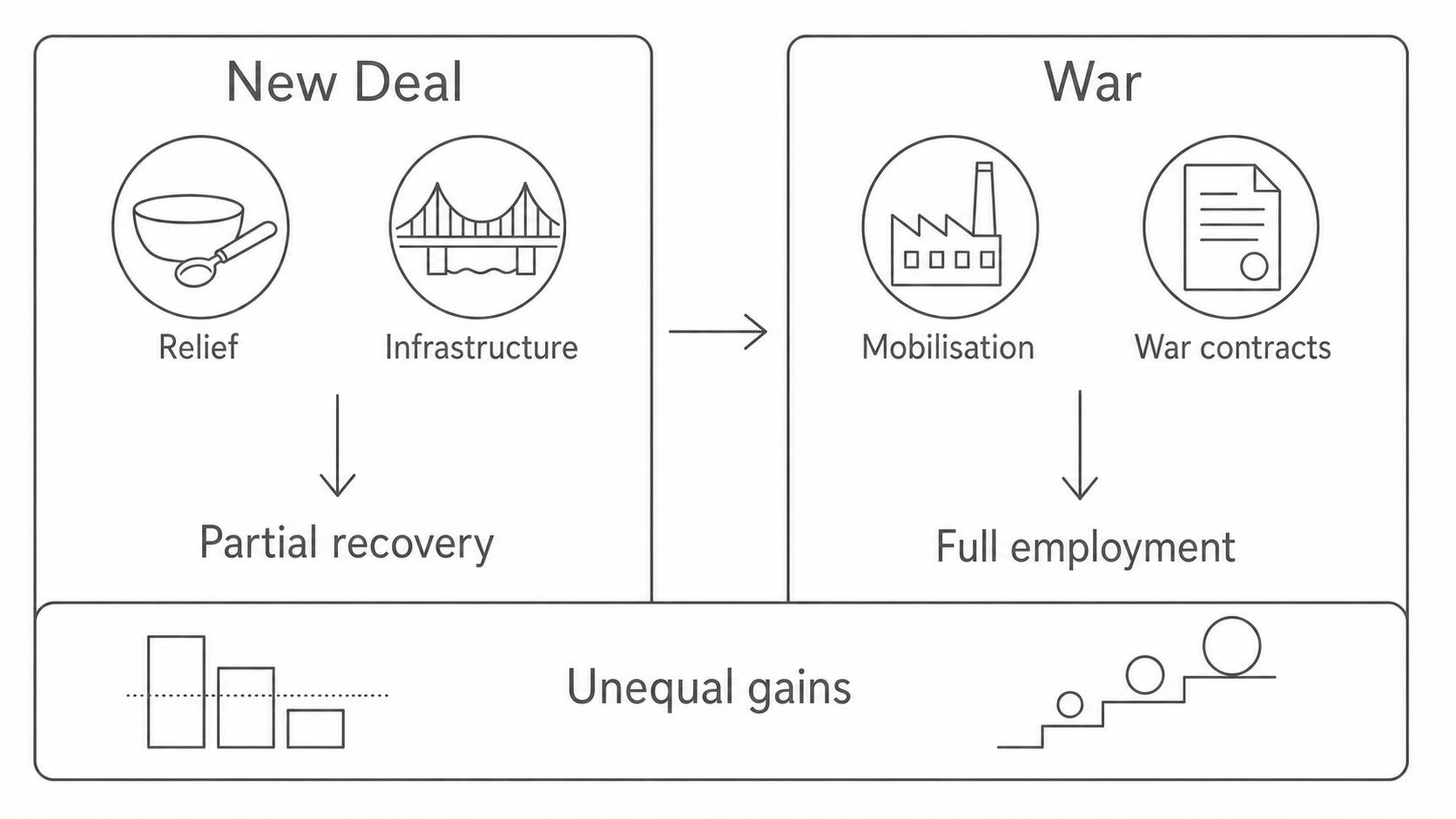
The judgement it supports is comparative: the New Deal changed federal responsibility and softened the Depression's effects, but war mobilisation created the decisive economic break. Neither phase removed racial and gender inequality by 1945.
A useful chronology runs like this:
| Date | Why it matters |
|---|---|
| March 1933 | Roosevelt became president and launched the early New Deal response to bank collapse, unemployment and social distress. |
| 1933-34 | Relief and recovery agencies such as the CCC, PWA and CWA put federal money into jobs, conservation and construction. |
| June 1934 | The Indian Reorganisation Act reversed allotment policy in principle and encouraged tribal self-government, though within federal limits. |
| 1935 | The WPA, Wagner Act and Social Security Act deepened the Second New Deal's public works, labour and welfare role. |
| 1936-40 | WPA cultural projects supported writers, musicians, artists and historical collection; Eleanor Roosevelt became an important public advocate for women, youth and civil rights. |
| 1937-38 | A sharp recession interrupted recovery, showing that the New Deal had not ended economic vulnerability. |
| 1940 | Defence production began to expand fast, but unemployment remained high by normal standards. |
| June 1941 | Executive Order 8802 banned discrimination in defence industries and government employment and created the Fair Employment Practice Committee after pressure from A. Philip Randolph and other activists. |
| 7 December 1941 | Pearl Harbor brought the USA into the war and transformed defence preparation into total mobilisation. |
| 1942 | The Double V campaign gave Black wartime patriotism a civil-rights edge; the Bracero programme began to recruit Mexican labour for US agriculture. |
| 1943 | Race riots in Detroit and Los Angeles exposed the racial strains beneath wartime prosperity and patriotic propaganda. |
| 1944-45 | Unemployment had virtually disappeared; war production peaked; the USA emerged with enormous industrial capacity and unresolved social tensions. |
For Paper 2, this topic can support AO1 essays about impact, change and continuity, and AO2 source work on contemporary evidence. A government poster, a Roosevelt speech, a WPA guidebook, a Black newspaper, a union statement, a film trailer or a woman's factory memoir can each be valuable, but each also has a viewpoint and purpose. Ask what the source reveals about policy, propaganda, lived experience and inequality.
The New Deal Economy And Women
The New Deal's economic impact was real but limited. It helped stabilise a broken system, put millions into work, created visible infrastructure and gave the federal government a new responsibility for economic welfare. But it did not restore full employment before the defence boom and war.
The most direct impact on unemployment came through work relief. The Civilian Conservation Corps, created in 1933, employed young men in conservation work such as planting trees, improving parks, maintaining trails and fighting soil erosion. The Public Works Administration funded large construction projects such as dams, bridges, schools, hospitals and public buildings. The Civil Works Administration briefly created emergency jobs in the winter of 1933-34. The Works Progress Administration, created in 1935 and later renamed the Work Projects Administration, became the best-known work-relief agency. Across its life it employed more than eight million people and left roads, bridges, schools, public buildings, parks and airports across the country.
This matters for judgement because public works were both economic policy and political symbolism. A new road, bridge, school or airport showed citizens that the federal government was acting. Work relief also protected the dignity of employment more than a simple cash handout did. Roosevelt and Harry Hopkins wanted relief to be connected to useful work, partly because it answered critics who accused the unemployed of dependency.
The infrastructure impact was lasting. WPA and PWA projects improved transport, education, public health, flood control, electricity and local administration. The Tennessee Valley Authority, though created earlier in the New Deal and not only a relief project, showed the scale of federal regional planning: dams, hydroelectricity, flood control and agricultural improvement in a poor region. Rural electrification also widened access to power, changing domestic work, farm life and local economies.
Yet the unemployment impact had clear limits. The New Deal reduced suffering and increased purchasing power, but it did not create enough demand to absorb all jobless workers. Some jobs were temporary, low paid and male-focused. The private sector remained cautious. The 1937-38 recession was especially damaging. Cuts in federal spending, the introduction of Social Security payroll taxes and tighter monetary conditions helped produce a downturn in which industrial production fell sharply and unemployment rose again. The lesson is not that the New Deal "failed" completely. It is that a mixed programme of relief, reform and limited stimulus was not the same as the full mobilisation later created by war.
The state of the US economy in 1940 proves this mixed verdict. Compared with 1933, the USA was much stronger: banks were stabilised, GDP had recovered substantially, farms and industry were no longer in free fall, and federal economic institutions were far larger. But unemployment was still around the mid-teens as a percentage of the labour force by common historical estimates. That is too high to call the Depression over in ordinary social terms. The defence build-up was beginning to pull the economy upwards, but the decisive break came only with war production.
Women and the New Deal also show the mixture of change and limitation. Roosevelt's administration included important women in public life. Frances Perkins, Secretary of Labor from 1933, was the first woman to serve in a US presidential cabinet. She helped shape labour legislation, social insurance and protections associated with the New Deal. Mary McLeod Bethune, a Black educator and activist, became Director of Negro Affairs in the National Youth Administration and a key figure in the informal "Black Cabinet". Women gained new visibility in administration, reform networks and social policy.
Eleanor Roosevelt mattered because she expanded the political role of the First Lady. She travelled widely, inspected projects, reported conditions to the president, wrote columns, held press conferences and spoke for women, youth, workers and Black Americans more directly than Franklin Roosevelt often did. Her women-only press conferences encouraged newspapers to employ female reporters. She supported "she-she-she" camps, a limited female parallel to the CCC, and pushed for greater inclusion of women and Black Americans in New Deal programmes. She was not a cabinet minister and did not control policy, but she acted as a public conscience, political broker and communicator.
The limitations were serious. Many New Deal programmes assumed a male breadwinner. Women were often channelled into lower-paid relief work such as sewing, school lunches, clerical work, nursery care and welfare services. The Social Security Act excluded many domestic and agricultural workers, which particularly harmed Black women and men in the South and many white women in service or seasonal employment. New Deal labour protections could reinforce existing gender divisions because the "normal" worker was often imagined as male, industrial and unionised.
Therefore, a strong judgement is that the New Deal broadened women's public presence more than it transformed gender equality. It made some women politically visible and offered some relief work, but it did not overturn the assumption that men had the first claim on jobs.
Minorities, The New Deal And War
The New Deal and the war affected ethnic minorities unevenly. The broad pattern is clear: federal action created new openings, but racism and discrimination shaped who benefited, how much, and on what terms.
For Black Americans, the New Deal was both useful and discriminatory. Relief agencies mattered because Black unemployment and poverty were severe. The WPA, CCC, PWA, NYA and other programmes offered some jobs, training and support. The New Deal also encouraged a political realignment: many Black voters, especially outside the South, shifted towards the Democratic Party because Roosevelt's government appeared more willing than earlier administrations to use federal power against economic distress.
But discrimination remained embedded. Many programmes were locally administered, which gave southern white officials power to exclude Black citizens, assign them lower wages or segregate facilities. Agricultural and domestic workers were often excluded from the strongest protections, including Social Security coverage and some labour protections, which disproportionately affected Black workers. Roosevelt did not support strong federal anti-lynching legislation because he feared losing southern Democrats in Congress. The New Deal therefore improved some material conditions while avoiding a frontal attack on Jim Crow.
Black advisers and activists still mattered. Mary McLeod Bethune, Robert Weaver, William Hastie and others in or near the federal government pressed for fairer treatment. Eleanor Roosevelt's advocacy, including her public support for Black rights and her friendship with Bethune, made civil rights harder for the administration to ignore. However, the president's caution meant that Black Americans often had to use protest, newspapers, unions and legal pressure to turn federal opportunity into actual access.
The Indian Reorganisation Act of 1934, known in the USA as the Indian Reorganization Act or Wheeler-Howard Act, was one of the clearest New Deal policy shifts for Native Americans. It ended the policy of allotting tribal lands to individuals, a policy associated with the Dawes Act of 1887 that had broken up reservations and contributed to massive land loss. The IRA encouraged tribal self-government, allowed tribes to adopt constitutions and councils, supported the restoration of some tribal lands, set aside funds for education and gave preference to Native hiring in the Bureau of Indian Affairs.
This was a significant change because it moved federal policy away from forced assimilation and towards a limited recognition of tribal sovereignty. Under Commissioner of Indian Affairs John Collier, the "Indian New Deal" treated Native cultures and tribal institutions with more respect than earlier allotment policy had done.
The limits were also important. The IRA still operated through federal law and Bureau of Indian Affairs supervision. Some tribes rejected it because its model of written constitutions and councils did not match their traditional political structures. It did not undo all previous land loss, poverty or federal control. For exam judgement, the IRA is best treated as a major policy reversal, not as full Native self-determination.
Hispanic Americans experienced change through migration, agriculture, urban youth culture and wartime labour demand. Mexican Americans in the Southwest had long faced segregated schools, low-paid agricultural work, police hostility and discrimination in housing and employment. During the war, labour shortages increased demand for Mexican and Mexican American workers. The Bracero programme, beginning in 1942, brought Mexican temporary workers into US agriculture under agreements that promised wages, food, housing and medical care. This helped meet labour shortages, but it also tied workers to temporary contracts and did not remove exploitation.
Mexican American women and men also entered defence work in cities such as Los Angeles. Some young people used zoot suits and music as styles of urban identity. White hostility turned that cultural visibility into a target. In the Los Angeles Zoot Suit riots of June 1943, white servicemen and civilians attacked mainly Mexican American youths, stripping and beating them while police often arrested the victims rather than the attackers. This is crucial because it shows that wartime patriotism did not produce racial harmony.
Ethnic minorities made major contributions to the war effort. Black Americans served in segregated armed forces, worked in defence industries and joined the migration to war-production cities. The Tuskegee Airmen, Black naval personnel such as Doris Miller, soldiers in supply and combat roles, and millions of Black civilians on the home front all challenged racist assumptions. Native Americans served in large numbers relative to their population; Navajo, Comanche, Hopi and other code talkers used Native languages to transmit military communications that enemies could not easily decode. Japanese Americans faced mass incarceration after Executive Order 9066, but Nisei soldiers served in units such as the 442nd Regimental Combat Team and the Military Intelligence Service. Hispanic Americans served in the armed forces and worked in agriculture, shipyards, aircraft plants and other war industries.
The Double V campaign captured the central Black wartime argument.
Double V campaign
A campaign launched by the Pittsburgh Courier in 1942, after a letter by James G. Thompson, calling for victory over fascism abroad and victory over racism at home.
It was patriotic and critical at the same time. That made it powerful: Black Americans were not rejecting the war effort; they were insisting that a democracy fighting Nazi racism had to confront segregation, lynching, job discrimination and police violence inside the USA.
The race riots of 1943 showed why Double V mattered. In Detroit, rapid wartime migration, overcrowded housing, competition over jobs, segregated neighbourhoods, police racism and white resistance to Black advancement produced explosive violence in June 1943. The riot left dozens dead and exposed the social costs of an industrial boom that created jobs faster than fair housing, policing or citizenship. Similar tensions appeared in other cities. The war created opportunity, but opportunity under unequal conditions could intensify conflict.
Wartime Economy, Work And Migration
The war transformed the economy more completely than the New Deal because it mobilised money, labour, industry and state power at a much greater scale. After Pearl Harbor, the USA did not merely recover; it converted a civilian economy into the "Arsenal of Democracy".
The collapse of unemployment was the clearest economic change. Defence spending had already accelerated in 1940-41, but after December 1941 military contracts, conscription and war production pulled millions into work or uniform. Historical estimates put unemployment around 14-15 percent in 1940 and close to 1 percent by 1944. This was not a normal peacetime recovery. It was the result of extraordinary federal spending, military mobilisation and production targets. The state bought ships, aircraft, tanks, trucks, ammunition, uniforms, food, radios, chemicals and machinery on a scale no private market would have created by itself.
Continue this lesson.
You’re previewing NovaLearn without an account. Create a free account to read the rest.
Create free account