1G Theme 1 - Political and governmental change, 1918-89
This lesson is about how Germany moved through three very different political
orders between 1918 and 1989: Weimar democracy, Nazi dictatorship and the
democratic Federal Republic of Germany. The central argument is not simply that
Germany "failed" and then "recovered". It is that each settlement was shaped by
the weaknesses, choices and fears created by the previous one. Weimar tried to
make Germany democratic after defeat and revolution; the Nazis destroyed
democracy by exploiting its legal openings and anti-democratic enemies; the FRG
then built a democratic state designed to avoid both Weimar instability and Nazi
dictatorship.
The Enquiry Frame
The specification topic is a Paper 1 breadth theme. It is not asking for a complete
history of every German event between 1918 and 1989. It is asking how
government changed: who held power, how institutions worked, how far democracy
was protected, and why different systems proved fragile or stable.
Keep the three official phases separate, then compare them.
| Phase | Core question | Best judgement problem |
|---|---|---|
| Weimar Republic, 1918-33 | How was a democratic republic created, defended and then lost? | Did democracy collapse mainly because of structural weaknesses, crisis, extremist pressure or elite choices? |
| Nazi dictatorship, 1933-45 | How did Hitler turn office as chancellor into total dictatorship, and how did Nazi government actually operate? | Was Nazi government strong because it was centralised, or radical because power was deliberately chaotic and competitive? |
| Federal Republic of Germany, 1945-89 | How was democratic government rebuilt and kept stable in West Germany? | Did stability depend most on constitutional design, economic and social recovery, party politics, or Cold War alignment? |
Use the schematic below to keep the breadth judgement visible while you work through detail. It is not just a sequence of regimes; it is also a story about how the Federal Republic was designed in conscious reaction to Weimar fragility and Nazi dictatorship.
[DIAGRAM: asset_name: Weimar Nazi rule FRG governmental change comparison; asset_slug: p1_1g_01_political_and_governmental_change_1918_89__diagram_01; recommended_method: image_gen; description: Plain boxes-and-arrows schematic on a white background showing Weimar with rights and fragility collapsing into Nazi rule with personal rule and terror, then rebuilding into the Federal Republic with rights and safeguards, with a lessons-learned arrow from the failures of Weimar and Nazi rule to the FRG]
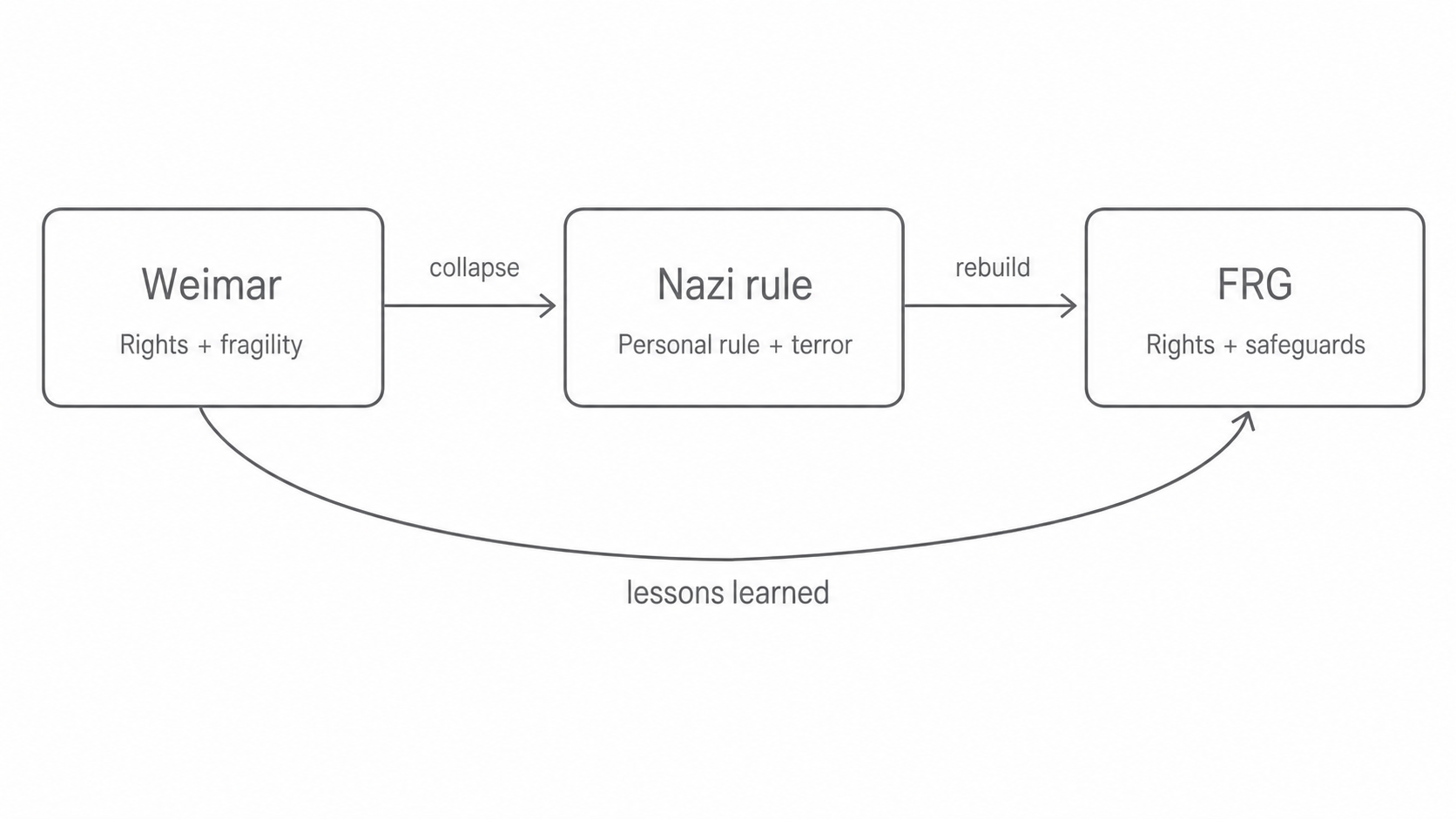
The key judgement is that the FRG was not simply Weimar restarted. It kept democratic rights, but surrounded them with stronger safeguards against cabinet collapse, leader dictatorship and anti-democratic parties.
Use this timeline as a spine for the topic.
| Date | Political and governmental significance |
|---|---|
| 9 November 1918 | Kaiser Wilhelm II's abdication was announced; Philipp Scheidemann proclaimed a republic in Berlin. |
| 11 August 1919 | The Weimar Constitution was signed, giving Germany its first full national democracy. |
| 1923 | Ruhr crisis, hyperinflation and Hitler's Beer Hall Putsch tested the republic severely. |
| 1924-29 | Relative stabilisation under Stresemann-era coalitions made democracy look more workable, though not secure. |
| March 1930 | The Muller Grand Coalition collapsed; presidential government under Article 48 became normal. |
| 30 January 1933 | President Hindenburg appointed Hitler chancellor. |
| 28 February 1933 | The Reichstag Fire Decree suspended civil liberties and opened the way to mass repression. |
| 23-24 March 1933 | The Enabling Act transferred legislative power to Hitler's cabinet. |
| 30 June-2 July 1934 | The Night of the Long Knives removed SA and conservative rivals and reassured the army. |
| 2 August 1934 | Hindenburg died; Hitler merged the presidency and chancellorship and gained a personal army oath. |
| 1939-45 | Wartime government intensified Hitler's personal rule, SS power, party competition and administrative fragmentation. |
| 8 May 1949 | The Parliamentary Council adopted the Basic Law for the western zones. |
| 23 May 1949 | The Basic Law was promulgated; the Federal Republic of Germany was created. |
| 1949-65 | Adenauer and Erhard helped consolidate parliamentary democracy, western alignment and CDU-led stability. |
| 1969-82 | Brandt and Schmidt showed that stable democratic government could survive alternation, Ostpolitik, terrorism and economic strain. |
| 1 October 1982 | Kohl became chancellor through the constructive vote of no confidence, a constitutional mechanism designed to avoid Weimar-style drift. |
| 1983-89 | Kohl's Christian-liberal coalition governed while new movements, especially the Greens, entered parliamentary politics. |
For exam judgement, avoid treating democracy as automatic. Germany had democratic
institutions in 1919 and 1949, but they operated in very different political
cultures. Weimar had a democratic constitution but many powerful groups had only
conditional loyalty to it. The FRG had democratic institutions, Allied backing,
a narrowed and more disciplined party system, economic recovery and a political
class determined to learn from catastrophe. That difference matters.
Weimar Created and Defended, 1918-29
The Weimar Republic was born from defeat, revolution and improvisation. In
October and November 1918, Germany's military position collapsed and sailors,
workers and soldiers formed councils in ports and cities. On 9 November 1918,
Kaiser Wilhelm II's abdication was announced by Max von Baden; Wilhelm signed his formal abdication on 28 November. Philipp Scheidemann, a leading Social Democrat,
proclaimed a republic from the Reichstag building. Friedrich Ebert, also of the
SPD, became head of the provisional government. Two days later, on 11 November,
Germany signed the armistice.
This matters because democracy began under conditions that made legitimacy hard.
The new republic was associated with military defeat, revolutionary fear and the
armistice before it had written a constitution. The right later used the "stab in
the back" myth to claim that civilian politicians had betrayed an undefeated
army. That claim was false, but politically damaging.
Ebert's first priority was order. On 10 November 1918 he reached the
Ebert-Groener understanding with the army high command: the army would support
the new government against revolutionary disorder, and the government would
preserve the officer corps and military hierarchy. This helped the republic
survive, but it also meant that a democratic government relied on an army whose
senior culture was not deeply democratic. That compromise was both a strength
and a weakness.
The republic was formally created through elections to a National Assembly in
January 1919. The assembly met in Weimar because Berlin was too unstable, and it
produced the constitution signed by Ebert on 11 August 1919. The constitution
created a modern democratic state:
| Feature | Democratic promise | Long-term problem |
|---|---|---|
| Universal suffrage for men and women aged 20 or over | Germany became a mass democracy with broad voting rights. | Many voters used democracy to support parties hostile to democracy. |
| Proportional representation | Parties gained seats in line with their vote share. | Fragmented parliaments made coalition-building difficult. |
| Reichstag responsibility | Chancellors needed parliamentary support. | Cabinets could be short-lived if coalitions fractured. |
| Directly elected Reich president | The president could provide national leadership above party conflict. | Article 48 and presidential appointment powers could be used against parliamentary democracy. |
| Federal structure and civil rights | The constitution promised rights, equality and state participation. | Rights could be suspended under emergency powers. |
The republic then had to defend itself against enemies from left and right. In
January 1919 the Spartacist uprising in Berlin was crushed with the help of
Freikorps units, and Rosa Luxemburg and Karl Liebknecht were murdered. That
showed that the government could defeat a revolutionary left challenge, but the
use of right-wing paramilitaries deepened bitterness on the left. In March 1920,
the Kapp Putsch exposed the opposite danger. Right-wing forces tried to overthrow
the republic, and the regular army leadership was reluctant to defend the
government. A general strike defeated the putsch, but the event revealed how
uncertain elite loyalty remained.
Political violence continued. The assassinations of Matthias Erzberger in 1921
and Walther Rathenau in 1922 showed the threat from nationalist extremists. The
government responded with measures such as the Law for the Protection of the
Republic, but the courts often treated right-wing offenders more leniently than
left-wing ones. A constitution can declare democracy; it cannot automatically
make judges, officers and officials democratic.
The year 1923 was the republic's greatest early test. French and Belgian troops
occupied the Ruhr after Germany fell behind on reparations deliveries. The
German government encouraged passive resistance, but this helped drive
hyperinflation. Savings were destroyed and middle-class confidence was badly
damaged. Separatist unrest, communist agitation in some regions and Hitler's Beer
Hall Putsch in Munich all suggested that the republic might break apart.
Yet Weimar did overcome these challenges. Gustav Stresemann ended passive
resistance, introduced the Rentenmark to stabilise the currency, and helped
negotiate the Dawes Plan in 1924, which eased reparations pressure and opened
the way for American loans. Germany joined the League of Nations in 1926 after
the Locarno Treaties. Between 1924 and 1929, coalition government still looked
fragile, but extremist parties lost ground and parliamentary politics seemed
more workable. The 1928 election produced a Grand Coalition under Hermann
Muller, including the SPD, Centre, DDP, DVP and BVP.
The key judgement is balanced. Weimar was not doomed from birth: it survived
revolution, putsch, occupation, inflation and diplomatic isolation. However, its
survival often depended on compromises and temporary recovery rather than deep
acceptance. The army, judiciary, civil service, old nationalist elites, many
landowners and much of the radical left never became reliable defenders of
parliamentary democracy. Weimar had been defended by 1929, but not securely
rooted.
Collapse of Democracy, 1930-33
The collapse of Weimar democracy between 1930 and 1933 was not just Hitler
winning votes. It was the interaction of economic crisis, constitutional
weakness, anti-democratic parties and conservative elite miscalculation.
The Great Depression struck Germany especially hard because recovery after 1924
had relied heavily on foreign loans, especially from the United States. As
credit contracted, businesses failed and unemployment rose sharply. The political
system then had to make painful decisions about taxes, spending, wages and
unemployment insurance. In March 1930, the Muller Grand Coalition collapsed over
how to fund unemployment benefits. This was a turning point because the last
fully parliamentary majority government of the republic fell.
President Paul von Hindenburg appointed Heinrich Bruning as chancellor. Bruning
did not command a secure Reichstag majority, so he increasingly governed through
Article 48 emergency decrees, signed by Hindenburg. When the Reichstag rejected
his financial measures, Bruning asked Hindenburg to dissolve it. The September
1930 election transformed politics: the Nazi Party rose to 107 seats, while the
Communists also gained. Parliamentary majorities became harder, and the parties
most hostile to the republic could claim to speak for millions.
Article 48 had been designed for emergency defence of the republic, but by
1930-32 it became a method of normal government. This weakened democracy in
three ways. First, it made the Reichstag look irrelevant. Second, it made the
president and his advisers more important than elected coalitions. Third, it
encouraged conservative elites to think they could rule without democratic
majorities. In 1932 alone, Hindenburg used emergency decree power repeatedly and
dissolved the Reichstag twice.
Article 48
The clause of the Weimar constitution that let the president issue emergency decrees; in 1930-32 it became a substitute for government by parliamentary majority.
The Nazis benefited because they offered different messages to different groups:
national revival, anti-communism, jobs, rejection of Versailles, attacks on
parliamentary compromise and a promise of decisive leadership. Their SA violence
also made politics feel like a struggle for power rather than a contest of
arguments. At the same time, the KPD attacked the republic and treated the SPD
as a major enemy. Extremist pressure therefore squeezed the democratic centre
from both sides.
The crisis deepened in 1932. Bruning was dismissed in May and replaced by Franz
von Papen, who governed with little parliamentary support. In July 1932 Papen
used emergency powers to depose the SPD-led Prussian government in the
Preussenschlag. This was a serious blow because Prussia was Germany's largest
state and one of the republic's strongest democratic bases. The July 1932
Reichstag election made the Nazis the largest party with 230 seats, but Hitler
still lacked a majority and Hindenburg initially refused to make him chancellor.
Papen failed, and General Kurt von Schleicher briefly became chancellor in
December 1932. He tried to split the Nazis and build support from trade unions
and parts of the army, but his manoeuvre collapsed. Papen then negotiated with
Hitler and Hindenburg's circle, believing that conservative ministers could
"box in" Hitler if he were chancellor in a cabinet where Nazis held only a few
posts. On 30 January 1933, Hindenburg appointed Hitler chancellor.
That appointment did not happen because the Nazis had won an absolute majority.
They never did in a free election. It happened because conservative elites
preferred a risky alliance with Hitler to parliamentary democracy, socialism or
communism. They thought they could use Nazi mass support while controlling the
leader. They were wrong.
For judgement, weigh the causes carefully.
| Cause | How it contributed | Limit of the explanation |
|---|---|---|
| Constitution | Article 48 and presidential powers allowed non-parliamentary government. | The constitution had survived earlier crises when political actors chose to defend it. |
| Depression | Mass unemployment discredited moderate parties and made radical promises attractive. | Crisis did not automatically require Hitler's appointment. |
| Extremist parties | Nazis and Communists made stable Reichstag majorities extremely difficult. | Extremist votes mattered because elites then abandoned parliamentary solutions. |
| Conservative elites | Hindenburg, Papen and others opened the door to Hitler. | They acted in a crisis partly created by economic collapse and electoral fragmentation. |
The strongest conclusion is that Weimar democracy collapsed when crisis turned
its emergency mechanisms into a route around democracy, and conservative elites
then handed office to the most dangerous anti-democratic force in German
politics.
Creating Nazi Dictatorship, 1933-34
Hitler's appointment as chancellor did not instantly make Germany a full Nazi
dictatorship. In January 1933, Hindenburg was still president, the Reichstag
still existed, the army was not yet personally sworn to Hitler, and conservative
ministers believed they could restrain the Nazis. The dictatorship was created
through a rapid sequence of legal manipulation, terror and institutional
takeover.
The Reichstag Fire on 27 February 1933 gave Hitler the opportunity to destroy
civil liberty in the name of emergency. The next day Hindenburg signed the
Reichstag Fire Decree under Article 48. It suspended key rights, including
freedom of expression, press, assembly, association and protections against
arbitrary searches and detention. Communists, Social Democrats and other
opponents were arrested, their newspapers and meetings suppressed, and the
police gained huge freedom to act.
The March 1933 election still did not give the Nazis an absolute majority on
their own. The Nazi vote rose to 43.9 percent, and Hitler still needed the DNVP
and intimidation of opponents. The decisive step was the Enabling Act. Passed on
23 March and promulgated on 24 March 1933, it allowed the Reich cabinet to make
laws, including laws deviating from the constitution, without normal Reichstag
procedure. The Centre Party supported the bill after pressure and promises; the
SPD alone voted against among those able to vote, while Communist deputies had
already been excluded or arrested. The Reichstag had not been abolished, but it
had surrendered its central legislative function.
The Nazis then carried out Gleichschaltung, or coordination. This meant bringing
Germany's political and social institutions into line with Nazi rule. State
governments were taken over by Reich commissioners and then subordinated to the
centre. The civil service was purged through the April 1933 Law for the
Restoration of the Professional Civil Service, which targeted Jews and political
opponents. Trade unions were destroyed on 2 May 1933 and replaced by the German
Labour Front. Opposition parties were banned or forced to dissolve; the Law
Against the Formation of New Parties in July 1933 made the Nazi Party the only
legal party.
Repression was central from the start. The SA, SS, police and early
concentration camps created a climate in which legal opposition became
impossible. Dachau opened in March 1933, first mainly for political prisoners.
This is why it is misleading to describe the Nazi dictatorship as created by
"legal methods" alone. Laws mattered, but they operated alongside violence,
fear, arrests and the destruction of free public life.
By early 1934, federalism had also been broken. The Reichsrat, which had
represented the German states, was abolished in February 1934. Yet two possible
limits remained: the SA under Ernst Rohm and the army, and President Hindenburg
himself. Rohm wanted the SA to become the basis of a more revolutionary people's
army, which alarmed army leaders and conservative elites. Hitler needed the army
more than he needed the SA's revolutionary ambitions.
Continue this lesson.
You’re previewing NovaLearn without an account. Create a free account to read the rest.
Create free account