2F.2 KT3 - Redefining resistance and challenges, 1968-83
Between 1968 and 1983, apartheid remained powerful, but resistance recovered in new
forms and the cost of defending National Party rule rose. You will trace how Black
Consciousness and Soweto revived internal mobilisation, how the ANC rebuilt in exile,
and how labour, township, homeland, economic, regional and international pressures
challenged the state. The period matters because resistance was redefined before it was
strong enough to defeat apartheid.
Enquiry Frame and Chronology
This lesson covers the exact Pearson Edexcel 9HI0 topic Redefining resistance and challenges
to National Party power, 1968-83. The enquiry is not simply: "what happened at Soweto?"
It is broader: how did resistance recover after the repression of the 1960s, and why did
National Party power face more serious domestic and external challenges by 1983?
Keep three layers of change in view:
| Layer of change | What changed | Why it matters for judgement |
|---|---|---|
| Resistance inside South Africa | Black Consciousness, school protest, labour organisation, township politics and new community campaigns challenged fear and passivity. | The state could suppress organisations, but it could not easily restore the political quiet of the early 1960s. |
| The ANC in exile and underground | After a weak early 1970s, the ANC rebuilt through Morogoro, Oliver Tambo's diplomacy, new recruits after Soweto, MK training camps and international legitimacy. | The ANC became a recognised focus for long-term anti-apartheid struggle, though it still could not overthrow the state militarily. |
| Pressure on the National Party state | The Bantustans, economic strain, defence commitments, National Party scandal, regional decolonisation and boycotts all raised the cost of apartheid. | The regime began to combine reform and repression, revealing weakness as well as tactical flexibility. |
The pressure map below is a useful way to keep the interaction clear. Each challenge mattered partly on its own, but its full significance came from forcing the National Party state to spend more effort on reform, repression and justification at the same time.
[DIAGRAM: asset_name: 1968-83 pressure web; asset_slug: p2_2f2_03_redefining_resistance_and_challenges_to_national_party_power_1968_83__diagram_01; recommended_method: image_gen; description: Pressure-web schematic on a white background showing the National Party state receiving pressure from Black Consciousness, ANC revival, labour and townships, and external pressure, with a downward response of reform plus repression across 1968-83]
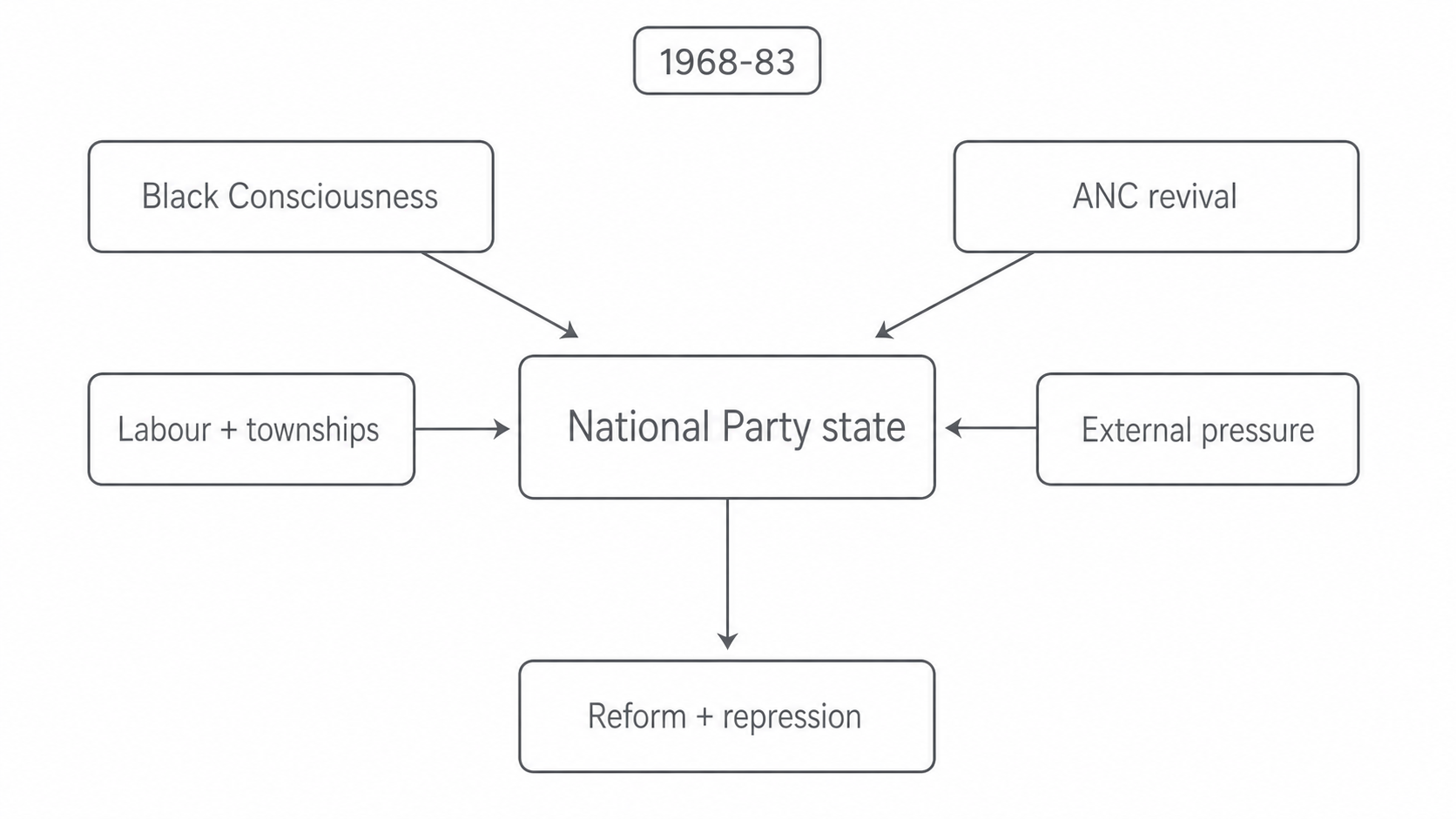
Read every later example as part of that pattern. Soweto, unions, regional change, ANC diplomacy and white political division did not have identical causes, but together they made apartheid harder to govern and harder to defend.
Use this chronology as the spine of the lesson:
| Date | Development | Why it matters |
|---|---|---|
| 1968-69 | SASO emerged, with Steve Biko as first president at its 1969 founding congress | Black Consciousness gave a new generation language of self-reliance and psychological liberation. |
| 25 April-1 May 1969 | ANC Morogoro Conference in Tanzania | The ANC responded to exile crisis by reorganising strategy, leadership and armed struggle. |
| January-February 1973 | Durban strikes involved tens of thousands of African workers | Black labour militancy revived after the quiet of the 1960s and later fed a stronger union movement. |
| April 1974 | Portugal's dictatorship fell | Mozambique and Angola soon became independent, weakening South Africa's regional buffer. |
| 1975 | Mozambique and Angola became independent; Inkatha was revived in KwaZulu | The ANC gained closer regional opportunities, while the Bantustan system faced political complications. |
| 16 June 1976 | Soweto schoolchildren began mass protest against Afrikaans in education | Student resistance exposed the brutality of apartheid and inspired further mobilisation. |
| 1976-81 | Transkei, Bophuthatswana, Venda and Ciskei were declared "independent" | The homelands policy reached its most ambitious form but remained dependent and internationally rejected. |
| 12 September 1977 | Steve Biko died after police detention | His death turned Black Consciousness into a global symbol of state violence. |
| 1977 | Gleneagles Agreement and UN Security Council Resolution 418 | Sporting isolation and a mandatory arms embargo showed growing external pressure. |
| September 1978 | P.W. Botha became prime minister after the Information Scandal weakened Vorster and Mulder | The National Party moved towards "total strategy": limited reform, stronger security and militarisation. |
| 1979 | FOSATU formed; Wiehahn reforms allowed registered African trade unions | The regime tried to manage labour unrest, but legal space also helped unions grow. |
| 1980 | Zimbabwe gained majority rule; ANC special operations attacked SASOL | Regional change and MK activity strengthened the sense of apartheid under pressure. |
| 1982-83 | Conservative Party split, tricameral constitution passed and approved by white referendum | Botha's reforms divided white politics and provoked new anti-apartheid organisation. |
For Paper 2, strong answers should not describe resistance as one smooth upward line. The
state scored real victories: it banned organisations, detained activists, raided neighbouring
states and used reform to divide opponents. The best judgement is about interaction: Black
Consciousness helped revive internal confidence; Soweto supplied recruits and international
outrage; the ANC and global anti-apartheid movement gave the struggle structure; and the
National Party's own responses created new divisions and costs.
Black Consciousness and Soweto
Black Consciousness developed in the space created by repression. After the ANC and PAC were
banned in 1960, and after major leaders were imprisoned or exiled, open African nationalist
politics inside South Africa became extremely difficult. Black university students, however,
still had some room to organise. They were frustrated not only by apartheid but also by the
dominance of white liberals in supposedly anti-apartheid student politics.
Steve Biko was central to this new mood. In 1968, black students met to discuss creating
their own student organisation. In July 1969, at Turfloop, the South African Students'
Organisation (SASO) held its founding congress, and Biko became its first president. SASO
did not mean "black" in the narrow apartheid sense of only African people. Black Consciousness
used "black" politically to include Africans, Coloureds and Indians who were oppressed by
white supremacy.
Black Consciousness
A movement led by Steve Biko and SASO from 1969 that used 'black' politically to include Africans, Coloureds and Indians, and stressed psychological liberation, self-reliance and black-led organisation.
The idea was psychological as well as organisational. Biko argued that apartheid worked partly
by making black people internalise inferiority and dependence. Black Consciousness therefore
emphasised pride, self-reliance, community projects, cultural confidence and black leadership.
This was why the state found it dangerous. It did not immediately produce a mass party able
to defeat the National Party, but it attacked one of apartheid's foundations: fear.
SASO helped create a wider Black Consciousness network. The Black People's Convention
(BPC) was founded in 1972 to take Black Consciousness beyond campuses. Biko was banned in
1973, restricting his movement and speech, but his influence continued through students,
community activists, health projects and the wider language of black self-assertion.
The Soweto uprising grew from this political atmosphere, but it also had a specific school
cause. In 1974 the state ordered that Afrikaans should be used alongside English as a medium
of instruction in parts of African secondary schooling, including subjects such as mathematics
and social science. For many students, Afrikaans symbolised police, officials and white
National Party rule. The policy also exposed the wider injustice of Bantu Education, which
trained black children for inferior social and economic positions.
Students began resisting before June 1976. School boycotts and protests developed in Soweto
in early 1976. The South African Students' Movement (SASM) and local student leaders,
including Tsietsi Mashinini, helped coordinate action. On 13 June 1976, hundreds of students
met in Orlando and planned a peaceful march for 16 June.
On 16 June 1976, thousands of schoolchildren marched through Soweto. They intended to
gather at Orlando Stadium and protest against Afrikaans and Bantu Education. Police blocked
the march near Orlando West. Accounts differ over the exact sequence, but police used force
and then live ammunition. Among the first students killed were Hastings Ndlovu and
Hector Pieterson, whose photographed dying body became an international symbol of
apartheid violence.
The uprising spread beyond one day and beyond Soweto. Funerals, school boycotts, solidarity
protests and confrontations spread through townships and other urban areas. The state
responded with police violence, detentions, trials and censorship. Casualty figures are
contested: the state-appointed Cillie Commission later gave 575 deaths and 3,907 injuries,
while other accounts use different figures. For exam judgement, it is safest to describe the
deaths as hundreds and to focus on the significance: schoolchildren had turned education
policy into a national and international crisis.
Soweto mattered in several ways:
| Significance | Explanation |
|---|---|
| It shattered the image of black political passivity | The protesters were young, urban and willing to confront the state after years of repression. |
| It exposed apartheid's violence | Images and reports of police firing on children damaged South Africa's international legitimacy. |
| It linked education to national liberation | Students rejected not just Afrikaans but the whole racial logic of Bantu Education. |
| It strengthened exile movements | Thousands of young people left South Africa after 1976; many joined the ANC and trained with MK. |
| It showed the limits of state coercion | Police could suppress demonstrations, but the uprising spread anger, not obedience. |
Biko's death intensified this pattern. He was arrested near Grahamstown on 18 August 1977,
severely injured in police custody in Port Elizabeth, transported over 1,000 kilometres to
Pretoria, and died on 12 September 1977 aged 30. The police initially tried to avoid
responsibility. His death drew worldwide condemnation, and his funeral became a major
political event. On 19 October 1977, the government banned a range of Black Consciousness
organisations and closed the newspaper The World.
The impact of Biko's death needs balanced judgement. It removed a gifted and charismatic
leader and helped the state disrupt Black Consciousness organisations. Yet it also made Biko
a martyr. The regime had tried to crush a movement of black self-assertion; instead, it
confirmed the movement's central claim that apartheid depended on violent domination.
The ANC Re-strengthened
The ANC's revival was not automatic. In the early 1970s, the organisation was weak inside
South Africa. Mandela, Sisulu, Mbeki, Kathrada and other Rivonia leaders were imprisoned.
Many activists were banned, detained or driven underground. MK's early sabotage campaign had
been disrupted. The Wankie and Sipolilo campaigns of 1967-68, fought with ZAPU in Rhodesia,
showed bravery but did not create a secure route back into South Africa. Exiled cadres were
frustrated by distance, poor conditions and limited action.
The Morogoro Conference in Tanzania in 1969 was a response to that crisis. It was the
ANC's first major consultative conference in exile. It endorsed a strategy that connected
armed struggle, political mobilisation and international solidarity. It strengthened Oliver
Tambo's authority, created or confirmed structures for revolutionary work, and tried to
repair morale after criticism from younger militants. It did not solve every problem, but it
gave the ANC a framework for survival.
Tambo's importance was that he kept several difficult fronts connected:
| Tambo's role | Why it mattered |
|---|---|
| Diplomat | He built relationships with African states, the OAU, the United Nations, Scandinavian supporters, churches, trade unions and western anti-apartheid groups. |
| Organiser of exile | He had to maintain offices, camps, welfare, education and discipline among exiles scattered across Africa and Europe. |
| Defender of ANC legitimacy | He argued that the ANC, not only Black Consciousness or the PAC, represented the broad liberation struggle. |
| Link between military and political strategy | He supported MK, but also understood that the ANC needed moral and diplomatic legitimacy, not only armed activity. |
External legitimacy grew in the 1970s. In 1974 the UN General Assembly refused to recognise
South Africa's credentials, a symbolic victory for anti-apartheid diplomacy. The ANC appeared
at UN and OAU forums, and international conferences increasingly treated apartheid as a
global issue rather than simply South Africa's internal affair. The global anti-apartheid
movement linked sanctions, prisoner-release campaigns, consumer boycotts, student activism,
church pressure, sporting boycotts and cultural isolation.
Soweto then changed the ANC's prospects. Many young people who fled South Africa after 1976
entered ANC camps, especially in Angola after its independence. This "Soweto generation" gave
the ANC new energy, but also new problems: training, discipline, political education and
safe infiltration routes all had to be managed. Mozambique, Swaziland, Lesotho, Botswana,
Zambia and later Zimbabwe became important, though vulnerable, points in the regional network.
The ANC also reviewed its military strategy. In 1978-79, after Tambo and other ANC figures
studied Vietnam's experience, the ANC developed what became known as the Green Book. Its
aim was not to copy Vietnam mechanically but to think about how armed struggle, underground
work and mass mobilisation could support one another. A Special Operations Unit was created
in 1979 to strike high-profile state and economic targets.
MK activity became more visible. The SASOL attacks of 31 May 1980 were especially important
because SASOL represented strategic economic capacity: fuel production, industrial modernity
and the state's effort to survive sanctions and oil vulnerability. The attacks caused
significant damage and embarrassment. Later attacks, including the 1983 Church Street bombing
in Pretoria, showed increased MK reach, though they also raised difficult questions about
civilian casualties and gave the state propaganda opportunities.
The ANC's revival should therefore be judged carefully. It was not strong enough by 1983 to
defeat the South African state in a military contest. The police, army and intelligence
services remained far stronger. But the ANC had recovered from near invisibility inside the
country. It had recruits, regional routes, diplomatic legitimacy, a growing underground and
international supporters. That re-strengthening mattered because it turned anger after
Soweto into a longer struggle with organisation behind it.
Continue this lesson.
You’re previewing NovaLearn without an account. Create a free account to read the rest.
Create free account