31 Theme 2 - Gaining the cooperation of the localities
This lesson is about how the Tudor Crown made government work beyond Westminster. The core argument is that Tudor rule became more effective because the Crown drew local elites, boroughs, parishes, and office-holders into national government. Yet this was cooperation, not simple command. The monarchy had more laws, more information, and more institutions by 1603 than it had possessed in 1485, but it still depended on unpaid local people to assess taxes, enforce statutes, keep order, host the court, and translate royal policy into local obedience.
The Enquiry Frame
The specification has two halves. The first is about involving the localities in governance, 1485-1603. That means regional councils, Welsh incorporation, borough representation, literacy, and justices of the peace. The second is about the Crown and the country. That means patronage, land, titles, court office, and royal progresses.
For a Paper 3 breadth essay, do not turn this into a list of institutions. The key question is: how did a relatively small central government persuade a large, varied kingdom to obey?
Use this chronological spine:
| Phase | Main pattern | Why it matters |
|---|---|---|
| 1485-1509 | Henry VII rebuilt obedience after civil war through personal monarchy, trusted local agents, finance, bonds, recognisances, JPs, and Parliament when needed. | The Crown had to re-establish authority without provoking another round of noble disorder. |
| 1509-37 | Henry VIII's war finance and religious changes made central government more demanding; the subsidy of 1513 and the Pilgrimage of Grace showed both reach and resistance. | Localities could cooperate when policy was legitimate, but could resist if taxation, religion, or regional liberties seemed threatened. |
| 1535-58 | Wales was legally incorporated; the Council of the North was re-established; Parliament and statute became more important; dissolution lands created new local stakeholders. | The Crown used law and patronage to tie regions and elites more closely to the Tudor state. |
| 1558-88 | Elizabeth relied heavily on JPs, borough MPs, Privy Council orders, lord lieutenants, progresses, and a Protestant political nation. | Local cooperation became more routine, documentary, and gentry-led. |
| 1588-1603 | War, poverty, harvest failure, inflation, recusancy, and Ireland increased pressure on local government. The 1598 poor-relief legislation shows the late Tudor Crown trying to impose national standards through parish and county office-holders. | The state had greater reach by 1603, but its success still depended on local willingness and capacity. |
The central change was not that Tudor England became a modern bureaucratic state. It did not. The Crown still had few paid officials in the shires. The real change was that more local people were made part of royal government: gentry as JPs, boroughs through Parliament, Welsh elites through English law, northern elites through a regional council, parish officers through poor relief, and courtiers through patronage and progress hospitality.
Why Local Cooperation Mattered
In 1485 the Tudor dynasty was new, and the kingdom was not a flat map ruled evenly from London. Local society was shaped by county loyalties, noble affinities, towns, church structures, marcher lordships, northern distance from Westminster, and powerful families whose cooperation mattered. Henry VII won the throne at Bosworth, but victory in battle did not automatically give him daily control over Yorkshire, Cornwall, Wales, the Marches, or the far north.
Tudor government therefore relied on a bargain. The Crown offered order, law, honour, office, access, protection, and sometimes land or titles. Local elites offered obedience, tax assessment, military musters, jury service, local intelligence, hospitality, parliamentary service, and enforcement of statutes. This bargain could be unequal, but it was still a bargain. A JP who under-assessed his neighbours, a borough that chose an awkward MP, a magnate who failed to keep order, or a parish that ignored poor-law duties could blunt royal authority without openly rebelling.
The diagram below keeps that bargain in view. It shows why Tudor rule in the localities was not just a downward command from London.
[DIAGRAM: asset_name: Tudor Crown and locality cooperation bargain; asset_slug: p3_31_02_gaining_the_cooperation_of_the_localities__diagram_01; recommended_method: image_gen; description: Clean 16:9 grey-on-white schematic showing Crown and Local elites linked by a two-way bargain of office and honour in return for taxes, order and musters, with local elites connecting to Counties, Boroughs and Parishes.]
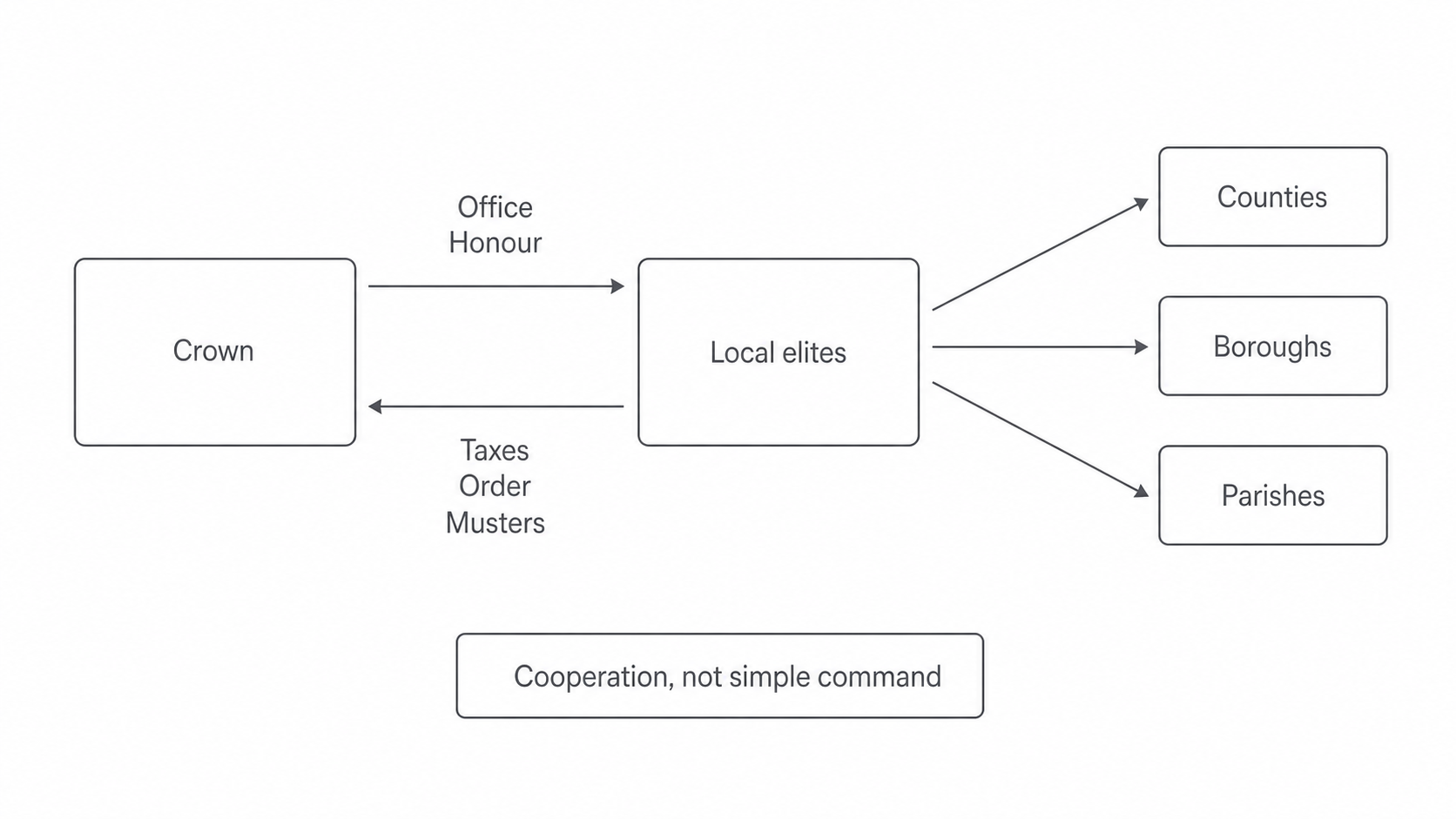
Use it as a reminder that local cooperation was active. The Crown gained reach by making local elites responsible for counties, boroughs and parishes, while those elites gained status and influence from serving the regime.
Henry VII's first priority was to make local power serve the dynasty rather than threaten it. He used attainders, bonds and recognisances against dangerous noblemen, but he also depended on those who could command local respect. He restored and rewarded loyal servants, used councils and commissions, and summoned Parliaments to legitimise taxation and dynastic settlement. His government did not replace local elites with central officials. It made local elites responsible for Tudor order.
The early Tudor subsidy showed why local cooperation mattered. Older fifteenths and tenths were based on fixed quotas for communities and had become increasingly outdated. The Tudor subsidy of 1513 was more ambitious because it assessed individuals on wealth from land, goods, or income. That gave the Crown a more searching way to tax the political nation and helped fund war. Yet the assessment depended on local commissioners, often drawn from the same gentry world as the people being assessed. The Crown gained information and revenue, but only through local knowledge and local negotiation.
Henry VIII's reign exposed the risk of pushing the localities too hard. The Amicable Grant of 1525 failed because it tried to raise money without proper parliamentary consent, and local resistance forced a retreat. The Pilgrimage of Grace in 1536 showed a still deeper problem. Northern rebels objected to religious change, dissolution, taxation, Cromwellian government, and the fear that local customs and institutions were being overridden. Many claimed to be loyal to the king while attacking "evil councillors". That language matters: it shows that obedience to monarchy could coexist with anger at the way royal policy was being delivered.
The lesson for the Tudors was not simply "use more force". Force mattered, and defeated rebels were punished. But the stronger long-term solution was to make local cooperation more structured. That is why the years after 1535 were so important: Wales was incorporated through statute, the Council of the North was re-established, Parliament grew, and JPs became more central to government. The Crown was learning that durable control required institutions, local status, and incentives as well as punishment.
Regional Incorporation: North and Wales
The specification names two key developments in relations with the localities: re-establishing the Council of the North in 1537 and the Law in Wales Acts 1535 and 1542. Both show the same Tudor instinct: difficult regions should be pulled closer into royal government, but through a mix of local personnel and central authority rather than by London officials alone.
The North was a long-standing problem because distance from Westminster, border defence against Scotland, great noble families, and religious conservatism all made direct rule difficult. There had been earlier northern councils before Henry VIII, but the crisis of 1536 made reform urgent. The Pilgrimage of Grace had mobilised huge numbers across northern counties and showed that ordinary people, clergy, gentry, and some nobles could unite around regional and religious grievances.
The re-established Council of the North in 1537 was based at York and acted as a regional arm of royal government. Its purpose was to maintain law and order, supervise local office-holders, hear cases, and give the Crown a stronger presence in Yorkshire, Durham, Northumberland, Cumberland, and Westmorland. It was not merely a concession to northern identity. It was also surveillance. The Council gave northern elites a channel into government, but it also kept them under closer royal watch.
Its significance changed over time. After the Pilgrimage of Grace, it helped restore order and represent royal authority in a region where trust had been damaged. Under Elizabeth, after the Northern Earls' Rising of 1569, its political importance increased again. The presidency of Henry Hastings, Earl of Huntingdon, from 1572 gave the Council a loyal Protestant and royal connection in a region where Catholic noble influence had been dangerous. By 1603, the Council of the North showed that Tudor local governance was not one-size-fits-all: the Crown used regional machinery where ordinary county government seemed insufficient.
Wales was handled differently. The Law in Wales Acts 1535 and 1542 brought Wales and the marcher lordships into a more uniform legal and administrative framework. The Acts ended many marcher privileges, created or regularised counties, extended English law, created representation in Parliament, and established courts and local offices that resembled English county government. The Court of Great Sessions gave Wales a distinctive judicial structure, but within a system tied closely to the English Crown.
This was a major act of state-building. Before the Acts, marcher lordships had allowed powerful families to exercise semi-independent jurisdiction. After them, Welsh gentry could operate inside English legal and parliamentary structures. Wales gained shire and borough representation, and Welsh office-holders could become part of the Tudor governing class. The Crown gained more uniform law, clearer administration, and a less fragmented western border.
There were limits. Incorporation did not mean cultural equality. English became the language of law and office, which disadvantaged many Welsh speakers. Nor did the Acts remove the need for local cooperation. They created a framework through which Welsh elites could serve the Crown, not a central bureaucracy that could govern Wales without them.
Compare the two developments:
| Development | Problem addressed | Method | Main effect |
|---|---|---|---|
| Council of the North, re-established 1537 | Distance, border insecurity, northern conservatism, and the shock of the Pilgrimage of Grace | Regional council at York, staffed by loyal elites and royal appointees | Stronger royal presence in northern governance while still using local knowledge |
| Law in Wales Acts, 1535 and 1542 | Fragmented marcher jurisdictions and uneven legal authority | Statutory incorporation, shiring, English law, courts, MPs, JPs and county offices | Wales was drawn into the English legal and parliamentary state |
The exam judgement is that both developments increased royal control, but neither worked by simple centralisation. The Crown gained cooperation by reshaping the terms on which regional elites governed.
Parliament, Literacy, and the Political Nation
Increasing borough representation in the Commons was another way of gaining local cooperation. In 1485 the Commons had about 296 MPs. By 1558 it had grown to about 400, and by 1603 there were 462 members: 90 knights of the shire and 372 burgesses from boroughs. This was not democratic reform in the modern sense. It was the enlargement of the propertied political nation.
The increase had several causes. Wales and Cheshire gained representation as part of the Henrician state-building process. English borough representation also expanded under Henry VIII, Edward VI, Mary, and Elizabeth. Some new or revived boroughs were small and open to influence by the Crown, nobles, bishops, or local patrons. Others reflected the desire of local gentry and towns to gain access to national politics.
This mattered for cooperation because Parliament became a meeting point between centre and locality. MPs carried local assumptions and local interests to Westminster, but they also carried statutes, taxation, and royal policy back into their counties and towns. A borough that returned MPs was more deeply tied to the state. A local gentleman who sat for a borough learned the language of statute, taxation, privilege, and national counsel. The Crown could use Parliament to make policy lawful, but Parliament also trained local elites to think of themselves as participants in government.
Do not overstate this. Borough franchises varied widely, and many borough elections were controlled by small corporations, patrons, or local oligarchies. Many MPs were country gentlemen representing boroughs with which they had limited personal connection. So increasing borough representation did not mean that ordinary townspeople gained a direct voice. Its real significance was that Tudor government drew more local elites into parliamentary service and made statutory government more familiar across the country.
Literacy strengthened this process. The specification asks for the impact of increasing literacy in the yeoman class. Yeomen were substantial farmers below the gentry but above ordinary husbandmen and labourers. They were not usually the main office-holding class at county level, but they were important in juries, parish life, taxation, musters, leases, local markets, and the social authority of villages. Rising literacy among such people did not make England politically equal, but it changed the texture of local governance.
Increasing literacy mattered in four ways:
Continue this lesson.
You’re previewing NovaLearn without an account. Create a free account to read the rest.
Create free account