2F.1 KT2 - Changing political relationships, 1920-30
Between 1920 and 1930, Indian politics moved from post-war anger to mass civil
disobedience as Gandhi helped turn Congress into a permanent mass organisation. You
will trace how Congress's changing methods, Muslim demands for constitutional
safeguards and Britain's mixture of repression and limited concession reshaped their
relationships. The decade did not bring independence, but it made India both harder
for the Raj to govern and harder for nationalists to unite.
The Enquiry Frame
This Edexcel topic asks you to explain changing political relationships, not just to list
campaigns. Keep asking: who was trying to lead India, by what methods, and with what
claim to speak for Indians?
Four relationships matter:
| Relationship | Main change in 1920-30 |
|---|---|
| Gandhi and Congress | Gandhi became the central Congress figure in 1920 and pushed Congress towards disciplined mass non-cooperation. |
| Congress and its own members | After 1922, Congress argued over council entry, constructive work and whether dominion status was enough. |
| Congress and Muslim politics | Khilafat briefly strengthened Hindu-Muslim cooperation, but the Nehru Report and Jinnah's Fourteen Points showed the breakdown of constitutional agreement. |
| Britain and Indian nationalism | The Raj used repression and imprisonment, but also tried constitutional concessions through the Simon Commission and Irwin Declaration. |
The diagram below compresses those relationships into three lanes. Read it from left to right: Congress becomes more mass-based, Muslim safeguards become more explicit, and British policy keeps moving between control and concession.
[DIAGRAM: asset_name: Changing political relationships, 1920-30; asset_slug: p2_2f1_02_changing_political_relationships_1920_30__diagram_01; recommended_method: image_gen; description: A clean 16:9 grey-on-white schematic with three labelled lanes showing Congress moving towards mass politics, Muslim safeguards moving towards separateness, and the British Raj using control and concession, all feeding into the judgement that India became harder to govern and harder to unify.]
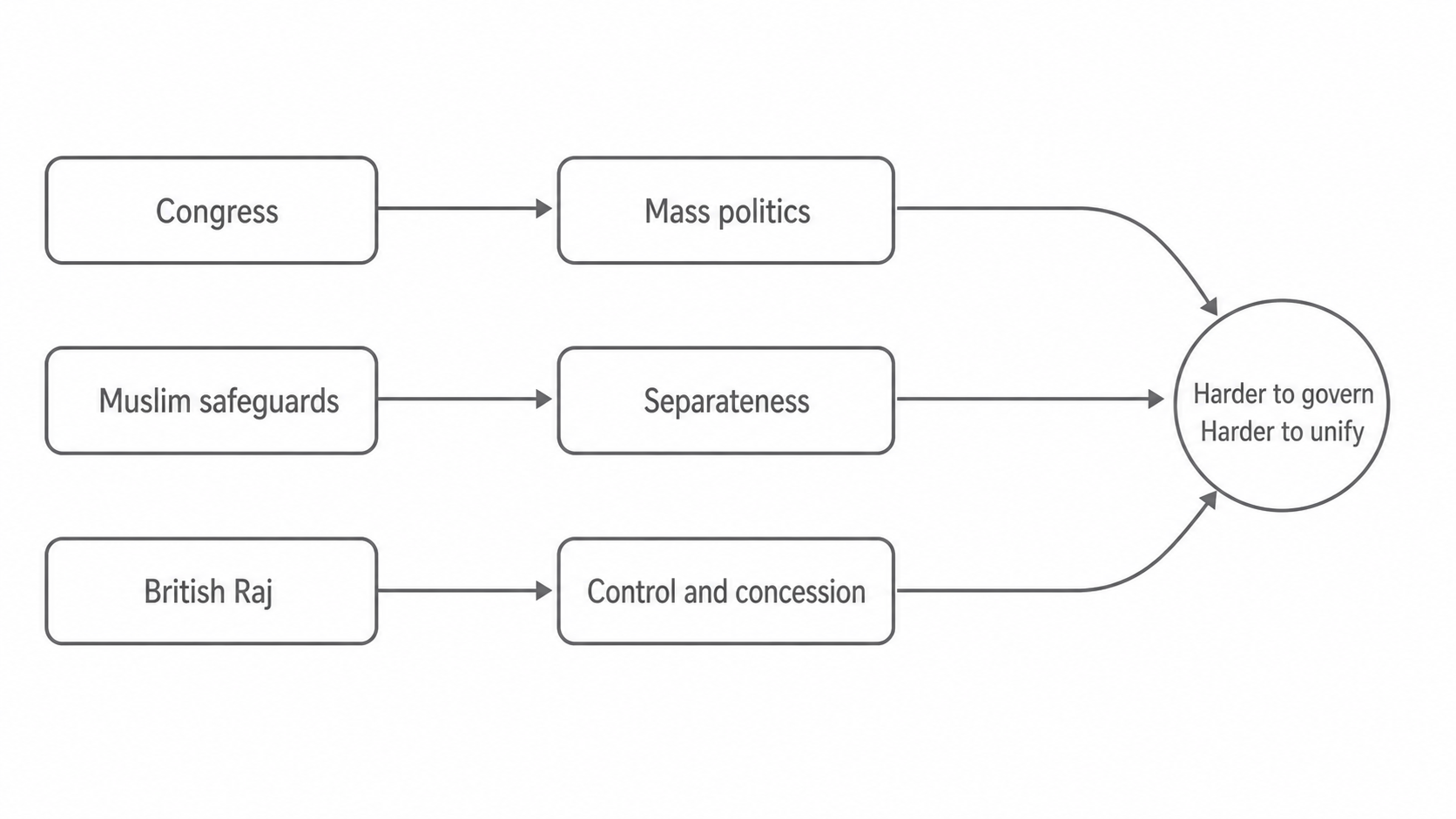
The final node is the argument to carry into essays. The decade made nationalism broader and harder for the Raj to contain, but it also made Congress-League unity more fragile.
The decade can be divided into three phases.
| Date | Development | Why it matters for argument |
|---|---|---|
| September-December 1920 | Congress accepted Gandhi's non-cooperation programme and reorganised at Nagpur | Gandhi became the leading strategist of a more permanent, mass-based Congress. |
| 1921-22 | Non-cooperation spread, then was suspended after Chauri Chaura | The movement showed Congress's reach and Gandhi's insistence on non-violence. |
| March 1922 | Gandhi was imprisoned | The Raj removed the nationalist leader, but also made him a symbol and forced Congress to rethink tactics. |
| 1923 | Swarajists entered elections to the new councils | Congress divided between political participation and Gandhi's constructive "back to basics" programme. |
| 1924 | Khilafat collapsed after the abolition of the Ottoman caliphate | A major basis of Hindu-Muslim mobilisation disappeared. |
| November 1927-February 1928 | Simon Commission appointed and arrived in India | Its all-British membership provoked boycott and protest. |
| August-December 1928 | Nehru Report debated | It proposed dominion status but deepened disagreement with many Muslim leaders. |
| March 1929 | Jinnah's Fourteen Points | Failed reunion attempts hardened the idea that Muslim safeguards had to be non-negotiable. |
| 31 October 1929 | Irwin Declaration | Britain gestured towards dominion status but without an immediate timetable. |
| December 1929-January 1930 | Lahore Congress and public Purna Swaraj declaration | Congress moved from dominion status to complete independence. |
| March-April 1930 | Salt March and start of civil disobedience | Gandhi turned a simple tax issue into a national challenge to British authority. |
For Paper 2, use precise chronology, but do not let chronology replace judgement.
British control, Congress mass mobilisation and Muslim separateness developed together.
Gandhi and Non-Cooperation, 1920-22
Gandhi's aims and beliefs made him different from many earlier Congress leaders. He did
not think self-government could be achieved only by petitions, speeches and elite
negotiation. He argued that British rule depended on Indian cooperation: Indians worked
in British institutions, attended British schools, bought British cloth, practised in
British courts and accepted British honours. If Indians withdrew cooperation in a
disciplined and non-violent way, the Raj would lose moral authority and practical
support.
His core ideas were linked:
| Idea | Meaning in political practice |
|---|---|
| Swaraj | Self-rule, but also self-discipline. For Gandhi, political freedom required Indians to change their own habits and social relationships. |
| Satyagraha | Non-violent resistance based on truth, self-suffering and refusal to obey unjust authority. |
| Ahimsa | Non-violence. This was not weakness; Gandhi treated it as the discipline that made mass politics morally legitimate. |
| Swadeshi and khadi | Use of Indian-made goods, especially homespun cloth, to attack dependence on British imports and symbolise national self-reliance. |
| Hindu-Muslim unity | A practical and moral necessity if Congress was to claim to speak for India rather than one community. |
| Social reform | Work against untouchability, drink, dirt, illiteracy and village poverty as part of national regeneration. |
Gandhi became the effective leader of Congress in 1920 because his method matched the
post-war mood. The Rowlatt Acts, Amritsar massacre and disappointment with the 1919
reforms had damaged trust in British liberal promises. The Khilafat issue also gave
Gandhi a way to connect Congress nationalism with Muslim anti-British mobilisation.
After Bal Gangadhar Tilak died in August 1920, Gandhi faced fewer rivals for national
leadership. At the special Calcutta session in September 1920 and the Nagpur session in
December 1920, Congress accepted non-cooperation.
Nagpur mattered because Congress was reorganised for mass politics. Membership was made
cheap enough for ordinary supporters to join, commonly described as a four-anna annual
subscription. Congress committees were built from local levels up to the provinces and
the all-India leadership. Provincial Congress Committees were reorganised on linguistic
lines, which helped Congress work through Indian languages rather than only English.
The All India Congress Committee and the Congress Working Committee gave the movement
more continuous direction than an annual session could provide. This was a major
political relationship change: Congress began to look less like a pressure group and
more like an alternative national organisation.
The non-cooperation campaign attacked the habits that linked Indians to the Raj.
Indians were urged to surrender titles, boycott official ceremonies, withdraw from
government schools and colleges, boycott law courts, refuse elections to the new
councils, resign from government service where possible, reject foreign cloth and use
khadi. In some places, picketing of liquor shops and foreign-cloth shops became highly
visible. Students moved to national schools. Lawyers gave up practice. Volunteers
collected funds, spread the message and built local Congress organisation.
The movement's significance was enormous, but so were its limits. It reached towns,
villages, students, traders, lawyers, peasants, women and workers unevenly across India.
Many people joined for local reasons: land grievances, anti-police anger, religious
concerns, economic distress or enthusiasm for Gandhi. This made the movement powerful,
but also hard to discipline. Gandhi wanted non-violent self-control; many local
supporters saw non-cooperation as a way to confront landlords, police, moneylenders or
officials.
Chauri Chaura exposed the danger. On 4 February 1922, protesters in the United
Provinces clashed with police and burned a police station, killing 22 policemen. Gandhi
called off the movement nationally on 12 February 1922. Many Congress activists were
furious because they thought the Raj was under pressure. Gandhi's view was different:
if the movement lost non-violent discipline, it lost its moral basis and would invite
destructive repression.
Gandhi's imprisonment in March 1922 was significant in several ways. It showed British
control: the Raj could still arrest and silence the most famous nationalist leader. It
also increased Gandhi's symbolic authority because he appeared willing to suffer for
truth. Yet it removed the movement's central disciplinarian and forced Congress to ask
what it should do without a mass campaign. Imprisonment did not defeat Congress, but it
shifted the argument from "how do we resist?" to "what kind of organisation should we
be between campaigns?"
Congress Reorganised, 1922-27
After 1922, Congress did not simply stop. It became a more complex organisation with
two connected strategies: political participation and "back to basics" constructive
work.
The first strategy was council entry. The Government of India Act of 1919 had created
elected councils, though real power remained limited and the provincial system of
dyarchy kept key areas under official control. During non-cooperation, Congress had
boycotted these institutions. After the movement was suspended, leaders such as
Chittaranjan Das and Motilal Nehru argued that nationalists should enter the councils
and obstruct them from within. They formed the Swaraj Party in 1923.
Swaraj Party
The party formed within Congress in 1923 by Chittaranjan Das and Motilal Nehru to contest elections to the reformed councils and obstruct them from within.
This was called "responsive non-cooperation" or council obstruction. The idea was not
to accept British rule as legitimate, but to expose the weakness of the Montagu-
Chelmsford reforms by blocking budgets, criticising officials and using speeches to
publicise nationalist arguments. Swarajists won notable seats in the 1923 elections and
were especially influential in Bengal and the Central Provinces.
The strategy had strengths. It kept educated nationalists active while Gandhi was in
prison. It restored Congress's appeal to some middle-class Indians who were uneasy with
street politics. It also showed that British-created institutions could become arenas
for anti-British criticism.
Its weakness was that participation could blur into cooperation. If Congressmen sat in
councils, helped debates function and used constitutional language, they could make the
1919 system look more workable. Council entry also divided Congress from the
"No-Changers", who believed that Gandhi's constructive programme mattered more than
legislative obstruction. Das's death in 1925 further weakened the Swarajist momentum.
The second strategy was "back to basics". Gandhi was released from prison in 1924 and
became president of Congress at the Belgaum session that year. He did not immediately
launch another national confrontation. Instead, he emphasised constructive work: khadi,
spinning, village sanitation, basic education, Hindu-Muslim unity, prohibition and the
campaign against untouchability. The All India Spinners' Association, founded in 1925,
symbolised this turn.
It is easy to underestimate this programme because it looks less dramatic than the Salt
March. For Gandhi, however, it was the foundation of swaraj. If Indians wore khadi,
organised villages, rejected social exclusion and built local committees, Congress would
become rooted in everyday life. Constructive work also helped Congress survive between
mass campaigns. Local membership, committees and volunteer networks kept the idea of
national politics alive even when there was no national civil-disobedience movement.
There was still a problem. Many younger leaders thought constructive work was too slow.
By the mid-1920s, Jawaharlal Nehru and Subhas Chandra Bose were
associated with a more impatient, socialist-influenced anti-imperialism. Gandhi later
called them the "young hooligans", a revealing phrase because it showed both affection
and distrust. These leaders wanted renewed action and complete independence, not just
dominion status within the British Empire. They lobbied in the All India Congress
Committee and Congress Working Committee for a more confrontational line.
By 1927, Congress was therefore stronger organisationally but less settled
ideologically. It had local machinery, council experience and constructive work. It
also had a young radical wing pressing for a break with British imperial status
altogether. The Simon Commission would turn that impatience into a national issue.
From Simon to Salt, 1927-30
The Simon Commission changed the mood of Indian politics. The Government of India Act
of 1919 had promised a review after ten years. In November 1927, the Conservative
government in Britain appointed the Indian Statutory Commission, chaired by Sir John
Simon, to examine how the 1919 arrangements were working and what further reforms might
be possible. The timing mattered. It was appointed before the full ten years had passed,
partly because Conservatives wanted to keep control of the reform process before a
possible change of government in Britain and before Indian parties could set the terms
themselves. The problem was its composition: all seven members were British
parliamentarians. There were no Indian commissioners.
This was a classic example of British control disguised as consultation. From the
British perspective, the commission could gather evidence, manage the pace of reform
and keep constitutional change within imperial hands. From the Indian nationalist
perspective, it was insulting: a commission about India's political future excluded
Indians from membership.
The reaction was fierce. At its Madras session in December 1927, Congress resolved to
boycott the commission. Jinnah's section of the Muslim League also opposed it, though
not every Muslim League faction or minority organisation responded in the same way.
When the commission arrived in India in February 1928, it faced hartals, black flags
and the slogan "Simon go back". In Lahore on 30 October 1928, Lala Lajpat Rai was
injured during police action against a protest and died in November. This intensified
anger and helped radicalise some younger nationalists.
Continue this lesson.
You’re previewing NovaLearn without an account. Create a free account to read the rest.
Create free account