1G Theme 2 - Opposition, control and consent, 1918-89
This lesson teaches the Pearson Edexcel 9HI0 Paper 1 theme topic Opposition,
control and consent, 1918-89. Keep three questions together throughout: who
opposed the government, how did the state control or limit that opposition, and
why did ordinary people give, withhold or withdraw consent?
The Breadth Argument
The central change across this topic is not simply that Germany moved from
democracy to dictatorship and then back to democracy. The sharper breadth
argument is that each political system had to solve the same problem in a
different way: how to deal with enemies of the state while persuading enough of
the population that the state itself was legitimate.
Weimar Germany was a real parliamentary democracy with genuine supporters, but
it was born from defeat, revolution and the Treaty of Versailles. Its control of
extremism was legal in form but often improvised, uneven and dependent on older
conservative institutions. Nazi Germany destroyed pluralism altogether. It
controlled people through terror, censorship and propaganda, while also winning
active or passive support from many Germans through national revival, social
inclusion for "racial" insiders, economic recovery and military success. The
Federal Republic after 1949 tried to learn from both failures: it protected
rights, but it also built a defensive democracy able to ban anti-democratic
parties, monitor extremism and use law against terrorism.
The specification has three strands: Opposition to government, 1918-89,
Controlling the people, 1918-89, and Popular support, 1919-89. The
lesson interweaves them because, in a breadth essay, the quality of control
usually affects the type of opposition that is possible, and the nature of
consent affects how much control a regime needs.
The concept model below is the mental shortcut for the whole lesson. Opposition, control and consent all fed into legitimacy, but each regime connected them differently: Weimar's balance was fragile, Nazi control was coercive, and the Federal Republic tried to make control lawful.
[DIAGRAM: asset_name: opposition control consent legitimacy model; asset_slug: p1_1g_02_opposition_control_and_consent_1918_89__diagram_01; recommended_method: image_gen; description: Triangle model on a white background with opposition, control and consent feeding into legitimacy, plus short callouts for Weimar as fragile, Nazi rule as coerced, and the Federal Republic as lawful]
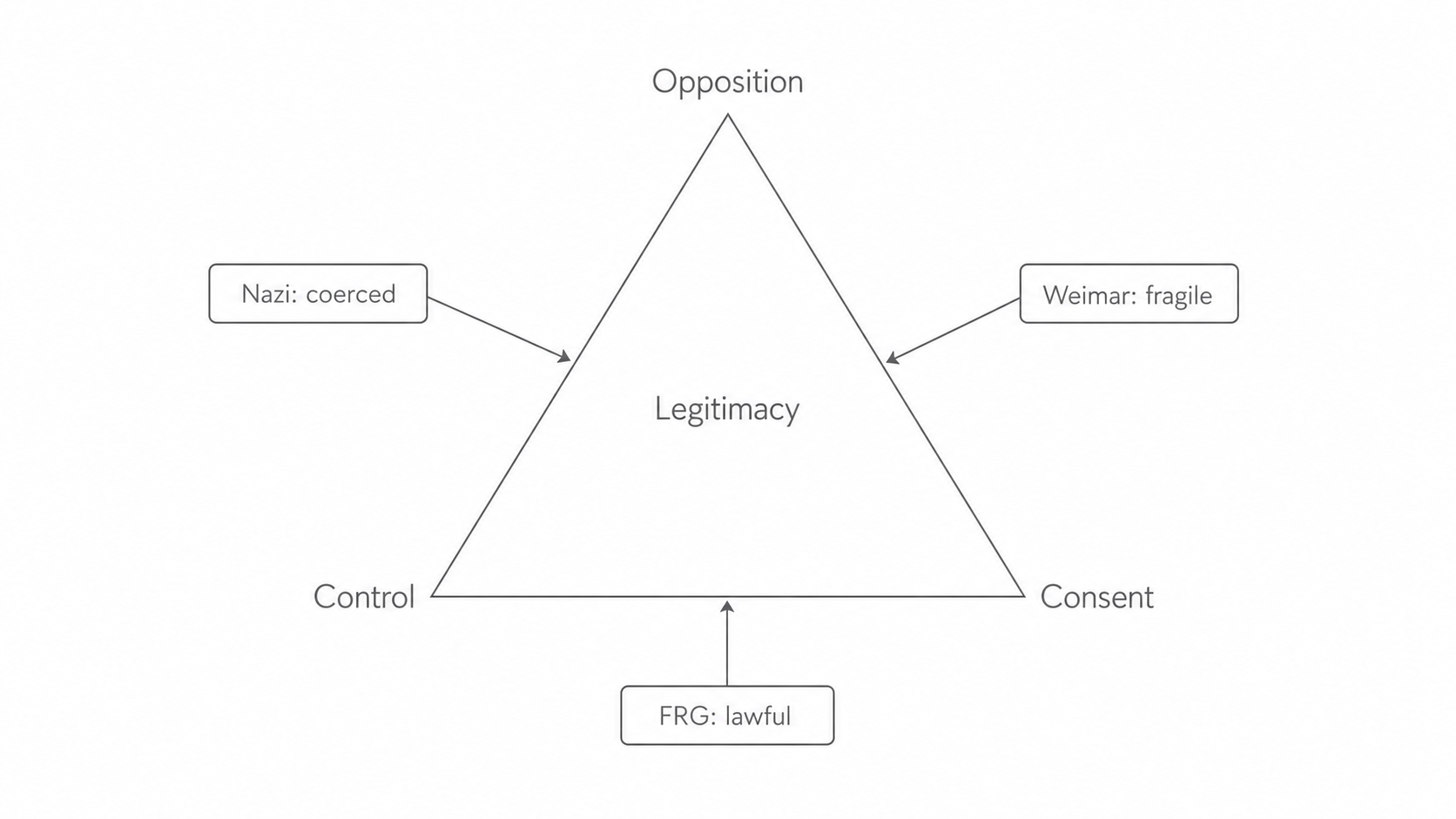
Keep the model dynamic. Stronger control did not always mean stronger consent, and visible opposition did not always mean a regime was about to collapse.
Use this comparison as the spine of the lesson:
| Period | Main opposition problem | Main control method | Nature of consent |
|---|---|---|---|
| 1918-23 | Revolution, Versailles, paramilitary violence, coups from left and right | Emergency powers, Reichswehr and police action, use of Freikorps, bans and the Law for the Protection of the Republic | Strong democratic support existed, especially among Social Democrats, Catholics and liberals, but it was weakened by defeat, inflation and elite hostility. |
| 1924-29 | Extremism remained present but economic and diplomatic recovery reduced its appeal | More normal policing and party politics, with republican defence groups such as the Reichsbanner | Consent became more stable, but often cautious and conditional rather than emotionally secure. |
| 1930-33 | Depression and presidential government made anti-system parties mass forces | Article 48 rule, bans and policing, but parliamentary democracy itself was hollowed out | Support for Weimar collapsed among many voters; Nazis and Communists became powerful protest vehicles. |
| 1933-45 | Any independent political, religious, youth or military challenge was treated as treason | Gleichschaltung, Gestapo, SS, camps, courts, censorship, propaganda and denunciation | Support ranged from ideological commitment to opportunism, fear, gratitude for recovery, nationalism and wartime loyalty. |
| 1945-49 | Nazism had to be removed while democratic habits were rebuilt under occupation | Western Allied de-Nazification, trials, removal from office, questionnaires, licensing and re-education | Consent was initially cautious and shaped by defeat, occupation, hunger and the desire for order. |
| 1949-89 | Extremism, terrorism and mass protest tested a liberal democratic state | Basic Law, Federal Constitutional Court, party bans, domestic intelligence, emergency laws and anti-terror legislation | Support for democracy became much deeper than in Weimar, helped by prosperity, stable institutions, European integration and peaceful government change. |
For Paper 1 breadth essays, avoid treating control and consent as opposites.
Control can sometimes create outward obedience without belief. Consent can exist
even in a system that also uses coercion. Opposition can be morally admirable,
but it can also be anti-democratic, violent or authoritarian. The strongest
answers judge the relationship between the three.
Weimar Crisis, Control and Consent, 1918-33
The Weimar Republic began in November 1918 because the imperial system collapsed
under military defeat, naval mutiny and popular revolution. That origin mattered
for the whole period. The new republic was not created in calm conditions by
politicians with wide elite trust. It was created while Germany was defeated,
hungry, armed and politically divided.
The Treaty of Versailles in June 1919 gave opposition to Weimar a powerful
language. Germany lost territory, accepted disarmament, faced reparations and
was made to accept responsibility for the war in Article 231. Nationalists
called the treaty a Diktat and attacked democratic politicians as "November
criminals". The stab-in-the-back myth claimed that the army had not truly been
defeated but had been betrayed by socialists, republicans and Jews at home. This
was historically false, but politically potent. It meant that many Germans blamed
the new republic for a defeat and treaty it had inherited.
Opposition from the left and right then turned crisis into violence:
| Challenge | What happened | Significance for the topic |
|---|---|---|
| Spartacist rising, January 1919 | Communist revolutionaries in Berlin were crushed with the help of Freikorps units; Rosa Luxemburg and Karl Liebknecht were murdered. | The republic survived, but it depended early on anti-communist military force, damaging trust on the left. |
| Bavarian Soviet Republic, 1919 | A revolutionary socialist regime in Munich was violently suppressed. | Fear of Bolshevism made many middle-class and conservative Germans accept harsh control. |
| Kapp-Luettwitz Putsch, March 1920 | Right-wing forces seized Berlin; the army refused to defend the government, and a general strike helped defeat the putsch. | Popular mobilisation saved the republic, but the Reichswehr's reluctance exposed the weakness of democratic control over the army. |
| Ruhr crisis and hyperinflation, 1923 | French and Belgian occupation of the Ruhr, passive resistance and currency collapse destroyed savings and confidence. | Economic crisis made extremist explanations more attractive and made the state look incompetent. |
| Beer Hall Putsch, November 1923 | Hitler and Ludendorff attempted a right-wing coup in Munich; Hitler received a lenient sentence and used the trial for publicity. | The republic could suppress revolt, but courts and conservative elites often treated right-wing enemies gently. |
| Depression and political breakdown, 1929-33 | Unemployment, coalition collapse and presidential government under Bruning, Papen and Schleicher weakened parliamentary rule. | Extremism became electoral mass politics, not just street violence. |
Weimar governments did try to control extremism. Friedrich Ebert used the
Ebert-Groener understanding with the army in 1918 and relied on Freikorps units
against revolutionary left-wing threats. Presidents and governments also used
Article 48 emergency powers. After the assassination of Foreign Minister Walther
Rathenau in June 1922, the state introduced the Law for the Protection of the
Republic, allowing action against anti-republican violence, incitement and
organisations. The Nazi Party was banned after the Beer Hall Putsch until 1925.
In April 1932 Bruning's government also banned the SA and SS, though Papen soon
lifted the ban.
The problem was not that Weimar did nothing. The problem was that its control was
uneven and politically damaging. The state was often harsher against the left
than against the right. Judges were frequently lenient towards nationalist
violence. The army defended order, but not necessarily democracy. Article 48
could protect the republic in emergencies, but after 1930 it also accustomed
Germany to rule by presidential decree. A tool meant to rescue the constitution
helped empty parliamentary government of meaning.
Popular support for Weimar therefore needs careful judgement. It is too simple
to say that the republic had no supporters. In the January 1919 election, the
main pro-republican Weimar Coalition parties - SPD, Centre and DDP - won a large
majority. The constitution introduced universal suffrage, civil rights, female
voting, parliamentary government and a directly elected president. Many workers,
Catholics, liberals, public servants, local politicians and veterans defended the
republic. The Reichsbanner Schwarz-Rot-Gold, founded in 1924, shows that
republican commitment could be active and emotional, not merely reluctant.
Yet democratic support narrowed after 1919. The coalition lost its overwhelming
majority in 1920. The DDP declined badly. The DNVP, KPD and later NSDAP rejected
or undermined the system from different directions. Some moderate conservatives
accepted Weimar as a practical necessity rather than a positive ideal; these
"republicans by reason" could be valuable in stable years but fragile in crisis.
By July 1932 the Nazis had become the largest party, and the KPD also grew. The
result was not simply that extremists shouted louder. It was that millions of
voters used democracy to support parties hostile to democracy.
The judgement for 1918-33 is therefore double-edged. Weimar's consent was real
but vulnerable. Its control of extremism was active but inconsistent. Versailles,
violence and economic crisis did not make dictatorship inevitable, but they made
it much harder for democratic politicians to persuade Germans that the republic
was the rightful guardian of national recovery.
Nazi Control, Terror and Propaganda, 1933-45
Nazi control after 1933 was built by destroying the legal, institutional and
cultural spaces in which opposition could operate. Hitler became chancellor on
30 January 1933, but he did not yet command an uncontested dictatorship. Civil
rights, federal states, trade unions, parties, newspapers and elections still
existed. The Nazi seizure of power therefore combined legality, intimidation and
emergency.
The Reichstag Fire Decree of 28 February 1933 suspended key civil liberties
after the burning of the Reichstag. Communists, Social Democrats and other
opponents could be arrested while the regime claimed to be defending Germany
from revolution. The Enabling Act of 23 March 1933 then allowed Hitler's
government to pass laws without the Reichstag in most circumstances. It was
passed under intimidation and without Communist deputies present. This matters
for breadth judgement because Nazi control did not begin as a fully secret coup:
it used constitutional language to destroy constitutional government.
Gleichschaltung
'Coordination': the Nazi process of bringing parties, trade unions, the federal states, the civil service, culture and youth under Nazi control, mainly in 1933-34.
Gleichschaltung, or coordination, followed quickly:
| Area controlled | Method | Political effect |
|---|---|---|
| Political parties | Communists and Social Democrats were repressed; other parties dissolved or were forced to dissolve; on 14 July 1933 the Nazi Party became the only legal party. | Organised electoral opposition disappeared. |
| Trade unions | On 2 May 1933 union offices were seized and leaders arrested; the German Labour Front replaced independent unions. | Workers lost independent representation and collective bargaining. |
| Federal states | State governments were brought under Reich control through Nazi commissioners and later legal reorganisation. | Regional autonomy could no longer shield opponents. |
| Civil service and professions | Jews and political opponents were removed through laws and professional purges. | The state and educated professions were made more ideologically obedient. |
| Culture | The Reich Chamber of Culture controlled membership in press, film, radio, literature, music, theatre and art. | Artists and writers needed political acceptability to work publicly. |
| Youth and education | Schools, textbooks, Hitler Youth and League of German Girls promoted racial and political conformity. | Control reached into generational formation, not just adult politics. |
Repression was central. The SA, SS, police and courts created a climate in which
criticism could be dangerous. Dachau opened in March 1933 as an early
concentration camp for political opponents; the camp system later expanded and
radicalised. The Gestapo did not need to watch everyone all the time. It used
informers, denunciations, interrogations, protective custody and fear. The
People's Court, especially after 1934, gave political punishment a public legal
form. After the Night of the Long Knives in June-July 1934, Hitler also showed
that violence could be used inside the Nazi movement and then justified as state
necessity.
Censorship and propaganda worked alongside terror. Joseph Goebbels's Ministry of
Public Enlightenment and Propaganda, created in March 1933, coordinated the
messages Germans heard and saw. Anti-Nazi newspapers were closed or taken over.
Radio ownership was encouraged through cheap receivers; speeches and rallies
were broadcast; film, posters, newsreels, textbooks and public ceremonies
glorified Hitler and the national community. Book burnings and attacks on
"degenerate" art signalled that cultural freedom was over.
Propaganda did more than praise Hitler. It explained reality in Nazi terms. The
regime presented Marxists, Jews, "asocials", disabled people, foreign enemies
and later wartime defeatists as threats to the national community. It turned
obedience into patriotism and exclusion into purification. This is why censorship
and propaganda have to be taught together: censorship removed alternative
interpretations; propaganda supplied the approved interpretation.
The limits of Nazi control are also important. Terror could silence many people,
but it could not make all Germans equally convinced Nazis. Propaganda could
shape public language, but private grumbling, religious loyalties, youth
nonconformity and wartime doubt survived. Still, the regime's achievement as a
dictatorship was formidable: by controlling parties, unions, courts, media,
culture, youth and policing, it made organised national opposition almost
impossible.
Nazi Opposition, Dissent and Support, 1933-45
Opposition in Nazi Germany must be sorted by aim, risk and reach. Opposition
means an attempt to challenge, remove or undermine the regime. Dissent can
mean refusal, criticism, nonconformity or moral protest without a realistic plan
to overthrow Hitler. Both mattered, but neither became a mass national movement.
The first opponents were the organised left. Communists, Social Democrats and
trade unionists had networks, newspapers and political experience, so the regime
targeted them immediately. Some activists printed illegal leaflets, kept exile
links, helped prisoners' families or maintained underground groups. Their
weakness was that repression was intense and the SPD-KPD split from Weimar had
left the left divided. By the later 1930s, most organised left opposition inside
Germany had been broken or pushed into tiny circles.
Religious opposition was more complicated. The Catholic Church and Protestant
churches were not consistently anti-Nazi institutions. Many church leaders hoped
to protect their own organisations rather than defend liberal democracy or Jews.
Even so, conflict developed when the regime interfered with churches, youth
groups, education and moral teaching. The Confessing Church challenged Nazi
attempts to dominate Protestantism; figures such as Martin Niemoeller and
Dietrich Bonhoeffer became associated with religious resistance. Catholic Bishop
Clemens August von Galen's 1941 sermons against the killing of disabled people
show that moral protest could force caution, even though it did not destroy the
regime. Jehovah's Witnesses, who refused loyalty to Hitler and military service,
faced severe persecution.
Youth dissent showed the limits of indoctrination. Some young people rejected
the discipline and conformity of the Hitler Youth. Edelweiss Pirates and Swing
Youth groups varied widely, from style and music-based nonconformity to sheltering
deserters or clashing with Nazi authorities. The White Rose students in Munich
went further by distributing anti-Nazi leaflets in 1942-43 that condemned the
regime and urged moral responsibility. Their courage was immense, but their
reach was small and the Gestapo quickly destroyed the group.
The most famous active challenge came from conservative, military and elite
circles. The Kreisau Circle discussed post-Hitler Germany. Some officers and
civilian conservatives turned against Hitler because of war, military disaster,
criminality or fear for Germany's future. The 20 July 1944 plot, led in action
by Claus von Stauffenberg and linked to Operation Valkyrie, attempted to kill
Hitler and seize control. It failed, and the regime executed or imprisoned many
connected to it. Its significance lies in its seriousness: the army was one of
the few institutions with the practical means for a coup. Its limitation is also
clear: many conspirators had conservative nationalist aims, some had previously
supported aspects of Nazi policy, and the plot came very late.
Why, then, did support for the Nazi regime remain substantial for so long? The
answer is not "everyone was brainwashed" and not "everyone was terrified". The
regime combined coercion with incentives and beliefs:
Continue this lesson.
You’re previewing NovaLearn without an account. Create a free account to read the rest.
Create free account