30 KT5 - Henry VII: seizing and keeping the throne, 1485-97
Henry VII's first twelve years tested whether a weak hereditary claim and victory at Bosworth could become accepted monarchy. You will examine how coronation, marriage, heirs, intelligence and financial controls strengthened his position without removing Yorkist alternatives. Simnel and Warbeck show how dynastic opposition could draw on English, Irish and foreign support, while the Yorkshire and Cornish risings reveal a different danger rooted in taxation and regional grievance. Comparing those threats explains why Henry survived through a mixture of legitimacy, coercion, diplomacy, military force and selective mercy.
Enquiry Frame
This Paper 3 depth topic is about political insecurity. Do not treat it as a list of rebellions. The enquiry is sharper: how did Henry VII claim a throne he had seized, and why did that throne remain vulnerable until 1497?
Start with the problem of legitimacy. Henry Tudor won at Bosworth on 22 August 1485, when Richard III was killed and the Stanley intervention helped decide the battle. Victory gave Henry the crown in practice, but it did not automatically give him secure consent. His hereditary claim came through his mother, Margaret Beaufort, from the Beaufort line descended from John of Gaunt and Katherine Swynford. That line had Lancastrian blood, but it was politically awkward: the Beauforts had originally been born outside marriage and later legitimised, and their claim was weaker than that of several Yorkists descended from Edward III through clearer lines.
That weakness shaped everything that followed. Henry could not simply say, "I won, therefore everyone obeys." He needed to make his reign look legal, providential, dynastic and useful to the political nation. He also needed to stop rivals from using Yorkist blood, Irish support, Burgundian help, Scottish policy or English resentment to reopen civil war.
The specification has three linked strands.
| Strand | What you must know | Historical judgement |
|---|---|---|
| Claiming the throne | Bosworth, coronation, Parliament, marriage to Elizabeth of York, birth of Arthur | Henry strengthened a weak title by layering conquest, law, ceremony and Yorkist connection. |
| Living in fear and seeking security | Spies, bonds, recognisances, control of noble loyalty, intelligence about plots | Henry's insecurity was not paranoia without cause; real Yorkist networks and foreign support existed. |
| Challenges and taxation | Simnel and Lincoln, Warbeck and Stanley, Margaret of Burgundy, Yorkshire 1489, Cornwall 1497 | Dynastic and fiscal threats were different, but both exposed limits to early Tudor authority. |
Before you move into individual episodes, use this diagram as a map of Henry's problem. The weak claim sits at the centre because it made each other pressure more dangerous.
[DIAGRAM: asset_name: Henry VII layered survival strategy; asset_slug: p3_30_05_henry_vii_seizing_the_throne_and_trying_to_keep_it_1485_97__diagram_01; recommended_method: image_gen; description: Clean 16:9 grey-on-white schematic with a central Weak claim box branching to Legitimacy, Security, Yorkist threats and Tax revolts, all converging on Survival by 1497.]
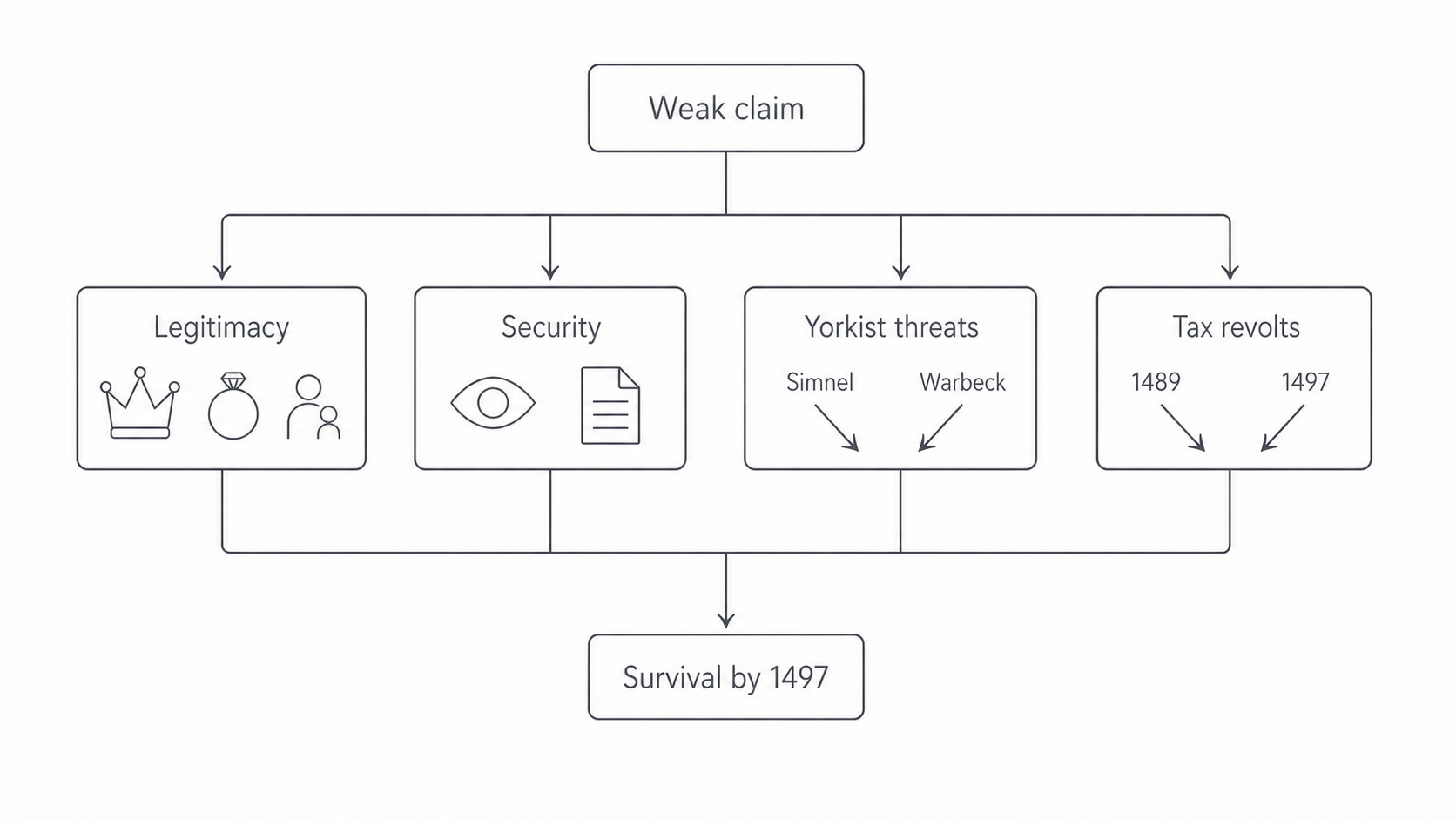
Read the visual from the centre outwards. Henry's survival depended on layering legitimacy-building, coercive security, military response and management of taxation, not on any single policy solving the succession problem.
The date range matters. By 1497 Henry had defeated the Cornish rising, captured Warbeck and weathered the most dangerous early challenges. That did not mean all later insecurity disappeared, but this topic is about the phase when survival itself was the central issue.
Claiming the Throne
Henry's first task was to control the meaning of Bosworth. He did this by presenting himself as king before he sought parliamentary confirmation. His reign was dated from 21 August 1485, the day before the battle. That was a bold legal fiction: it meant that men who had fought for Richard III could technically be treated as traitors against Henry. The point was not just revenge. It asserted that Henry was not merely a rebel who had won a battle; he was the lawful king whose enemies had been in rebellion.
Henry was crowned at Westminster Abbey on 30 October 1485, before his first Parliament met. This sequencing mattered. If Parliament appeared to make him king, his title might look dependent on parliamentary grant. By being crowned first, Henry signalled that kingship came to him by right, conquest and God's judgement, with Parliament confirming rather than creating his rule.
Parliament then helped secure the regime. Acts of attainder punished selected opponents and gave Henry access to lands and bargaining power. A parliamentary recognition of his title gave legal weight to the new settlement. Yet Henry was careful not to punish every former Yorkist. Too much severity would have made reconciliation impossible; too much mercy would have left danger untouched. His policy was selective: reward useful loyalty, punish visible treason, and keep doubtful men under pressure.
The marriage to Elizabeth of York was the most important symbolic act of reconciliation. Elizabeth was Edward IV's eldest daughter and had a stronger Yorkist connection than Henry's Lancastrian one. Henry had promised at Rennes in 1483 to marry her if he succeeded, and the wedding took place on 18 January 1486. The marriage mattered for three reasons.
First, it joined the Lancastrian and Yorkist lines in the new Tudor dynasty. The Tudor rose expressed this claim visually: red and white were folded into one royal badge. Second, it made Henry's future children heirs of both houses. That was more useful than allowing Elizabeth herself to appear as the source of his crown. Henry did not rule as Elizabeth's husband or co-monarch; he ruled in his own right, using the marriage to strengthen the succession. Third, the marriage helped attract Yorkists who could accept peace under a Tudor-Yorkist household more easily than naked Lancastrian conquest.
The birth of Prince Arthur on 20 September 1486 was therefore politically important. His name evoked British legendary kingship and Welsh-Tudor symbolism, but his practical significance was simpler: the dynasty had an heir. A new regime with no heir invites faction. A new regime with a son can ask subjects to imagine continuity.
There were limits. Elizabeth's Yorkist blood did not remove every Yorkist claimant. Edward, Earl of Warwick, son of George Duke of Clarence, remained alive in the Tower. John de la Pole, Earl of Lincoln, had been named Richard III's heir. The de la Pole family and other Yorkist networks still had political weight. Henry's marriage reduced the appeal of Yorkism, but it did not abolish Yorkist politics.
Fear, Security and Control
Henry VII's reputation for suspicion makes most sense if you remember the world he came from. He had spent much of his life in exile, dependent on the shifting interests of Brittany, France and English plotters. He had watched kings rise and fall quickly. In 1485 he also knew that several nobles had changed sides at Bosworth only when the outcome became clear. A king created by a battlefield could be destroyed by another one.
That is why the specification pairs "living in fear" with "striving for security". Fear was personal, but security was political. Henry tried to turn unpredictable noble loyalty into something measurable, enforceable and expensive to break.
Spies and informers were central to this. Henry did not run a modern intelligence service, but he used ambassadors, household servants, merchants, informers, clerics, local officers and double agents to discover plots before they became armies. Intelligence mattered most in the Warbeck years. A pretender who moved between Ireland, Burgundy, France and Scotland could not be defeated only by troops inside England. Henry needed news from ports, courts, noble households and foreign governments.
The exposure of Sir William Stanley in 1495 shows the value and danger of this world. Stanley had helped Henry at Bosworth and became Lord Chamberlain, one of the most important offices at court. Yet he was accused of saying that, if Warbeck really were Edward IV's son, he would not fight against him. Whether this was firm treason or dangerous talk, Henry treated it as fatal. Stanley was executed in February 1495. The case proved that the regime's insecurity reached into the king's household and that old service did not guarantee trust.
Bonds and recognisances were another security tool.
Bond
A written obligation to pay money if conditions were broken.
Recognisance
A formal acknowledgement of a debt or obligation, often recorded in royal administration.
Henry used them to bind nobles and gentry to good behaviour, loyalty, appearance before council, payment of fines or fulfilment of promises. They were not invented by Henry, but his reign intensified their political use.
Their value lay in prevention. Executing every doubtful noble would have been dangerous and wasteful. Letting them act freely was also dangerous. A bond created a pressure point: a noble could keep lands and status, but disloyalty might trigger ruinous financial penalties. This was especially useful in a society where noble affinity, retaining and local influence could turn private discontent into armed challenge.
The limitation was resentment. Bonds could look like legalised intimidation. They did not create love for the Tudor dynasty. They created caution. For Henry, that was often enough. The early Tudor state did not need every noble to be enthusiastic; it needed them to calculate that rebellion was too risky.
Use this distinction in essays. Henry's security methods were not separate from his weakness. They were responses to it. The more insecure the title, the more useful surveillance and financial pressure became. But the harsher the pressure, the more Henry risked confirming the image of a suspicious usurper.
Simnel, Lincoln and Stoke
Lambert Simnel's challenge in 1486-87 was dangerous because the boy was not the real centre of the threat. Simnel was a child pretender, probably trained by the priest Richard Symonds. He was eventually presented as Edward, Earl of Warwick, the Yorkist claimant held in the Tower. If people could be persuaded that Warwick had escaped, then Henry's possession of the real Warwick mattered less than public belief.
Henry's first response was political theatre. He had the real Earl of Warwick displayed in London in early 1487 to disprove rumours. That was sensible, but it did not solve the problem because Simnel's value did not depend only on factual truth. He was a banner around which Henry's Yorkist enemies could gather.
The challenge took shape in Ireland. Ireland had strong Yorkist connections, and the Earl of Kildare's influence made Dublin a useful place for anti-Tudor politics. Simnel was crowned in Dublin as King Edward in May 1487. This was more than a childish episode. A coronation created an alternative royal image and suggested that Henry's authority did not command obedience across the king's lands.
The most important supporter was John de la Pole, Earl of Lincoln. Lincoln was a genuine Yorkist prince and had been treated cautiously by Henry after Bosworth. His decision to back Simnel made the rebellion serious. If Lincoln had won, Simnel might have been discarded, controlled or used as a temporary figurehead. The real issue was whether leading Yorkists could replace Henry under cover of a more attractive claimant.
Margaret of Burgundy was also crucial. She was Edward IV and Richard III's sister, living in the Burgundian Netherlands, and she became a persistent sponsor of Yorkist threats. For Simnel's rebellion she helped provide foreign troops, including German mercenaries under Martin Schwartz. This mattered because it turned exile politics into invasion capacity. Henry could manage many English nobles; he could not simply command Burgundy to stop sheltering Yorkist enemies.
The rebels landed in Lancashire in June 1487 and marched inland. On 16 June 1487 Henry defeated them at the Battle of Stoke, near Newark. The battle was hard fought. Lincoln, Schwartz and many leading rebels were killed. Simnel and Symonds were captured.
Henry's treatment of the survivors reveals his political judgement. Symonds was imprisoned. Simnel was pardoned and put to work in the royal kitchens, later becoming a falconer. This mercy was not softness. It separated the harmless puppet from the dangerous organisers. Executing a child could have made Henry look frightened and cruel; sparing him mocked the rebellion by showing that the "king" had been only a tool.
Continue this lesson.
You’re previewing NovaLearn without an account. Create a free account to read the rest.
Create free account