31 KT2 - Challenging religious changes, 1533-37
This lesson is about the most serious challenge Henry VIII faced after the break with Rome. Between 1533 and 1537 royal supremacy turned religious obedience into political obedience. The Lincolnshire Rising and the Pilgrimage of Grace were not simply "Catholic rebellions", but they were impossible to understand without the impact of Henrician religious change: the attack on papal authority, the dissolution of the monasteries, resentment of Cromwell, regional distrust of the south, legal grievances, taxation fears and the role of leaders who tried to make armed resistance look like loyal petitioning.
The Depth Enquiry Frame
Edexcel treats Challenging religious changes, 1533-37 as a Paper 3 depth key topic. That means you need close knowledge of a short crisis, not a broad survey of the whole Tudor Reformation. The strongest answers explain why religious policy created discontent, how that discontent became organised rebellion, why the threat was serious, and how Henry's government turned negotiation into repression.
The central question is: why did Henrician religious change produce such a dangerous challenge, and why did that challenge fail?
Keep this chronological spine in view:
| Date | Event | Why it mattered |
|---|---|---|
| 1533 | Act in Restraint of Appeals | Appeals to Rome were ended; Henry's marriage case could be settled in England. |
| 1534 | Act of Supremacy and Treasons Act | Henry became Supreme Head of the Church of England; denial of supremacy could be treason. |
| 1535 | Valor Ecclesiasticus and monastic visitations | Cromwell's machinery assessed monastic wealth and gathered evidence for reform or closure. |
| March 1536 | Act for the Dissolution of the Lesser Monasteries | Religious houses with income below 200 pounds a year were targeted for closure. |
| July-August 1536 | Ten Articles and royal injunctions | Doctrine and worship were unsettled; official religion was anti-papal but not fully Protestant. |
| 1 October 1536 | Lincolnshire Rising began at Louth | Local panic over commissioners, dissolution and religious change became armed protest. |
| October-December 1536 | Pilgrimage of Grace | A much larger northern rising, led by Robert Aske, forced the government to negotiate. |
| January-February 1537 | Bigod's rising and further disturbances | Francis Bigod's failed action gave Henry the chance to treat earlier rebels as renewed traitors. |
| 1537 | Executions and northern control | Henry repressed leaders and strengthened royal authority in the north. |
The diagram below turns that chronology into an escalation chain. Focus on how policy made local fear politically explosive, and how dispersal left the rebels vulnerable once Bigod's failed rising reopened the crisis.
[DIAGRAM: asset_name: Escalation of the 1533-37 religious challenge; asset_slug: p3_31_02_challenging_religious_changes_1533_37__diagram_01; recommended_method: image_gen; description: Clean 16:9 grey-on-white flow schematic in sequence from Royal supremacy to Dissolution, Local fears, Lincolnshire, Pilgrimage, Negotiation, Dispersal, Bigod and Repression.]
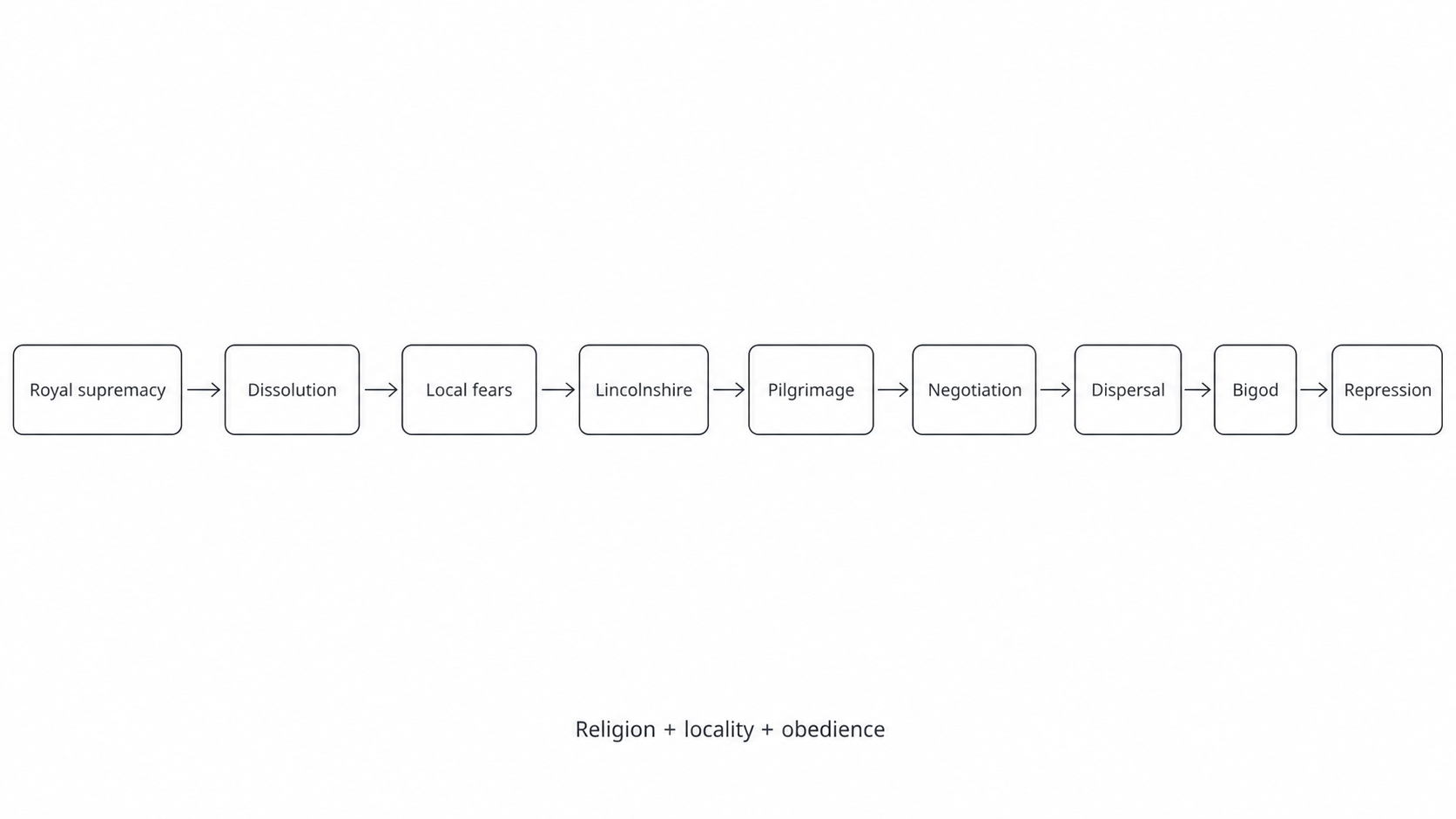
The takeaway is that the risings were not isolated outbursts. They formed a sequence in which religious authority, local anxiety, loyal petitioning and royal punishment fed into each other.
For source work, remember that Paper 3 often asks about the value of a source for a particular enquiry. A rebel article, a government proclamation, a confession, or a letter from Norfolk is not valuable because it is simply "true" or "biased". It is valuable when you connect its origin, purpose, audience and date to the specific enquiry: aims, methods, support, threat, leadership or repression.
Henrician Religious Impact
The impact of Henrician religious change began with the break with Rome. Henry VIII's original problem was dynastic and political: he wanted his marriage to Catherine of Aragon annulled so he could marry Anne Boleyn and secure a male heir. Yet the solution became revolutionary. Between 1533 and 1536, Cromwell steered legislation through Parliament that made the English Church subject to the Crown rather than the Pope.
The most important change was not a sudden conversion to Protestantism. It was a change in jurisdiction. The Act in Restraint of Appeals in 1533 declared that final legal and spiritual authority in England rested within the realm. The Act of Supremacy in 1534 made Henry Supreme Head of the Church of England. The Treasons Act in 1534 made denial of royal supremacy extremely dangerous. This meant that religious disagreement could become political disobedience.
That shift had several consequences:
- Bishops, clergy and religious houses were expected to acknowledge the royal supremacy.
- The Pope's authority was treated as foreign interference.
- Oaths of succession and supremacy forced subjects to make public choices.
- Opposition from high-profile figures such as Thomas More and Bishop John Fisher was punished by execution in 1535.
- Thomas Cromwell gained enormous influence over religious policy, inspection and enforcement.
The dissolution of the monasteries made the change much more visible to ordinary people. In 1535 the Valor Ecclesiasticus assessed church wealth, and Cromwell's visitors investigated religious houses. In March 1536 the Act for the Dissolution of the Lesser Monasteries targeted houses worth less than 200 pounds a year. The Court of Augmentations was set up to handle monastic revenue.
This was not a small administrative reform. Monasteries were woven into local life. They provided prayers for the dead, hospitality, charity, education, employment, medical care, tenancy networks and visible sacred places. Critics of monasteries attacked corruption, wealth and superstition, but many local communities saw the closures as an attack on religion, welfare and custom at the same time.
The impact was especially sharp in the north. Northern religion was often more conservative, monastic houses were important local institutions, and distance from London encouraged suspicion that Cromwell's commissioners were outsiders attacking both faith and regional liberties. Rumours mattered. Even where government policy did not formally threaten parish churches, people feared that plate, jewels, bells or parish goods might be seized next.
There was also a doctrinal ambiguity that made the crisis more confusing. Henry's Church rejected papal authority, but Henry was not a straightforward Protestant. The Ten Articles of 1536 gave some space to reforming ideas, but traditional beliefs and practices did not vanish. For many rebels, the problem was not that Henry had become an evangelical reformer overnight. It was that the king and Cromwell had interfered with the old Church, attacked religious houses, promoted "heretical" advisers, and demanded obedience to royal supremacy.
The key judgement is this: Henrician religious change was dangerous because it joined belief, property, locality and obedience. The break with Rome altered authority; the dissolution altered communities; the oath turned conscience into loyalty; and Cromwell's machinery made change feel immediate.
The Lincolnshire Rising
The Lincolnshire Rising began at Louth on 1 October 1536. Its immediate trigger was local fear of royal commissioners. People believed that commissioners connected to Cromwell's religious policy would inspect clergy, close religious houses, seize church goods, and perhaps interfere with parish worship. The rising then spread through parts of Lincolnshire and reached Lincoln.
The causes were layered:
| Cause | How it worked in Lincolnshire |
|---|---|
| Dissolution | The closure of lesser monasteries threatened religious houses and their local social functions. |
| Religious conservatism | Many protesters wanted to defend traditional worship, sacraments, holy days and parish religion. |
| Hostility to Cromwell | Cromwell was blamed as the "low-born" minister driving religious change and intrusive government. |
| Taxation fears | Commissioners and subsidies fed suspicion that the Crown wanted more money from the localities. |
| Local leadership and rumour | Clergy, townspeople and some gentry helped turn anxiety into organised protest. |
The rising's aims were partly religious and partly political. Rebels wanted the dissolution halted or reversed, heretical bishops and advisers removed, traditional worship protected, taxation grievances heard, and the king informed of the harm supposedly being done in his name. Like many Tudor rebels, they claimed loyalty to the king while attacking his ministers. That language mattered because it made rebellion appear as correction, not treason.
The methods were those of armed petitioning. Rebels gathered in large numbers, rang bells, took oaths, marched to Lincoln, occupied a major religious and civic centre, and drew up articles of complaint. There was violence and coercion: officials were threatened, documents were destroyed, and local gentlemen could be pressured to join or represent the movement. But the rebels did not have a clear plan to march on London or overthrow Henry.
The nature of support was broad but unstable. Commons, clergy, townspeople and some gentry were involved. Yet gentry support was often reluctant, cautious or coerced. That weakness mattered. Tudor rebellion usually became more dangerous when people with status, arms, administrative experience and local authority committed themselves firmly. In Lincolnshire, support was large enough to frighten the government but not solid enough to survive royal pressure.
The extent of threat was real but limited. The rising may have drawn tens of thousands and showed that religious policy had created explosive anger. However, Henry refused to negotiate with armed subjects. The Duke of Suffolk's forces approached, the king's reply denied the rebels' legitimacy, and the movement collapsed by mid-October. Repression followed, including executions of leaders and participants.
For source utility, a record of interrogations after the Lincolnshire Rising can be very useful for the local origins of protest, because it may reveal what people said, feared, and did at Louth. Its limitation is just as important: testimony taken after defeat was shaped by fear, self-protection and the government's search for blame.
The Pilgrimage of Grace
The Pilgrimage of Grace began almost immediately after the Lincolnshire Rising and became far more serious. Its main centre was Yorkshire, but it drew support across much of the north. Robert Aske, a Yorkshire lawyer and gentleman, gave the movement its religious language: a "pilgrimage" for grace and the commonwealth rather than a rebellion against the king.
Continue this lesson.
You’re previewing NovaLearn without an account. Create a free account to read the rest.
Create free account