2F.1 KT4 - The road to independence, 1942-48
Between 1942 and 1948, wartime crisis gave way to British withdrawal, independence and
partition. You will distinguish why Britain left from why power was transferred to two
states, following the interaction of war, Indian nationalism, Congress-League rivalry,
failed negotiations and British exhaustion. This distinction helps explain why
independence was both a nationalist victory and a traumatic, violent imperial exit.
The Enquiry Frame
The specification begins in 1942, when Britain needed Indian cooperation more urgently than ever. Japan had conquered Malaya, Singapore and Burma, bringing war to India's eastern frontier. India was not a remote colony watching the war from the sidelines: it was a military base, a source of troops and supplies, and a possible target. By the end of the war about 2.5 million Indians had served in the British armed forces, while Indian civilians faced inflation, shortages, repression and famine.
The topic ends in 1948 because independence was not a neat midnight ceremony and then calm. Pakistan and India became independent in August 1947, but the consequences of partition, refugee movement, communal violence, the division of assets and armed conflict over Kashmir continued into 1948. The exam issue is therefore about both transfer of power and the form that transfer took.
Use this chronological spine:
| Date | Event | Why it matters |
|---|---|---|
| February-March 1942 | Singapore falls; Japan advances into Burma | The threat of invasion makes Indian cooperation a strategic necessity. |
| 22 March-12 April 1942 | Cripps Mission | Britain offers post-war dominion status but no immediate real transfer of power. |
| 8-9 August 1942 | Quit India resolution followed by arrests | Congress moves to mass confrontation; Britain crushes the campaign and jails the leadership. |
| 1943 | Bengal Famine; Wavell becomes Viceroy | Wartime rule is associated with administrative and moral failure. |
| 25 June-14 July 1945 | Simla Conference | Wavell's attempt at an Indianised Executive Council fails over Muslim representation. |
| July 1945 | Labour wins British general election | Attlee's government is more willing to transfer power, but still wants an orderly settlement. |
| Winter 1945-46 | Central and provincial elections in India | Congress dominates general seats; the Muslim League proves its strength in Muslim seats. |
| March-June 1946 | Cabinet Mission | Last major attempt to preserve a united India through a weak centre and provincial groupings. |
| 16 August 1946 | Direct Action Day | League pressure for Pakistan turns into mass communal violence in Calcutta and beyond. |
| 2 September 1946 | Interim Government under Nehru begins | Congress enters central government; League participation later deepens deadlock rather than solving it. |
| 20 February 1947 | Attlee announces transfer by June 1948 | Britain fixes a deadline and admits it cannot wait indefinitely for agreement. |
| 24 March 1947 | Mountbatten becomes Viceroy | Withdrawal is accelerated and partition becomes the working solution. |
| 3 June 1947 | Mountbatten Plan announced | British India is to be divided into India and Pakistan. |
| 18 July 1947 | Indian Independence Act | Parliament creates the legal framework for two independent Dominions. |
| 14-15 August 1947 | Pakistan and India become independent | Formal British rule ends, but the boundary award is still unpublished. |
| 17 August 1947 | Radcliffe Awards published | New borders in Punjab and Bengal intensify uncertainty, migration and violence. |
| 1948 | Refugee crisis, Kashmir war and Gandhi's assassination | The consequences of partition remain central after independence. |
For Paper 2, always keep two questions separate. First, why did Britain leave? War weakened Britain, strengthened Indian claims, raised American pressure and made repression harder to justify. Second, why did Britain leave through partition? The answer lies in Congress-League rivalry, electoral mandates, failed federal schemes, communal violence, and the British decision that speed mattered more than an agreed united constitution.
The diagram below separates those two questions visually. The upper lane explains the weakening of British rule, while the lower lane explains why the transfer of power took a divided form.
[DIAGRAM: asset_name: Withdrawal and partition, 1942-48; asset_slug: p2_2f1_04_the_road_to_independence_1942_48__diagram_01; recommended_method: image_gen; description: A clean 16:9 grey-on-white schematic with two lanes, one showing war pressure, exhaustion and withdrawal as reasons Britain left, and the other showing elections, deadlock and violence as reasons partition shaped the transfer of power.]
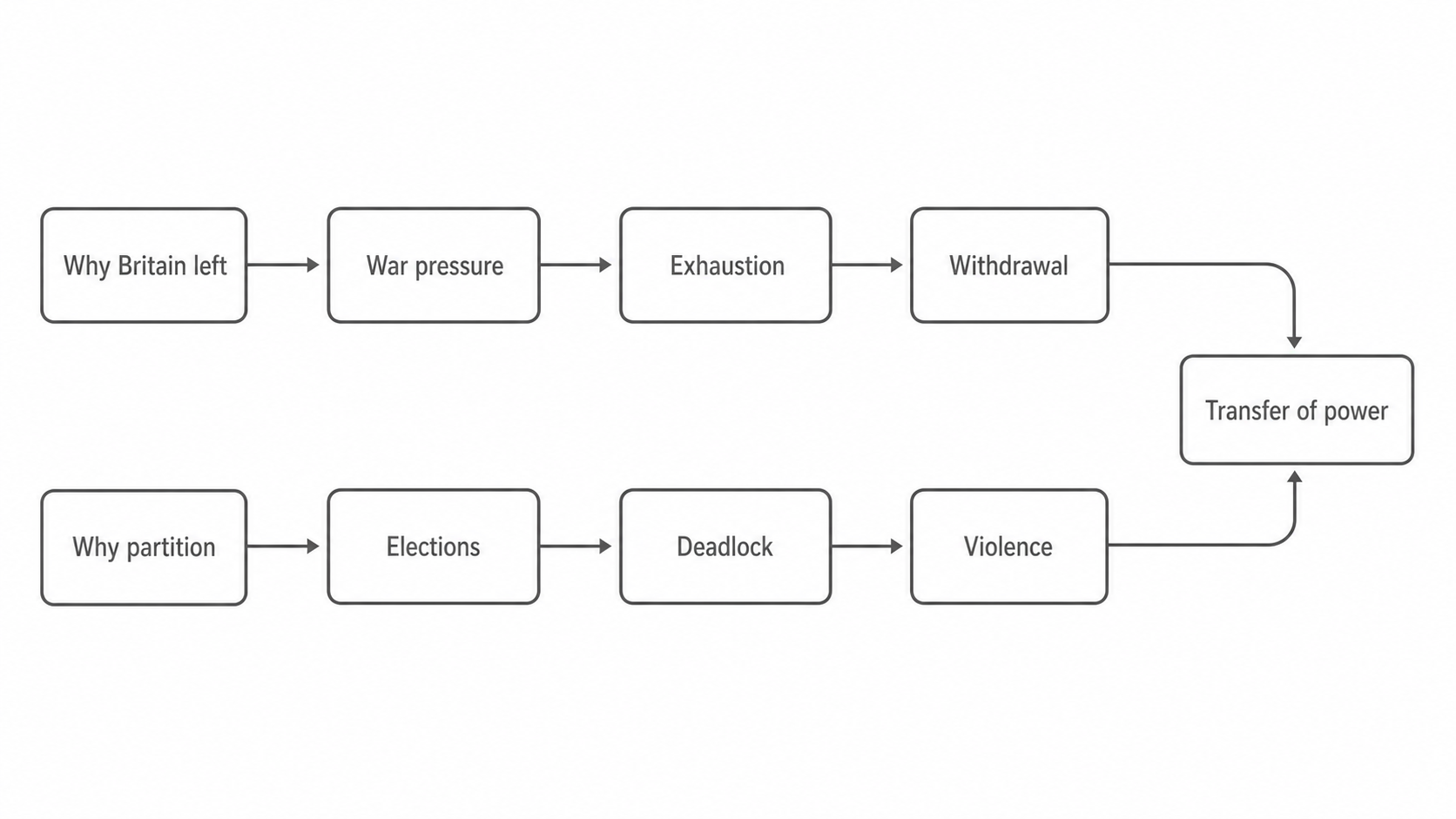
Use the split lanes as a planning check. An answer that explains only British weakness misses partition, while an answer that explains only communal division misses why Britain could no longer sustain the Raj.
War, Cripps and Quit India
The Second World War changed Indian politics because it exposed a contradiction at the heart of British rule. Britain claimed to be fighting for freedom against fascist aggression, but India had been taken into the war in September 1939 by the Viceroy, Lord Linlithgow, without consultation with Indian political leaders. Congress ministries had resigned in protest in 1939. By 1942, the war had made that constitutional grievance much more urgent.
The immediate trigger was the Japanese advance. Singapore fell in February 1942, a major blow to British imperial prestige. Burma then fell, cutting off rice imports and bringing Japanese forces close to India's north-east frontier. Japanese aircraft attacked ports on India's east coast, and the Bay of Bengal became a war zone. For Gandhi and Congress, the danger seemed to prove that British rule did not protect India; it attracted attack while denying Indians the right to decide their own war policy. For Britain, the danger proved the opposite: it made India too important to risk by a sudden transfer of defence control.
The Cripps Mission was sent to India in March 1942 to break the deadlock. Sir Stafford Cripps was a left-wing British politician and a member of Churchill's War Cabinet. His proposals offered:
| Cripps proposal | Why it seemed significant | Why it failed |
|---|---|---|
| Dominion status after the war | It promised India a constitutional route to self-government. | Congress wanted immediate power, not a post-war promise. |
| A constitution-making body after the war | It recognised that Indians should frame the new constitution. | It postponed the key decision until after Indian cooperation had already been given. |
| Provinces could opt out of the future Indian Union | It reassured the Muslim League that a single Congress-led India would not be forced on all provinces. | Congress saw this as a possible route to partition. |
| Britain would retain control of defence during the war | It protected the Allied war effort. | It left the Viceroy and Commander-in-Chief with the real power Congress most wanted changed. |
Congress rejected the offer because it gave too little immediately and threatened India's unity. Gandhi dismissed it as a promise payable only in a failing future. The Muslim League did not accept it either, because it did not explicitly grant Pakistan, although the opt-out clause strengthened Jinnah's bargaining position. The failure mattered because it convinced Congress that negotiation under Churchill would not produce independence during the war.
The result was the Quit India Campaign. On 8 August 1942, the All India Congress Committee in Bombay endorsed a mass movement demanding immediate British withdrawal. Gandhi's slogan was "Do or Die". British authorities acted first: on 9 August they arrested Gandhi, Nehru, Patel, Azad and much of the Congress leadership under wartime emergency powers.
The arrests had two contradictory effects. They prevented Congress from directing a disciplined non-violent movement, but they also triggered spontaneous resistance. Protests, strikes, sabotage of railways and telegraph lines, attacks on police stations, underground radio and local "parallel governments" appeared in parts of India, especially Bihar, the United Provinces, Bombay Presidency and Bengal. British repression was harsh: troops were used, censorship tightened, aircraft were sometimes used against crowds, thousands were killed or wounded, and roughly 60,000 people were arrested in the first months of the campaign.
Quit India did not force Britain out in 1942. By early 1943 the movement had largely been crushed, and most Congress leaders remained imprisoned until 1945. Yet its repercussions were enormous:
- It showed that Britain could still coerce India in wartime, but only by ruling against the largest nationalist party.
- It removed Congress from open politics for much of the war, allowing the Muslim League more space to organise.
- It convinced many British officials that another mass uprising after the war would be much harder to suppress.
- It made constitutional delay look dangerous, because repression had not restored consent.
That is the key exam judgement. Quit India was a short-term defeat for Congress but a long-term warning to Britain. It did not win independence directly; it made continued imperial rule look unstable and morally costly.
Wavell, Famine and Simla
Lord Wavell became Viceroy in 1943 after a career as a soldier and Commander-in-Chief in India. His appointment mattered because it showed that India was still being governed through a wartime security lens. Wavell was more realistic than Churchill about the need for political movement, but he was not a revolutionary decoloniser. He wanted to stabilise India, revive constitutional talks, and keep Indian cooperation for the war.
The setting for his appointment was grim. The Bengal Famine of 1943 killed around three million people through starvation and disease. Its causes were complex: the fall of Burma cut rice imports, wartime inflation pushed food beyond the reach of many workers, the state prioritised military needs, transport and boat-denial policies disrupted local exchange, and hoarding and speculation worsened scarcity. The crucial point for this lesson is not to turn the famine into a single-cause argument. It is that famine damaged the legitimacy of British rule at exactly the moment Britain claimed to be the responsible guardian of India.
The famine affected politics in several ways:
| Impact | Political significance |
|---|---|
| Humanitarian disaster | It exposed the weakness of provincial and imperial administration in wartime. |
| Inflation and food insecurity | It linked everyday suffering to the war economy and British priorities. |
| British censorship and delay | It encouraged nationalist claims that imperial rule protected its own reputation before Indian lives. |
| Wavell's relief efforts | They showed some administrative response, but could not undo the wider damage. |
Wavell's major political initiative was the Wavell Plan, tested at the Simla Conference from 25 June to 14 July 1945. He proposed reconstructing the Viceroy's Executive Council so that all members except the Viceroy and Commander-in-Chief would be Indian. There would be parity between caste Hindus and Muslims, and the Council would include representatives of major communities. This was meant to bring Indian leaders into central government before a final constitutional settlement.
The plan failed over representation. Jinnah insisted that the Muslim League should nominate all Muslim members of the Executive Council. Congress refused, partly because it claimed to represent all Indians, including nationalist Muslims such as Maulana Azad, who was then Congress president. If Congress accepted Jinnah's demand, it would concede that the League alone spoke for India's Muslims. If Jinnah accepted Congress-nominated Muslims, he weakened the League's claim to be the sole spokesman of Muslim India.
This is why Simla is more than another failed conference. It revealed that the argument had moved from how much power Britain should transfer to who had the right to receive power. Wavell could propose an Indianised Executive Council, but he could not make Congress and the League accept the same definition of Indian representation.
The changing relationship between Britain and India in 1942-45 should therefore be understood in layers:
- War weakened British prestige: Singapore and Burma showed that Britain was not invincible in Asia.
- War strengthened Indian bargaining power: Britain needed Indian troops, labour, bases, railways, food and political calm.
- War made nationalism more urgent: Indian leaders argued that a people asked to fight for freedom should not be denied it.
- War strengthened the League as well as Congress: Congress imprisonment after Quit India gave Jinnah time to build organisation and British access.
- The United States mattered, but indirectly: Roosevelt's government disliked old-style colonialism and wanted Indian cooperation, but it would not break the wartime alliance with Britain over India.
- Labour's victory in 1945 changed the tone: Attlee's government was more sympathetic to self-government than Churchill's coalition had been, but it still wanted an orderly transfer that protected British interests and avoided civil war.
Continue this lesson.
You’re previewing NovaLearn without an account. Create a free account to read the rest.
Create free account