2F.1 KT3 - Consultation and confrontation, 1930-42
Between 1930 and 1942, British consultation produced conferences, constitutional reform
and provincial elections, yet no stable agreement about who should govern India. You
will trace how disputes over representation, continued British control, party rivalry
and the Second World War turned consultation into confrontation. This explains why the
1935 settlement widened Indian participation while leaving the central question of
sovereignty unresolved.
The enquiry frame
The central enquiry is: why did constitutional consultation between 1930 and 1942 deepen confrontation rather than produce an agreed route to independence?
This topic has four connected strands:
- failure of the three Round Table Conferences, 1930-32
- political developments from 1932 to 1935, especially the Communal Award and the Yeravda or Poona Pact
- the Government of India Act 1935, its partial implementation and the impact of the 1937 elections
- Indian reactions to the Second World War, including Congress, the Muslim League, the Lahore Resolution, the August Offer and Subhas Chandra Bose's search for Axis support
The pattern is easier to see as a sequence of bargaining moments.
| Date | Development | Why it matters for judgement |
|---|---|---|
| 12 Nov 1930-Jan 1931 | First Round Table Conference in London | Congress was absent, so consultation lacked the largest nationalist organisation. |
| 5 Mar 1931 | Gandhi-Irwin Pact | Congress suspended civil disobedience and Gandhi agreed to attend the second conference. |
| Sep-Dec 1931 | Second Round Table Conference | Gandhi attended, but disputes over communal representation and British safeguards blocked agreement. |
| 16 Aug 1932 | Ramsay MacDonald's Communal Award | British ministers imposed a solution on representation after consultation failed. |
| 20-24 Sep 1932 | Gandhi's Yeravda prison fast and the Poona Pact | Gandhi and Ambedkar compromised on Depressed Classes representation, but the episode exposed deep divisions inside Indian politics. |
| 1935 | Government of India Act | Provincial autonomy was created, but the all-India federation was never fully implemented. |
| 1937 | Provincial elections under the Act | Congress gained office in most provinces it dominated; the Muslim League performed poorly but then reorganised. |
| Apr 1939 | Bose resigned as Congress president | Congress was divided over office, socialism, planning and how aggressively to confront Britain. |
| 3 Sep 1939 | Linlithgow declared India at war with Germany | The viceroy's unilateral decision made the limits of constitutional reform unmistakable. |
| Oct-Nov 1939 | Congress ministries resigned | Congress rejected responsible office without control over war and independence. |
| 22 Dec 1939 | Muslim League "Day of Deliverance" | Jinnah used Congress resignation to present the League as a separate political force. |
| 23 Mar 1940 | Lahore Resolution | The League moved towards a demand for Muslim-majority areas to form sovereign units. |
| 8 Aug 1940 | August Offer | Britain promised postwar constitutional discussion but gave no immediate transfer of power. |
| 1941-42 | Bose operated from Germany and Axis radio networks | Bose represented a militant anti-British strategy outside Congress constitutional and Gandhian methods. |
For Paper 2, this content can support AO1 essays and AO2 source evaluation. A British conference statement may be valuable for showing what officials thought was practical, but it will understate nationalist impatience. A Congress resolution may reveal the language of national sovereignty, but not necessarily the fears of Muslims, Sikhs, Dalits, princes or British Conservatives. A Muslim League report on Congress ministries may show how the League built its case, but it may exaggerate grievance for political effect. Strong answers use provenance and content together.
Round Table failure
The Round Table Conferences were held in London because the old reform framework had run out of authority. The Government of India Act 1919 had promised gradual responsible government, but by the late 1920s Indian politics had moved faster than British reform. The Simon Commission, appointed in 1927 to review the 1919 settlement, contained no Indian members. Its report was therefore widely attacked in India. By 1930, Congress had moved to civil disobedience after the Salt March, and British ministers needed a constitutional process that looked more consultative than the Simon Commission.
The First Round Table Conference met from November 1930 to January 1931. It included princes, Muslims, Hindus, Sikhs, Indian Christians, Anglo-Indians, Europeans, Liberals, landlords and other interests, but not Congress. Congress leaders were involved in civil disobedience and many were imprisoned. This was the central weakness of the first conference. It discussed important ideas, especially an all-India federation including British Indian provinces and princely states, and it accepted dominion status as a broad goal. But without Congress, it could not claim to represent the strongest mass nationalist pressure in India.
The Gandhi-Irwin Pact of 5 March 1931 tried to repair that weakness. Congress agreed to suspend civil disobedience and attend the next conference. The government agreed to release many political prisoners, withdraw many repressive ordinances and allow limited salt collection. The pact mattered because it brought Congress into consultation, but it also created high expectations. If Gandhi went to London and returned with little, many nationalists would see consultation as a trap.
The Second Round Table Conference, from September to December 1931, was the decisive failure. Gandhi attended as the sole Congress representative. His position was powerful but also risky. He claimed that Congress represented the Indian nation as a whole. Other delegates rejected that claim. Muslim leaders, Sikhs, Depressed Classes representatives such as B. R. Ambedkar, Indian Christians, Anglo-Indians, Europeans and princes argued that Congress did not speak for them. The argument was not only personal rivalry. It was about what kind of India would exist if the British withdrew or transferred power.
The hardest issue was separate electorates, called "separate elections" in the specification topic. Under separate electorates, voters from a particular community elected representatives from that same community. Muslims had had separate electorates since 1909, and many minority spokesmen saw them as political insurance against a Hindu-majority Congress-dominated future. Gandhi rejected separate electorates for the Depressed Classes because he believed they would split Hindu society and weaken national unity. Ambedkar supported separate political safeguards because Dalits could be oppressed inside Hindu society as well as by British rule. Jinnah and other Muslim figures wanted guarantees that a future constitution would not leave Muslims permanently outvoted.
The diagram below helps you hold the conference problem in one view. Each pressure points towards a possible settlement, but each also pulls the settlement in a different direction.
[DIAGRAM: asset_name: Why consultation became confrontation; asset_slug: p2_2f1_03_consultation_and_confrontation_1930_42__diagram_01; recommended_method: image_gen; description: A clean 16:9 grey-on-white schematic showing Congress national claim, minority safeguards, British control, and princely autonomy all pulling towards an unresolved settlement question, with a dashed arrow from failed settlement to confrontation.]
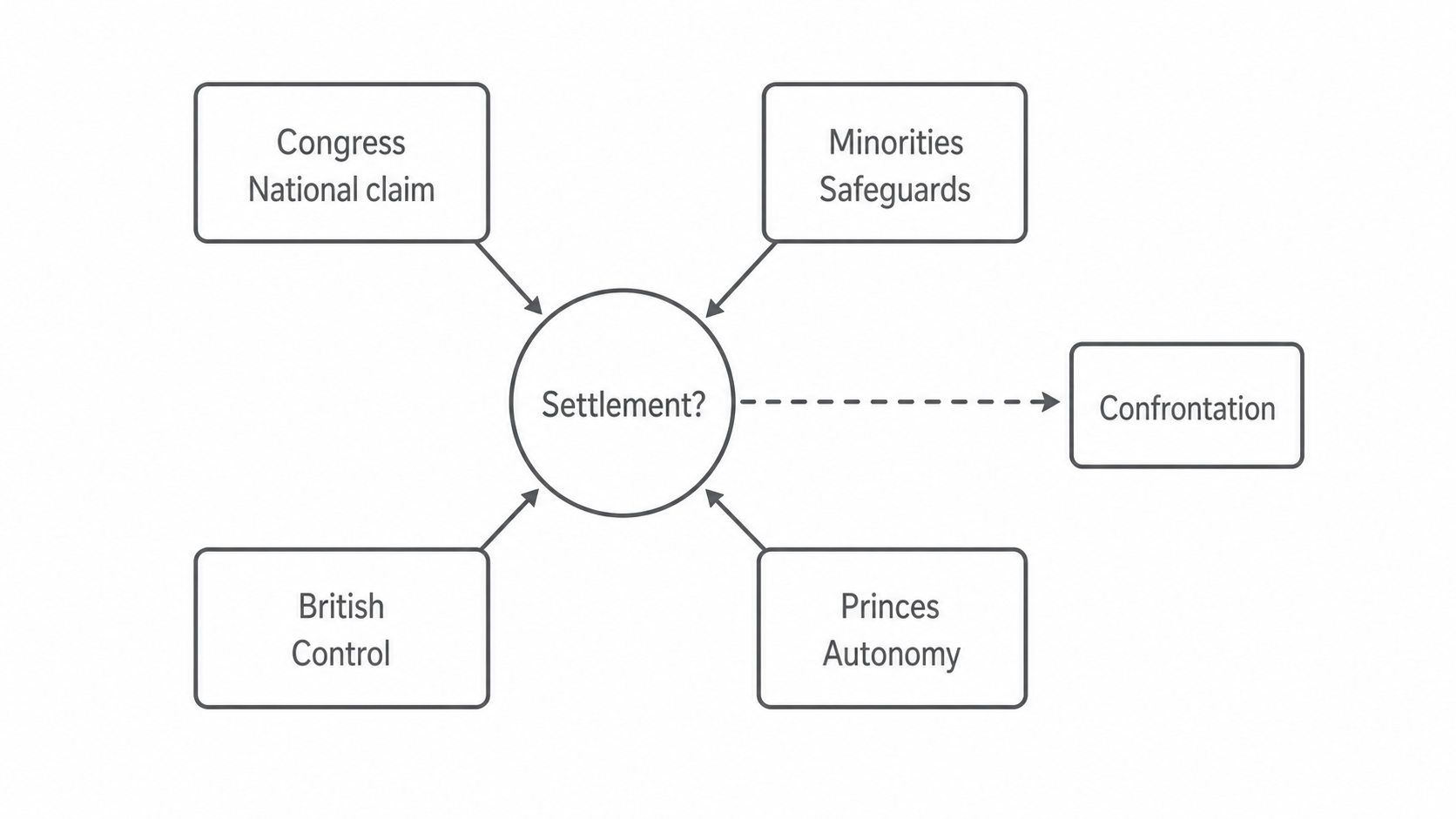
This is why representation was not a technical detail. It was bound up with sovereignty: who spoke for India, who needed safeguards, and how much control Britain would actually surrender.
British politics made agreement harder. The first conference had been called by Ramsay MacDonald's Labour government, but in 1931 Britain entered severe financial and political crisis. MacDonald formed a National Government, and Conservatives became much stronger in British politics. The Great Depression, imperial defence concerns and Conservative hostility to rapid Indian self-government narrowed the room for compromise. British ministers could talk about dominion status, but they still insisted on safeguards over defence, finance, minorities and the position of the princes. To Congress, these safeguards looked like the Raj keeping decisive power. To minorities and princes, they looked like protection from Congress centralism.
The Third Round Table Conference, from November to December 1932, was short and much less important. Congress did not attend. The British Labour Party also stayed away. Many leading Indian politicians were absent. The conference therefore confirmed the failure rather than solving it. Its recommendations fed into a White Paper, a Joint Select Committee and eventually the Government of India Act 1935, but the political bargain had already broken down.
| Reason for failure | How it worked | Why it matters |
|---|---|---|
| Congress role | Congress boycotted the first conference, Gandhi attended the second alone, and Congress missed the third. | The conferences could not produce an agreed national settlement without the strongest nationalist organisation. |
| British situation | The National Government and Conservative pressure made British ministers cautious about surrendering central control. | Consultation was limited by imperial priorities, especially defence, finance and safeguards. |
| Separate electorates | Muslims, Sikhs, Depressed Classes and other groups sought safeguards; Gandhi resisted arrangements he thought would fragment India. | The problem was not just Britain versus India, but competing Indian claims about representation. |
| Princes and federation | Princes were included in plans for federation but did not want a democratic centre that threatened their autonomy. | The proposed federation depended on groups with different interests agreeing to one structure. |
The conferences therefore failed because they asked one process to answer several incompatible questions: how much power Britain would give up, who represented India, how minorities would be protected, and whether princes would join a federation. By 1932, consultation had clarified the disagreements without resolving them.
Political fallout, 1932-35
The immediate Indian reaction to the failure of consultation was frustration and renewed confrontation. Gandhi returned from London in late 1931 without a settlement. Civil disobedience resumed, and in January 1932 the British arrested Gandhi and other Congress leaders. The Raj used ordinances, censorship, property seizures and imprisonment to weaken Congress organisation. This mattered because consultation and repression were not separate phases. British officials talked constitutionally in London while suppressing mass politics in India.
Not all Indian reaction was the same. Congress nationalists treated the failure as evidence that Britain would not concede real self-government voluntarily. Constitutional Liberals regretted the lost chance for gradual reform. Muslim leaders, Sikh leaders, Ambedkar and other minority representatives remained focused on safeguards. Princes wanted to preserve internal autonomy. The failure of consultation therefore pushed politics towards separate bargaining channels: Congress versus the Raj, minorities versus Congress majoritarian claims, and princes versus democratic federation.
The Communal Award of August 1932 was Britain's attempt to impose an answer to the representation problem.
Communal Award (1932)
Ramsay MacDonald's decision to extend and adjust separate representation for communities such as Muslims, Sikhs, Indian Christians, Anglo-Indians, Europeans and the Depressed Classes.
British ministers presented this as a way to protect minorities and make constitutional progress possible. Many nationalists saw it differently: it seemed to divide Indians into political communities and allow Britain to arbitrate between them.
Gandhi's response was dramatic. While imprisoned in Yeravda Jail, he announced a fast unto death against separate electorates for the Depressed Classes. Gandhi's objection was not that Dalits should have no representation. He objected to classifying them as a separate electorate outside the Hindu electorate, because he believed that would fracture Hindu society and weaken the nationalist struggle. Ambedkar's starting point was different. He argued that Depressed Classes needed political power of their own because caste oppression was real, and a Hindu majority electorate might simply reproduce caste Hindu dominance.
The compromise was the Poona Pact of 24 September 1932, often linked with Yeravda because Gandhi was fasting in Yeravda prison. The pact rejected separate electorates for the Depressed Classes but increased the number of reserved seats for them within joint electorates. It also included promises about fair representation in public services and educational grants. Gandhi ended his fast on 26 September.
The Pact should not be treated as a neat national reconciliation. It solved an immediate crisis, but it left serious grievances. Gandhi believed he had protected Hindu and national unity. Ambedkar later argued that separate electorates would have given Dalits a stronger independent political voice. For exam judgement, the key point is that the Pact revealed the limits of Congress's claim to represent all India. Even inside the broad nationalist movement, representation was contested.
British debate from 1932 to 1935 was also divided. Support for constitutional change came from ministers and officials who believed controlled reform was necessary to preserve imperial stability. The National Government, especially figures such as Samuel Hoare at the India Office, moved the reform scheme through White Paper proposals, a Joint Select Committee and then the Government of India Bill. Supporters argued that provincial autonomy could train Indian politicians in responsible government while keeping imperial safeguards at the centre.
Opposition in Britain came from different directions. Conservative diehards, including Winston Churchill and his allies in the India Defence League, argued that reform endangered British power, imperial defence and minority security. Some feared that Congress would use elections and ministries to weaken the Raj from within. Labour critics generally favoured more Indian self-government than Conservative imperialists did, but Labour had been pushed out of power and had limited influence after 1931. The result was a reform act shaped less by Indian consent than by British parliamentary calculation.
This period is therefore best judged as unilateral constitutionalism. Britain used the language of consultation, but when Indians could not agree and British politicians would not surrender central power, the imperial state wrote the next settlement itself.
Government of India Act
The Government of India Act 1935 was the largest constitutional measure passed for British India before independence. It was a major change, but not independence in disguise. Its importance lies in the contradiction between real provincial power and continuing imperial control.
Continue this lesson.
You’re previewing NovaLearn without an account. Create a free account to read the rest.
Create free account