35.1 KT1 - The loss of the American colonies, 1770-83
This lesson explains how a dispute over customs and parliamentary authority became an independence war that Britain could no longer afford, coordinate or win. It follows the escalation from the tea crisis and Coercive Acts through armed resistance and the Declaration of Independence to Saratoga, foreign intervention, Yorktown and the 1783 peace. The central judgement is that political miscalculation alienated the colonies, while global war and strategic overstretch made reconquest untenable. Defeat was a severe imperial shock rather than the end of British power, because Britain retained major territories and began rethinking how settler colonies might be governed.
Enquiry Frame and Chronology
This is a Paper 3 depth key topic. The topic asks you to explain a connected
sequence: rising tension from 1770 to 1775, armed clashes and independence in
1775-76, and Britain's defeat in 1777-83. A strong answer keeps chronology and
causation together. It should not treat the Boston Tea Party, the Declaration of
Independence, Saratoga and Yorktown as isolated episodes.
Keep three enquiry questions in view.
| Question | Why it matters |
|---|---|
| Why did tax and customs enforcement become a constitutional crisis? | Colonists objected to Parliament taxing them without colonial representation; Britain saw resistance as a challenge to sovereignty and law. |
| Why did the crisis become a war for independence in 1775-76? | Bloodshed, military occupation, Congress, loyalist-patriot polarisation and failed reconciliation made ordinary protest politics inadequate. |
| Why did Britain accept defeat in 1783? | The war became global after French and Spanish involvement, British resources were stretched, and Saratoga and Yorktown exposed the limits of military strategy. |
The chronology has three phases.
| Date | Event | Significance |
|---|---|---|
| 5 March 1770 | British soldiers fired on a crowd in Boston, killing five people in what became known as the Boston Massacre. | Tension around troops, customs enforcement and crowd protest turned violent and became powerful Patriot propaganda. |
| 1770 | Lord North's government repealed most Townshend duties but kept the tea duty. | Keeping the tea duty asserted Parliament's right to tax, even though the revenue itself was not the main issue. |
| 10 May 1773 | Tea Act passed. | It helped the East India Company export tea more cheaply to America while keeping the colonial tea duty in place. |
| 16 December 1773 | Boston Tea Party. | Protesters destroyed East India Company tea rather than allow tea to be landed and the duty paid. |
| 1774 | Coercive Acts passed. | Parliament punished Massachusetts, closed Boston's port and strengthened royal authority; many colonists saw this as a threat to all colonial liberties. |
| 5 September 1774 | First Continental Congress met in Philadelphia. | Resistance became intercolonial rather than only a Massachusetts crisis. |
| 19 April 1775 | Lexington and Concord. | British troops sent to seize military stores met armed militia; open fighting began. |
| 17 June 1775 | Battle of Bunker Hill. | The British won the ground but suffered heavy losses, proving that colonial forces could inflict serious damage. |
| 4 July 1776 | Declaration of Independence adopted. | Congress turned resistance into a claim that the colonies were free and independent states. |
| 15 November 1777 | Articles of Confederation adopted by Congress. | The new states attempted to create a wartime political union, though ratification was not complete until 1781. |
| 17 October 1777 | Burgoyne surrendered at Saratoga. | A British plan to split New England failed; the victory helped persuade France to ally with the Americans. |
| 1778 | France entered the war openly. | Britain now faced a major European and naval enemy, not only a colonial rebellion. |
| 1779 | Spain entered the war against Britain. | British forces had to defend Gibraltar, the Caribbean and other imperial interests as well as fight in North America. |
| 19 October 1781 | Cornwallis surrendered at Yorktown. | A British army was trapped by Franco-American land forces and French naval control of the Chesapeake. |
| March 1782 | Lord North resigned. | Parliamentary pressure to end the American war became irresistible. |
| 3 September 1783 | Treaty of Paris signed. | Britain recognised American independence and accepted the loss of the thirteen colonies. |
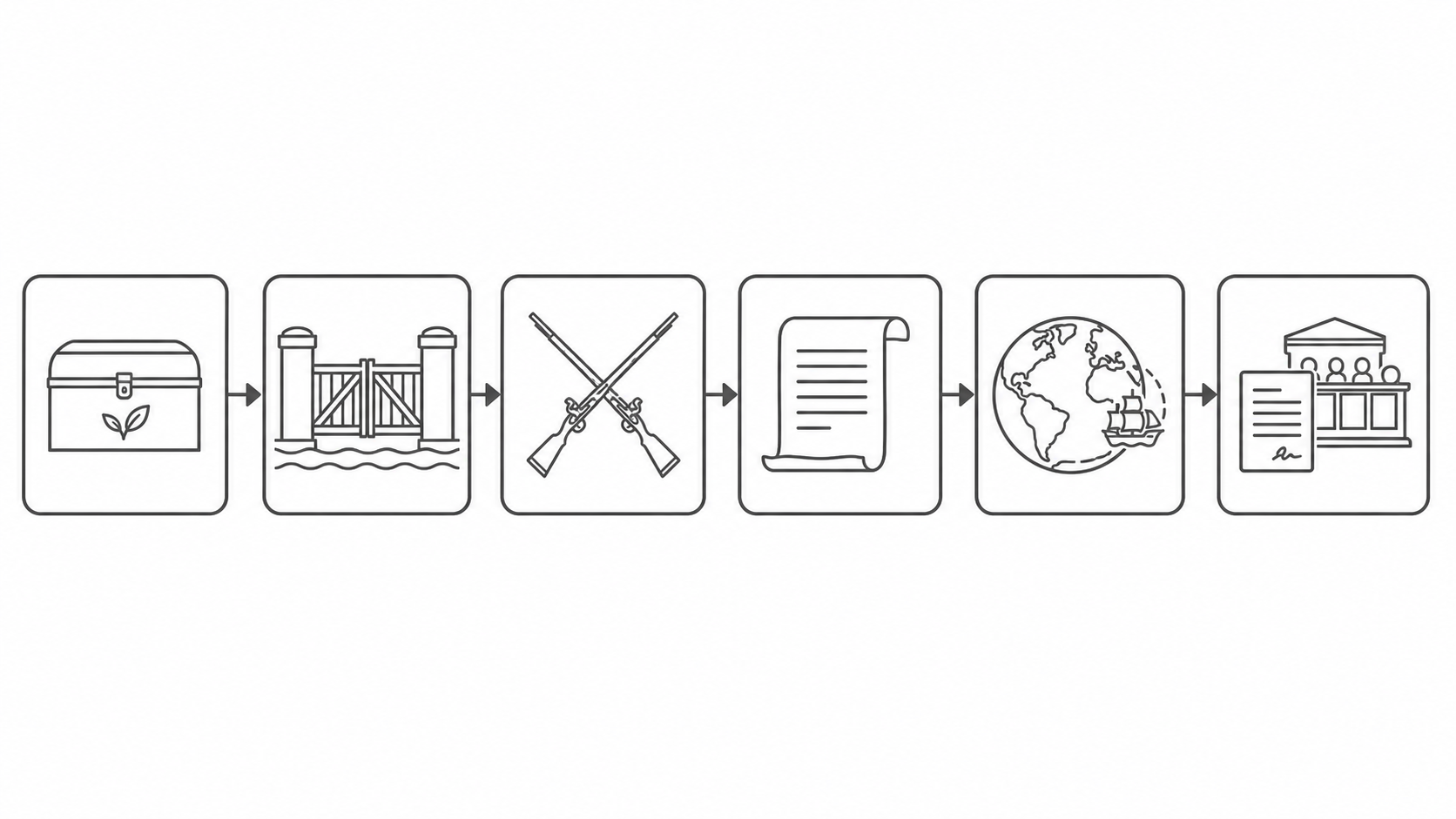
Before going deeper, use the diagram as a simple escalation chain. It is not a
map and it does not replace the chronology. It helps you see the change in type
of problem: from revenue enforcement, to coercion, to war, to documents of
independence, to international conflict, and finally to parliamentary acceptance
of peace.
[DIAGRAM: asset_name: From tea crisis to imperial defeat; asset_slug: p3_351_01_the_loss_of_the_american_colonies_1770_83__diagram_01; recommended_method: image_gen; description: Monochrome six-stage schematic showing the escalation from tea/customs conflict, Boston harbour and coercion, armed clashes, independence documents, international war across the Atlantic, and Britain's parliamentary acceptance of peace]
The strongest overall explanation is an interaction argument. Britain could
have survived colonial protest if it had restored trust. It could have survived
early military setbacks if the rebellion had stayed local and isolated. It
could have continued the war longer if France and Spain had not widened the
conflict. It was the combination of political alienation, colonial mobilisation,
major military defeats and global overstretch that made defeat decisive.
Customs, Tea and Authority
The tensions of 1770-75 grew from an older imperial problem. After the Seven
Years' War, Britain had a larger empire and a larger debt. Ministers wanted the
colonies to contribute more to imperial defence and administration. Many
colonists had become used to a high degree of local self-government and loose
enforcement of trade laws. They did not accept that Parliament could tax them
without colonial representation.
This argument was constitutional, not just financial. A small customs duty could
therefore create a large crisis. British ministers often saw customs collection
as the normal enforcement of lawful trade and taxation. Patriot activists saw it
as evidence that Parliament intended to raise revenue in America without consent
and pay crown officials in ways that made them less dependent on colonial
assemblies.
The Townshend duties are the essential background. In 1767 Parliament placed
import duties on goods including glass, lead, paint, paper and tea. Colonial
opposition included non-importation agreements, crowd pressure, pamphlets and
attacks on customs officials. Boston became especially tense because it had a
strong tradition of popular protest, smuggling and resistance to customs
enforcement. The presence of British troops in Boston from 1768 added another
source of conflict.
The Boston Massacre on 5 March 1770 shows why customs politics mattered. The
crowd confrontation that ended with British soldiers killing five people did
not begin as a formal battle for independence. Yet it turned soldiers, customs
officers and royal authority into symbols of oppression. Patriot writers such
as Samuel Adams used the event to argue that standing armies and imperial
enforcement threatened colonial liberty.
North's government then repealed most Townshend duties in 1770, but kept the
tea duty. This was a compromise that pleased almost nobody. It reduced economic
pressure, but preserved the principle that Parliament had the right to tax the
colonies. For many colonists, that principle was the danger. For British
ministers, abandoning it would look like surrendering parliamentary sovereignty.
The Tea Act of 1773 made the dispute explosive. It did not simply add a new
large tax. Its purpose was to help the East India Company, which had large
stocks of tea and financial problems, by allowing it to sell tea more directly
and cheaply in America. But the existing tea duty remained. If colonists bought
the tea, they would pay the duty and appear to accept Parliament's right to tax
them.
That is why cheaper tea could still be politically unacceptable. The Company’s privileged direct sales through selected consignees also threatened colonial merchants excluded from that distribution, giving a commercial reason for opposition alongside the constitutional dispute.
| British view | Patriot view |
|---|---|
| The Tea Act helped a major imperial company and made legal tea cheaper. | The Tea Act tempted colonists to accept the tea duty and Parliament's claim to tax without representation. |
| Customs duties were legitimate laws of Parliament. | Customs duties for revenue undermined colonial consent and assembly control. |
| Resistance to landing tea was intimidation and lawlessness. | Resistance was necessary because once tea was landed and the duty paid, the principle of taxation would be conceded. |
| Boston had to be brought back under lawful authority. | Punishing Boston would prove that British rule was becoming coercive and arbitrary. |
On 16 December 1773, protesters in Boston boarded ships and destroyed the tea.
The action was carefully political. The tea itself was attacked, not the ships
or crews. To supporters, that made the protest disciplined. To British
ministers, it was still property destruction and defiance of law. The Boston Tea
Party therefore narrowed the space for compromise. Britain now had to decide
whether to retreat, negotiate or punish.
For exam judgement, do not write that the American Revolution was "caused by a
tax on tea" as if the price of tea explains everything. Tea mattered because it
joined several issues: customs enforcement, Parliament's sovereignty, colonial
consent, the East India Company, crowd protest, royal authority and Boston's
reputation for defiance.
Coercive Acts and Escalation
Parliament's response to the Boston Tea Party was the Coercive Acts of 1774,
called the Intolerable Acts by many colonists. The language matters. British
ministers presented the measures as coercive because they were meant to restore
order and compel obedience. Colonists called them intolerable because they saw
them as proof that British liberty could be overridden by imperial force.
Coercive Acts
Laws passed by Parliament in 1774 to punish Massachusetts after the Boston Tea Party; many colonists called them the Intolerable Acts.
The main measures were aimed especially at Massachusetts and Boston.
| Measure | What it did | Why it mattered |
|---|---|---|
| Boston Port Act | Closed Boston's port until compensation was made for the destroyed tea. | It punished the whole town economically and encouraged other colonies to send support. |
| Massachusetts Government Act | Restricted town meetings and increased royal control over the colony's government. | It attacked local self-government, not only the people who destroyed the tea. |
| Administration of Justice Act | Allowed some trials of officials to be moved out of Massachusetts. | Patriots argued it could let royal officials escape local accountability. |
| Quartering Act | Strengthened arrangements for housing troops. | It reminded colonists that coercion would be backed by soldiers. |
The impact was not what Lord North intended. Ministers hoped to isolate Boston
and show that Parliament would not be intimidated. Instead, many colonists saw
Massachusetts as a warning. If Parliament could close one port and alter one
colony's charter, it might do the same elsewhere. Virginia, Pennsylvania, South
Carolina and other colonies did not have identical interests, but the Coercive
Acts gave them a common reason to coordinate.
The First Continental Congress met in Philadelphia in September 1774. It did not
yet declare independence. Many delegates still hoped to defend colonial rights
inside the empire. But Congress mattered because it turned resistance into an
intercolonial political structure. It supported a boycott of British goods,
issued statements of rights and grievances, and encouraged committees to enforce
the Continental Association.
This changed the balance of power inside the colonies. Local committees,
provincial congresses and militia networks increasingly competed with royal
governors and official assemblies. In Massachusetts, General Thomas Gage was
both governor and military commander. He faced not only angry speeches but
organised resistance, military stores and militia mobilisation.
The movement from protest to war was not inevitable, but by early 1775 each
side's actions made the other side's fears look reasonable.
| British fear | Colonial fear |
|---|---|
| If Boston went unpunished, Parliament's authority across the empire would collapse. | If Boston could be punished, every colony's charter and local liberty was vulnerable. |
| Colonial committees and militias were becoming illegal alternative governments. | British troops and royal governors were becoming instruments of coercion. |
| Rebellion had to be checked before it spread. | Arms and militia preparation were necessary for self-defence. |
| Moderate colonists could be protected if radicals were isolated. | Moderates would be powerless if Britain changed colonial government by force. |
Lexington and Concord on 19 April 1775 converted this atmosphere into open
fighting. British troops moved from Boston to seize military stores at Concord.
Militia confronted them at Lexington and along the road back from Concord to
Boston. The result was not a planned battle by Congress, but it was enough to
change the crisis. Armed resistance had begun, and the British army in Boston
was placed under siege by New England militia.
Bunker Hill on 17 June 1775 confirmed the seriousness of the conflict. The
British eventually took the position on the Charlestown peninsula, but only
after repeated assaults and heavy casualties. The lesson for both sides was
different. British commanders could still defeat militia in a set-piece attack,
but victory was expensive. Colonial forces learned that they could stand against
regulars long enough to make conquest difficult.
For judgement, the Coercive Acts were a turning point because they widened the
crisis. Before 1774, the dispute might still be framed as Boston radicalism or a
quarrel over revenue. After 1774, many colonists framed it as a general defence
of constitutional liberty. Britain had tried to coerce one colony and helped
create a wider resistance movement.
Clashes and Independence
The specification separates the first military clashes in 1775-76 from Britain's
later defeat. This is useful because war did not automatically mean
independence. Many colonists in 1775 still wanted reconciliation if Britain
would recognise colonial rights. Independence became more plausible as violence,
military mobilisation and British policy made a return to the old imperial
relationship less believable.
Continue this lesson.
You’re previewing NovaLearn without an account. Create a free account to read the rest.
Create free account