2H.1 KT1 - Boom and crash, 1920-29
This lesson examines why the American economy boomed in the 1920s, why prosperity remained uneven, and why the Wall Street Crash exposed deeper weaknesses rather than ending a uniformly successful decade. You will connect mass production, automobiles, credit and pro-business government to farm distress, unequal purchasing power, overproduction, speculation and fragile banks. You will also explore how radio, cinema, jazz and changing roles for women coexisted with the Red Scare, immigration restriction, the Ku Klux Klan, Prohibition and racial inequality.
The Enquiry Frame
For Paper 2, this topic is a depth topic. You need precise knowledge of the 1920s, but the strongest answers do not become a catalogue of inventions, gangsters, flappers and jazz clubs. They build judgement about contradiction.
The decade was contradictory in three ways.
First, it was economically dynamic but structurally weak. The USA was the world's leading industrial power after the First World War. Output rose, factories became more efficient, and consumer goods reached millions of homes. Yet that prosperity depended heavily on a few expanding industries, consumer credit and confidence.
Second, it was socially modern but politically defensive. More Americans lived in towns and cities than in the countryside by the 1920 census, and urban leisure looked freer and faster. At the same time, the Red Scare, immigration quotas, the revived Ku Klux Klan and Prohibition all showed fear that the nation was losing older Protestant, rural and white assumptions about authority.
Third, it was culturally creative but unequal. Jazz, Harlem writing, baseball, radio, cinema and modern literature reshaped American identity. But Black artists could win national attention while facing segregation; women could vote and enter public leisure while remaining economically and politically limited; immigrants could enrich cities while being treated as suspect outsiders.
Use this framework to hold the topic together:
| Date | Development | Why it matters |
|---|---|---|
| 1919-20 | First Red Scare, Palmer Raids, Prohibition begins, women gain the vote | The postwar years produced both new rights and intense fear of disorder. |
| 1920 | Warren Harding elected on a "return to normalcy" | Republican politics promised business confidence and retreat from wartime reform. |
| 1921 | Emergency Quota Act; first MLB radio broadcast | Restriction and mass culture grew at the same time. |
| 1923 | Calvin Coolidge became president after Harding's death | Coolidge came to symbolise pro-business, limited-government politics. |
| 1924 | Immigration Act made national-origins quotas permanent | Nativism became federal immigration law. |
| 1925 | Klan reached peak influence; Scopes Trial; consumer advertising expanded | Public conflict over modernity, religion, science, race and urban culture sharpened. |
| 1927 | The Jazz Singer signalled the coming of sound cinema; Babe Ruth hit 60 home runs | Mass entertainment created national celebrities and shared cultural reference points. |
| 1928 | Herbert Hoover elected; bull market optimism intensified | Many Americans believed prosperity was permanent, even as weaknesses deepened. |
| October 1929 | Wall Street Crash | Falling share prices exposed the fragility of confidence, credit and speculation. |
The exam issue is not whether the 1920s were "good" or "bad". It is how far the boom was broad-based, how far the crash was caused by deep weaknesses rather than sudden panic, and how far cultural freedom was matched by social equality.
The Economic Boom
The economic boom of the 1920s rested on a new relationship between production, consumption and confidence. The United States had emerged from the First World War as a creditor nation and a leading industrial power. After the short but severe recession of 1920-21, output and productivity rose strongly. By the later 1920s, business leaders and many politicians claimed that the USA had discovered a new formula for prosperity.
Mass production was central. The most famous example was the moving assembly line in the automobile industry. Ford had pioneered assembly-line production before the 1920s, but the decade showed its full economic effect. Standardised parts, repetitive tasks, conveyor systems and careful timing reduced the cost of making each unit. The Model T became a symbol of this system: a product once associated with the wealthy became available to many wage-earning households.
The automobile mattered because it was not just one industry. It pulled other industries with it:
| Linked industry or service | How the automobile stimulated it |
|---|---|
| Steel, rubber, glass and oil | Cars required large quantities of materials and fuel. |
| Road building and construction | More vehicles increased demand for roads, bridges, garages, filling stations and roadside businesses. |
| Advertising and finance | Companies had to sell mass-produced goods to a mass market and help buyers spread payments. |
| Suburban and leisure services | Cars made weekend travel, motels, tourist sites and out-of-town shopping more practical for some families. |
This created a multiplier effect. When car production expanded, employment and profits rose in many surrounding sectors. Registered motor vehicles in the USA rose from about 20 million in 1925 to 27 million in 1929. These totals include commercial vehicles as well as cars and do not mean that every household owned a car, but they show how far the USA had moved beyond the prewar world of local transport and limited mobility.
Technological advance also changed leisure. Electricity spread into factories and homes, raising productivity and making domestic appliances, lighting, radios and urban entertainment more available. Radio was especially important because it linked leisure to advertising. By the end of the decade, around 40 percent of American families owned radios. Families could listen to music, comedy, sport, news and advertisements in the home. Radio helped create a shared national culture while also encouraging people to buy branded goods.
Cinema had a similar effect. Hollywood's studio system turned film into a national industry. Silent film stars such as Charlie Chaplin, Mary Pickford and Douglas Fairbanks had already created mass celebrity, and sound film after 1927 deepened the sense that modern entertainment was immediate and shared. Cinema encouraged fashions, slang, consumer aspiration and changing ideas about romance, youth and success.
Hire purchase, often called installment buying in the USA, helped convert desire into demand. Instead of paying the full price immediately, consumers made a down payment and then paid the rest over time. This mattered because cars, radios, refrigerators, washing machines and furniture were expensive durable goods. Credit allowed more households to buy them before they had saved the full amount. It also kept factories producing because demand did not depend only on cash savings.
The danger was that credit brought tomorrow's income into today's spending. As long as wages, employment and confidence rose, installment buying looked like clever modern finance. If employment fell or confidence broke, debt became a trap. The same point applies to stock-market buying on margin: borrowed money magnified gains in a rising market and losses in a falling one.
Republican economic policy supported business confidence. Warren Harding, Calvin Coolidge and Herbert Hoover all favoured a pro-business climate, though Hoover was not simply inactive. Treasury Secretary Andrew Mellon promoted tax reduction, debt reduction and balanced budgets. Revenue Acts in the 1920s lowered personal income taxes and helped wealthier investors and consumers keep more income. The federal government also preferred cooperation with business, tariff protection and limited interference in corporate expansion. Coolidge's famous line that the "chief business of the American people is business" captured the mood.
This is usually described as laissez faire, but treat that phrase carefully. The federal government did not disappear. It cut taxes, protected American industry through tariffs, collected economic information, worked with business leaders and encouraged standardisation. The point is that government generally trusted business expansion more than social reform or strong regulation.
The boom had major limits. Farmers had been in difficulty since the end of the First World War. Wartime demand had encouraged them to borrow, buy machinery and expand production. When European agriculture recovered after 1918, crop prices fell. Many farmers faced debt, falling land values and overproduction. They were producing more efficiently, but not earning secure prosperity. This made rural America a weak point long before 1929.
Black Americans also experienced the boom unevenly. The Great Migration brought hundreds of thousands of African Americans from the rural South to northern and midwestern cities, partly because wartime and postwar industrial labour demand created openings. Cities such as Chicago, Detroit, Philadelphia, New York and Cleveland offered wages, schools, voting rights and cultural opportunity that were often unavailable under Jim Crow. But migration did not mean equality. Black workers were often confined to the lowest-paid or least secure jobs, faced discrimination in trade unions and skilled work, and lived with overcrowding, housing segregation, harassment and racial violence. The Harlem Renaissance showed Black cultural confidence, but it did not prove that Black Americans shared equally in the consumer boom.
The best judgement is that the boom was powerful but selective. It was strongest for urban, white, middle-class and skilled or semi-skilled workers in expanding sectors. It was much weaker for farmers, many Black Americans, many recent immigrants, older industries such as coal and textiles, and workers whose wages did not keep pace with the new consumer ideal.
Causes Of The Crash
The Wall Street Crash of October 1929 was the dramatic moment when confidence broke, but it was not the only cause of economic crisis. A strong answer separates the trigger from the conditions that made the trigger dangerous.
The bull market was the most visible sign of danger. A bull market is a period when share prices are rising and investors expect further rises. In the late 1920s, many Americans bought shares because they believed prices would keep going up, not because they had carefully judged the long-term value of companies. Brokerage houses, investment trusts and margin accounts made this easier.
Buying on margin
Paying only a small part of a share's price, often around 10 per cent, and borrowing the rest.
If prices rose, the investor could sell, repay the loan and keep a profit. If prices fell, losses could be rapid and severe.
The danger was psychological as well as financial. Rising prices created a belief that prosperity was self-confirming: if shares kept rising, the rise itself seemed to prove that the economy was sound. Newspaper reports, tips, stories of quick profits and the prestige of Wall Street drew more people into speculation. This did not include every American. Many working people owned no shares. But the stock market became a symbol of national confidence, so its collapse damaged expectations far beyond the number of direct investors.
Land speculation showed that the speculative mood was not confined to Wall Street. Florida experienced a major land boom in the mid-1920s, especially around Miami and resort development. Buyers purchased land expecting to resell it quickly at a higher price, sometimes before real development had occurred. The Florida boom collapsed before 1929, helped by overbuilding, transport bottlenecks, bad publicity, hurricanes and a shortage of new buyers. Agricultural land had its own earlier boom and bust: wartime prices encouraged borrowing and expansion, but commodity prices fell after 1920. These examples matter because they show a wider credit culture in which rising asset prices could become detached from sustainable income.
Overproduction was a deeper economic weakness. Mass production could produce enormous quantities of goods, but workers and farmers needed enough purchasing power to buy them. By the late 1920s, some consumer markets were becoming saturated. Many families who could afford cars or radios already had them; others could buy only through credit or not at all. If demand slowed, factories faced unsold goods and might reduce production, lay off workers or cut orders from suppliers. That would reduce purchasing power further.
Agriculture suffered especially from overproduction. Farmers produced more food and raw materials than markets could absorb at profitable prices. Mechanisation increased output, but it also increased debt. A farmer could be efficient and still be poor if prices were too low. This meant that rural banks and rural purchasing power were fragile throughout the decade.
The Wall Street Crash unfolded in stages. Share prices had already been unstable in September and October 1929. On Thursday 24 October, later called Black Thursday, heavy selling caused panic before leading bankers tried to restore confidence. The recovery was temporary. On Monday 28 October and Tuesday 29 October, Black Monday and Black Tuesday, the market fell heavily again. The crash destroyed paper fortunes, forced margin investors to sell, damaged banks and brokers, and shattered the belief that prosperity would continue automatically.
The banking system made the downturn more dangerous. American banking was fragmented, with many small local banks tied closely to local agriculture, property or business conditions. Many banks did not belong to the Federal Reserve System. There was no federal deposit insurance, so if a bank failed, depositors could lose their savings. Banks also held only a fraction of deposits as cash reserves, so a rush of withdrawals could threaten even banks that were not immediately insolvent.
The biggest banking panics came after the crash, especially from 1930 onward, but the weaknesses existed before then. Rural distress, speculative loans, uneven regulation, nonmember banks and fragile public confidence meant that financial shocks could spread. The crash was therefore important not because every family owned shares, but because it struck a credit system already vulnerable to fear.
Weaknesses in the banking system also help you avoid a simplistic answer. It is not enough to write, "The crash caused the Great Depression." The more convincing view is that the crash triggered a collapse of confidence in an economy already weakened by overproduction, inequality, agricultural distress, speculation and banking fragility. The crash mattered because it turned hidden weaknesses into visible panic.
Use the diagram as a cause map, not as a simple chronology. Its arrows summarise vulnerabilities in the wider economic crisis. Weak banks especially explain how the downturn spread through later banking panics; the diagram does not mean that every factor directly caused the October stock-market collapse.
[DIAGRAM: asset_name: Causes feeding the Wall Street Crash; asset_slug: p2_2h1_01_boom_and_crash_1920_29__diagram_01; recommended_method: image_gen; description: A left-to-right causal schematic in which output, weak demand, debt, speculation and weak banks feed into the crash, followed by a collapse of confidence.]
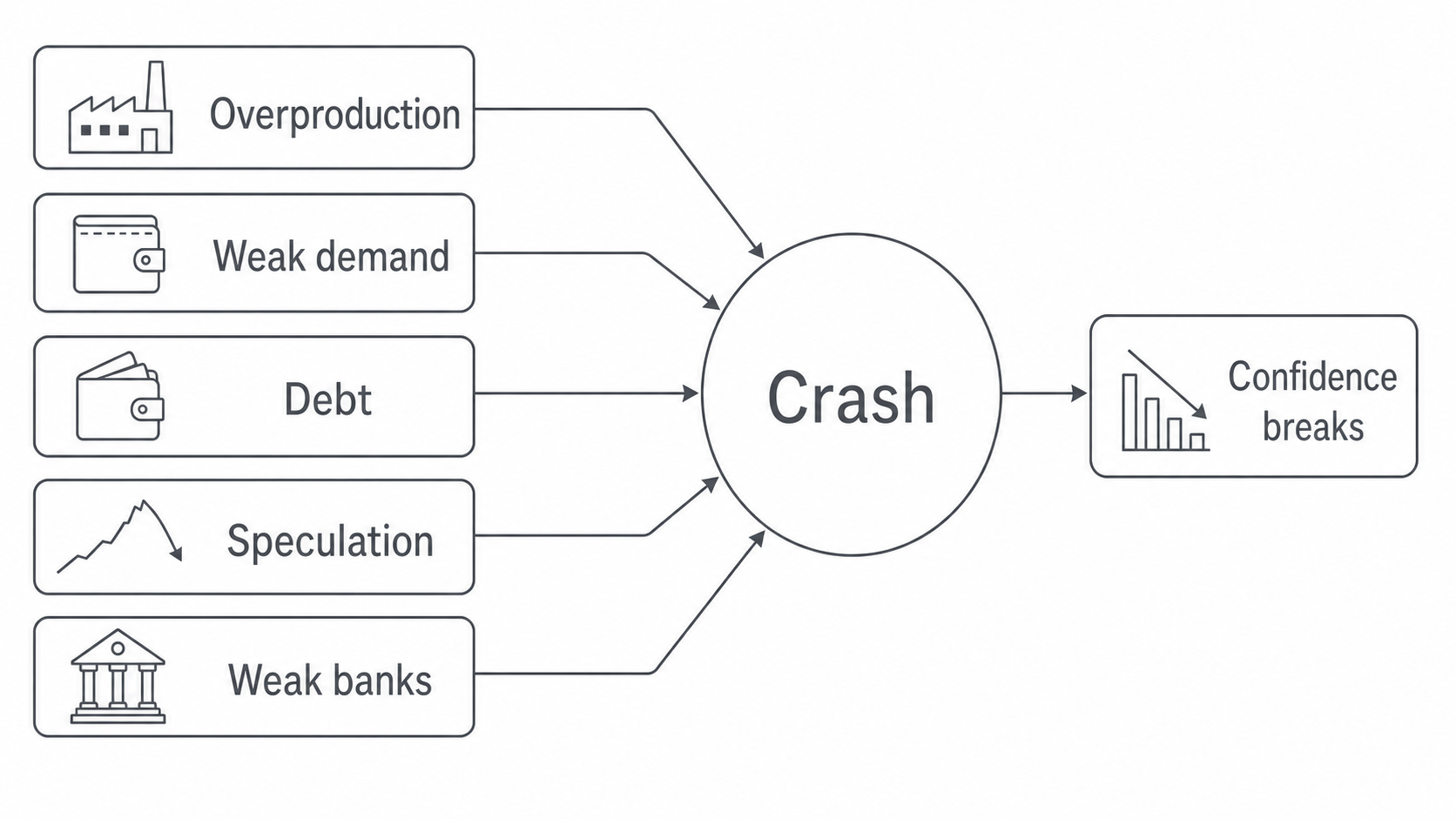
The judgement is that speculation explains the drama of October 1929, but the economy's deeper weaknesses explain why that drama became so damaging. The crash exposed fragility; it did not invent it from nothing.
| Cause | Short-term effect | Deeper significance |
|---|---|---|
| Wall Street Crash | Share prices fell sharply and confidence broke. | It exposed the dependence of prosperity on speculation and optimism. |
| Overproduction | Goods and crops became harder to sell profitably. | Mass production outpaced purchasing power, especially among farmers and lower-paid workers. |
| Land speculation | Farm and Florida land prices rose beyond sustainable values and then fell. | Credit and expectations inflated assets outside the stock market too. |
| Bull market | More investors bought shares expecting constant rises. | Speculation detached prices from underlying company strength. |
| Weak banking system | Bank failures and fear could restrict credit and destroy savings. | Fragmented banks without deposit insurance made shocks harder to contain. |
For exam judgement, weigh causes by function. The bull market and Wall Street Crash explain the moment of panic. Overproduction and unequal purchasing power explain why the economy was vulnerable. Land speculation shows that the problem was a wider speculative culture. Banking weakness explains why a shock could become a prolonged crisis.
Social Tensions
The 1920s were not only an economic story. They were also a struggle over who counted as properly American. This struggle was sharpened by urbanisation, immigration, war memories, Bolshevism, race, religion and moral change.
The First Red Scare came immediately after the First World War. The Bolshevik Revolution of 1917, labour strikes, inflation, unemployment, anarchist bombings and wartime suspicion of dissent all fed fear that radical politics might spread in the USA. Attorney General A. Mitchell Palmer authorised raids in 1919 and January 1920 against suspected radicals, anarchists and communists. J. Edgar Hoover, then a young official in the Justice Department, helped organise information on suspects. Thousands were arrested, and some foreign-born radicals were deported.
Continue this lesson.
You’re previewing NovaLearn without an account. Create a free account to read the rest.
Create free account