2H.1 KT4 - The transformation of the USA, 1945-55
This lesson explains how prosperity, Cold War fear, mass culture and civil rights
transformed the USA between 1945 and 1955. Post-war employment, mortgages, cars, suburbs
and consumer goods changed daily life, while anti-communism and nuclear anxiety encouraged
conformity. Hollywood, television and rock'n'roll created shared cultures that often
reinforced racial and gender stereotypes, even as Truman, professional sport, the NAACP
and the 1954 Brown decision challenged segregation. Comparing these changes will
help you judge how far the USA had been transformed, and for whom, by 1955.
The Enquiry Frame
The enquiry question is: how far had the United States been transformed by 1955?
The word transformation matters. This topic is not only about economic growth. It asks how prosperity, fear, media, suburbs, youth culture and civil rights interacted. A strong answer must therefore compare different kinds of change:
| Kind of change | What changed most clearly | What stayed limited |
|---|---|---|
| Economic | Employment, wages, credit, consumer goods, cars, home ownership and suburbs expanded rapidly. | Prosperity was uneven by race, gender and region; many women and minorities faced restricted opportunities. |
| Political and psychological | Cold War fears made anti-communism a national political language. | Security campaigns damaged civil liberties and encouraged conformity rather than confidence. |
| Cultural | Hollywood, television, sitcoms, popular music and teenage spending created a more national mass culture. | Much culture normalised white suburban domesticity and stereotyped women and ethnic minorities. |
| Civil rights | The armed forces, baseball, some entertainment and school law began to desegregate. | Jim Crow, housing discrimination, school resistance and violence meant equality was far from achieved. |
Use the diagram to see the topic as four strands pulling into one judgement. Prosperity, fear, culture and rights all changed the USA, but none of them changed it evenly for all Americans.
[DIAGRAM: asset_name: Four strands of transformation by 1955; asset_slug: p2_2h1_04_the_transformation_of_the_usa_1945_55__diagram_01; recommended_method: image_gen; description: A four-node concept map showing prosperity, fear, culture and rights feeding into a central judgement that the USA was transformed but unequal by 1955.]
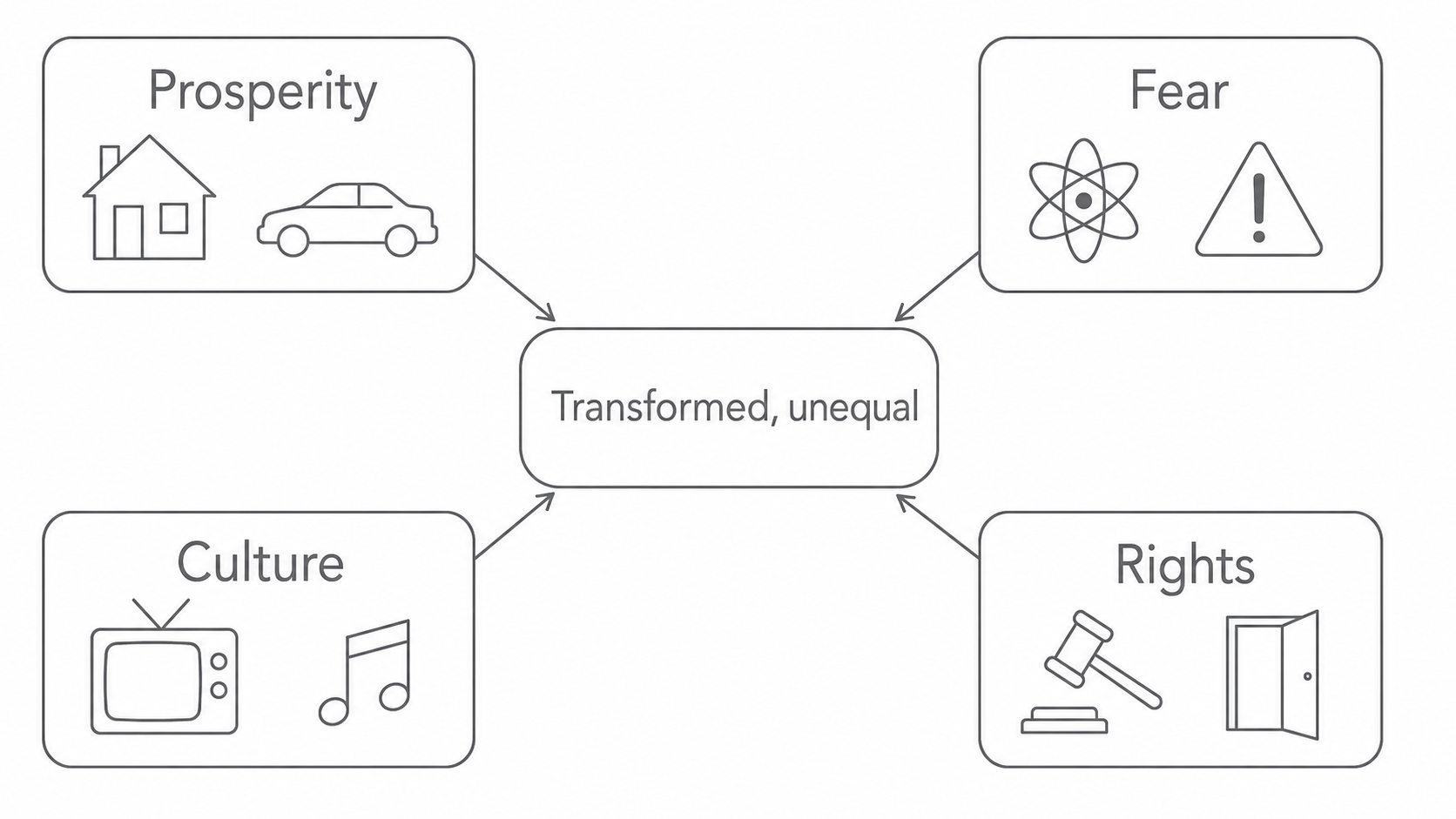
The centre of the diagram matters. By 1955 the USA was materially richer, culturally more connected and legally less secure for segregationists, while Cold War fear and unequal access to prosperity limited the meaning of transformation.
Use this chronological spine to keep the topic coherent:
| Date | Event | Why it matters |
|---|---|---|
| 1944 | Servicemen's Readjustment Act, or GI Bill; Federal-Aid Highway Act | Veterans' education, loans and future road planning helped shape post-war growth. |
| 1945 | War ended; reconversion began | The economy had to absorb veterans and shift from war production to consumer production. |
| 1946 | Employment Act; major strike wave | The federal government accepted more responsibility for prosperity, while labour conflict exposed post-war tension. |
| 1947 | Truman Doctrine; federal loyalty programme; HUAC Hollywood hearings; Jackie Robinson entered Major League Baseball | Cold War language, domestic anti-communism and early civil-rights breakthroughs emerged together. |
| 1948 | Truman's Executive Order 9981; Levittown houses filling rapidly | Military desegregation and suburbanisation both showed a post-war society in motion. |
| 1949 | Soviet atomic bomb; communist victory in China; Housing Act | International events intensified anti-communism, while federal housing policy supported construction and redevelopment. |
| 1950 | McCarthy's Wheeling speech; Korean War began; first Black players entered the NBA | Cold War fear became more intense, while integration in sport widened slowly. |
| 1951 | I Love Lucy began; Rosenberg trial | Television culture expanded as nuclear espionage fears became a public drama. |
| 1953 | Rosenbergs executed; Korean armistice; military desegregation advanced | The nuclear age and civil-rights change were both visible, but in very different ways. |
| 1954 | Brown v. Board of Education; Army-McCarthy hearings | School segregation was ruled unconstitutional, while McCarthy's methods were nationally exposed. |
| 1955 | Brown II; Eisenhower highway planning; rock'n'roll entered mainstream youth culture | By 1955 the next stage of civil-rights conflict, car mobility and youth culture was opening. |
For Paper 2 AO1 essays, avoid treating the decade as either a golden age or an age of repression. It was both richer and more anxious, more mobile and more segregated, more nationally connected and more conformist. For AO2 source work, remember that contemporary sources from advertisements, television scripts, government speeches, HUAC hearings, NAACP statements or court opinions reveal values and assumptions as much as facts.
Economic Transformation
The economic transformation after 1945 was rooted in a problem that had frightened many Americans before victory: how could a war economy become a peace economy without returning to depression? During the Second World War, federal spending, defence contracts and military mobilisation had ended mass unemployment. When the war ended, millions of servicemen returned, war contracts were cancelled, women war workers were dismissed or pressured to leave, and factories had to switch from aircraft, ships and munitions to cars, houses, appliances and consumer goods.
The feared collapse did not happen. There were tensions, including inflation, shortages and a huge strike wave in 1945-46, but the broader pattern was growth. Wartime savings, pent-up demand, rising productivity, strong unions in major industries, federal policy and defence spending all supported expansion. The Korean War from 1950 to 1953 also kept defence industries important. The result was not a return to the weak consumer economy of the 1930s, but the emergence of a larger middle-class economy based on wages, credit, home ownership and mass-produced goods.
Employment opportunities changed in several ways. Many returning veterans entered education, skilled work, public administration, sales, construction, engineering or managerial jobs. Manufacturing remained important, especially in cars, steel, chemicals, electrical goods and defence production. But white-collar and service employment also grew: clerical work, retail, advertising, finance, education, health care, insurance and public administration all expanded. This mattered because it shifted the image of success from the factory or farm towards the salaried employee, the professional, the office worker and the suburban breadwinner.
The limits were serious. Many women who had worked in wartime industry were displaced by returning men or channelled into lower-paid clerical, teaching, nursing, domestic, sales and service work. Yet women's paid employment did not simply vanish; married women's labour-force participation continued to rise across the post-war decades, even while popular culture preached domesticity. African American, Mexican American and Native American workers faced discrimination in hiring, training, unions and housing. So changing employment opportunities were real, but unequal.
Federal policy encouraged growth without creating a fully planned economy. The Employment Act of 1946 declared that the federal government had a responsibility to promote employment, production and purchasing power, and created the Council of Economic Advisers. This did not guarantee a job to every American, but it showed a new assumption after the New Deal and the war: Washington could not simply stand aside if the economy failed. The GI Bill was more immediately visible. It helped veterans pay for education and training, and it guaranteed loans for homes, farms or businesses. The FHA and VA systems made long-term mortgages more available, spreading lower down payments and longer repayment periods.
The provision of mortgages for veterans was one of the most important mechanisms of post-war change. The GI Bill did not usually hand veterans a house. It made banks more willing to lend by guaranteeing part of the loan. That reduced risk for lenders and helped millions of veterans enter the housing market. Builders responded by producing large numbers of affordable houses for young families who wanted space, privacy and security after depression and war.
Yet this mortgage revolution was racially unequal. Federal rules could be formally race-neutral, but local banks, real-estate agents, appraisers, developers and white neighbourhood associations often excluded Black buyers. Restrictive covenants were declared unenforceable by the Supreme Court in 1948, but informal discrimination continued. Redlining and racially biased lending meant that the wealth-building power of suburban home ownership was far more available to white veterans than to Black veterans. This is crucial for judgement: the post-war state expanded opportunity and reinforced inequality at the same time.
Suburban growth was the clearest physical sign of economic transformation. Depression and wartime restrictions had produced a housing shortage. After 1945, young families, veterans, mortgage finance, cars and construction firms pushed millions of Americans outward from older cities. Suburbs promised a small house, garden, schools, safety and neighbours who seemed socially similar. They also relied on gendered assumptions: men often commuted to work, while women were expected to manage the home, children and consumption inside the suburban household.
The Levittown projects became the symbol of mass suburbanisation. Levitt & Sons used standardised designs, division of labour, bulk purchasing and rapid construction methods to build large planned communities. Levittown, New York, developed between 1947 and 1951, contained more than 17,000 low-cost homes. The significance of Levittown was not that every suburb looked exactly like it. It was that housing could be treated like industrial production: repeated plans, quick assembly, mortgage finance, shopping centres, schools and a planned family environment.
Mobility made this possible. Car ownership rose sharply after wartime shortages ended. The car was a practical tool for commuting, shopping and family leisure; it was also a consumer symbol of freedom. Suburban layouts assumed car use, and car use made further suburban sprawl possible. Highway construction reinforced the pattern. The 1944 Federal-Aid Highway Act authorised a national system of interstate highways, though it did not yet provide the funding that would arrive with the 1956 Federal-Aid Highway Act just after this topic's end. Eisenhower's 1954-55 highway proposals show that by 1955 car mobility, defence planning, congestion and economic growth were already linked in federal policy.
The new consumer society grew from the same conditions. Wartime rationing had postponed purchases; post-war wages, credit and advertising encouraged them. Families bought cars, refrigerators, washing machines, radios, televisions, furniture, vacuum cleaners, lawnmowers and packaged foods. Shopping centres, supermarkets and suburban retail changed everyday habits. Consumer goods were marketed as proof that American capitalism delivered comfort and freedom in contrast to Soviet communism.
But consumer society was selective. Advertisements often imagined a white, male breadwinner household with a wife as housekeeper and buyer of domestic goods. Many families remained poor, especially in inner cities, rural areas, Native reservations and parts of the South. The strongest judgement is therefore that economic transformation was deep and visible, but not universal. The United States became more prosperous and mobile, while the benefits of home ownership, secure employment and consumer status were distributed unevenly.
End Of Post-War Euphoria
Victory in 1945 created hope, but the euphoria did not last. The United States emerged rich and powerful, yet Americans quickly faced a new set of fears: Soviet expansion, nuclear weapons, communist victory in China, the Korean War, espionage, inflation, strikes and doubts about loyalty at home. The Cold War did not only shape foreign policy. It entered workplaces, schools, universities, trade unions, churches, film studios, government departments and family living rooms.
Anti-communism had several causes. The Soviet Union dominated much of eastern Europe after 1945. The Truman Doctrine of 1947 framed the world as a struggle between free peoples and armed minorities or outside pressures. The Berlin blockade of 1948-49 made confrontation visible in Europe. In 1949 the Soviet Union tested an atomic bomb, ending the American monopoly on nuclear weapons, and Mao Zedong's communists won power in China. In 1950 North Korea invaded South Korea, beginning a war in which American troops fought under the United Nations banner against communist forces. These events made many Americans believe that communism was advancing globally.
Domestic politics sharpened the fear. Republicans accused Democrats of being "soft on communism". Truman tried to protect his administration by creating a federal loyalty programme in 1947, requiring checks on government employees. The programme was meant to reassure the public and protect security, but it also encouraged suspicion, anonymous accusation and self-censorship. A person did not have to be a Soviet spy to suffer; association with left-wing groups, unions, civil-rights campaigns or unpopular ideas could become dangerous.
The House Un-American Activities Committee, or HUAC, became one of the most visible institutions of domestic anti-communism.
HUAC
The House Un-American Activities Committee: a congressional committee that existed before the Cold War but after 1945 investigated alleged communist influence in government, labour organisations and Hollywood.
Its hearings were public theatre as well as investigation. Witnesses could be asked whether they were or had been members of the Communist Party, and whether they would name others. Refusal could bring contempt charges, job loss and public suspicion.
The Hollywood hearings of 1947 showed the impact. Ten writers and directors, later known as the Hollywood Ten, refused to answer HUAC's questions about communist affiliation, often citing constitutional rights. They were cited for contempt of Congress and blacklisted by the film industry. The blacklist widened beyond those ten. Actors, writers, directors, musicians and technicians could lose work because of past associations, rumours or refusal to cooperate. Some worked under pseudonyms; others left the industry or the country.
HUAC's impact therefore went beyond finding spies. It changed the boundaries of acceptable opinion. It encouraged studios, schools, unions and employers to prove loyalty by excluding suspected radicals. It pushed Hollywood towards caution, patriotic themes and anti-communist films. It also made civil liberties vulnerable, because the act of refusing to answer could be treated as evidence of guilt.
McCarthyism gave domestic anti-communism its most famous name. Senator Joseph McCarthy rose to national prominence in February 1950 when he claimed that communists had infiltrated the State Department. His numbers and accusations shifted, but his method was politically powerful: assert hidden betrayal, demand investigation, imply that doubt itself was disloyal. McCarthy chaired the Senate Permanent Subcommittee on Investigations in 1953-54 and targeted government agencies, the press and the army.
McCarthyism had real consequences even where evidence was weak. Public employees resigned or were dismissed. Careers were damaged. Universities and schools became cautious. Trade unions expelled or marginalised communists and left-wing activists. Artists and broadcasters avoided controversial subjects. Gay federal employees were also targeted under the wider security culture of the period, since officials presented them as vulnerable to blackmail. The broad impact was a culture of conformity: many Americans learned that silence was safer than dissent.
McCarthy's decline came in 1954. The Army-McCarthy hearings were televised nationally, allowing viewers to watch his aggressive style. His attacks on the army and his confrontation with army counsel Joseph Welch damaged his public standing. In December 1954 the Senate censured him. But his fall did not mean anti-communism disappeared. The larger security state, loyalty rules and cultural pressures remained.
The nuclear age made the end of euphoria more frightening. In 1945 the atomic bomb had symbolised American military superiority. By 1949, when the Soviet Union tested its own atomic bomb, nuclear weapons became a mutual threat. The United States tested a hydrogen bomb in 1952, and the Soviet Union followed with thermonuclear development. Civil-defence campaigns, school drills, fallout discussions and images of total destruction made nuclear war part of ordinary imagination.
The case of Ethel and Julius Rosenberg condensed these fears. Julius and Ethel Rosenberg were charged with conspiracy to commit espionage, accused of helping pass atomic information to the Soviet Union. Their trial took place in 1951; they were convicted and sentenced to death. They were executed on 19 June 1953 after appeals and clemency campaigns failed. Their case became a symbol of the nuclear Cold War because it joined espionage, communism, atomic secrets, Jewish identity, family, capital punishment and public fear.
For historical judgement, the Rosenberg case should be handled carefully. It was not simply invented hysteria: Soviet espionage was real, and later evidence supports Julius Rosenberg's involvement in espionage. But the case also raises questions about the extent of Ethel Rosenberg's role, the pressure placed on witnesses, the severity of the death penalty and the political atmosphere in which the trial occurred. For this lesson, the key point is that the Rosenbergs showed how the nuclear age made internal enemies seem existential. Espionage was presented not as ordinary treason, but as a threat to the survival of American families.
Continue this lesson.
You’re previewing NovaLearn without an account. Create a free account to read the rest.
Create free account