35.1 KT4 - Nearly losing an empire: the British in India, 1829-58
This lesson explains why the East India Company's apparently powerful state nearly collapsed during the rebellion of 1857-58. Company rule depended on Bengal revenue, Indian soldiers and cooperation from rulers and landholders, while reform and annexation steadily damaged trust. The cartridge crisis triggered a revolt whose centres at Meerut, Delhi, Cawnpore and Lucknow exposed both the reach and the divisions of resistance. Britain retained control with Indian allies, surviving bases, reinforcements and repression, then replaced Company rule with a more cautious Crown settlement in 1858.
Enquiry Frame and Chronology
This is a Paper 3 depth key topic. The specification is not just "the Indian
Rebellion". It starts in 1829 because the rebellion grew out of a longer period
of Company government, social reform, anti-crime campaigns, missionary pressure,
annexation and military dependence. A strong answer explains why British power
looked impressive before 1857 and why the same system then became vulnerable.
Keep three enquiry questions in view.
| Question | Why it matters |
|---|---|
| How did the East India Company govern India before 1857? | Company rule depended on the Governor General, Bengal revenue, Indian soldiers and alliances with Indian rulers. |
| Why did reform and annexation create distrust? | Measures presented by British officials as humanitarian or efficient could look like religious interference, political aggression or social disruption. |
| Why did Britain retain control after the rebellion began? | The rebellion was fierce but geographically uneven; British forces held key bases, gained allies, used reinforcements and exploited rebel divisions. |
The chronology has four connected phases.
| Date | Event | Significance |
|---|---|---|
| 1828 | Lord William Bentinck became Governor-General of Bengal. | His governorship became associated with cost-cutting, administrative reform and social intervention. |
| 4 December 1829 | The Bengal Sati Regulation prohibited sati in territories under the Bengal Presidency. | It marked a major official intervention in a practice defended by some as religious custom and attacked by others as coercive and inhumane. |
| 1830s | William Sleeman's campaign against Thagi expanded, especially after his appointment as superintendent in 1835. | The Company used intelligence, informers, special policing and cooperation with princely states to suppress alleged networks of stranglers and robbers. |
| 1833 | The Charter Act ended the Company's remaining commercial role in India and strengthened central government under the Governor-General of India. | The Company became more clearly an administrative state rather than a trading monopoly. |
| 1848 | Dalhousie became Governor-General. Satara was annexed under the doctrine of lapse. | Dalhousie's rule intensified annexation and "improvement", alarming many princes and elites. |
| 1849 | Punjab was annexed after the Second Anglo-Sikh War. | Punjab later became a crucial British base during the rebellion, showing that recent conquest did not automatically produce rebellion against Britain. |
| 1853-54 | Jhansi and Nagpur were annexed under the doctrine of lapse. | These annexations suggested that dependent rulers without a natural heir could lose their states if the Company rejected adoption claims. |
| 1856 | Awadh was annexed on grounds of misgovernment. | This was one of the most important political causes of the rebellion because Awadh supplied many Bengal Army sepoys and contained many dispossessed elites. |
| 1856 | The General Service Enlistment Act required new Bengal Army recruits to accept overseas service if ordered. | It fed fears that the Company was disregarding caste and religious concerns, even though the cartridge crisis became the immediate trigger. |
| 29 March 1857 | Mangal Pandey attacked British officers at Barrackpore. | The incident revealed severe tension in the Bengal Army before the wider outbreak. |
| 10 May 1857 | Sepoys at Meerut rebelled after punishment of cavalrymen who had refused cartridges. | The rebellion began in earnest and quickly moved beyond one garrison. |
| 11 May 1857 | Rebels reached Delhi and sought the leadership of Bahadur Shah Zafar, the Mughal emperor. | Delhi gave the rebellion a symbolic centre and helped turn mutiny into a wider political revolt. |
| June-July 1857 | Cawnpore was besieged and its British survivors were killed after surrender and imprisonment. | The killings became central to British demands for revenge and intensified the brutality of repression. |
| July-November 1857 | The Lucknow Residency was besieged, relieved and then evacuated. | Lucknow showed both the depth of resistance in Awadh and the ability of British forces to hold out until reinforcement. |
| 14-20 September 1857 | British forces stormed and recaptured Delhi. | This was a decisive turning point because it broke the main symbolic rebel centre. |
| March 1858 | Lucknow was recaptured by British forces under Colin Campbell. | The recovery of Awadh's capital did not end all resistance, but it restored British strategic control. |
| 2 August 1858 | The Government of India Act transferred rule from the East India Company to the Crown. | The Company lost its administrative powers and India was governed through a Secretary of State for India and a viceroy. |
| 1 November 1858 | Queen Victoria's Proclamation was announced in India. | It promised respect for princes, religious non-interference and a more cautious imperial settlement after rebellion. |
Use the diagram as a compact map of the argument. It does not replace the
chronology. It helps you see how three things connected: the Company-state
before 1857, the pressures created by reform and annexation, and the survival
factors that stopped rebellion becoming successful revolution.
[DIAGRAM: asset_name: Company-state, pressure and rebellion in India, 1829-58; asset_slug: p3_351_04_nearly_losing_an_empire_the_british_in_india_1829_58__diagram_01; recommended_method: image_gen; description: Monochrome schematic linking the East India Company state, Governor General, Bengal revenue and Company Army to pre-1857 pressures from Sati, Thagi, missionary fears, Dalhousie annexations and Awadh, then to Meerut, Delhi, Cawnpore, Lucknow, retained control and survival factors including Punjab support, loyal princes, reinforcements and rebel divisions]
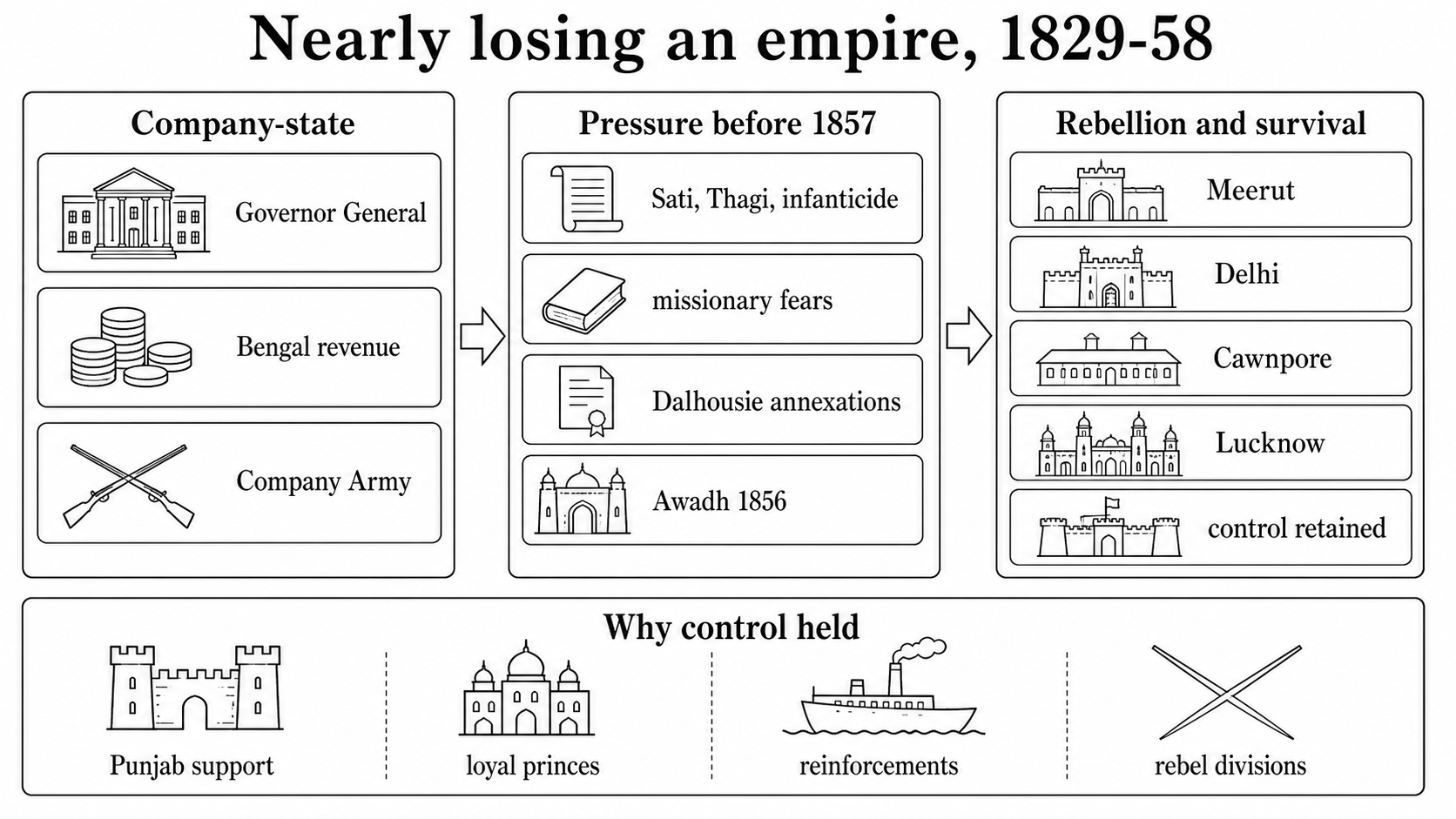
The best overall judgement is an interaction argument. The Company did not nearly
lose India because one rifle cartridge caused a simple military mutiny. It nearly
lost India because many groups had reasons to distrust Company power, and the
Bengal Army provided the armed structure through which that distrust could spread.
Company-State and Bengal Army
By 1829 the East India Company was a strange imperial institution. It had begun
as a trading company, but by the nineteenth century it governed large parts of
India. It still had directors in London and shareholders, but it was also subject
to growing parliamentary supervision through charter renewals and the Board of
Control. In India, practical authority was exercised through governors,
collectors, judges, political residents, military commanders and the Governor
General.
The Governor General mattered because Company rule was increasingly centralised.
The office had grown out of the governorship of Bengal, but by the Charter Act of
1833 the Governor-General of Bengal became Governor-General of India. This did
not mean that every village was ruled directly from Calcutta. It did mean that
major decisions about annexation, law, finance, diplomacy and military strategy
were concentrated in a single imperial office. Bentinck, Dalhousie and Canning
therefore mattered far beyond their personal biographies. Their decisions shaped
how Indians experienced British power.
Bengal was central to that power. The Company had become a territorial force
after Plassey in 1757 and Buxar in 1764, and its right to collect revenue in
Bengal from 1765 made the province an economic foundation of British power.
Calcutta was the capital of Company government. Bengal's revenue helped finance
administration and war. Bengal also gave the Company a political identity: it was
not only a merchant body working from coastal factories, but a land-revenue state
with officials, courts and soldiers.
This created a self-reinforcing system.
| Element of Company power | How it worked | Why it was vulnerable |
|---|---|---|
| Revenue | Land revenue and customs helped pay for administration, public works and armies. | Revenue settlements could disrupt local landholders and peasants, especially when older rights were misunderstood or overridden. |
| Army | Indian sepoys under British officers gave the Company the manpower to conquer, police and defend territory. | British rule depended on soldiers whose religion, status, pay and family interests could be threatened by Company policy. |
| Governor General | A central executive could act decisively across India. | A decisive Governor General could also impose changes too quickly and make local groups feel ignored. |
| Princely states | Alliances and indirect rule extended British influence without direct annexation everywhere. | Annexation and intervention made princes wonder whether British protection was becoming a route to dispossession. |
| Ideology of improvement | British officials justified rule through order, reform, law and "civilisation". | Indians could read reform as contempt for Indian customs or as a cover for deeper control. |
The Company Army was especially important. It was not one simple army but three
presidency armies: Bengal, Bombay and Madras. The Bengal Army became the largest
and most politically sensitive. It recruited heavily from high-caste Hindu
communities and other groups in the Gangetic plain, including areas such as Awadh
and Bihar. Sepoys could value Company service because it offered pay, status,
pensions and honour. Many families depended on it. The problem was that the same
soldiers also carried local grievances back into the barracks.
This is why Bengal and Awadh are so closely linked. When Awadh was annexed in
1856, many sepoys did not see it as a remote diplomatic decision. They saw their
home region altered, its ruler removed, its aristocracy and landholders unsettled
and its social hierarchy humiliated. A soldier's loyalty to his regiment did not
erase his connection to family, village, caste and religion.
British officers often misunderstood this. Some earlier Company officers had
learned Indian languages and cultivated close paternal relations with their men.
By the 1850s many sepoys felt that the relationship had become colder and more
racially distant. Promotion was limited. Pay and allowances were resented.
Service conditions changed. Discipline sometimes seemed harsh or arbitrary. The
Bengal Army was therefore both the engine of empire and the point at which empire
could break.
The Company-state was powerful because it could turn revenue into armies, armies
into conquest, conquest into more revenue, and conquest into claims of lawful
government. It was vulnerable because each part of that chain created losers:
dispossessed rulers, anxious soldiers, suspicious religious communities,
resentful landholders and people whose lives were being reorganised by officials
who claimed to know what was best.
Reform, Thagi and Religious Fear
The specification links William Sleeman's campaign against Thagi with the drive
against sati and female infanticide and the impact of missionaries. The link is
not that all these issues were the same. It is that they made the Company appear
more interventionist. British officials increasingly claimed that they had a
moral duty to reform Indian society. Some Indian reformers supported particular
changes, but many Indians feared that the Company was moving from political rule
to social and religious transformation.
Sati was the most dramatic early example. Sati, often called suttee in British
sources, was the immolation of a widow on her husband's funeral pyre. It was not
practised by all Hindus, and Indian opinion was not uniform. Reformers such as
Ram Mohun Roy argued against it. Many British evangelicals and humanitarians also
denounced it. Other Hindus argued that British interference in the practice was
an attack on religious custom.
Bentinck's Bengal Sati Regulation of 4 December 1829 made sati illegal in the
Bengal Presidency and treated participation as a criminal offence. Madras and
Bombay followed in 1830. Bentinck's decision shows the tension inside Company
rule. Earlier Company policy had often stressed religious non-interference
because officials feared that interference might provoke resistance. By 1829
Bentinck decided that non-interference could not justify allowing a practice that
he and many critics considered morally intolerable.
For judgement, the ban on sati should be handled carefully. It was not simply a
British reform imposed on a passive Indian society, because Indian critics of
sati mattered. It was also not simply a neutral act of benevolence, because the
Company used such reforms to present its rule as morally superior. For some
Indians, the ban became proof that the British would override custom when they
judged it wrong.
Sleeman's campaign against Thagi worked in a similar moral-political register.
British officials used "Thagi" or "Thuggee" to describe organised groups accused
of gaining travellers' trust, strangling them and stealing their goods. Sleeman,
a Company officer and administrator, became the leading figure in the campaign
from the early 1830s. In 1835 he became General Superintendent of the operations
for the suppression of Thagi. The campaign used informers, called approvers,
special investigation, intelligence gathering, cross-regional policing and
cooperation with some princely states.
The campaign was important for three reasons.
| Significance | Explanation |
|---|---|
| It increased Company policing power. | Suppressing alleged Thagi networks required surveillance, informers, special procedures and coordination across territories. |
| It strengthened the British "civilising" story. | Officials could claim that British rule protected travellers from hidden violence and disorder. |
| It created source problems. | Much of what historians know about Thagi comes through colonial officials who had reasons to dramatise the threat and justify their own powers. |
This does not mean that robbery and murder on roads were invented. It does mean
that students should be alert to how colonial knowledge worked. Sleeman's reports
and later British accounts are useful for understanding Company methods,
official fears and the language of moral rule. They are less safe as transparent
descriptions of Indian society because they classify, simplify and sometimes
sensationalise.
The campaign against female infanticide also fitted the Company's reforming
language. British officials had identified female infanticide among some
communities, especially certain high-status landholding or warrior groups where
marriage costs, lineage honour, dowry pressures and status competition could make
daughters economically and socially vulnerable. The Company response was not one
single neat measure between 1829 and 1858. It involved investigation,
record-keeping, pressure on local elites, policing and later legislation. Like
the sati debate, it turned a social practice into evidence for British claims
that Indian society needed external correction.
Missionaries intensified this atmosphere. The East India Company had once been
cautious about missionaries because it feared that overt Christian activity might
threaten order. The Charter Act of 1813 changed the situation by opening India
more clearly to missionary activity and by linking British rule to ideas of
education, moral improvement and religious uplift. Missionaries founded schools,
translated texts, preached, printed tracts and attacked practices they considered
immoral or idolatrous.
The important point is not that missionaries directly caused the rebellion by
converting large numbers of Indians. The more important impact was symbolic.
Missionaries made many Indians fear that British rule had a hidden religious
purpose. When this was combined with changes in education, English-language
administration, legal reform, the 1856 Hindu Widows' Remarriage Act and rumours
about cartridges greased with cow and pig fat, suspicion could become explosive.
| British reforming view | Indian source of fear or resentment |
|---|---|
| Banning sati showed humane government. | If the Company could define a religious custom as criminal, what might it prohibit next? |
| Suppressing Thagi showed the value of British law and policing. | Special policing and colonial reports could extend British authority into regions and communities previously beyond close control. |
| Campaigning against female infanticide protected vulnerable children. | Officials often ignored the economic and social structures that shaped the practice and treated Indian society as morally inferior. |
| Missionary education and preaching brought "improvement". | Missionary activity suggested that British power and Christian conversion might be connected. |
These reform campaigns matter for the rebellion because they created a climate of
distrust. The Company often claimed neutrality in religion, but many Indians saw
an accumulation of signs pointing in the opposite direction. In an empire
dependent on Indian soldiers, that perception was politically dangerous even when
specific rumours were false.
Dalhousie, Annexation and Awadh
Lord Dalhousie, Governor-General from 1848 to 1856, believed that British rule
should be efficient, centralised and modernising. His defenders could point to
railways, the electric telegraph, postal reform, public works, the Ganges Canal,
educational initiatives and attempts to rationalise administration. In British
eyes, this looked like improvement. In many Indian eyes, it looked like a more
confident and intrusive foreign state.
Dalhousie's reforms mattered because they altered the speed and feel of Company
rule. Railways and telegraphs helped communication and military movement. A
standardised postal system and public works made government more visible. New
administrative systems promised order, but they could also flatten older rights
and relationships. An empire that became more efficient could also become more
frightening.
Annexation was the sharper issue. Dalhousie used the doctrine of lapse to annex
dependent Hindu states when a ruler died without a natural male heir and the
Company refused to recognise an adopted heir for political succession. In Hindu
law, adoption could carry powerful family and religious meaning. Dalhousie
asserted the Company's right, as paramount power, to decide whether adoption
would preserve rulership.
Doctrine of lapse
Dalhousie's policy of annexing a dependent state when its ruler died without a natural male heir, by refusing to recognise an adopted heir as successor.
Continue this lesson.
You’re previewing NovaLearn without an account. Create a free account to read the rest.
Create free account