31 Theme 1 - Changes in governance at the centre
This lesson is about how Tudor central government changed between 1485 and 1603. The central argument is that the Tudor monarchy did not stop being personal monarchy, but it learned to govern through stronger instruments: statute, the Privy Council, secretarial paperwork, household access, and county lieutenancy. Those instruments made royal authority more durable, but they also made Parliament, councillors, and local office-holders more important than they had been in 1485.
The Enquiry Frame
The specification asks you to hold two stories together. The first is the story of central administration: household, council, Secretary, Privy Council, and lords lieutenant. The second is the constitutional and religious story: Crown, Church, and Parliament after the Reformation.
The long pattern is not a simple march towards Parliament ruling the country. A stronger change-over-time argument looks like this:
- In 1485, Henry VII inherited a late medieval monarchy where government was built around the king's person, household, council, land, and patronage.
- By the 1530s, Henry VIII and Thomas Cromwell used Parliament and statute to remake royal authority over the Church. This made law passed by Crown-in-Parliament the most powerful instrument of policy.
- In 1540, the Privy Council became more clearly organised as a small, regular, record-keeping executive body. This was a key development because government could not safely depend only on a favourite such as Wolsey or Cromwell.
- In the mid-Tudor years, minority rule, female rule, religious reversal, rebellion, and invasion threats made the Privy Council, Secretary, and county lieutenants more important.
- By 1603, Elizabethan government was still royal government, but Parliament was more experienced, MPs were more conscious of privilege, and statute had become central to Church, succession, taxation, treason, and national security.
Two phrases matter throughout the lesson.
Crown-in-Parliament means the monarch, Lords, and Commons acting together through statute. It did not mean Parliament ruled independently of the monarch. It meant royal policy had exceptional legal force when enacted by Parliament.
Governance at the centre means more than "who advised the monarch". It includes the offices and institutions that turned royal will into enforceable action: the household controlled access, the Secretary controlled information, the Privy Council coordinated executive business, Parliament supplied statute and taxation, and lieutenants connected central commands to the counties.
The diagram below turns that list of offices into a working model. Look for the way authority still begins with the monarch, but moves through several instruments by the later Tudor period.
[DIAGRAM: asset_name: Tudor central governance machinery; asset_slug: p3_31_01_changes_in_governance_at_the_centre__diagram_01; recommended_method: image_gen; description: Clean 16:9 grey-on-white schematic placing Monarch above Household, Privy Council, Secretary and Parliament, with Statute and Lieutenants connecting central authority to Counties.]
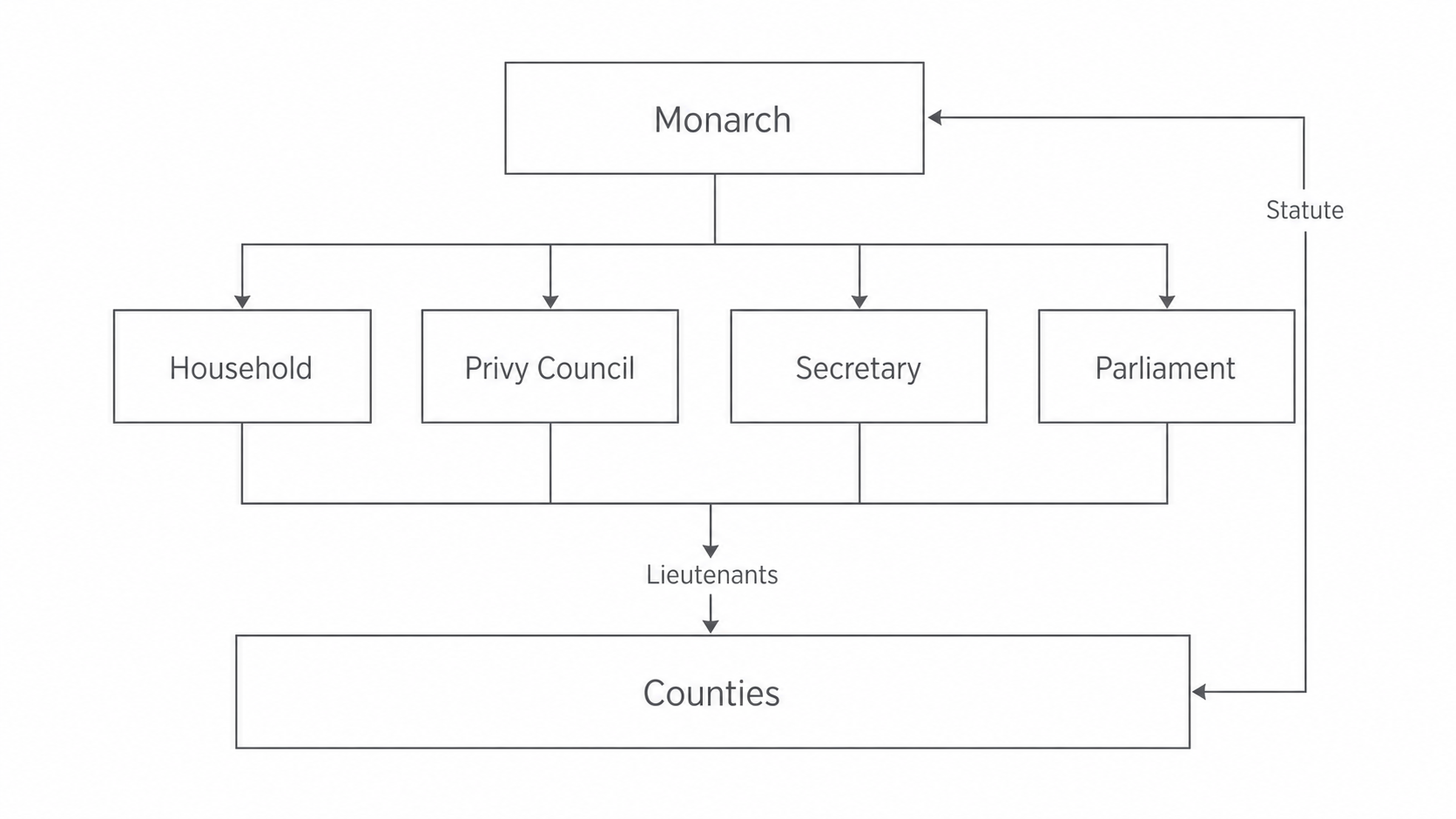
The diagram groups routes of authority and information rather than showing one administrative chain. Statute was made jointly by Crown, Lords and Commons; Parliament did not directly command the lieutenants. The key judgement is that Tudor government became denser rather than less royal. The Crown remained the source of authority, but by 1603 it relied on council business, paperwork, statute and county military leadership to make that authority work.
Household and Personal Access
In 1485, the centre of government was still the monarch's person. Henry VII had won the throne by conquest at Bosworth, so his first problem was security. He needed to reward loyalty, watch the nobility, raise revenue, and prevent over-powerful subjects from turning dynastic uncertainty into rebellion. The royal household was therefore political as well as domestic.
The household mattered in three ways. First, it projected monarchy: ceremony, servants, progresses, feasts, and access all showed who held favour. Second, it was administrative: many financial and clerical functions were still connected to the king's household. Third, it filtered access: proximity to the king could turn a courtier into a political actor.
Henry VII strengthened the Chamber as a way of handling royal finance more directly than the slower Exchequer. Chamber finance helped him keep closer personal control over income from crown lands, feudal dues, bonds, recognisances, and fines. The Council Learned in the Law, associated especially with Edmund Dudley and Richard Empson, enforced financial obligations and bonds. It made Henry VII's monarchy more secure and solvent, but also more resented. Its abolition in 1509 after Henry VII's death showed a limit of highly personal fiscal government: what looked like efficient control under one king could look like extortion under the next.
Under Henry VIII, the household became even more visibly political. Henry's court was a place of magnificence, favour, and faction. The Privy Chamber was especially important because it controlled intimate access to the king.
Privy Chamber
The monarch's private apartments and the staff who served there; under Henry VIII its gentlemen controlled personal access to the king.
Gentlemen of the Privy Chamber were not just servants; they could influence appointments, news, petitions, and the monarch's mood. Wolsey understood this danger, and the Eltham Ordinances of 1526 tried to regulate the household and reduce the influence of some of Henry's close companions.
Yet the household did not disappear as government became more bureaucratic. It changed function. Under Henry VIII, male courtiers around the king could turn intimacy into policy influence. Under Mary I and Elizabeth I, the most intimate household space was staffed by women, so the Privy Chamber could not function in exactly the same way. The Bedchamber and household still mattered for patronage, information, and faction, but high policy increasingly depended on the Privy Council, principal secretaries, financial officers, and parliamentary management.
The key judgement is that the household lost some administrative centrality but retained political importance. In 1485 it was near the heart of finance and government. By 1603 it was less the main administrative machine, but it still shaped access, favour, faction, and the personal politics of monarchy.
Secretary, Statute and 1540
The changing role of the Secretary shows how Tudor government became more dependent on information and paperwork. Earlier secretaries had been royal clerks who handled correspondence, the signet, and drafting. Under Henry VIII, especially through Thomas Cromwell, the office became much more central. The Secretary was close to the monarch, knew what was being discussed, drafted orders and legislation, coordinated correspondence, and helped connect the king, council, Parliament, Church, and local officials.
Cromwell's career shows the transformation. After Wolsey's fall in 1529, Cromwell became increasingly important in Henry VIII's service. He entered the king's council, managed legal and parliamentary business, and became Principal Secretary in 1534. His power came from more than one office, but the secretaryship gave him a strategic position: he could turn royal aims into drafts, letters, proclamations, instructions, and statutes.
The Reformation made this role more important because the break with Rome required administrative enforcement. The government had to secure clerical submission, manage Parliament, draft legislation, supervise oaths, collect information about monasteries, handle propaganda, and punish opposition. This could not be done only by personal command at court. It needed records, correspondence, officials, and follow-up.
The reform of the Privy Council in 1540 was the key development named in the specification. It should not be treated as if no council existed before 1540. English kings had long had councils. The change was that, by 1540, the Privy Council had a clearer identity as a smaller, more regular, more businesslike executive body. It normally contained leading officers of state and household, met frequently, used clerks, recorded decisions, and issued orders in the monarch's name.
This mattered because the Tudor state needed continuity. Wolsey had dominated government personally until 1529. Cromwell had dominated much of the 1530s but was executed in July 1540. A more organised Privy Council reduced the danger of government depending entirely on one over-mighty minister. It also gave later Tudor regimes a tool for managing crisis: minority rule under Edward VI, Catholic restoration under Mary, Elizabeth's settlement, rebellion scares, war, recusancy, and local disorder.
The 1540 reform therefore changed the centre in three linked ways:
| Feature | Earlier pattern | Later Tudor pattern |
|---|---|---|
| Council | Larger, less sharply defined, often overshadowed by a dominant minister | Smaller working Privy Council with clearer executive identity |
| Records | Business could be personal and unevenly recorded | Council clerks and registers made decisions more traceable |
| Function | Advice, justice, patronage, and occasional policy | Daily executive coordination, orders to localities, emergency management |
Do not overstate the change. The Privy Council was not a modern cabinet and the monarch remained the source of authority. But after 1540, central government had a more durable executive core than it had possessed in 1485.
Council, Secretaries and Lieutenants
After 1540, the Privy Council became the working centre of Tudor government, but it did not operate alone. It depended on secretaries, clerks, regional officers, JPs, sheriffs, bishops, nobles, and later lords lieutenant. The centre became stronger by becoming better connected to the country.
Edward VI's reign showed both the importance and the fragility of council government. Edward was nine when he became king in 1547. Real authority was exercised first by Somerset as Lord Protector and then by Northumberland. The Privy Council gave the regime an institutional framework, but faction and personal dominance remained dangerous. The rebellions of 1549, war costs, inflation, religious reform, and succession planning all placed heavy pressure on the council.
Mary I also relied on council government. Her accession in 1553 depended on defeating the attempt to put Lady Jane Grey on the throne, and she then had to manage Catholic restoration, her Spanish marriage, and Wyatt's rebellion in 1554. Mary's council was politically mixed at first because she needed experienced councillors as well as Catholic loyalists. That mixture shows a wider Tudor pattern: the council was a tool of monarchy, but it also carried institutional memory across religious reversals.
Continue this lesson.
You’re previewing NovaLearn without an account. Create a free account to read the rest.
Create free account