2F.2 KT4 - The end of apartheid and the 'rainbow nation', 1984-94
Between 1984 and 1994, township revolt, economic weakness and international
isolation made apartheid harder to sustain, while negotiation and violence shaped
what replaced it. You will trace how Botha's strategy failed, why de Klerk and
Mandela entered talks, and how constitutional compromise led to the 1994 election
and Government of National Unity. The transition ended legal white minority rule,
but the 'rainbow nation' began with deep social inequalities and political mistrust
still unresolved.
Enquiry Frame and Chronology
The central enquiry is: why did apartheid end between 1984 and 1994, and how
far did the 1994 settlement create a new "rainbow nation"?
The answer needs two balances. First, distinguish between pressure and
settlement. Township revolt, sanctions and economic crisis made apartheid
harder to sustain, but they did not automatically create a constitution. Second,
distinguish between dismantling apartheid law and ending apartheid's
social consequences. By 1994 South Africans voted in a non-racial democracy,
but inequality, mistrust and violence did not disappear overnight.
The transition chain below separates the forces that made apartheid less workable from the bargaining that shaped the final settlement. Follow the movement from ungovernability and economic pressure into negotiation, then notice that violence and compromise sit inside the same process.
[DIAGRAM: asset_name: 1984-94 transition chain; asset_slug: p2_2f2_04_the_end_of_apartheid_and_the_creation_of_the_rainbow_nation_1984_94__diagram_01; recommended_method: image_gen; description: Left-to-right schematic on a white background showing township revolt, economic pressure, de Klerk opening talks, negotiation and violence, interim constitution, and the 1994 election plus Government of National Unity, with pressure marked over the early stages and compromise over the later stages]
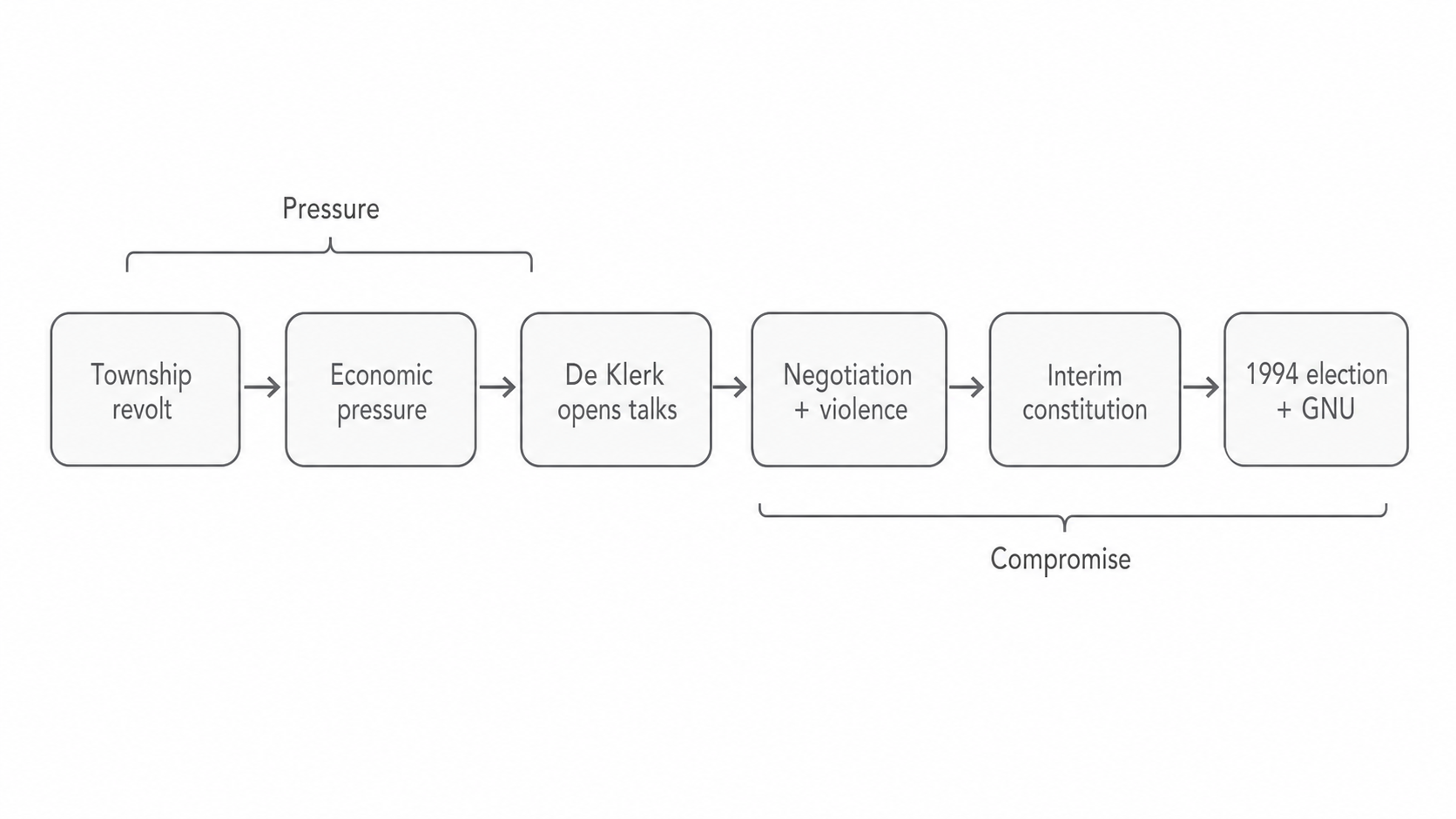
This is why strong answers avoid single-cause explanations. Pressure narrowed the regime's choices, but constitutional compromise explains why apartheid ended through an election, interim rules and a Government of National Unity rather than through simple collapse.
| Date | Event | Why it matters for judgement |
|---|---|---|
| 1983 | United Democratic Front formed against the Tricameral Constitution | Created a broad internal front linking civic, church, student, youth, women's and trade union activism. |
| 3 September 1984 | Vaal uprising began | Township revolt moved from opposition to reform into sustained local challenge to the apartheid state. |
| 20 July 1985 | Partial State of Emergency declared | Botha relied on emergency powers because ordinary policing could not restore control. |
| 15 August 1985 | Botha's Rubicon speech disappointed reform expectations | Increased doubts among foreign lenders, investors and governments about whether the regime would reform seriously. |
| 12 June 1986 | Nationwide State of Emergency declared | Repression disrupted resistance, but also exposed the regime's dependence on force. |
| 5 July 1989 | Botha secretly met Mandela at Tuynhuys | Signalled that contact with the imprisoned ANC leader had become thinkable even before open negotiation. |
| September 1989 | F. W. de Klerk became State President | Opened the way for a new National Party strategy. |
| 2 February 1990 | De Klerk unbanned the ANC, PAC and SACP and announced major changes | Turned secret contact into public political negotiation. |
| 11 February 1990 | Nelson Mandela released from Victor Verster Prison | Gave negotiations a nationally and internationally recognised leader. |
| 6 August 1990 | Pretoria Minute | ANC suspended armed struggle; government and ANC tried to remove obstacles to talks. |
| June 1991 | Parliament repealed core apartheid legislation | Dismantled legal pillars such as racial classification and racially based land controls. |
| 20-21 December 1991 | CODESA I | Multi-party constitutional negotiation began at national level. |
| 17 March 1992 | White referendum endorsed de Klerk's reform process | Strengthened de Klerk against the white right. |
| May 1992 | CODESA II deadlocked over constitutional questions | Disagreement about the future constitution-making process blocked agreement. |
| 17 June 1992 | Boipatong massacre, followed by ANC withdrawal from talks | Violence and mistrust deepened the negotiation crisis. |
| 26 September 1992 | Record of Understanding | ANC and government resumed movement towards an elected constitution-making process. |
| 18 November 1993 | Interim Constitution agreed | Created the rules for the democratic election and the transition. |
| 26-29 April 1994 | First democratic election | Ended white minority rule through universal adult suffrage. |
| 10 May 1994 | Mandela inaugurated; Government of National Unity began | Made the new political order visible at home and internationally. |
For Paper 2 assessment, this topic supports both AO1 essays and AO2 source work.
In an essay, avoid writing a simple heroic story in which Mandela or de Klerk
alone "ended apartheid". Strong answers show interaction: township revolt
destroyed governability, economic and international pressure reduced room for
delay, leadership choices turned crisis into negotiation, and constitutional
compromise prevented the transition from collapsing into wider civil war. In
source questions, ask what a source reveals about its moment. A government
speech may show public reform strategy but hide security calculations; a UDF
leaflet may reveal mobilisation but not the full diversity of township opinion;
a foreign sanctions document may show outside pressure but not prove that
sanctions alone caused change.
Township Revolt and People's Power
The revolt in the townships from 1984 to 1987 began in the context of Botha's
attempted reform. The 1983 constitution created a Tricameral Parliament with
separate chambers for white, Coloured and Indian representatives, while Africans
remained excluded from national political rights and were still treated as
citizens of homelands. The reform was meant to divide opposition and give the
regime a more moderate image. Instead it convinced many activists that the
government wanted to modernise apartheid without surrendering white power.
The United Democratic Front, launched in 1983, became the key internal
umbrella movement. It did not operate as a normal single party. It linked
hundreds of affiliates: civic associations, student bodies, youth groups,
churches, women's organisations, trade union activists and local campaign
committees. Its strength was that it could connect national slogans such as
"UDF unites, apartheid divides" to ordinary local grievances: rent increases,
poor services, corrupt township councillors, police raids, school conditions and
the exclusion of Africans from the Tricameral settlement.
The Vaal uprising on 3 September 1984 showed how local anger could become
national crisis. In townships such as Sebokeng, Sharpeville, Evaton, Boipatong
and Bophelong, protest against rent rises and councillors turned into clashes
with police and attacks on local government symbols. Township councillors were
seen by many residents as collaborators because they helped administer apartheid
locally while lacking real power over housing, wages, services or national law.
The state could replace councillors, send police and deploy troops, but that did
not restore legitimacy.
The protest strategies were varied:
| Strategy | How it challenged apartheid | Limitation or risk |
|---|---|---|
| Stayaways | Workers and students stayed away from workplaces and schools, showing that townships and industry could not be governed without black cooperation. | They were difficult to sustain and could cost wages or expose participants to dismissal and police action. |
| Rent boycotts | Residents refused to fund local councils they rejected, undermining township administration. | Councils and the state sometimes responded with evictions, repression or pressure on vulnerable households. |
| Consumer boycotts | Shoppers withheld custom from targeted businesses to force white business and local elites to recognise township demands. | Boycotts required discipline; informal traders and poorer residents could suffer. |
| School boycotts | Students attacked inferior apartheid education and used schools as sites of political mobilisation. | Long boycotts disrupted learning and created tension between youth activists, parents and UDF leaders. |
| Funerals and rallies | Funerals of victims of police violence became mass political gatherings. | They could be banned, attacked or turned into confrontations with security forces. |
| People's courts and street committees | Some activists tried to replace state authority with local forms of "people's power". | Informal justice could become coercive or violent, especially against alleged informers or collaborators. |
This is why the phrase grassroots organisation matters. The UDF did not
simply command the revolt from above. Local civic associations, youth groups and
shop-floor organisers often moved faster than national leaders. That gave the
movement energy, but it also made it hard to control. Some activists promoted
disciplined mass action; some youths used intimidation; some communities turned
against suspected collaborators with extreme violence. A strong answer should
not romanticise township revolt as entirely peaceful or dismiss it as mere
chaos. It was a mass political challenge to apartheid rule, but it was also a
period of fear, coercion and fractured authority inside black communities.
Government violence was central. Police used live ammunition, detentions, raids
and torture; the South African Defence Force entered townships; emergency
regulations restricted movement, meetings and reporting. The partial State of
Emergency of July 1985 applied first to selected districts, especially in the
Eastern Cape and the Pretoria-Witwatersrand-Vereeniging region. In June 1986 it
became national. Tens of thousands were detained during the emergency period.
The state also used censorship, banning orders, treason trials and restrictions
on organisations to break leadership networks.
Communal violence also mattered. Some violence was between residents and
township councillors or alleged informers. In Natal and later on the Rand,
conflict between supporters of the ANC-aligned movement and Inkatha became
increasingly deadly. Vigilante groups, hostel residents, local chiefs, police
forces and political organisations all appeared in different local conflicts.
The apartheid state often presented this as "black-on-black violence" to deny
its own responsibility, but security force action, policing choices and covert
support for anti-ANC forces made the violence part of the wider struggle over
power.
The immediate effect of the State of Emergency was mixed. It disrupted UDF
organisation, pushed some activism underground and gave the state temporary
breathing space. Its deeper significance was different: a government that needed
armoured vehicles, censorship and detention without trial to rule its own
townships had not solved its legitimacy crisis. By 1987 the revolt had been
contained more than defeated. Apartheid was still armed, but it was less able to
claim that reform plus repression could create stable consent.
Why Botha Moved Towards Negotiation
P. W. Botha did not set out to create majority rule. His policy was often
described as total strategy.
Total strategy
P. W. Botha's response to what the government called a 'total onslaught' by communism, the ANC, internal opposition and hostile neighbouring states.
In practice, total strategy mixed selective reform,
security-state coordination, propaganda, regional military pressure and harsh
internal repression. The aim was to preserve white power by adapting apartheid
enough to survive.
Botha's reforms included the Tricameral Parliament, some relaxation of petty
apartheid, the abolition of influx control and pass laws in 1986, and attempts
to create black local government structures. These reforms had important
limits. Africans still had no national vote. Homelands remained central to the
official fiction that black South Africans belonged somewhere else politically.
The State Security Council and security establishment gained enormous influence.
The result was not democratisation, but a system that looked both repressive and
uncertain: too reformist for the white right, too exclusionary for the black
majority, and too violent for international opinion.
The failure of total strategy can be seen in four areas:
| Area of failure | What happened | Why it pushed towards negotiation |
|---|---|---|
| Township governability | The UDF, civic associations, youth groups and unions helped make many councils and townships ungovernable. | The state could suppress organisations, but could not build legitimate black political consent through apartheid structures. |
| White political unity | Reform split white politics: the Conservative Party attacked Botha from the right, while business and reformists feared endless crisis. | The National Party could not simply stand still without losing support in different directions. |
| Regional strategy | South Africa's wars and destabilisation in southern Africa were costly and controversial, especially around Angola and Namibia. | Military power did not remove diplomatic isolation and did not solve internal legitimacy. |
| Security-state rule | Emergency government gave temporary control but normalised censorship, detention and militarisation. | Repression made apartheid more internationally indefensible and did not create a durable political settlement. |
Economic problems made this political failure more dangerous. South Africa was
not a poor state collapsing in a simple economic sense: it had minerals,
industry, finance and a sophisticated infrastructure. The problem was that
apartheid made the economy increasingly costly and isolated. Spending on
security and regional war rose. Business confidence weakened. Investment became
scarce. Inflation and unemployment contributed to social strain. Most
important, the 1985 debt crisis showed that political crisis could turn into
financial crisis when foreign banks became unwilling to roll over loans.
International isolation added pressure. The UN arms embargo had already limited
South Africa's legitimacy. In 1986 the United States passed the Comprehensive
Anti-Apartheid Act over President Reagan's veto, banning new loans and
investment and restricting trade and air links. Other governments, churches,
universities, city authorities, trade unions and campaign groups supported
sanctions, disinvestment, sports boycotts and cultural boycotts. Sanctions did
not by themselves topple apartheid, and some employers and workers feared their
economic effects. But they changed calculations inside South Africa by raising
the cost of delay and by signalling that cosmetic reform would not restore full
international acceptance.
Botha's Rubicon speech in August 1985 is a useful turning point. Many
observers expected major reform. Instead Botha refused to cross the political
Rubicon towards genuine power sharing. The speech damaged confidence because it
suggested that the government understood the crisis but would not make the
decisive change expected by investors and foreign governments. That helped turn
political disappointment into economic pressure.
The State of Emergency also had a double effect. In the short term it weakened
open resistance and allowed Botha to claim that order was being restored. In the
longer term it proved the limits of coercion. Detention and censorship could
reduce visible protest, but they could not answer the central question: how
could a state permanently rule a black majority that rejected the political
system? The emergency also encouraged many foreign governments and businesses to
see apartheid not as a difficult reform problem but as a source of permanent
instability.
That is why secret contact with Mandela and the ANC became thinkable. Mandela
had been moved from Robben Island to Pollsmoor in 1982, and during the later
1980s he held discussions with government representatives such as Kobie Coetsee.
Botha offered Mandela conditional release in 1985 if he renounced violence;
Mandela refused because he would not accept freedom on terms that delegitimised
the ANC's struggle. In July 1989 Botha met Mandela privately at Tuynhuys. This
did not mean Botha accepted majority rule. It did mean that the government had
begun to explore whether negotiation with the ANC might become a controlled way
out of crisis.
The best judgement is that Botha moved towards negotiation reluctantly because
his existing strategy was failing. Internal revolt made apartheid ungovernable;
economic weakness made repression more costly; international isolation made
cosmetic reform inadequate; and the emergency showed that force could delay but
not solve the crisis. However, Botha himself was not the leader who made the
decisive break. That came under de Klerk after 1989.
De Klerk's New Course and CODESA
F. W. de Klerk became State President in September 1989. He was not a lifelong
anti-apartheid liberal. He was a National Party politician who recognised that
the old strategy had run out of road. His "new course" rested on a hard
calculation: if the government waited until it was weaker, it might lose the
chance to shape the terms of transition. Negotiation from a position of
remaining state power offered a better chance of protecting white interests,
property rights, civil service continuity and minority representation.
On 2 February 1990, de Klerk announced the unbanning of the ANC, PAC, SACP
and other organisations, the release of political prisoners, a relaxation of
media restrictions, and movement away from emergency rule. Mandela was released
from Victor Verster Prison on 11 February 1990 after twenty-seven years in
prison. The symbolic importance was enormous. Mandela's release did not end
apartheid immediately, but it gave negotiations a leader who could speak to the
ANC, to township supporters, to international audiences and to many anxious
white South Africans.
Mandela's release was significant for several reasons:
| Significance | Explanation |
|---|---|
| Legitimacy | Negotiations with the ANC became credible only when its most famous leader was free to participate publicly. |
| Discipline | Mandela could urge supporters to combine pressure with negotiation, even when anger over violence made compromise difficult. |
| Reassurance | Mandela's language of non-racial democracy helped counter white fears of revenge, though mistrust remained deep. |
| International attention | His release signalled to the world that the transition might be real, while also keeping pressure on the government to go further. |
Continue this lesson.
You’re previewing NovaLearn without an account. Create a free account to read the rest.
Create free account