2F.2 KT2 - Radical resistance and National Party power, 1960-68
Between 1960 and 1968, resistance to apartheid became more radical even as the
National Party tightened its control. You will trace how Sharpeville, banning, armed
struggle, Rivonia, exile and imprisonment changed the ANC and PAC, while the republic,
separate development, economic recovery and an expanded security state strengthened
white rule. This paradox explains why apartheid looked more secure in 1968 even though
opposition had become more militant and international.
The Enquiry Frame
This topic is about a paradox: why did resistance radicalise at the same time as National Party power consolidated?
The official content falls into four linked developments:
- resistance to apartheid and government reaction in 1960-61
- the creation of a republic in 1960-61
- African nationalist radicalisation in 1961-68
- the strengthening of "separate development" in 1961-68
Read the period as a sequence of cause and consequence. The killing of protesters at Sharpeville did not automatically produce a successful revolution. It produced a new political climate. For African nationalists, the old strategy of disciplined mass protest now looked dangerously inadequate. For the National Party, the same crisis justified emergency powers, bannings and a claim that white South Africans needed firmer protection from disorder.
| Date | Event | Why it matters for this topic |
|---|---|---|
| 3 February 1960 | Harold Macmillan delivered the "Wind of Change" speech in Cape Town | Britain publicly recognised African nationalism as a force South Africa could not ignore. |
| 21 March 1960 | Sharpeville Massacre; police also shot protesters at Langa | Peaceful anti-pass protest was met by state violence, making Sharpeville a turning point in resistance and international opinion. |
| 30 March 1960 | State of emergency declared | The government suspended normal liberties and arrested thousands of opponents. |
| April 1960 | ANC and PAC banned under the Unlawful Organisations Act | Open African nationalist politics was forced underground or into exile. |
| 5 October 1960 | White-only republic referendum | A narrow white electorate majority supported replacing the monarchy with a republic. |
| 29-31 May 1961 | ANC-linked stay-at-home against the republic | The state used arrests and intimidation to limit protest, strengthening the case for new tactics among ANC leaders. |
| 31 May 1961 | Republic of South Africa established outside the Commonwealth | Verwoerd achieved a major Afrikaner nationalist goal and presented apartheid as a sovereign domestic policy. |
| 16 December 1961 | Umkhonto we Sizwe launched its sabotage campaign | The ANC-linked armed wing marked the shift from exclusive reliance on non-violent protest. |
| 1962-63 | Poqo attacks in the Western Cape and Transkei | PAC-linked radicalisation took a more violent and decentralised form. |
| 1963 | Transkei given partial self-government; 90-day detention law introduced; Liliesleaf raid | Separate development, police powers and the destruction of MK's internal high command advanced together. |
| 12 June 1964 | Rivonia Trialists sentenced to life imprisonment | Mandela and other leaders were removed from domestic struggle but became symbols of resistance. |
| 6 September 1966 | Verwoerd assassinated | John Vorster inherited and intensified the security state. |
| 1967 | Terrorism Act; compulsory white military service; ANC/ZAPU Wankie campaign | The state linked domestic apartheid to regional counter-insurgency. |
| 1968 | Homeland development continued; PAC military structures remained weak | By the end of the topic, radicalisation had not yet rebuilt a strong internal mass movement. |
Two terms need careful handling. Radicalisation does not mean that every opponent of apartheid suddenly supported violence. It means that the major liberation movements increasingly concluded that constitutional petitioning and peaceful protest could not, by themselves, defeat a state prepared to ban, shoot and detain. Consolidation does not mean apartheid became morally accepted or permanently safe. It means the National Party strengthened its practical hold on power in these years.
Before moving into detailed examples, use the schematic below to hold the two directions of change together. Track how the same 1960 crisis pushed resistance towards underground survival, exile and armed struggle while also helping the state expand its constitutional, security and territorial controls.
[DIAGRAM: asset_name: 1960-68 radicalisation and consolidation flow; asset_slug: p2_2f2_02_radicalisation_of_resistance_and_the_consolidation_of_national_party_power_1960_68__diagram_01; recommended_method: image_gen; description: Split-flow schematic on a white background showing the 1960 crisis dividing into resistance radicalisation through banning, underground work, armed struggle and exile or prison, and state consolidation through republic, security laws, homelands and growth or defence, converging in 1968 as a stronger state facing more militant resistance]
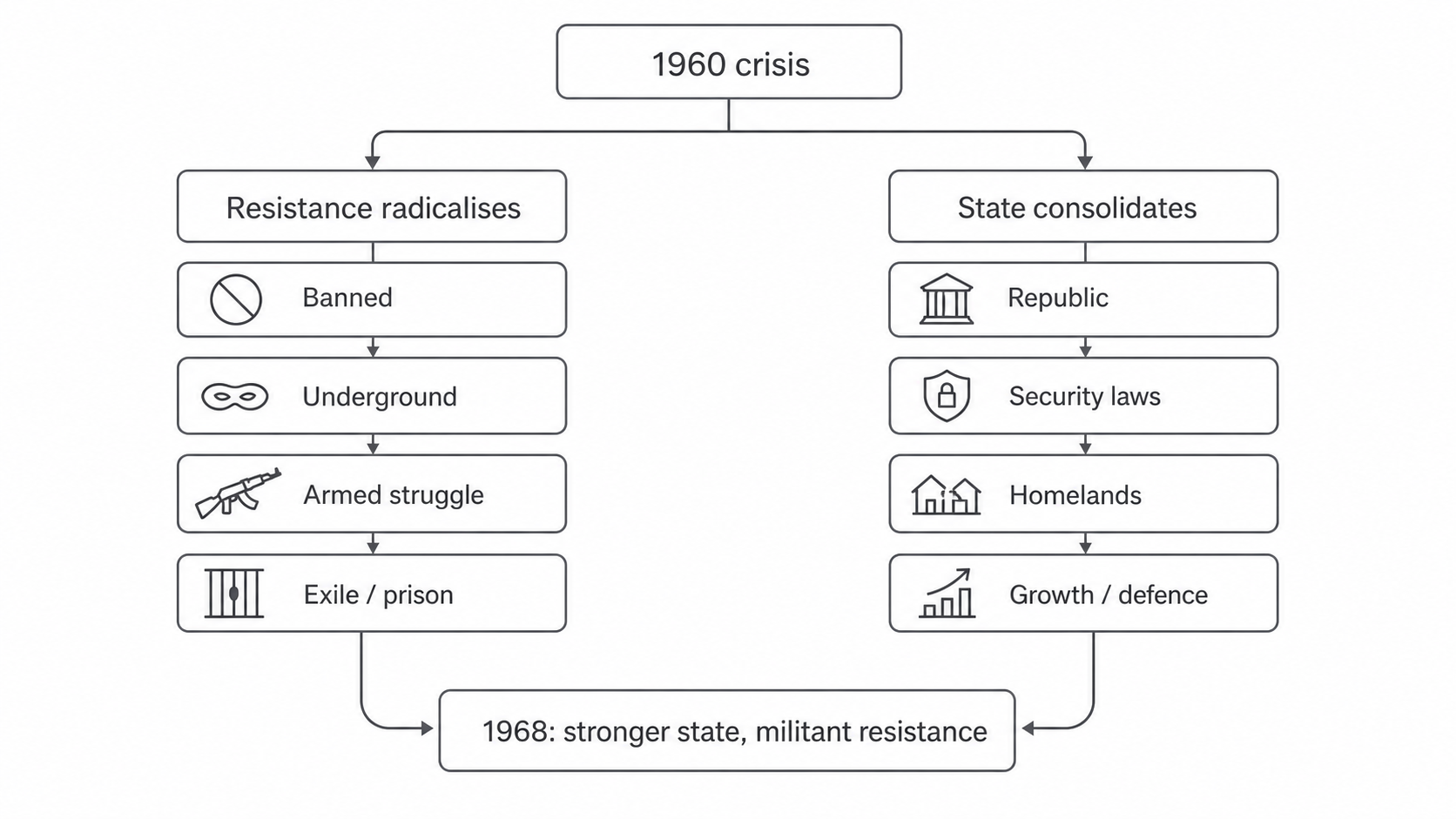
The point is not that these tracks cancel each other out. The exam problem is that both were true: resistance became ideologically and strategically tougher, while the state became institutionally harder to challenge inside South Africa.
For Paper 2, use this topic for both AO1 essays and AO2 source questions. In essays, explain the interaction between resistance and repression. In source questions, ask what a source can reveal about its moment: a police statement after Sharpeville, a PAC leaflet, Macmillan's speech, Mandela's court statement or a government defence of Bantustans will each be useful for different reasons, but each will also carry the limits of its purpose and audience.
Sharpeville and State Repression
The immediate crisis of 1960 began with protest against the pass laws. Pass laws controlled the movement of African people by requiring documents that showed where they were permitted to live and work. They were not just bureaucratic rules. They were a daily form of racial control, linking labour, housing, policing and family life.
The PAC, founded in 1959 after breaking from the ANC, tried to seize the initiative in March 1960 with an anti-pass campaign. Its tactic was deliberately peaceful and confrontational: protesters would leave passes at home, present themselves at police stations and invite arrest. The aim was to overwhelm the system and expose the injustice of pass controls. The ANC had also planned anti-pass action, but the PAC moved first.
At Sharpeville on 21 March 1960, thousands gathered near the police station. The crowd was not an armed military force. Police opened fire, killing 69 people and injuring at least 180. Many of those shot were hit as they ran away. On the same day at Langa, near Cape Town, police action also killed and wounded protesters. Sharpeville became the more famous name, but it should be understood as part of a wider national confrontation over pass laws and state authority.
Sharpeville mattered for four connected reasons.
| Significance | Explanation |
|---|---|
| Moral shock | The massacre made the violence of apartheid visible inside and outside South Africa. Images and reports of dead and wounded protesters damaged the government's claim to be maintaining civilised order. |
| Strategic turning point | Many activists concluded that peaceful protest could expose injustice but could not force change if the state answered with bullets, emergency powers and bannings. |
| International pressure | The United Nations Security Council discussed South Africa soon after Sharpeville, and anti-apartheid campaigning overseas gained urgency. |
| State opportunity | The government used the crisis to arrest leaders, restrict gatherings and outlaw the ANC and PAC. Repression was presented to white voters as necessary security. |
The government's reaction was swift. A state of emergency was declared on 30 March 1960. It gave the authorities power to detain without ordinary legal safeguards, ban meetings and suppress political activity. More than 18,000 people were arrested during the emergency, including important ANC and PAC figures. Public meetings were severely restricted, and the state tried to cut the links between national organisations, local branches and township communities.
In April 1960 the government banned the African National Congress and the Pan Africanist Congress under the Unlawful Organisations Act. This was more than a legal technicality. It changed the operating conditions of African nationalist politics. The ANC, created in 1912, had built decades of petitions, deputations, boycotts, Defiance Campaign activity and the Congress Alliance. The PAC, although much younger, had shown that it could mobilise rapidly around pass resistance. Banning both organisations aimed to prevent open recruitment, public meetings, fundraising, publication and leadership.
The bannings did not end resistance. They changed its form. Some activists went underground. Some left South Africa to build external missions. Some were imprisoned or restricted by banning orders. The state believed it had removed the main organisers from public life. In the short term, it largely succeeded in making open mass politics much more difficult.
That is why Sharpeville should not be treated as an automatic victory for resistance. It radicalised the moral and strategic argument against apartheid, but it also gave the National Party a security framework for crushing organisation inside the country. A strong essay should hold both points together: Sharpeville exposed the brutality of apartheid, yet the immediate balance of power moved towards the state.
Republic, Commonwealth and White Politics
Creating a republic was one of Hendrik Verwoerd's central aims. For many Afrikaner nationalists, republicanism was not a sudden response to Sharpeville. It had deep roots in resentment of British imperial rule, memories of the Boer republics and the desire to remove the British monarch as South Africa's head of state. Verwoerd also had a more immediate political aim: he wanted to define South Africa as a sovereign white-ruled state whose racial policies would not be dictated by Britain, the Commonwealth or newly independent African states.
The international context made this more urgent. On 3 February 1960, British Prime Minister Harold Macmillan addressed the South African Parliament in Cape Town. His "Wind of Change" speech recognised African nationalism as a political fact across the continent. Macmillan was not calling for immediate revolution in South Africa, and Britain still had major economic and strategic interests there. Even so, the speech was a major public warning. It told South Africa's rulers that Britain was moving with decolonisation rather than defending white minority rule across Africa indefinitely.
For Verwoerd, Macmillan's speech was useful as well as embarrassing. It showed that Britain could no longer be trusted as a comfortable imperial partner. Verwoerd rejected the implication that majority rule should apply to South Africa and defended apartheid as "separate development": each racial or ethnic group, he claimed, should develop in its own political space. This reply turned the republic issue into part of a wider argument about white security and Afrikaner independence.
The white-only referendum on a republic was held on 5 October 1960. The result was narrow: roughly 52 percent of white voters supported a republic, while roughly 48 percent opposed it. This matters because the republic was not created by the South African population as a whole. African, Coloured and Indian people were excluded from the decision, although they formed the great majority of the population. Even among whites, English-speaking voters and Natal were often more suspicious of breaking the British connection.
The republic was established on 31 May 1961. The date had symbolic weight: it was the anniversary of the Treaty of Vereeniging in 1902, which had ended the South African War, and of the Union of South Africa in 1910. South Africa kept a parliamentary system, but the monarch and governor-general were replaced by a state president. The change did not democratise the country. It made white minority rule more assertively independent.
Leaving the Commonwealth was a crucial consequence. Verwoerd initially wanted South Africa to become a republic while remaining in the Commonwealth, as India had done after becoming a republic. At the Commonwealth Prime Ministers' Conference in March 1961, however, opposition from countries such as India, Ghana and Canada focused on apartheid. When it became clear that continued membership would not be accepted without a political confrontation over race, Verwoerd withdrew the application. South Africa's Commonwealth membership ended when the republic came into being.
This was a diplomatic defeat, but it was not a simple weakening of National Party power. Verwoerd could present withdrawal as a defence of South Africa's "honour" against outside interference. Among many Afrikaner nationalists, the republic fulfilled a long political dream. Among some conservative English-speaking whites, decolonisation elsewhere in Africa made Verwoerd's appeal to white unity more persuasive.
Black South Africans largely rejected the republic because they had had no vote in its creation. In May 1961, ANC-linked activists called for a national convention and organised a stay-at-home protest around the inauguration. The government responded with arrests, intimidation and temporary detention powers. The protest did not stop the republic. For Nelson Mandela and others, its suppression helped confirm that the state would not negotiate a democratic constitution through peaceful pressure alone.
The republic therefore consolidated National Party power in three ways. It satisfied Afrikaner nationalist identity, shifted white politics towards the defence of apartheid rather than loyalty to Britain, and allowed Verwoerd to frame international criticism as an attack on South African sovereignty. But it also widened the gap between white constitutional politics and black political exclusion. That gap fed the radicalisation that followed.
Armed Struggle and Rivonia
African nationalist radicalisation after 1961 was not a simple emotional reaction. It came from a strategic conclusion: if peaceful protest led to massacres, bannings and detention, then resistance had to find methods the state could not so easily absorb. The ANC and PAC both moved towards armed activity, but they did so in different ways and with different consequences.
The ANC had a long tradition of constitutional protest, petitions, disciplined campaigns and non-violent mass action. After Sharpeville and the banning of the ANC, this tradition became harder to sustain as the sole strategy. The failed attempt to force constitutional talks around the republic in May 1961 was especially important. Mandela and other leaders increasingly argued that the state had closed peaceful channels.
The ANC-linked armed wing, Umkhonto we Sizwe or MK, was launched on 16 December 1961. Mandela was its first commander-in-chief. The date was deliberately symbolic because 16 December was associated in Afrikaner nationalist memory with the Battle of Blood River; MK used it to announce that the liberation movement would now contest the state's historical confidence. MK's early campaign focused on sabotage: attacks on symbols and infrastructure such as government installations, pass offices, power lines or communications. Its initial purpose was to damage the state and attract attention while trying to avoid loss of life.
That choice matters for judgement. MK did not begin as a conventional army capable of defeating the South African state. It was a political-military signal. The aim was to show that the banned ANC was still alive, that apartheid would carry costs, and that the state could not indefinitely rely on one-sided force. The limits were obvious: MK lacked arms, bases, training, secure communications and internal freedom of movement.
The PAC followed a different path through Poqo, its armed wing. Poqo drew support especially in the Western Cape and Transkei. It was more decentralised and often more openly violent than early MK. It attacked whites, police, suspected informers and chiefs seen as collaborators with apartheid. The Paarl attack of 22 November 1962, when armed Poqo supporters moved from Mbekweni into Paarl, became one of its most notorious actions. The Bashee River killings in February 1963 intensified white fear and gave the state further justification for harsh security measures.
Poqo's radicalism was both a strength and a weakness. It created fear and showed that PAC militants were not prepared to wait for gradual reform. But its violence was poorly coordinated, often locally driven and vulnerable to informers, arrests and state propaganda. The government could present Poqo as proof that only stronger policing stood between whites and chaos. By 1963 Poqo had been badly damaged.
Continue this lesson.
You’re previewing NovaLearn without an account. Create a free account to read the rest.
Create free account