2G.1 KT3 - The fascist state, 1925-40
This lesson examines how Mussolini tried to make dictatorship work between 1925 and 1940 through consent, coercion, economic direction and compromise with powerful institutions. You will compare attempts to fascistise education, leisure and public culture with repression, corporatism, autarky and the Lateran settlement. The central question is how far Fascism transformed Italy when Mussolini still depended on the monarchy, Church, conservative elites and employers.
The Enquiry Frame
The central question is: how far did Mussolini create a genuinely fascist state between 1925 and 1940?
The date range matters. By 1925-26 Mussolini had moved beyond coalition government and was turning Italy into a dictatorship. By 1940 Italy entered the Second World War, which exposed the weaknesses of the system he had built. Between those points, the regime tried to solve four linked problems:
- how to make Italians accept, admire or at least obey Fascist rule
- how to control institutions that Fascism did not create, especially the monarchy, Church, army, civil service and economic elites
- how to turn economic policy into national strength
- how to reconcile a revolutionary-looking movement with a deeply Catholic society
Use this timeline to keep the topic chronological:
| Date | Development | Why it matters |
|---|---|---|
| 1925 | Press controls tightened; the Opera Nazionale Dopolavoro was created; the Battle for Grain began; the Vidoni Pact recognised Fascist unions in dealings with employers | The regime moved from emergency politics towards structured control of leisure, labour and information. |
| 1925-26 | The "Fascist Laws" made Mussolini head of government, weakened parliament, abolished opposition parties and removed elected local government | Dictatorship gained legal and administrative form. |
| 1926 | The Opera Nazionale Balilla was founded; strikes and lockouts were banned; the Special Tribunal for the Defence of the State was created | Youth, labour and opposition politics were brought under state control. |
| 1927 | The Charter of Labour expressed the principles of the Corporate State; the OVRA secret police developed from the political police | The regime claimed class collaboration while expanding repression. |
| 1929 | The Lateran Pacts settled the Roman Question; the state textbook for elementary schools began; a plebiscitary election offered only a Fascist-approved list | Church reconciliation, education and political theatre worked together. |
| 1931 | University professors were required to swear loyalty; conflict with Catholic Action produced the papal encyclical Non abbiamo bisogno | The regime's claim over youth and culture collided with Catholic independence. |
| 1933 | The IRI was created to rescue banks and industrial holdings during the Depression | Fascist economics became much more interventionist, though not socialist. |
| 1934 | Twenty-two corporations were established for the Corporate State | Corporatism became a large bureaucratic structure, but mostly strengthened state and employer control. |
| 1935-36 | The invasion of Ethiopia and League sanctions accelerated autarky | Foreign policy and domestic economic mobilisation became inseparable. |
| 1937 | The Ministry of Popular Culture, Minculpop, and the Gioventu Italiana del Littorio were created | Propaganda and youth control became more centralised and party-directed. |
| 1938 | Anti-Semitic racial laws were introduced | The regime radicalised its racial ideology and made the state machinery enforce exclusion. |
| 1939 | The Chamber of Fasces and Corporations replaced the Chamber of Deputies | Parliamentary representation was formally replaced by Fascist-corporate representation. |
| 1940 | Italy entered the Second World War | The regime's claims about unity, production and national strength faced their hardest test. |
For Edexcel Paper 2, this topic can support both AO1 essays and AO2 source questions. In AO1, avoid writing four separate mini-essays on "propaganda, economy, Church, terror". A strong answer weighs how those elements interacted. In AO2, always ask what a source can reveal about purpose and context: a propaganda poster may show the regime's ideal Italian, but it cannot prove that ordinary Italians believed it; a police report may reveal state anxieties, but it may exaggerate threats because police institutions were rewarded for finding enemies.
Consent, Culture And The New Italian
Mussolini wanted dictatorship to seem normal, modern and emotionally attractive. Consent was not the same as free democratic support. It meant a mixture of enthusiasm, habit, conformity, opportunism, fear of isolation and acceptance of benefits. The regime tried to shape that consent through schools, youth organisations, leisure, press control, propaganda and the cult of il Duce.
Education mattered because the regime wanted to form children before they became independent citizens. The 1923 Gentile Reform was not originally a fully Fascist reform, but it gave the state a more hierarchical education system and restored religious instruction in primary schools, which helped relations with Catholics. From the late 1920s the regime pushed harder. Elementary schools used a single state textbook from 1929, teachers were expected to present Fascism as the fulfilment of Italy's national story, and school rituals celebrated the flag, the Duce, war, empire and sacrifice. In 1931 university professors had to swear loyalty to the regime; only a tiny minority refused, which showed both the pressure of conformity and the weakness of open intellectual resistance.
Youth organisations were meant to carry fascistisation beyond the classroom. The Opera Nazionale Balilla (ONB), founded in 1926, organised children and adolescents in uniformed, militarised groups. Boys were trained through drills, sport, marching, weapons-style exercises and stories of sacrifice. Girls were trained in a gendered ideal of discipline, motherhood, health and service. In 1937 the Gioventu Italiana del Littorio (GIL) brought Fascist youth organisations more directly under PNF control. The aim was to make the state, rather than the family or Church, the organiser of youth loyalty.
The results were uneven. Many children enjoyed sport, camps, uniforms and trips. Many parents enrolled children because it was expected or useful, not because the whole family was ideologically Fascist. The regime reached young people widely, but it did not automatically control what they thought at home, in church, in local communities or later as adults.
Adult leisure was handled through the Opera Nazionale Dopolavoro (OND), created in 1925 and placed under PNF control from 1927. "Dopolavoro" means after-work. The OND offered sports, theatres, libraries, music, radio, cinema, holiday trips, workplace clubs, tourist excursions and cheap "popular trains". It became one of the regime's most important mass organisations because it made Fascism present in ordinary free time.
This was clever politics. Direct ideological lectures often bored people, but a cheap football club, a day trip, a cinema evening or a workplace bar could make the regime feel generous and modern. The OND also monitored sociability: it drew people away from socialist, Catholic or independent associations and into state-approved spaces. Yet its limitation was built into its strength. Many members treated it as leisure rather than conversion. The OND could encourage compliance and gratitude, but it could not prove deep Fascist belief.
Press control made the public sphere safer for Mussolini. The 1925 press law made editors more vulnerable to removal and made newspapers dependent on official approval. Opposition papers were shut down after the dictatorship was consolidated. Journalists learned to follow official lines, and the regime used instructions, warnings and censorship to shape what could be printed. By the 1930s this apparatus became more elaborate through the Ministry of Press and Propaganda, renamed the Ministry of Popular Culture or Minculpop in 1937.
Propaganda worked across many media:
| Medium | Fascist purpose | Limitation |
|---|---|---|
| Newspapers | Present Mussolini as decisive, suppress bad news and frame events through Fascist priorities | Many Italians knew newspapers were controlled and read them cautiously. |
| Radio | Carry speeches, music, ceremonies and news into homes and public listening spaces | Radio ownership was uneven, especially among poorer families. |
| Newsreels and cinema | Make the regime visible through images of rallies, public works, empire and the Duce | Cinema audiences could enjoy entertainment while ignoring political messages. |
| Architecture and exhibitions | Link Fascism to Roman greatness, modernity and permanence | Monumental culture was stronger in cities than in many rural lives. |
| School and youth ritual | Make loyalty habitual through uniforms, songs, salutes and ceremonies | Ritual participation did not guarantee private belief. |
The cult of il Duce was the emotional centre of this system. Mussolini was shown as tireless leader, soldier, worker, pilot, sportsman, thinker and father of the nation. Balcony speeches, photographs, slogans, staged newsreels and public ceremonies made him appear above ordinary politics. This mattered because the regime often worked less through coherent ideology than through Mussolini's personal authority. If Italians could believe that "the Duce" knew best, local failures could be blamed on officials, not on Fascism itself.
Fascist culture tried to create a new national style. It used Roman symbols, the fasces, imperial language, disciplined bodies, mass choreography, modern architecture and myths of youth, virility and sacrifice. It also tried to reshape ordinary conduct: speech, names, greetings, gender roles, consumer habits and attitudes towards war. But Fascist culture competed with older loyalties: Catholic ritual, regional identity, family life, local notables, class culture and simple private indifference. The regime could flood public space with Fascist signs. It could not fully empty private life of non-Fascist meanings.
Repression, Terror And Race
Consent was always backed by coercion. Mussolini did not need to execute opponents on the scale of Stalin's USSR or Hitler's Germany to create a police state. Fascist repression worked through law, surveillance, exile, intimidation, imprisonment, career penalties and the destruction of independent politics.
The turning point was 1925-26. After the Matteotti crisis of 1924, Mussolini chose dictatorship rather than retreat. The Fascist Laws made him head of government with powers far beyond an ordinary prime minister. Opposition parties were banned. Non-Fascist trade unions were destroyed. Opposition newspapers were closed. Elected local government was replaced. Political life became legal only inside the Fascist system.
The Law for the Defence of the State in November 1926 created the Special Tribunal for the Defence of the State. This court tried political crimes against the regime. The same repressive environment restored the death penalty for certain political offences, though executions inside Italy remained relatively rare before the war. More common punishments included prison, police supervision, warnings, loss of employment and confino, or internal exile, often to remote southern villages or islands.
The OVRA secret police developed after 1927 from the political police system. It used informers, surveillance, mail checks, infiltration and files on suspected opponents. The regime targeted communists, socialists, liberals, republicans, anarchists, anti-fascist Catholics, Slovenes and Croats in border areas, and other people labelled "subversive". Antonio Gramsci, the communist thinker, was arrested in 1926 and spent years in prison; his case is a reminder that the regime aimed not only to defeat armed plots, but also to silence alternative political thought.
Fascist terror was therefore real, but it had its own character. It was often bureaucratic and preventive. It made people ask: who might report me? Will a joke affect my job? Will my son lose opportunities if I am known as anti-Fascist? That kind of fear encouraged self-censorship even when the police were not physically present.
The regime also used violence beyond ordinary policing. Squadrist violence had helped Fascism rise to power, and intimidation did not simply disappear after 1926. Exiles, border minorities and colonial subjects faced harsher treatment. The state presented itself as orderly and lawful, but its law defined opposition so broadly that legality itself became an instrument of repression.
The anti-Semitic decrees of 1938 marked a major radicalisation. Before 1938, Italian Jews were a small, highly integrated minority, and some had supported Fascism. The regime's racial turn did not come from long-standing mass Italian anti-Semitism alone. It grew from Fascist racial thinking in empire, especially after Ethiopia, from the desire to harden the regime ideologically, and from closer alignment with Nazi Germany. Mussolini and the Fascist state were active agents in this policy; it was not simply imposed from Berlin.
The sequence was rapid:
| Date | Anti-Semitic development | Significance |
|---|---|---|
| July 1938 | The Manifesto of Race was published | It gave pseudo-scientific language to biological racism. |
| August 1938 | A census recorded Jews in Italy | The state gathered the information needed for exclusion. |
| September 1938 | Decrees excluded Jewish teachers and pupils from schools and universities and targeted foreign Jews | Education became an early site of racial separation. |
| October 1938 | The Grand Council defined criteria for who counted as Jewish | Persecution was bureaucratised through racial categories. |
| November 1938 | Royal Decree-Law no. 1728 introduced major measures for the "defence of the Italian race" | Mixed marriages were banned and Jews were excluded from public life, public employment, the armed forces and many professions. |
The laws were signed by King Victor Emmanuel III and enforced by the machinery of the Italian state. They removed Jews from schools, universities, the army, the civil service, the PNF, many professions and parts of economic life. They also attacked mixed marriages and defined Jewishness in biological terms, so conversion to Catholicism did not necessarily protect a person from classification.
For exam judgement, the racial laws matter in three ways. First, they show that Fascist Italy was not merely an old conservative dictatorship; by the late 1930s it was capable of ideological radicalisation. Second, they reveal how the regime's institutions cooperated: party, monarchy, ministries, police, schools and press all helped enforce exclusion. Third, they expose the limits of consensus. Some Italians accepted, ignored or benefited from persecution; others were uneasy; the Catholic hierarchy objected especially where racism challenged Catholic teaching or converted Jews, but it did not stop the state.
State, Party And Elites
The Fascist state was not built on a clean revolutionary break. Mussolini ruled through institutions that existed before Fascism and through elites who expected Fascism to defend order, property and national prestige. This is one of the most important limits on the idea of a fully totalitarian Fascist state.
The monarchy remained central. Italy was still the Kingdom of Italy, and Victor Emmanuel III was still king. Mussolini was head of government, but the monarchy retained symbolic and constitutional importance. The army swore loyalty to the king, not simply to Mussolini. Royal decrees and royal assent gave Fascist laws formal authority. The king also became emperor after the conquest of Ethiopia in 1936, showing how Fascist expansion could strengthen the monarchy as well as Mussolini.
This relationship benefited both sides. Mussolini gained respectability from the crown. The king and conservative elites gained a regime that crushed socialism, weakened parliament and promised national greatness. But it also meant that Mussolini did not abolish all rival sources of authority. The monarchy looked passive during these years, but its survival showed that Fascism had not absorbed the whole state.
Conservative elites mattered in similar ways. Senior army officers, judges, civil servants, prefects, police officials, diplomats, bankers, industrialists, large landowners and many local notables kept important roles. Some were enthusiastic Fascists. Others were careerists or conservatives who preferred Fascism to socialism and parliamentary instability. Mussolini usually co-opted them rather than replacing them wholesale with radical Fascist militants.
Before judging how totalitarian the state became, separate the routes of control from the bargains that kept the regime working. The diagram shows the centre of Fascist authority surrounded by the older institutions and interests that Mussolini still needed.
[DIAGRAM: asset_name: Mussolini's hybrid Fascist state; asset_slug: p2_2g1_03_the_fascist_state_1925_40__diagram_01; recommended_method: image_gen; description: Clean 16:9 schematic showing Duce plus PNF as the central node, linked to consent, coercion and compromise, with surrounding actor nodes for monarchy, Church, elites and employers to show that Fascist power depended on both control and bargains with traditional institutions.]
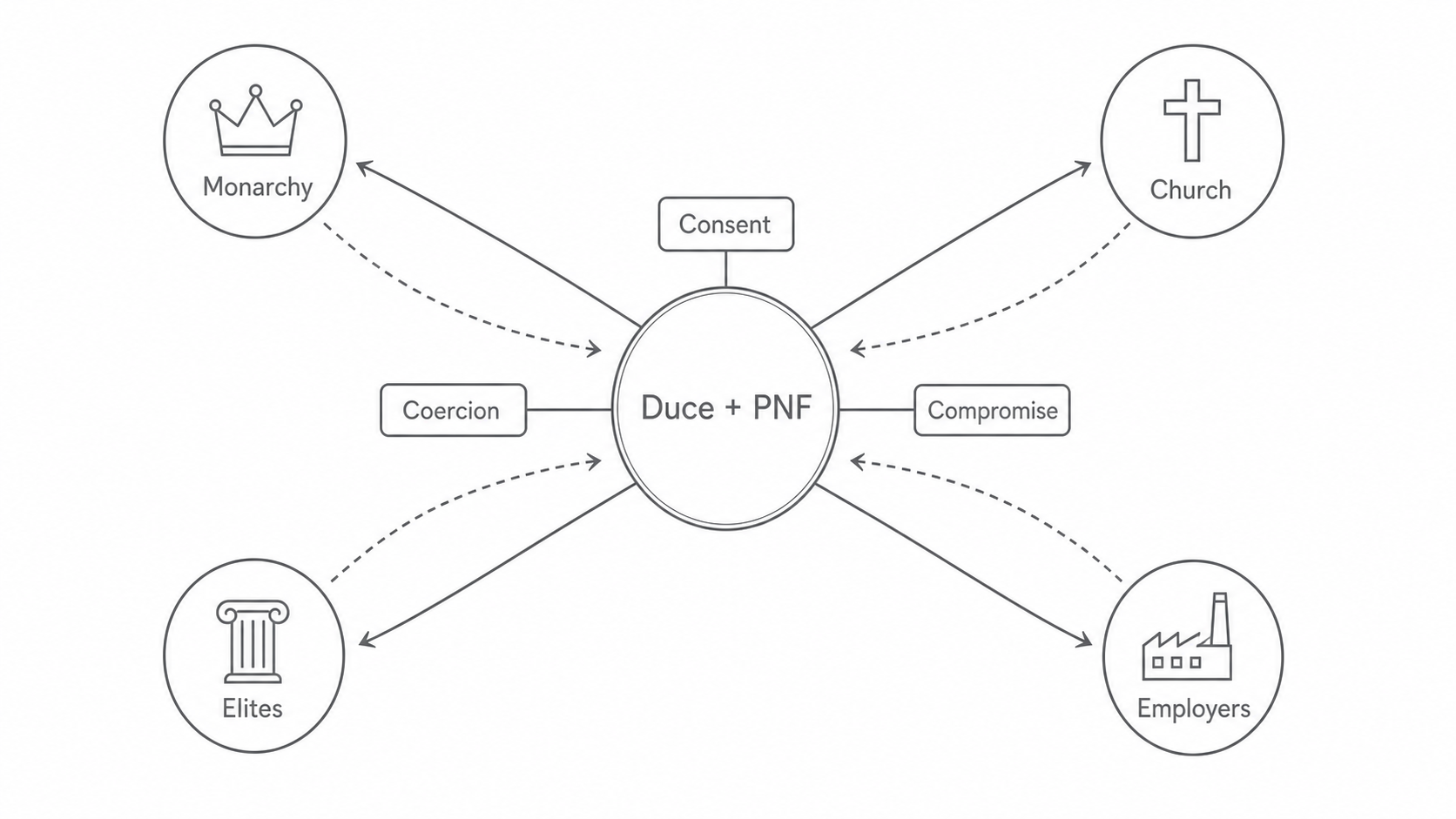
The key takeaway is not that these groups secretly opposed Fascism. Most benefited from the dictatorship in important ways. The limit is that their continuing importance meant Fascism dominated the state without fully replacing Italy's traditional ruling forces.
Local government shows how this worked. In 1926 elected mayors and councils were replaced by appointed podesta. By September 1926 the podesta system was extended to all communes. Podesta were appointed by royal decree on the recommendation of the interior ministry and operated under the supervision of the prefect. This destroyed local democracy, but it did not always mean local rule by revolutionary squadristi. Many podesta were local notables, professionals, landowners or respectable Fascists acceptable to the traditional authorities.
Prefects were especially important. A prefect was the central state's representative in a province. Mussolini used prefects to control local administration, public order and party-state tensions. This often put the professional state above local PNF bosses. The result was a dictatorship with a strong central state, but not a simple party takeover of every locality.
The PNF was still vital. It organised membership, rituals, youth, propaganda, local mobilisation and access to careers. But it was not an independent revolutionary force after 1926. Mussolini kept the party subordinate to himself and the state. Party secretaries reveal that pattern:
Continue this lesson.
You’re previewing NovaLearn without an account. Create a free account to read the rest.
Create free account