32 Theme 2 - Changing military and financial power
This lesson is about how Spain became the leading military power of sixteenth-century
Europe, and why that power was never as secure as it looked. The central argument is
that Spanish power grew because armies, fleets, credit and American silver could be
combined on an extraordinary scale. The weakness was that the same system depended on
Castile, lenders and future revenues so heavily that every new military commitment made
the monarchy more vulnerable to debt, mutiny and strategic overreach.
The Breadth Argument
The specification asks for change across the whole period 1474-1598. Do not treat the army,
navy and finance as separate mini-topics. They formed a single fiscal-military system:
the monarchy needed money and credit to recruit soldiers, build ships, hire commanders,
move troops, fortify towns and sustain long wars far from Spain.
Use the diagram to keep that system together. The arrows show why Spanish strength cannot
be explained by army, navy or finance alone: resources created military reach, but war
also created debt that pushed the monarchy back towards more credit.
[DIAGRAM: asset_name: Spanish fiscal-military feedback loop; asset_slug: p3_32_02_changing_military_and_financial_power__diagram_01; recommended_method: image_gen; description: Monochrome flow diagram showing Castile, silver and credit feeding the treasury, the treasury funding army and navy, war producing debt, and debt looping back to credit]
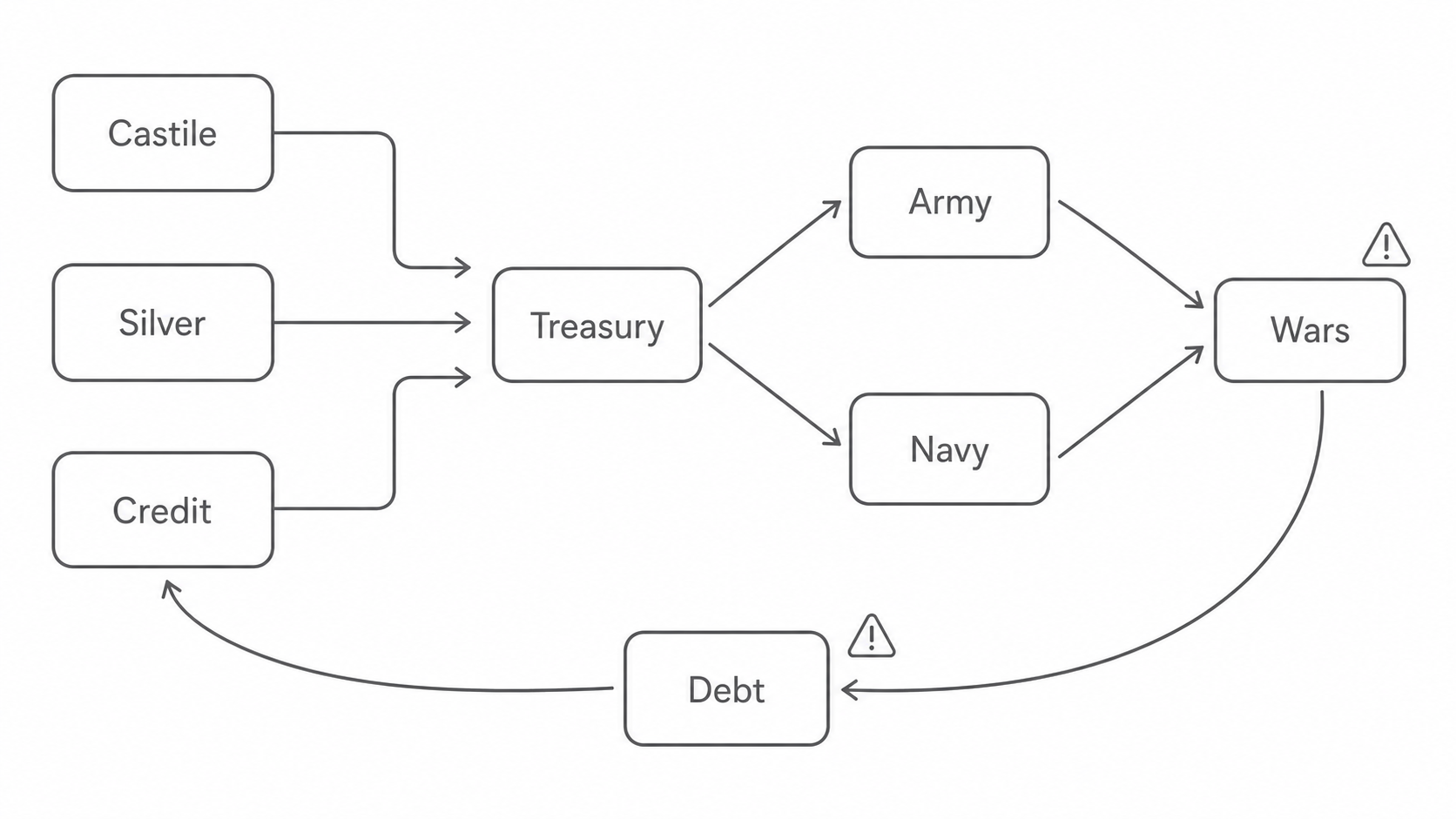
The takeaway is that Spanish power rose by converting future revenue into present force.
That made the monarchy formidable, but it also meant strength and strain grew together.
The main pattern is not a simple rise and fall. It is a rise into overextension.
| Phase | Military and naval change | Financial change | Overall judgement |
|---|---|---|---|
| 1474-1516 | The Catholic Monarchs built authority in Castile and Aragon, completed the conquest of Granada, and used Gonzalo de Cordoba in the Italian Wars. | Castile was already the strongest fiscal base, but resources were still limited and dynastic. | Spain began to develop the army that would dominate Europe, but it was not yet a global fiscal-military power. |
| 1516-59 | Charles V used Spanish infantry, Italian bases, German and Italian troops, and Genoese naval and financial support across Europe and the Mediterranean. | Credit expanded through juros and short-term loans, with Castilian revenues increasingly pledged to lenders. | Spain's military reach widened sharply, but war was becoming a permanent financial condition. |
| 1560-98 | Philip II inherited a formidable army and navy, fought in the Mediterranean, Netherlands, Atlantic and France, and used leaders such as Alba and Parma. | American silver, especially after Potosi, increased royal credit, but Castile carried the main burden and the Netherlands became a drain. | Spain remained the greatest European power in 1598, but its power was more constrained by debt and simultaneous commitments. |
The strongest breadth judgement is therefore:
- Army: the most consistent source of Spanish superiority, especially through professional infantry, siege warfare, and commanders who adapted tactics to changing theatres.
- Navy: increasingly important after 1528, but divided between Mediterranean galley warfare and Atlantic sailing warfare; its peak moments were impressive but uneven.
- Finance: the enabling condition for both army and navy, but also the main limitation because Spain converted future income into present war-making power.
This means a high-level essay should avoid two traps. First, do not say that American
silver simply made Spain rich enough to dominate Europe. Silver increased credit, but
armies and navies spent it quickly. Second, do not say that the Armada defeat in 1588
destroyed Spanish power. It exposed serious limits, but Spain remained dangerous in the
1590s. The better answer is that Spain's power became wider, more professional and more
expensive at the same time.
Army Growth, 1474-1559
The Spanish army's growth began before Spain ruled a vast empire. Under Ferdinand and
Isabella, war against Granada and intervention in Italy helped create a more disciplined
and adaptable force. This mattered because late medieval armies based mainly on noble
cavalry and temporary levies were not enough for the new warfare of fortified cities,
gunpowder weapons, mercenaries and long campaigns.
The key figure was Gonzalo de Cordoba, known as the Great Captain. He learned from
early setbacks against French heavy cavalry and Swiss-style infantry in Italy. His answer
was not simply bravery. It was tactical reorganisation. Spanish forces increasingly used
infantry units that combined pikes, swords, arquebuses, field fortifications and careful
defensive positions. At Cerignola in 1503, Spanish firepower and fieldworks helped
defeat a French force. At Garigliano in 1503, Gonzalo used manoeuvre, surprise and
river crossing to break French power in Naples. These victories helped secure Spanish
influence in southern Italy and gave Spain a reputation for modern infantry warfare.
The longer significance of Gonzalo was that he helped create the conditions for the
tercio. The tercio was not just a block of soldiers. It was a flexible professional
infantry formation that combined pikes with firearms and could operate with cavalry,
artillery and engineers. Tercios became associated with discipline, staying power and
adaptability. They were especially effective in the first half of the sixteenth century
because they could resist cavalry, use firearms, hold defensive positions and fight in
coordinated formations.
Charles V then turned this military inheritance into imperial power. His wars against
France, the Ottomans and Protestant princes were fought across Italy, Germany, the
Mediterranean and the Low Countries. Spanish troops played a major role in the victory
over Francis I of France at Pavia in 1525, and Spanish-controlled Italy gave the
Habsburgs bases, roads, ports and manpower. Spain's army was therefore not simply a
"Spanish national army". It was part of a wider Habsburg military system, using Spanish,
Italian, German, Burgundian and Netherlandish resources.
This was a major change from 1474. By the 1550s Spain had:
| Feature | Why it increased power |
|---|---|
| Professional infantry | Soldiers could serve in repeated campaigns and build battlefield experience. |
| Pike-and-shot tactics | Firearms and pikes worked together, making infantry more effective against cavalry and other infantry. |
| Italian bases | Naples, Sicily, Milan and Genoese support helped Spain project power into Europe and the Mediterranean. |
| Experienced commanders | Leaders such as Gonzalo created a tradition of tactical adaptation rather than relying on noble cavalry alone. |
| Credit-backed war-making | Armies could be raised before ordinary revenues arrived, as long as lenders trusted future repayment. |
The limitation was already visible. Professional troops had to be paid. Mercenaries and
veterans were effective because they expected wages, booty and supply. When pay failed,
Spain's own military strength could become dangerous. That problem would become much
more serious in the Netherlands later in the century.
Alba, Parma and Flanders
The second half of the century showed both the height and the limits of Spanish land
power. The key theatre was the Netherlands, where the army had to restore obedience in
wealthy provinces far from Castile. Here the two named figures, the Duke of Alba and
Alexander Farnese, Prince of Parma, show two different models of military power.
Alba was a formidable soldier and disciplinarian. In 1567 Philip II sent him to the
Netherlands with veteran Spanish and Italian troops after the iconoclastic crisis of
1566. Alba's march demonstrated Spanish logistical reach: troops could move from Italy to
the Low Countries through Habsburg and allied territories, the route later called the
Spanish Road. Militarily, Alba could defeat rebel forces and intimidate towns. Politically,
however, his methods deepened resistance. The Council of Troubles punished suspected
rebels and heretics; the executions of Egmont and Hoorn in 1568 shocked many elites; and
the proposed Tenth Penny tax turned fiscal policy into a direct attack on provincial
privilege and commercial life.
Alba therefore proves an important point about power. Military strength could restore
order temporarily, but it could also make rebellion wider if it appeared to destroy local
rights, religion and property. Alba's army was powerful enough to frighten the provinces,
but not politically flexible enough to pacify them. His governorship helped turn protest
into a long war.
The financial weakness of the army became visible after Alba. The Army of Flanders
was one of Europe's most effective forces, but it was also extremely expensive. Troops had
to be recruited, moved, supplied and paid hundreds of miles from Spain. When pay failed,
mutiny followed. The Spanish Fury at Antwerp in 1576, when unpaid troops sacked the
commercial capital of the Low Countries, was a military and political disaster. It showed
that Spain's best army could become uncontrollable when finance broke down.
Parma represented a more successful kind of power. He became governor-general in the
Netherlands in 1578 and combined soldiering with diplomacy. He exploited the split between
Catholic southern provinces and more Calvinist northern resistance. The Union of Arras
in 1579 allowed him to reconcile parts of the south to Philip II by promising Catholicism,
order and respect for privileges. Parma then used disciplined siege warfare to recover
towns and communications. His capture of Maastricht in 1579 and, above all, his siege
of Antwerp in 1584-85 showed superb engineering, river control, blockade and patience.
Parma's military success was therefore not just battlefield skill. It was the ability to
turn political division into strategic advantage. He rebuilt Spanish authority in much of
the southern Netherlands and made the Catholic south more securely Habsburg. Yet even
Parma could not solve the wider problem. The northern provinces survived, partly because
geography, sea power, provincial institutions and foreign help made them hard to conquer.
In 1588 Parma's troops were diverted into Philip II's plan to invade England, and the
Armada's failure prevented the intended link between the fleet and the Army of Flanders.
The named commanders show the long change clearly:
| Commander | What he shows about Spanish power | Limitation |
|---|---|---|
| Gonzalo de Cordoba | Tactical innovation and the rise of infantry power in Italy. | His victories belonged to a smaller Iberian-Italian world, before global overstretch. |
| Duke of Alba | Coercive discipline, veteran troops and logistical reach into the Netherlands. | Repression and taxation widened opposition. |
| Alexander Farnese, Prince of Parma | Siegecraft, diplomacy, political judgement and recovery of the Catholic south. | Even brilliant command could not overcome every geographical, naval and financial constraint. |
The army was Spain's strongest instrument. But the Netherlands proved that military power
was not the same as governability. An army could win battles and sieges while still
failing to make a political settlement affordable or lasting.
Naval Power, 1474-1598
Spanish naval power changed unevenly because Spain needed different kinds of sea power in
different theatres. In the Mediterranean, galleys fought close to shore and relied on oars,
boarding and soldiers. In the Atlantic, larger sailing ships, artillery, convoy protection
and oceanic logistics mattered more. Spain's problem was that it needed both at once.
The first major development in the Edexcel topic is the use of Genoa and Andrea Doria
from 1528. Genoa mattered because it supplied maritime expertise, galleys, commanders
and financial networks. Andrea Doria had served France, but in 1528 he switched to Charles
V, expelled the French from Genoa, and became Charles's grand admiral. This brought Spain
a powerful Mediterranean ally rather than forcing it to build every naval resource from
Castile. It also linked military and financial power: Genoese families did not only
provide ships and commanders; they also became central to Habsburg credit.
Spain's Mediterranean challenge was the Ottoman Empire and its allies in North Africa.
Charles V's capture of Tunis in 1535 showed what a combined naval and land operation
could achieve, but failures such as Algiers in 1541 and the costly defeat at Djerba
in 1560 showed that Ottoman naval power remained formidable. The topic's reference to
galley building from 1560 belongs in this context. After Djerba, Philip II had strong
reasons to strengthen the galley fleet. Galleys were expensive, manpower-hungry and
limited in bad weather, but they were still the key warship for the enclosed waters of
the Mediterranean.
The greatest symbolic success was the Battle of Lepanto on 7 October 1571. The Holy
League fleet of Spain, Venice and the papacy, commanded by Don John of Austria, defeated
the Ottoman fleet off western Greece. Lepanto mattered because it checked Ottoman momentum
and gave Spain enormous prestige as defender of Catholic Christendom. It also showed the
continuing importance of soldiers at sea: galley warfare was often decided by boarding,
close combat and disciplined infantry as well as by seamanship.
Continue this lesson.
You’re previewing NovaLearn without an account. Create a free account to read the rest.
Create free account