32 Theme 1 - Changing geographical reach of Spanish power
Between 1474 and 1598, Spanish power grew from a dynastic union of Castile and Aragon into a composite monarchy spanning Europe, the Mediterranean and the Americas. This lesson compares the different routes to that expansion, including inheritance, conquest, alliance and colonial government. You will also consider why some gains became durable while England, the Netherlands and the Mediterranean exposed the costs and limits of maintaining such wide reach.
The Enquiry Frame
This is a Paper 3 breadth topic, so the main task is to explain change and continuity across the full period 1474-1598. Do not treat the lesson as a list of famous expeditions. The exam issue is how and why Spanish power reached new areas, and why some areas were easier to hold than others.
Start by controlling the word reach. It can mean several different things:
| Type of reach | What it looked like in this period | Example |
|---|---|---|
| Direct dynastic rule | A ruler held a crown, duchy or province by inheritance, marriage or conquest | Naples, Milan, the Netherlands, Portugal |
| Military power | Spain could send armies, fleets or garrisons to impose or defend authority | Pavia, Tunis, Malta, the Army of Flanders |
| Colonial control | The Crown claimed, conquered and administered territory overseas | New Spain and Peru |
| Diplomatic influence | Spain shaped another kingdom's policy without fully ruling it | England during Mary Tudor's marriage to Philip |
| Strategic denial | Spain prevented an enemy from turning a place into a base against it | Malta and parts of the western Mediterranean |
This matters because Spanish power did not expand in one way. Naples was not acquired in the same way as Mexico. The Netherlands were not held in the same way as Peru. Portugal was not simply annexed as if it were a province of Castile. Spain was a composite monarchy, held together by dynasty, religion, councils, viceroys, armies, fleets, credit, patronage and negotiation with local elites.
Composite monarchy
A collection of crowns, territories and legal systems under one ruler, each keeping its own laws and institutions.
Use this chronological spine:
| Date | Development | Why it matters for changing reach |
|---|---|---|
| 1474 | Isabella became Queen of Castile after a disputed succession | Castile became the base for later Atlantic expansion. |
| 1479 | Ferdinand became King of Aragon | Castile and Aragon were linked dynastically; Aragon brought Mediterranean interests. |
| 1492 | Granada fell; Columbus made his first voyage | The same year symbolised Iberian consolidation and Atlantic opening. |
| 1504 | Ferdinand was recognised as King of Naples | Spanish power became firmly rooted in southern Italy. |
| 1521 | Cortes and his allies captured Tenochtitlan | Spain gained the basis of New Spain. |
| 1525 | Battle of Pavia; Francis I captured | Habsburg-Spanish power reached a high point against France in Italy. |
| 1532 | Pizarro captured Atahuallpa at Cajamarca | The conquest of Peru opened the Andean world to Spanish rule. |
| 1535 | Charles V captured Tunis | Spain showed major power projection in the western Mediterranean, but not permanent mastery. |
| 1554 | Philip married Mary Tudor | Spain briefly extended influence into England. |
| 1558 | Mary died without an heir | The English connection ended and later became a hostile front. |
| 1565 | Siege of Malta failed | Ottoman advance into the western Mediterranean was checked. |
| 1572 | Sea Beggars and rebels gained a foothold in Holland and Zeeland | Spanish power in the Netherlands became a long war of maintenance. |
| 1580 | Philip II conquered and inherited Portugal | Spain reached its greatest geographical extent through the Iberian Union. |
| 1598 | Philip II died | Spain remained vast, but the Netherlands, England and imperial overstretch exposed its limits. |
Before going region by region, use the diagram to compare the kinds of reach involved. The labels summarise relative durability by 1598; follow the chronology below for when each connection developed.
The important point is that Spanish power did not spread out from Iberia in one uniform
way: some links became secure, some stayed contested, one English opening was brief, and
Portugal widened the whole global burden.
[DIAGRAM: asset_name: Spanish reach by theatre, 1474-1598; asset_slug: p3_32_01_changing_geographical_reach_of_spanish_power__diagram_01; recommended_method: image_gen; description: Monochrome hub-and-spoke schematic placing Iberia at the centre and comparing Italy, the Americas, the Mediterranean, the Netherlands, Portugal and England as different forms of Spanish reach]
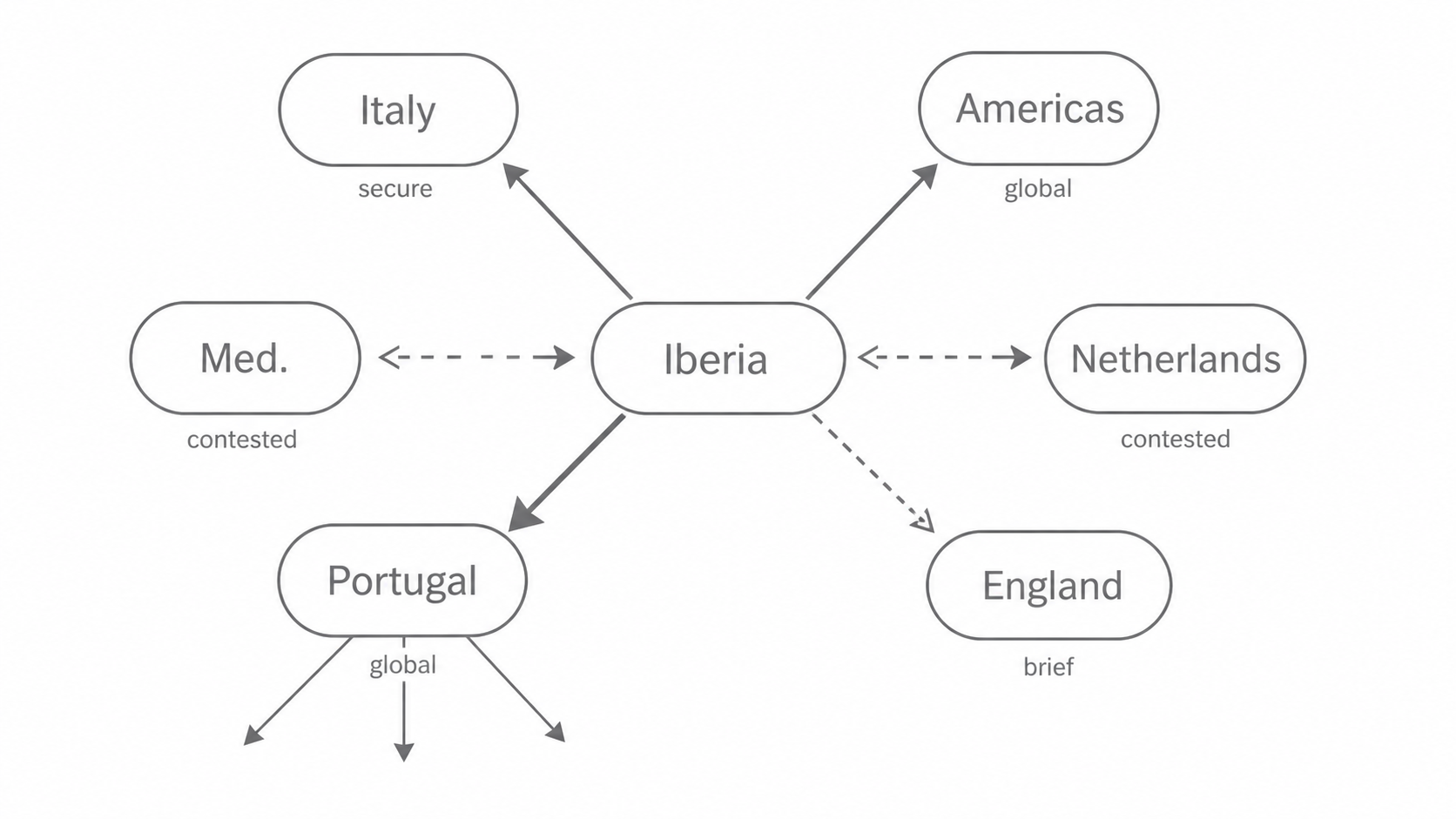
That comparison should shape your breadth judgement. The question is not simply where
Spain appeared, but how securely each area could be acquired, governed, defended and paid
for across the period.
The central line of argument is this: Spanish reach expanded from Mediterranean and Atlantic possibilities under Ferdinand and Isabella into a global Habsburg monarchy under Charles V and Philip II; however, the very breadth of that reach made maintenance increasingly difficult.
Italy, France and Habsburg Hegemony
Italy was central to Spanish power before the New World became the great symbol of empire. Aragon already had Mediterranean interests before 1474, including Sicily and Sardinia. Naples was especially important because it gave control of southern Italy, protected routes across the western Mediterranean, and offered prestige in the struggle between Aragonese and French claims. For Ferdinand, Italy was not a distraction from Spanish power; it was part of what made Spanish power Mediterranean.
The French invasion of Italy in 1494 turned these interests into a long struggle. Charles VIII of France invaded Naples, claiming the Angevin inheritance. Ferdinand responded because a French Naples would threaten Aragonese Sicily and wider Spanish security. The conflict brought Spain into the Italian Wars, a series of struggles in which France, Spain, the papacy, Venice, the Holy Roman Empire and Italian states fought over control of the peninsula.
The key development was Ferdinand being recognised as King of Naples in 1504. The route to that recognition was military and diplomatic. Spain had first joined France in the Treaty of Granada in 1500 to divide Naples, but partnership quickly became rivalry. Spanish forces under Gonzalo Fernandez de Cordoba defeated the French at Cerignola and Garigliano in 1503. By 1504, Ferdinand's title to Naples was recognised. The significance was not only that Spain gained territory. It meant Spain had a secure base in southern Italy from which to defend Sicily, influence the papacy and project power across the Mediterranean.
Naples also shows how Spanish expansion was maintained. Spain did not rule every Italian possession directly from Madrid, because Madrid itself only became Philip II's settled capital in the later sixteenth century. Instead, territories such as Naples, Sicily and later Milan were governed through viceroys, governors, councils, local elites, fortresses and taxation. Spanish power therefore depended on cooperation as well as force. It was strong when local elites accepted Spanish protection, offices and honours. It became strained when war costs rose too high.
Charles V changed the scale of the struggle. As Charles I of Spain from 1516 and Holy Roman Emperor from 1519, he joined Spanish, Burgundian, Habsburg and imperial interests in one person. His inheritance included the Netherlands and claims in Italy as well as Spain and the expanding American empire. This made France feel encircled by Habsburg power. The Valois-Habsburg struggle was therefore not only about Italy; it was about which dynasty would dominate western Europe.
The Battle of Pavia in 1525 was the greatest single military triumph in this struggle. Francis I of France had invaded Lombardy and besieged Pavia. Charles V's forces defeated the French army on 24 February 1525, and Francis himself was captured. The shock was immense: a king of France was held prisoner by his Habsburg rival. The Treaty of Madrid in 1526 forced Francis to make humiliating concessions, including claims in Italy, though he repudiated the treaty after release.
Pavia matters for a change-over-time essay because it marks the moment when Spanish-Habsburg power seemed capable of dominating Italy and humiliating France. But it was not a final solution. Francis resumed war; the League of Cognac formed against Charles; imperial troops sacked Rome in 1527, damaging Charles's reputation even while increasing his leverage over the papacy. The Treaty of Cambrai in 1529 and the later Peace of Cateau-Cambresis in 1559 made Spanish-Habsburg dominance in Italy more durable, but only after decades of war.
By the mid-sixteenth century, Spanish power in Italy had become one of the most secure parts of the wider monarchy. Naples, Sicily and Milan gave Spain strategic depth: Naples and Sicily guarded the central Mediterranean, while Milan linked Italy to the Habsburg route towards the Netherlands. The Italian possessions also supplied money, soldiers and naval resources. Genoese bankers and shipowners became important partners in Spanish finance and Mediterranean operations.
Yet Italy also reveals a wider limitation. Spain's geographical reach depended on expensive military systems. The tercios became famous for discipline and battlefield effectiveness, but professional war required pay, credit and logistics. Holding Italy against France was possible; holding Italy, the Netherlands, the Mediterranean, the Atlantic and the Americas at the same time was much harder. Italy was therefore both a success story and a warning: Spanish reach could be maintained, but only by constant expenditure and political management.
Mediterranean and Ottoman Pressure
The Mediterranean part of this topic is about maintenance as much as expansion. Spain did not conquer the Ottoman Empire. It tried to protect Italy, Sicily, Naples, the Balearics, Spain's own coasts and Christian shipping from Ottoman and North African pressure. The struggle with "the Turks" was therefore a contest over islands, ports, sea lanes, corsair bases and prestige.
The Ottoman threat grew under Suleyman the Magnificent. Ottoman naval power expanded into the western Mediterranean through commanders such as Hayreddin Barbarossa, who linked North African corsair power to Ottoman strategy. Algiers became an Ottoman-aligned base, and raids threatened Spanish, Italian and Mediterranean Christian coasts. For Charles V, this mattered because his Italian possessions and Iberian coastline were vulnerable. The Mediterranean was not a closed Spanish lake; it was a contested frontier.
The capture of Tunis in 1535 shows the height and the limit of Spanish-Habsburg power projection. Barbarossa had taken Tunis in 1534, creating a dangerous base close to Sicily and the route to Italy. Charles V led a huge expedition in 1535, captured La Goulette and Tunis, freed Christian captives, and restored the local ruler as a Spanish client. The victory gave Charles immense prestige. It showed that Spain and its allies could assemble fleets, soldiers and money for a major amphibious operation.
But Tunis did not solve the Mediterranean problem. Barbarossa escaped. Algiers remained a threat, and Charles's attempted expedition against Algiers in 1541 failed disastrously. Tunis itself did not become a permanently secure Spanish possession: it was contested again and finally taken by the Ottomans in 1574. The lesson is that spectacular victories could protect Spanish reach without guaranteeing control of North Africa.
Malta was another crucial point. Charles V had granted Malta to the Knights Hospitaller in 1530 after the Ottomans had expelled them from Rhodes. This helped create a Christian military outpost between Sicily and North Africa. To the Ottomans, Malta was dangerous because it harassed Ottoman shipping and blocked movement into the western Mediterranean. To Spain, Malta was a shield for Sicily, Naples and the western Mediterranean.
The siege of Malta in 1565 was therefore a key defensive turning point. Ottoman forces besieged the island from May to September. The Knights resisted under Jean de Valette, and a relief force from Sicily helped force the Ottomans to withdraw. The victory did not destroy Ottoman naval power, but it prevented Malta becoming an Ottoman base. For Spanish reach, the significance was strategic denial: Spain and its allies stopped an enemy from gaining a position that could have threatened Italy and the western Mediterranean.
The later Battle of Lepanto in 1571, fought by the Holy League under Don John of Austria, confirmed that Spain could still play a leading role in Catholic naval coalitions. Yet Lepanto also shows the limit of victory. It was celebrated across Catholic Europe, but the Ottomans rebuilt their fleet, Venice lost Cyprus, and Tunis fell again in 1574. By the late sixteenth century, the Mediterranean struggle had become a rough stalemate. Spain maintained its Italian and western Mediterranean position, but it did not gain mastery over the eastern Mediterranean or North Africa.
This distinction is important for exam judgement. In Italy, Spanish power became territorial and administrative. In the Mediterranean, Spanish power was more often defensive and maritime. The aim was to hold key bases, protect routes and prevent Ottoman expansion westwards. That was a real achievement, especially after Malta, but it was not the same kind of empire as New Spain or Peru.
Continue this lesson.
You’re previewing NovaLearn without an account. Create a free account to read the rest.
Create free account