1G Theme 4 - Aspects of life in Germany and West Germany, 1918-89
This lesson is about how ordinary life, social status and cultural authority
changed across three German systems: Weimar democracy, Nazi dictatorship and the
Federal Republic of West Germany. The specification has three strands:
attitudes towards women, education and cultural developments, and the
position of ethnic minorities. They belong together because each regime tried
to define who counted as a full member of the nation, what young people should
learn, and which forms of family life, culture and identity were acceptable.
The central breadth judgement is that legal equality and cultural freedom were
strongest in democratic systems, but neither Weimar nor the Federal Republic
automatically produced social equality; Nazi Germany was different because it
turned education, culture, gender and minority status into instruments of racial
dictatorship and war.
The Social Breadth Argument
For Paper 1, this is a breadth theme. You are not being asked for a complete
social history of every German family, school, film, minority group or youth
movement between 1918 and 1989. You are being asked to track long-term
change and continuity in three linked areas:
| Strand | Main question | Best exam judgement problem |
|---|---|---|
| Women | Did political and legal change alter women's real status in family, work and public life? | Weimar and the FRG created legal openings, but social expectations and economic pressures limited equality; Nazi rule actively subordinated women to racial and demographic aims. |
| Education and culture | Did schools and culture encourage freedom, conformity or democratic learning? | Weimar was culturally experimental but socially contested; Nazism destroyed pluralism; the FRG rebuilt democratic education but faced conflict over authority, the Nazi past and youth culture. |
| Ethnic minorities | Who was included, tolerated, excluded or persecuted? | Weimar gave legal citizenship but tolerated prejudice; Nazi policy escalated from exclusion to genocide; the FRG restored rights but struggled with memory, immigration and discrimination. |
Keep three chronological phases clear.
| Period | Women | Education and culture | Ethnic minorities |
|---|---|---|---|
| 1918-32 | Women gained the vote and formal civic equality, entered public politics and visible urban employment, but marriage law, pay, class and conservative attitudes still limited status. | The republic introduced the common four-year Grundschule and became associated with Bauhaus, New Objectivity, cinema, cabaret, radio and modernist experiment. Cultural freedom also provoked nationalist and religious backlash. | Jews, Sinti and Roma, Poles, Danes, Sorbs, Black Germans and others lived under legal citizenship or minority protections, but nationalist racism and antisemitism remained powerful. |
| 1933-45 | The regime praised "Aryan" motherhood, restricted women in politics and professions, rewarded large "racially valuable" families, then used women in war work and auxiliary service when necessity demanded it. | Schools, youth organisations, universities, film, radio, literature, music and art were coordinated to serve Nazi racial ideology, obedience and militarism. | Nazi racial policy stripped Jews and other groups of rights, property and security, then developed into genocide, including the Final Solution against Europe's Jews and mass murder of Sinti and Roma. |
| 1945-89 | West Germany wrote equality into the Basic Law, but the 1950s still prized the male-breadwinner household. Reform, education, employment and feminism changed women's status, especially from the 1960s and 1970s. | Western Allied re-education, federal schooling and civic education rebuilt democracy. Later educational expansion and youth culture created generational tensions over authority, sexuality, the Nazi past and protest. | The FRG restored constitutional rights and rebuilt Jewish life, but Sinti and Roma faced delayed recognition, and "guest workers" became permanent minority communities in a state slow to admit it was an immigration country. |
The diagram below compresses the breadth theme into one idea: each regime tried to define belonging. Read the gateways as a guide to the direction of change, while the table above supplies the precise examples for women, education and minorities.
[DIAGRAM: asset_name: Changing Membership in German Society; asset_slug: p1_1g_04_aspects_of_life_in_germany_and_west_germany_1918_89__diagram_01; recommended_method: image_gen; description: 16:9 white-background grey schematic with three gateway panels labelled Weimar opening, Nazi racial control, and FRG rights rebuilt, with small symbols for citizenship, education, and minority status]
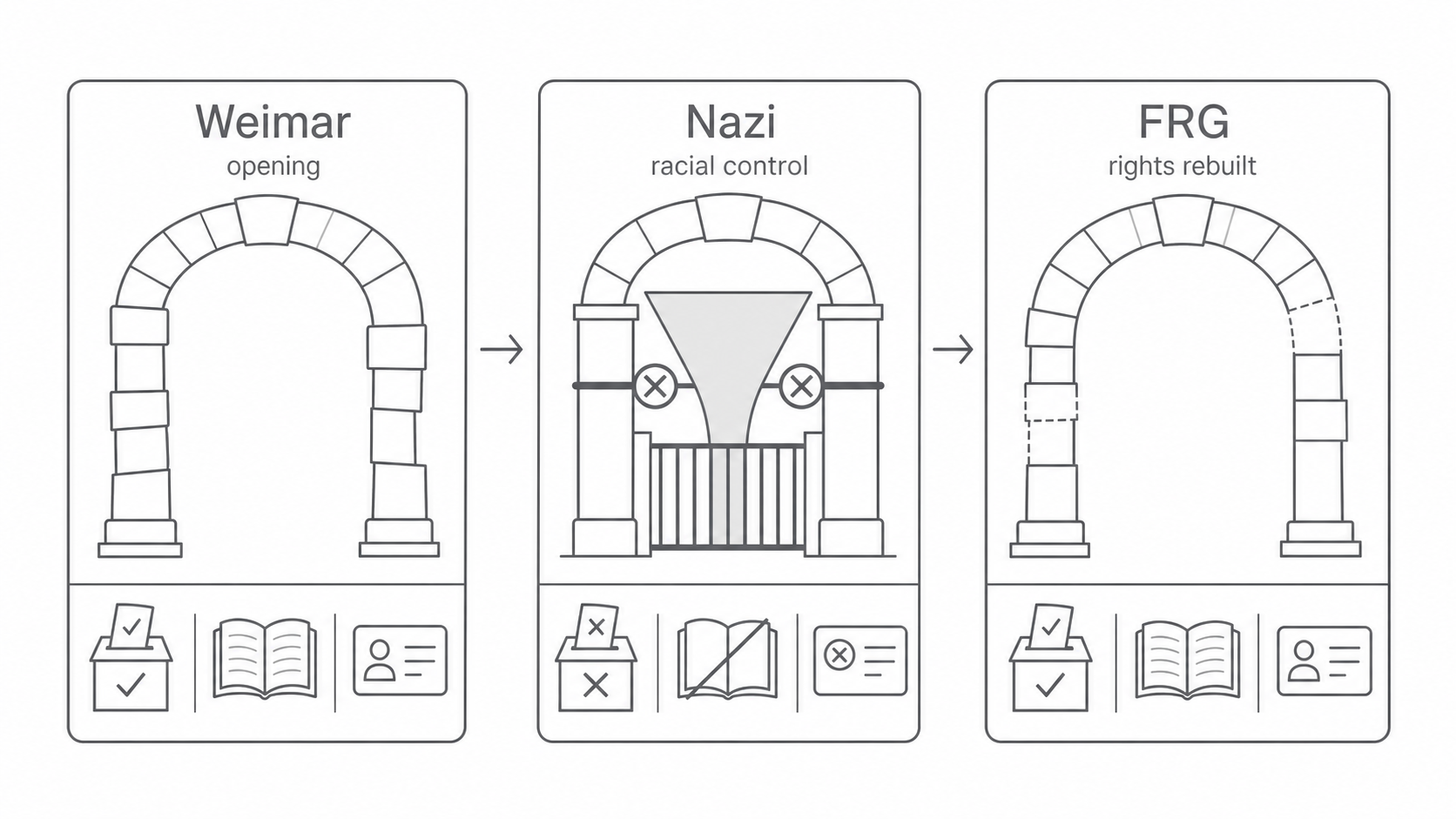
The important takeaway is that the story is not a straight line from oppression to freedom. Weimar opened rights but left many limits intact; Nazi rule violently closed membership through race and obedience; the FRG rebuilt rights but still had to struggle over gender equality, memory and migrant belonging.
The strongest essays avoid two traps. The first is assuming that democracy alone
solves social inequality. Weimar and the FRG both made legal promises that daily
life did not immediately fulfil. The second is treating Nazi social policy as
merely "traditional". Nazi attitudes towards women, education and minorities
were not just old-fashioned. They were tied to racial hierarchy, demographic
planning, mobilisation for war and the creation of a supposedly pure
Volksgemeinschaft.
Use change and continuity throughout. Women's voting rights in 1918-19
were a major change, but domestic expectations continued. Weimar culture was
brilliantly experimental, but many Germans saw it as moral decline. Nazi policy
looked like a return to the family, but war forced contradictions. The FRG's
Basic Law promised equality and rights, but it took decades of court decisions,
legislation and social pressure to make those principles more real.
Weimar Modernity and Limits, 1918-32
The Weimar Republic began with a dramatic legal change for women. In November
1918, the revolutionary government introduced equal, direct and secret
suffrage for men and women aged 20 or over. Women voted and stood for election in the
National Assembly election of January 1919. That made Weimar Germany one of
the more advanced European states in formal political rights for women. The
constitution also promised equality before the law and opened public life more
fully to women.
This change mattered, but it did not make women socially equal. The German Civil
Code still reflected older patriarchal assumptions about marriage and family.
Women were present in parliament, local government, professions, welfare work
and white-collar employment, but politics and senior professions remained
male-dominated. Many employers paid women less than men. Married women who
worked could be criticised as "double earners", especially during periods of
unemployment. Working-class women often had no choice but to combine paid work,
housework and childcare. Middle-class women might gain education or office work,
but still face pressure to marry and withdraw from employment.
The image of the Neue Frau, or "New Woman", captured both real change and
exaggerated fear. In large cities, especially Berlin, some women appeared in
advertising, film and magazines as independent consumers: short hair, modern
clothes, paid office work, sport, nightlife and sexual freedom. This image
should not be taken as the experience of most German women. Rural women, older
women, Catholic women, poorer women and many married women lived within much
more conventional constraints. Even so, the image is historically important
because it shows that the republic changed what was imaginable. It also helps
explain conservative hostility. For many nationalists, Weimar democracy,
Americanised mass culture, female independence and sexual openness all became
symbols of the same supposed disorder.
Education also mixed reform with limitation. The Weimar Constitution allowed
education to be discussed as a democratic right, and the Reich Primary School
Law of 1920 created a common four-year Grundschule for all children. This
was significant because it weakened the old practice by which wealthier children
could be prepared separately for elite secondary schools from an early age. It
suggested that social background should matter less in early schooling.
Yet Weimar education did not become a fully equal, secular or democratic system.
After the common primary years, pupils were still divided into different school
paths. Class, region, religion and parental income continued to shape access to
secondary and higher education. Religious schools and denominational disputes
remained powerful because the republic was a compromise between Social
Democrats, liberals and the Catholic Centre. Universities remained socially
selective and often culturally conservative. Many teachers and professors were
not committed democrats. This matters because a democratic constitution can
create schools, but it cannot instantly create democratic habits among adults who
run them.
Culturally, Weimar Germany became famous as a laboratory of modernity. The
Bauhaus, founded by Walter Gropius in 1919, tried to unite art, craft,
architecture, design and modern production. Artists associated with New
Objectivity painted sharp, unsentimental images of war injury, urban life,
poverty, gender performance and social hypocrisy. Film developed rapidly, from
expressionist works such as The Cabinet of Dr Caligari to socially observant
and technically ambitious cinema. Cabaret, theatre, radio, illustrated
magazines, architecture, photography and popular music all expanded the sense
that Germany's cities were part of a new mass culture.
This was not just entertainment. Culture became a way of arguing about the
republic. Modernist artists and writers often exposed what older patriotic
language had hidden: the trauma of war, sexual double standards, poverty,
capitalism, militarism and hypocrisy. Left-wing theatre and satire attacked
authoritarianism and nationalism. At the same time, conservative critics saw
Weimar culture as un-German, Jewish, Marxist, Americanised, immoral or decadent.
The cultural freedom of the republic was therefore a strength and a vulnerability:
it made Germany intellectually exciting, but it gave enemies of the republic
visible targets.
The position of ethnic minorities in Weimar was similarly mixed. German Jews
were citizens with legal rights, and many were deeply integrated into German
politics, professions, science, journalism, business, arts and urban life. Some
supported liberal or socialist parties; others were conservative, patriotic or
religious. Jewish Germans had fought in the First World War and many understood
themselves as German citizens, not outsiders.
However, antisemitism remained embedded in nationalist politics and popular
prejudice. After defeat in 1918, right-wing groups used Jews as scapegoats
for revolution, democracy, capitalism, Bolshevism, Versailles and modern culture.
The "stab-in-the-back" myth often carried antisemitic assumptions even when Jews
were not named directly. Antisemitic newspapers and organisations spread
conspiracy theories, including the false claim of a Jewish world conspiracy.
This did not mean Weimar was already Nazi Germany. But it does mean that
minority rights existed inside a society where prejudice could be mobilised
politically.
Other minorities also reveal the limits of Weimar tolerance. Sinti and Roma had
lived in German lands for centuries, but they faced police registration,
surveillance and local discrimination. Poles in eastern border regions, Danes in
Schleswig, Sorbs in Lusatia and other linguistic or national minorities could
claim certain protections, yet nationalist feeling after Versailles made minority
questions politically sensitive. Black Germans, including children born in the
Rhineland after the French occupation, were few in number but exposed to racist
propaganda. In short, Weimar law offered citizenship and pluralism, but Weimar
society did not free minorities from exclusion.
The exam judgement for 1918-32 should be balanced. Weimar genuinely widened
rights and cultural freedom. Women's suffrage, the Grundschule, artistic
experimentation and Jewish participation in public life were real gains. But
these gains rested on a fragile social settlement. Legal equality ran ahead of
family law and employment practice. Cultural modernity was strongest in urban
centres. Schools and universities still carried older hierarchies. Minority
rights existed, but prejudice remained available to anti-democratic politics.
Nazi Gender, Education and Culture, 1933-45
Nazi rule did not simply slow Weimar modernity; it tried to reverse and
racialise it. The regime defined social value through the Volksgemeinschaft, the
"national community", but this community was not open to everyone. It was meant
to include those classified as racially valuable, politically obedient and
socially useful. Women, schools and culture were all judged by whether they
served this racial community.
The slogan often associated with Nazi attitudes towards women was Kinder,
Kueche, Kirche: children, kitchen and church. The phrase was older than the
Nazis, but it summarises the domestic ideal they promoted. The ideal "Aryan"
woman was healthy, racially approved, loyal to Hitler, devoted to marriage and
motherhood, and prepared to raise children for the future nation. In Nazi
thinking, motherhood was not private. It was a political service to the race.
The regime supported this ideal through policy and propaganda.
| Policy or institution | What it did | Historical significance |
|---|---|---|
| Marriage loans, introduced in 1933 | Helped approved newly married couples buy household goods; early rules encouraged women to leave paid employment. | Linked family formation to employment policy, consumer goods and racial selection. |
| Restrictions on women in professions and politics | Women were pushed out of many senior public, legal, medical, academic and political roles. | Reversed Weimar openings and signalled that public leadership was male. |
| Motherhood propaganda and Mother's Cross, introduced in 1938 | Honoured women with large numbers of racially approved children. | Turned maternity into a visible state service. |
| National Socialist Women's League and mother schools | Trained women in domestic skills, childcare, health, ideology and racial duties. | Made gender education part of political mobilisation. |
| League of German Girls, or BDM | Organised girls through sport, domestic preparation, racial teaching and loyalty to the regime. | Made youth formation a bridge between school, family and state. |
There were also brutal exclusions hidden behind the praise of motherhood. The
regime encouraged births among those it classified as "hereditarily healthy" and
"Aryan", while disabled people, Roma and Sinti, Black Germans and others could
face forced sterilisation or worse. Abortion and contraception were discouraged
or restricted for women considered racially valuable, while reproductive control
could be imposed violently on those considered racially undesirable. Nazi gender
policy was therefore not just conservative family policy. It was racial
population policy.
The Second World War exposed contradictions in the Nazi ideal. Women did not
simply disappear into the home after 1933. Many continued to work in
agriculture, domestic service, offices, shops and industry, especially if their
families needed wages. After 1939, labour shortages became more severe as
men entered the armed forces. The regime used women in auxiliary service,
communications, anti-aircraft support, nursing, administration and war-related
work. By 1945, female auxiliaries in the armed forces were numerous, and a
small number of women served as guards in the camp system.
Yet Germany did not mobilise women in the same straightforward way as some
wartime states. Nazi leaders feared damaging the family ideal and had access to
forced foreign labour from occupied Europe. The result was contradictory:
official rhetoric continued to honour the mother, while wartime necessity drew
women into paid and auxiliary labour. For an essay, the key judgement is that war
modified Nazi gender policy but did not make it egalitarian. Women's work was
accepted when it served survival and victory; it did not give women equal
political or social status.
Education was transformed in the same spirit. The Nazis did not trust schools to
remain neutral or pluralist. Teachers, textbooks, curricula and youth
organisations were expected to produce obedient members of the Volksgemeinschaft.
The regime removed Jewish and politically unreliable teachers, pressured
teachers into Nazi organisations, and rewrote subjects around race, struggle and
obedience. Biology taught heredity and racial theory. History stressed national
humiliation, heroic struggle and Hitler's movement. Physical education became
more important because boys were to be prepared for military service and girls
for healthy motherhood. Geography and German literature were also bent towards
nation, soil and racial destiny.
Youth organisations mattered because they reached beyond the classroom. The
Hitler Youth for boys and the BDM for girls offered uniforms, camps, songs,
sport, marching, comradeship and adventure. The Law on the Hitler Youth of
1936 declared that German youth were to be educated physically, intellectually
and morally in the spirit of National Socialism. Membership pressure increased
until participation became effectively unavoidable for most "Aryan" young
people. This reduced the authority of parents, churches and independent youth
groups. It also made peer culture political.
The regime created elite schools as well. National Political Institutes of
Education and Adolf Hitler Schools were designed to train future leaders through
physical hardness, ideological loyalty and selection. Universities were purged
and coordinated, but they were not simply closed down. Many academics adapted,
collaborated or used Nazi priorities in medicine, racial science, law,
engineering and military research. Education under Nazism therefore combined
indoctrination, career pressure and genuine institutional collaboration.
Cultural policy completed the attack on Weimar pluralism. Joseph Goebbels's
Ministry of Public Enlightenment and Propaganda was created in 1933. The
Reich Chamber of Culture controlled who could work publicly in literature, music,
theatre, film, radio, press and the visual arts. Jewish artists, modernists,
left-wing writers and political opponents were excluded. In May 1933,
students and Nazi supporters burned books by writers considered "un-German".
The 1937 "Degenerate Art" exhibition mocked modernist art, while officially
approved art praised heroic bodies, rural purity, soldiers, mothers and the
racial community.
Film, radio and public spectacle were especially important. Cheap radios helped
spread speeches and official news. Rallies, flags, songs and ceremonies made
politics feel like belonging. Films could entertain, but they also normalised
leadership, antisemitism, sacrifice and war. Nazi cultural policy did not only
censor. It replaced independent judgement with a state-approved emotional world.
There were limits. Some young people resented Hitler Youth discipline. Churches
kept some influence. Private taste did not always match official art. Jazz,
swing and foreign music attracted some youth despite condemnation. War weariness
and bombing weakened confidence. Still, the overall change from Weimar was huge.
Under Weimar, education and culture were arenas of argument. Under Nazism, they
were meant to be instruments of conformity, racial teaching and mobilisation.
Continue this lesson.
You’re previewing NovaLearn without an account. Create a free account to read the rest.
Create free account