34.2 KT2 - Less eligibility: the Poor Law Amendment Act, 1832-47
This lesson examines the attempt to make poverty policy more centralised, cheaper and more deterrent between 1832 and 1847. Less eligibility meant that relief should be less attractive than the condition of the poorest independent labourer, discouraging able-bodied claims. You will see how the 1834 Act, its new administration and the workhouse test pursued that principle while outdoor relief, local guardians and northern opposition limited uniform enforcement. The central judgement is that the Act transformed poor-law ideology and administration, but uneven enforcement, opposition and scandal forced greater parliamentary accountability by 1847.
The Enquiry Frame
The specification covers a tight depth enquiry: 1832-47. Do not turn it into the whole history of poverty from Elizabeth I to the welfare state. Earlier poor law practice matters only as the background to reform; later changes matter only if they help explain why 1847 was a meaningful end point.
Keep three linked questions in view:
| Question | Why it matters |
|---|---|
| Why did reformers think the old Poor Law had to change? | Their answer explains the Royal Commission, Chadwick's role and the aims of policy. |
| How was the New Poor Law supposed to work? | This explains the 1834 Act, the Commission, unions, guardians, workhouses, less eligibility and the workhouse test. |
| Why was impact uneven? | This explains outdoor relief, local discretion, opposition, Oastler, Fielden and the Anti-Poor Law movement. |
The chronology is short but dense:
| Date | Development | Argument use |
|---|---|---|
| 1830 | Swing Riots expose rural distress and fears about wages, mechanisation and poor relief | Helps explain why poverty policy looked urgent to the governing class. |
| 1832 | Royal Commission appointed to investigate the old Poor Law | Shows reform beginning through inquiry, statistics and administrative diagnosis. |
| February 1834 | Royal Commission report published | Gives reformers the intellectual case for central control, less eligibility and the workhouse test. |
| 14 August 1834 | Poor Law Amendment Act receives royal assent | Creates the legal machinery of the New Poor Law. |
| 1834-37 | Poor Law Commission, assistant commissioners and local unions begin implementation | Shows the move from theory to administration. |
| 1837-39 | Anti-Poor Law agitation peaks in parts of the industrial North and Midlands | Reveals the limits of imposing a uniform deterrent system. |
| 1842 | Outdoor Labour Test Order allows some outdoor relief with a labour test | Shows that strict workhouse-only theory had to bend in practice. |
| 1844 | Outdoor Relief Prohibitory Order tightens restrictions on outdoor relief to able-bodied adults in many unions | Shows the Commission still trying to enforce deterrence. |
| 1845-46 | Andover workhouse scandal damages the Commission's reputation | Exposes the moral and administrative risks of the workhouse regime. |
| 1847 | Poor Law Commission replaced by the Poor Law Board | Marks greater parliamentary accountability without abolishing the New Poor Law. |
The upper arrows show the intended implementation chain from inquiry to the workhouse test. The lower row summarises constraints on that system and its later 1847 accountability: do not read it as four prior causes of the 1832 inquiry.
[DIAGRAM: asset_name: New Poor Law implementation and pressure points; asset_slug: p3_342_02_less_eligibility_the_poor_law_amendment_act_and_its_impact_1832_47__diagram_01; recommended_method: image_gen; description: Clean 16:9 grey-on-white schematic showing the New Poor Law chain from the 1832-34 inquiry to the 1834 Act, Poor Law Commission, local unions and workhouse test, with pressure arrows for outdoor relief, local resistance, northern opposition and 1847 accountability.]
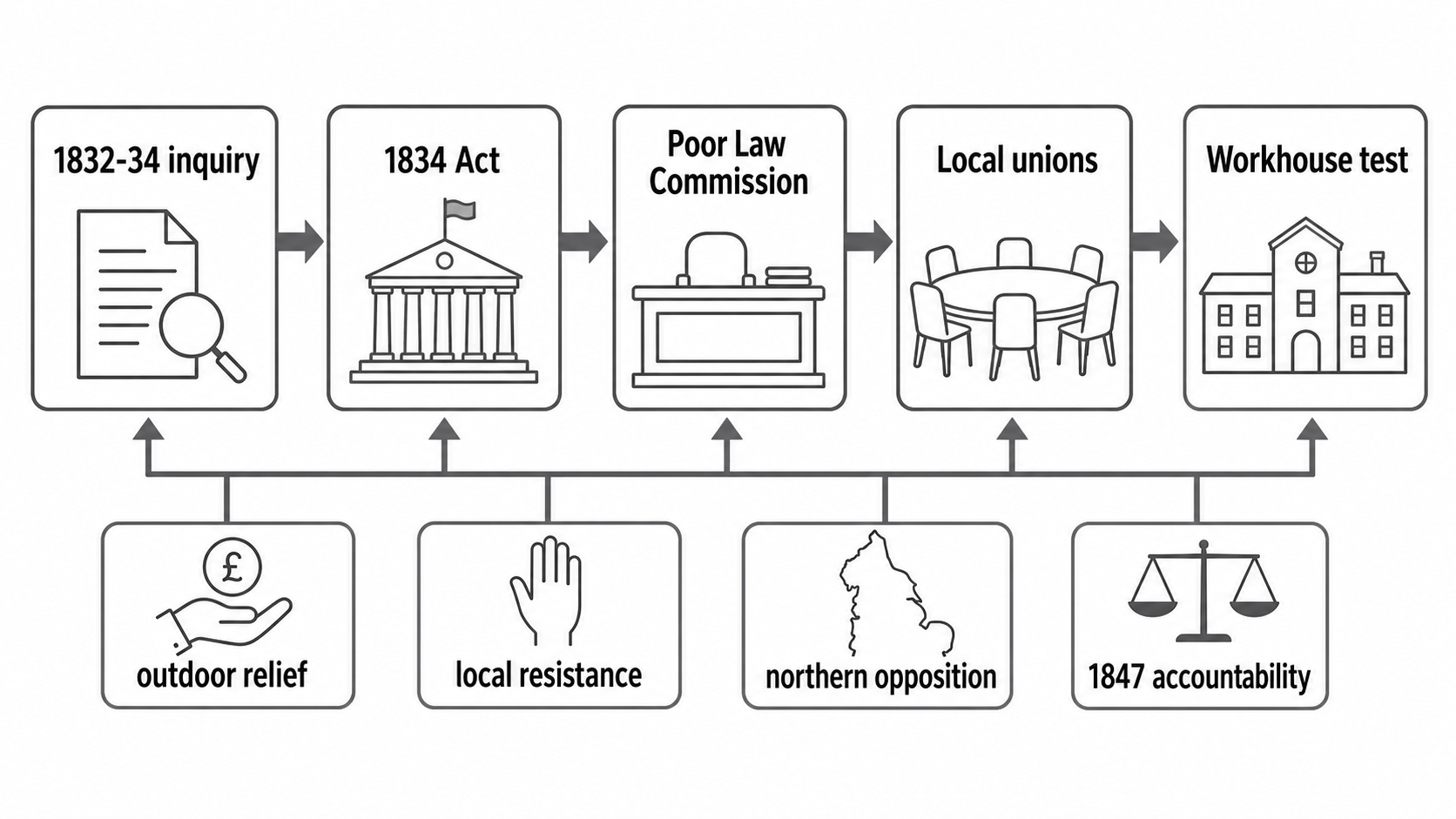
Use the diagram to avoid a common weak answer. The New Poor Law was not just "the workhouse". It was an administrative system: ideas moved through law, central commissioners, local guardians and workhouse policy. Opposition mattered because each link in that chain depended on local cooperation.
Royal Commission and Reform Aims
Before 1834, poor relief in England and Wales was still rooted in the old parish system. Local overseers collected a poor rate and distributed relief according to local custom. Much of that relief was outdoor relief, meaning help given outside an institution: money, bread, fuel, clothing, medical aid or wage supplements. This system could be humane and flexible. It allowed families to remain at home during sickness, old age, unemployment or seasonal hardship.
To many ratepayers and political economists, however, the old system looked expensive and morally dangerous. They objected especially to allowance systems associated with agricultural southern and eastern England, where relief could supplement wages according to bread prices or family size. Critics argued that such relief encouraged dependency, subsidised low wages, weakened labour discipline and increased poor rates. This was not a neutral diagnosis. It reflected the interests and assumptions of property owners, employers, magistrates and reformers who believed the labour market should be disciplined by necessity.
The Royal Commission of Enquiry into the Poor Laws was appointed in 1832. Its report appeared in 1834 and was associated especially with Edwin Chadwick and Nassau Senior. Senior was a political economist; Chadwick was a Benthamite administrator. Both helped turn complaints about local poor relief into a national programme of reform.
The report argued that the old Poor Law had blurred the distinction between independent labour and pauperism. Reformers wanted relief to be available in cases of real destitution, but not attractive enough to compete with wages. That is why less eligibility became the central principle.
Less eligibility
The principle that a pauper's condition should be less eligible, or less desirable, than that of the poorest labourer who remained independent of the Poor Law.
The Commission's recommendations rested on several aims:
| Aim | What reformers wanted | Why it mattered |
|---|---|---|
| Reduce poor-law expenditure | Lower the burden on ratepayers | Financial pressure made reform politically attractive after years of complaint. |
| Deter able-bodied claims | Make relief unattractive enough that only the truly desperate would apply | This was the moral logic behind less eligibility and the workhouse test. |
| End wage-subsidising outdoor relief | Stop parishes topping up low wages for able-bodied labourers | Reformers believed this would restore a clearer labour market. |
| Create central supervision | Replace uneven parish custom with inspection, reports and rules | This was the administrative logic of Chadwick's approach. |
| Group parishes into unions | Make workhouses and administration more efficient than tiny parish arrangements | Larger units could build or run workhouses and standardise practice. |
It is important to judge the report carefully. It was powerful because it provided Parliament with a clear reform programme at a moment when the Great Reform Act of 1832 had encouraged confidence in administrative change. But it was also selective. It often treated poverty as a problem of incentives and character rather than as a consequence of low wages, cyclical unemployment, illness, old age or structural economic change. That bias helps explain both the strength of the New Poor Law and the anger it provoked.
Act, Commission and Chadwick
The Poor Law Amendment Act 1834 did not simply order every poor person into a workhouse overnight. Its significance was that it created the machinery through which reformers tried to reshape relief. The Act established a central Poor Law Commission for England and Wales. The first three commissioners were Thomas Frankland Lewis, George Nicholls and John Shaw-Lefevre, with Edwin Chadwick as secretary. Their office at Somerset House became a symbol of centralised poor-law authority.
The Commission worked through assistant commissioners, circulars, reports, model rules and general orders. Parishes were grouped into Poor Law Unions, each administered by a Board of Guardians. Guardians were locally elected by ratepayers, with property carrying political weight, and local magistrates could sit as ex officio guardians. Relief was still funded locally through the poor rate, but local administration now operated under central pressure.
This mixture of central and local control is crucial. The New Poor Law was more centralised than the old parish system, but it was not a modern welfare department with direct control over every case. The Commission could inspect, advise, order, approve plans and regulate relief. It still needed guardians, overseers, clerks, workhouse masters, medical officers, magistrates and ratepayers to make policy work in each union.
Chadwick's role was larger than his formal title suggests. He helped shape the 1834 report, pushed for uniform administration, believed in expert inspection and was impatient with local custom. His approach was utilitarian in the administrative sense: he wanted policy to be rational, economical, measurable and centrally supervised. He did not think kindness was the main test of a good poor law. He thought the key test was whether relief discouraged dependency and reduced pauperism.
That made Chadwick effective and controversial. To supporters, he represented energetic reform against wasteful localism. To opponents, he represented remote government by officials who did not understand northern industry, family life or Christian charity. The nickname sometimes attached to the commissioners, the "Three Kings of Somerset House", captured a fear that unelected central officials were overriding older local rights and duties.
The Act's early impact was therefore administrative before it was social. It created unions, demanded better records, spread inspection, encouraged the building or adaptation of workhouses, and made guardians answer to a central authority. This was a genuine increase in state capacity. But because the system still depended on local bodies, its impact varied sharply. A compliant rural union, an industrial union in depression, and a town with organised anti-Poor Law activists did not experience the Act in the same way.
For source work, this matters. A source written by a Poor Law Commissioner may be useful for understanding the aims of central policy, but it may understate local resistance or suffering. A local anti-Poor Law poster may be useful for fear and opposition, but it may exaggerate the typical workhouse. Strong AO2 answers ask: where in the system is this source speaking from - Somerset House, a board of guardians, a workhouse, a ratepayer meeting, or the poor themselves?
Workhouse Test and Less Eligibility
The workhouse was the New Poor Law's most powerful symbol because it turned the principle of less eligibility into a practical test. The workhouse test meant that an able-bodied applicant for relief could be offered indoor relief in the workhouse rather than help at home. If they refused, officials could argue that their need was not desperate enough. In theory, the workhouse separated the genuinely destitute from those who could still survive independently.
The workhouse regime was deliberately austere. Inmates were classified by sex, age and condition. Husbands and wives could be separated; children could be separated from parents; families lost the ordinary rhythms of home life. Inmates wore institutional clothing, followed strict rules, ate a plain and monotonous diet, and performed work such as oakum-picking, stone-breaking or other repetitive tasks. The regime was designed to deter, not to make poverty comfortable.
Less eligibility did not mean that every workhouse was identical or that every official was personally cruel. It meant that harshness had a policy function. The workhouse had to be unattractive enough that the lowest-paid labourer outside would still seem better off than the pauper inside. That made the workhouse a moral and psychological instrument. Its impact was felt even by people who never entered it, because the threat of the workhouse made unemployment, sickness or old age more frightening.
The impact can be assessed in four layers:
| Layer of impact | What changed | Limitation |
|---|---|---|
| Administrative | More unions, guardians, inspection, record-keeping and central orders | Central rules still depended on local enforcement. |
| Financial | Poor-law costs could be restrained by discouraging applications and restricting relief | Cost reduction did not prove poverty had fallen. |
| Social | Relief became more stigmatised; the workhouse threatened family separation and loss of independence | Many recipients were not idle able-bodied adults, but children, widows, the old, sick or disabled. |
| Political | The workhouse made poor relief a national controversy | Its unpopularity made uniform enforcement difficult. |
Continue this lesson.
You’re previewing NovaLearn without an account. Create a free account to read the rest.
Create free account