34.1 KT2 - Samuel Greg: cotton and cottages, 1784-1816
Quarry Bank Mill shows why early industrialisation depended on more than machines. This
lesson explains how Styal combined River Bollin water power with Manchester and Liverpool
networks, and how Samuel Greg, managers and engineers kept the business growing through the
French wars. It also examines how Poor Law apprentices, the Apprentice House and workers'
cottages supplied and controlled labour, including the tension between welfare and
exploitation. By 1816, these linked systems made Quarry Bank a revealing and durable factory
colony rather than the birthplace of Lancashire cotton.
The Enquiry Frame
This is a Paper 3 depth enquiry. The specification asks you to explain the growth of Quarry
Bank Mill, the labour problem, and the significance of the mill for the cotton industry in
Lancashire by 1816. Keep three questions in view.
| Question | Why it matters |
|---|---|
| Why did Greg choose Styal? | The site was rural, but the River Bollin gave water power and Manchester was close enough to connect the mill to a wider cotton market. |
| How did Greg deal with labour? | The mill needed disciplined, regular workers in a small hamlet. Poor Law apprentices, the Apprentice House, cottages and village management solved that problem while creating exploitation and dependence. |
| How significant was Quarry Bank? | It was an important successful example of early factory-based cotton spinning, but its significance was as a model and survivor rather than as the single origin of Lancashire cotton. |
The chronology is short enough to learn, but dense enough to misjudge if you treat the mill
as a static heritage site.
| Date | Event | Significance |
|---|---|---|
| 1758 | Samuel Greg was born in Belfast. | He came from a merchant world, not from the artisan workforce. |
| 1782 | Greg took control of Hyde and Company after his uncle Robert Hyde's death and Nathaniel Hyde's retirement. | This gave him a commercial base in cotton textiles before he became a mill owner. |
| January 1784 | Greg leased land at Styal from the Earl of Stamford. | Leasing reduced the cost of entry and secured a water-power site. |
| 1784 | Quarry Bank Mill was completed on the River Bollin. | It became an early water-powered cotton-spinning factory in the Manchester textile district and the Cheshire/north-west factory landscape. |
| 1784-96 | Matthew Fawkner managed the mill on Greg's behalf. | Daily management mattered because Greg's success depended on discipline, production and continuity, not only on investment. |
| 1789 | Greg married Hannah Lightbody. | Hannah brought Liverpool mercantile connections, money and a Unitarian moral culture that shaped the family community at Quarry Bank. |
| c.1790 | The Apprentice House was built. | Greg could draw on parish apprentices from workhouses and poor families, solving the labour shortage at a rural site. |
| 1793-1815 | Britain was at war with Revolutionary and Napoleonic France, apart from the brief Peace of Amiens in 1802-03. | War disrupted credit and some European markets, but cotton exports also found opportunities in Atlantic and later European demand. |
| 1796 | Quarry Bank was extended and Peter Ewart became Greg's technical partner. | Engineering skill helped the mill expand and keep up with changes in spinning technology. |
| 1806 | Runaway apprentices Thomas Priestley and Joseph Sefton were examined before magistrates after returning to London. | Their evidence is valuable for the realities of work, injury, schooling, food, homesickness and discipline. |
| 1807 | Greg and Ewart built a mule-spinning mill in Peter Street, Manchester. | The firm was not confined to the original water-frame mill; it adapted to finer yarn and urban production. |
| 1810 | A small Boulton and Watt steam engine was installed at Quarry Bank. | Steam supported the water wheels when water was short; it did not yet replace water power. |
| 1811-15 | Ewart became a sleeping partner and then retired from the partnership. | By the end of the wars, Greg was ready to expand under his own family control. |
| 1816 | The topic's end point. | Quarry Bank had survived the hardest early decades; the major New Mill expansion came just after, in 1817-20. |
Use the diagram below as a system diagram rather than a picture of the site. The point is
to see how the mill pulled together inputs and controls: water, cotton, markets, Poor Law
labour and village accommodation. Each arrow is part of an explanation for why Quarry Bank
worked.
[DIAGRAM: asset_name: Quarry Bank Mill as an industrial system; asset_slug: p3_341_02_samuel_greg_cotton_and_cottages_1784_1816__diagram_01; recommended_method: image_gen; description: Monochrome schematic showing Quarry Bank Mill linked to River Bollin water power, Liverpool cotton imports, Manchester markets, Poor Law apprentices, Styal cottages and a disciplined workforce, under the pressure of the French wars, 1793-1815.]
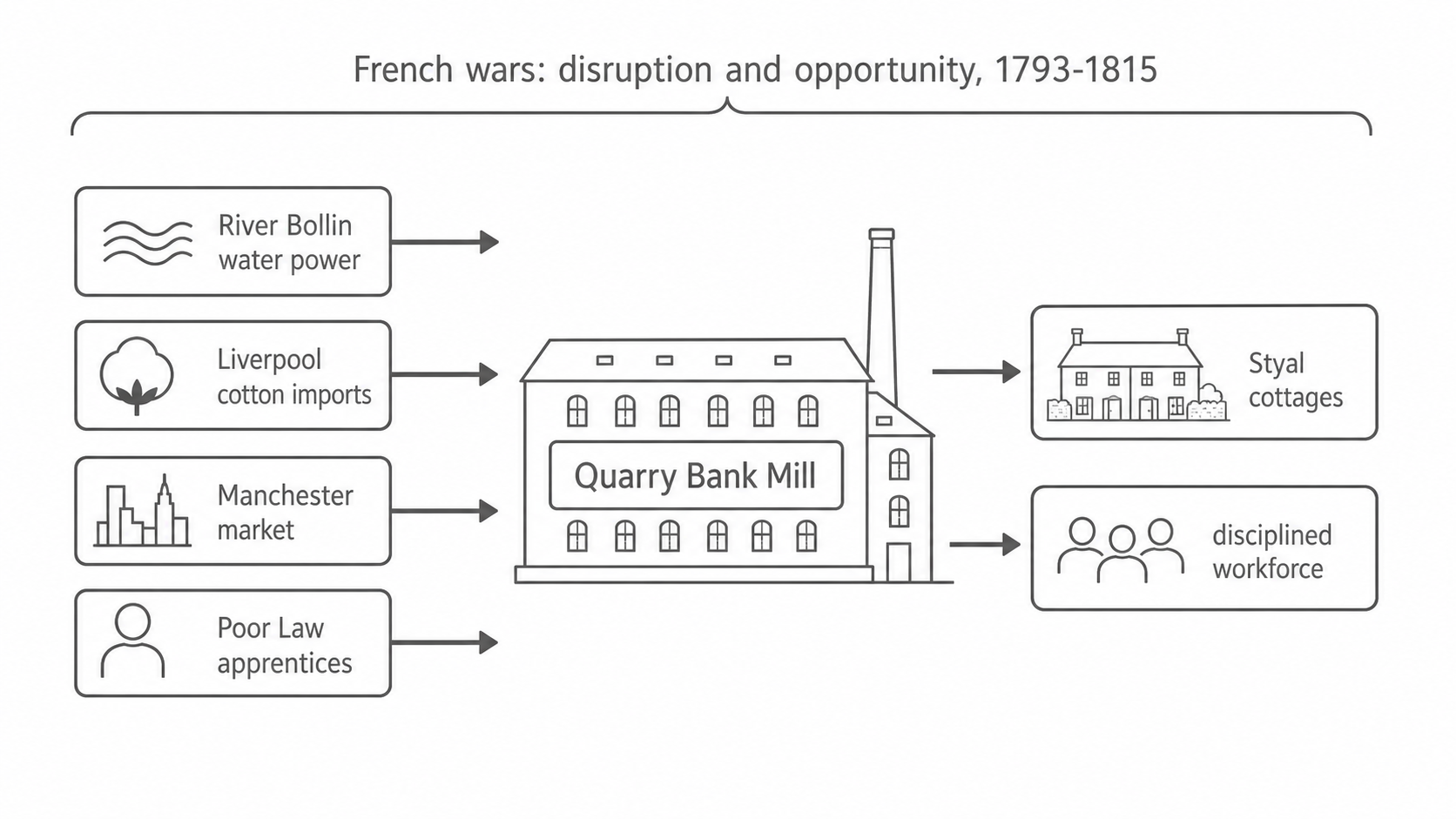
The big exam judgement is therefore not "Greg was kind" or "Greg was cruel". A stronger
answer says that Quarry Bank combined commercial opportunity with social control. Greg's
system could provide housing, food, training and some medical care, but it did so in order
to secure cheap, disciplined and dependent labour for a profit-making cotton business.
Site and First Growth
Greg's choice of Styal looks odd only if you imagine all industrialisation as urban. In
the 1780s, factory spinning still depended heavily on water power. Steam power existed,
but it was not yet cheap, flexible or dominant enough to free cotton mills from rivers and
streams. For an Arkwright-type cotton mill using water frames, a reliable fall of water was
more important than being in the middle of Manchester.
The River Bollin was the decisive attraction. A survey in 1783 identified a fall of water
near Pownall Ford that could power a mill. Styal was a small agricultural hamlet, not an
industrial town, so it did not provide an obvious labour force. But it offered the energy
source that early factory spinning needed. Greg could then connect that rural site to
urban and Atlantic networks: Manchester supplied merchants, credit, machinery, customers
and skilled contacts; Liverpool was the major port through which cotton and mercantile
connections entered the region; and the wider canal and road system linked the Cheshire
site to Lancashire's textile economy.
This made Quarry Bank a hybrid. It was rural in its power source and housing pattern, but
urban and global in its business connections. Cotton was imported from the Atlantic world;
yarn and cloth moved through Manchester's trading networks; and Greg's own family wealth
was tied to wider imperial and plantation interests. The mill in the Bollin valley was
therefore not isolated from the world. It was a rural node in a global cotton system.
The earliest mill was built in 1784 and followed the Arkwright-type model. That means a
narrow, multi-storey spinning block designed around water-powered machinery, especially
water frames for producing strong coarse yarn. The mill's tall windows and regular floors
were not decorative choices. They supported long working days, supervision, light, and the
positioning of machinery. Quarry Bank was smaller than some major early mills, but it was
large enough to bring spinning under one roof and make production depend on factory time
rather than household rhythm.
Samuel Greg's role was strategic. He supplied the capital, commercial judgement and
business direction. He had been raised in a Manchester textile-merchant environment by his
uncle Robert Hyde and took over Hyde and Company in 1782. That background mattered. Greg
was not starting from nothing; he already understood cotton markets, credit, contacts and
supply chains. He built Quarry Bank partly to secure a reliable supply of yarn for wider
textile interests.
But Greg could not run the mill by capital alone. The original technical partner was John
Massey, but Massey died before the mill began production. Matthew Fawkner then managed the
mill for the first twelve years. Fawkner's role is easy to underestimate because managers
leave less heroic evidence than founders. Yet a cotton mill needed continuous discipline:
machines had to run, children and adults had to be organised, supplies had to arrive,
output had to be monitored, and costs had to be controlled. Fawkner helped turn Greg's
investment into daily production.
Hannah Greg's role began after her marriage to Samuel in 1789. She was not the technical
founder of the mill, but she was central to the family and social world that grew around
it. She came from the wealthy Unitarian Lightbody family in Liverpool, brought a large
dowry and useful mercantile connections, and helped shape Quarry Bank's moral and domestic
culture. The phrase "cotton and cottages" should therefore make you think about household,
religion, education and discipline as well as machinery.
The first phase of growth was successful enough for expansion. By 1796 the mill was
extended, an expanded power system was associated with that growth, and Peter Ewart
became Greg's partner. This is the moment when Quarry Bank's
development moved beyond first foundation into a more technically confident business.
French Wars and Adaptation
The French wars, 1793-1815, did not have one simple effect on Quarry Bank. It is tempting
to write "war damaged trade" and stop. That is too crude. War disrupted credit, insurance,
shipping, European markets and business confidence, but it also redirected trade and
created periods of strong demand. The cotton industry in these years was volatile rather
than simply depressed.
The sequence matters.
| Phase | Impact on cotton trade | Meaning for Quarry Bank |
|---|---|---|
| 1790-92 | Cotton expanded in boom conditions before war fully broke out. | Greg had entered the industry at a moment when factory spinning looked highly promising. |
| 1793 | War with France contracted some European trade, but exports to America helped offset the shock. | The business faced risk, but not collapse. |
| 1796-98 | Oversupply, uncertainty over peace and the 1797 cash crisis strained the trade; yarn prices could fall sharply. | Greg's decision to expand in 1796 was bold and needed capital reserves. |
| 1801-02 | Preliminary peace in 1801 and the Treaty of Amiens in 1802 encouraged expansion and stronger profits. | Cotton entrepreneurs could see renewed opportunity. |
| 1803-05 | War resumed, disrupting confidence, but yarn exports still grew strongly by 1805. | The industry remained unstable but dynamic. |
| 1812-15 | The later war years and immediate aftermath saw major growth in twist and yarn exports. | By 1816 Quarry Bank had survived the dangerous early decades and was positioned for post-war expansion. |
The key point is that war rewarded firms that could survive fluctuations. Quarry Bank's
importance lies partly in the fact that many pioneering cotton manufacturers failed during
the 1790s, while Greg weathered the shocks. That survival depended on more than luck. He
had merchant experience, family and credit networks, a rural power source, a controlled
workforce and technical partners.
Peter Ewart's role belongs here. Ewart was a millwright and engineer with experience linked
to Boulton and Watt and Samuel Oldknow's mills. When he became Greg's partner in 1796, he
added technical expertise just as the mill was expanding. The 1796 extension, new water
arrangements, later steam support, and probably the adoption of mule-spinning knowledge all
show the same pattern: Quarry Bank succeeded by adapting proven technologies rather than
inventing everything from scratch.
Water remained the basis of power. The mill's first logic was the River Bollin, weirs,
wheel pits and water frames. But the 1810 steam engine is important because it shows a
transition. The engine was not installed to replace the water wheels. It was a backup or
auxiliary source, useful when water levels were low.
This makes Quarry Bank a good example of the gradual shift from water-dependent factory
locations towards a more flexible industrial energy system.
The firm's wider development also matters. In 1807 Greg and Ewart built a mule-spinning
mill in Peter Street, Manchester. Mules could produce finer yarn than water frames. The
evidence is not certain that all finer mule yarn was produced at Quarry Bank itself, so be
careful in an essay: Quarry Bank's main output remained low-count yarn for coarse goods.
However, the Peter Street venture shows that Greg's business was not frozen in 1784. The
company responded to markets, machinery and urban possibilities.
Matthew Fawkner, Ewart and Greg therefore played different but connected roles.
| Person | Main role | Why it mattered |
|---|---|---|
| Samuel Greg | Merchant capitalist and strategic owner | He chose the site, financed the enterprise, managed risk and built a labour system around the mill. |
| Matthew Fawkner | Manager in the first twelve years | He made the new mill work day to day during the difficult foundation phase. |
| Peter Ewart | Engineer, millwright and partner from 1796 to 1815 | He strengthened Quarry Bank's technical capacity during expansion and wartime adaptation. |
| Hannah Greg | Household, moral and welfare influence | She helped shape the family community, education and paternalist claims that surrounded the workforce. |
This table is useful because Paper 3 questions often reward precise roles. Do not merge all
achievement into "Samuel Greg did it". Quarry Bank grew because several types of expertise
were combined: capital, management, engineering and social organisation.
Poor Law Apprentices
The labour problem at Quarry Bank had two parts. First, Styal did not have enough local
workers for an expanding mill. Second, factory work required a different kind of labour
from domestic spinning or weaving. Workers had to arrive at set times, obey bells and
overlookers, keep pace with machinery, work long hours, accept repetitive tasks and learn
factory discipline.
Continue this lesson.
You’re previewing NovaLearn without an account. Create a free account to read the rest.
Create free account