2H.1 KT2 - Depression and New Deal, 1929-38
This lesson explains how economic collapse spread through American society, how Hoover
responded, and how Roosevelt's First and Second New Deals changed the federal government's
role. The key question is not simply whether Hoover failed and Roosevelt succeeded, but
how the Depression changed what Americans expected the federal government to do. Hoover,
Roosevelt, Congress, the Supreme Court and competing social groups fought over the limits
of federal action. By 1938 the New Deal had provided relief, stabilised institutions and
reshaped politics, but it had not restored full prosperity or removed entrenched racial,
regional and employment exclusions.
The Enquiry Frame
The enquiry is: how far did the Great Depression force a transformation in American
government and society between 1929 and 1938?
Avoid two weak answers. One says Hoover did nothing and Roosevelt solved everything. The
other says the New Deal failed because unemployment remained high. A stronger answer sees
three connected developments. First, the Depression was a national and international
collapse that overwhelmed older methods of private charity, local relief and voluntary
business cooperation. Second, Hoover did intervene, especially from 1931-32, but his
measures were usually indirect, cautious and tied to confidence in business and state
governments. Third, Roosevelt's New Deal greatly expanded federal responsibility for
relief, banking, agriculture, labour relations and social security, but it worked through
compromise, experiment and political conflict.
Use the diagram to keep that progression clear. It shows the Depression pushing federal action from cautious indirect aid towards broader New Deal relief, reform and welfare security, while opposition and incomplete recovery stayed part of the story.
[DIAGRAM: asset_name: Federal response from collapse to Second New Deal; asset_slug: p2_2h1_02_depression_and_new_deal_1929_38__diagram_01; recommended_method: image_gen; description: A stepped pathway from collapse to indirect aid, the First New Deal, opposition and the Second New Deal, with a baseline showing a bigger federal role and a final note that recovery remained incomplete.]
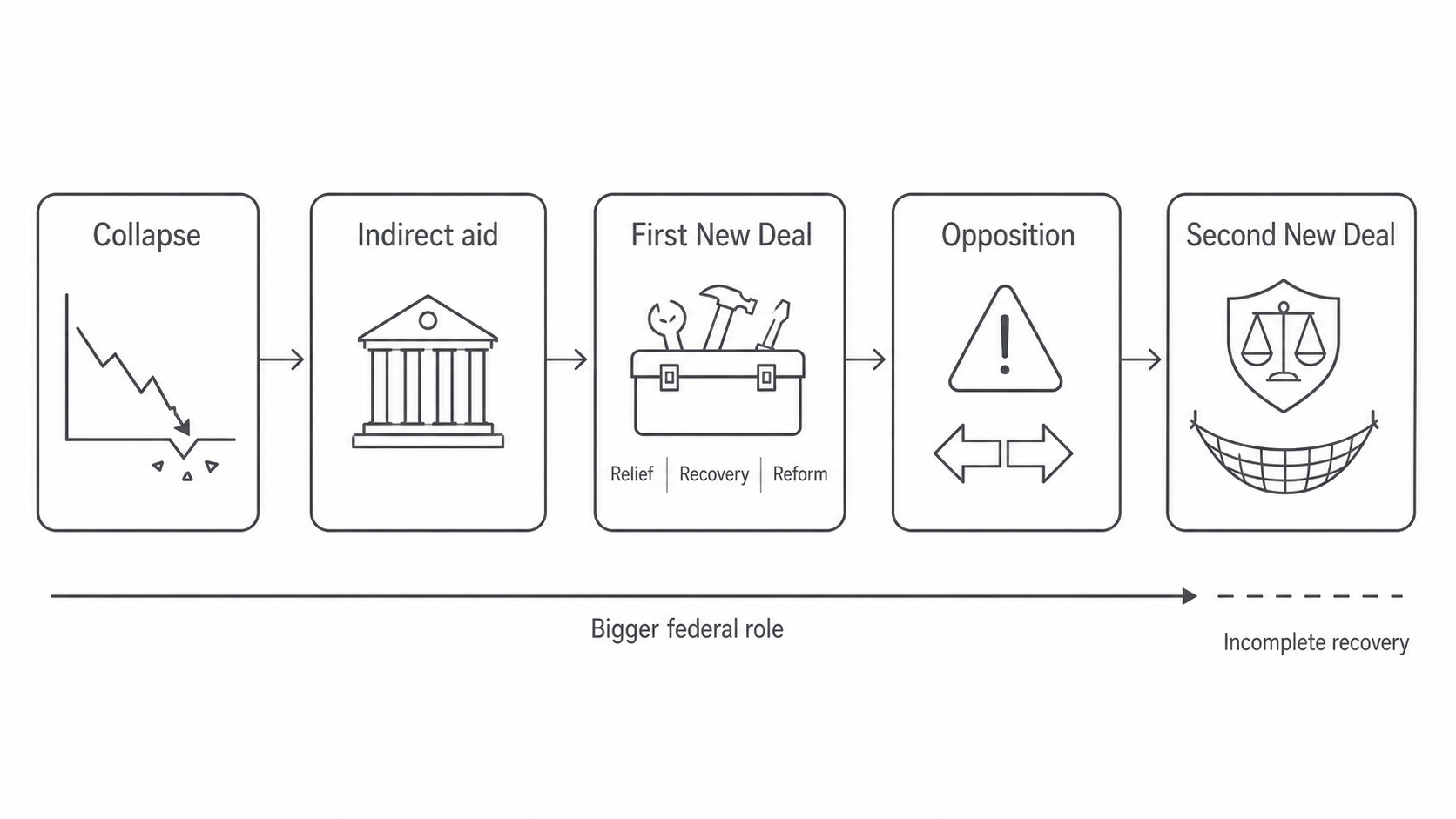
The key judgement is that the arrow does not mean simple success. Federal responsibility expanded dramatically, but the New Deal remained experimental, contested and unable by itself to restore full prosperity.
| Date | Event | How to use it in argument |
|---|---|---|
| August 1929 | US economic downturn began before the Wall Street crash | The crash mattered, but depression was not caused by one week on Wall Street alone. |
| 24-29 October 1929 | Wall Street crash, including Black Thursday and Black Tuesday | Destroyed confidence and wealth, and helped expose deeper weaknesses in credit, demand and banking. |
| June 1930 | Smoot-Hawley Tariff signed | Hoover tried protection, but it worsened the international trading climate. |
| 1930-33 | Banking failures and money-supply contraction | Bank collapse turned recession into catastrophe and wiped out savings. |
| January 1932 | Reconstruction Finance Corporation created | Hoover accepted federal emergency lending, but mainly through banks, railroads and major institutions. |
| 21 July 1932 | Emergency Relief and Construction Act signed | First large federal relief loans to states, but still not direct permanent welfare. |
| March 1933 | Roosevelt inaugurated; bank holiday and Emergency Banking Act | Restoring confidence in banks became the first New Deal priority. |
| March-June 1933 | First Hundred Days | Congress passed a flood of relief, recovery and reform measures. |
| 1933 | FERA, CCC, AAA, TVA, NRA, PWA and banking/securities reforms | The "alphabet agencies" showed experimental federal activism. |
| May 1935 | Supreme Court struck down the NRA in Schechter | Judicial opposition exposed constitutional limits to early New Deal recovery planning. |
| July-August 1935 | Wagner Act, Social Security Act and Revenue Act | The Second New Deal moved further towards labour rights, welfare security and progressive taxation. |
| 1937 | Court-packing dispute; Supreme Court upheld major New Deal measures | Roosevelt won more constitutional room but lost political authority in Congress. |
| 1937-38 | Roosevelt recession | Recovery was fragile; reduced stimulus and tighter money damaged confidence in New Deal recovery. |
| 1938 | Fair Labor Standards Act and conservative resistance | Reform continued, but the New Deal's main domestic momentum was running out. |
For Paper 2, this topic supports AO1 depth essays and AO2 source analysis. In essays, build
judgement around change and limitation: the New Deal changed federal responsibility
more than it ended unemployment. In source questions, think about provenance. A Hoover
speech may reveal his principles but hide political desperation; an FDR fireside chat may
show confidence-building but not policy outcomes; a photograph of a Hooverville may show
visible hardship but not the whole national economy.
The Spread of Depression
The Depression spread because several weaknesses interacted. The Wall Street crash of
October 1929 destroyed paper wealth and confidence, but the deeper problem was a collapse
in demand, investment, prices, credit and banking. When consumers spent less, businesses
cut production. When firms cut production, workers lost jobs or wages. When workers lost
income, demand fell further. Falling prices also made debts harder to repay, so farmers,
homeowners and businesses faced foreclosure or bankruptcy even when the number of dollars
they owed had not changed.
The scale was extraordinary. Measured as inflation-adjusted, or real GDP, US output
fell by about 30 percent between 1929 and 1933. Industrial production fell even more sharply. BLS
historical estimates show unemployment rising from around 3 percent before the crash to
23.6 percent in 1932 and 24.9 percent in 1933. In everyday terms, by 1932 about one in
four workers was unemployed, and many others had shorter hours, lower wages or insecure
part-time work. From 1930 to 1933, thousands of banks suspended operations, so households
could lose both wages and savings.
Workers experienced the Depression as insecurity and humiliation. Skilled workers queued
for relief; unemployed men searched for work across city streets, farms, railroads and
industrial towns; young people postponed adult independence. Some employers cut wages to
survive. Others closed entirely. Trade unions were often too weak in the early 1930s to
protect workers effectively, especially in mass-production industries.
Families absorbed the shock. The male breadwinner ideal made unemployment feel like a
personal failure even when the cause was national collapse. Families took in lodgers,
shared housing, stretched meals, delayed marriage and relied on older children or women's
paid work where possible. Women were sometimes condemned for holding jobs while men were
unemployed, but many families needed every possible wage. Relief could be humiliating
because local agencies often investigated household need closely before giving help.
Farmers had been in trouble before 1929, so the Depression deepened an existing rural
crisis. After the First World War, demand and prices had fallen while many farmers still
carried debts for land and machinery. In the early 1930s, crop prices collapsed further.
Farmers could produce more and earn less. Mortgage foreclosures and tax sales pushed many
off their land. Tenants and sharecroppers were especially vulnerable because they owned
little and depended on landlords' decisions. In the Great Plains, drought and poor land
management began to create the Dust Bowl crisis, which became most visible after 1934 but
had roots in the early Depression years.
Ethnic minorities were hit especially hard because economic collapse operated through
existing discrimination. Black workers were often "last hired, first fired", and many were
concentrated in agricultural, domestic or low-paid service work. Southern Black
sharecroppers faced eviction when landowners cut costs or changed production. Mexican
immigrants and Mexican Americans faced job hostility and repatriation campaigns; some US
citizens were pressured or forced to leave for Mexico because they were assumed to be a
burden on relief. Native American communities already affected by poverty, poor land and
federal control had fewer reserves against collapse. The Depression was therefore not one
equal national experience: it magnified inequalities of race, region, class and citizenship.
The specification also includes gangsterism. This should not be treated as if the
Depression simply turned ordinary Americans into gangsters. Organised crime had grown
mainly from Prohibition, which created huge illegal profits from alcohol between 1920 and
1933. Chicago gang warfare, Al Capone's power and the St Valentine's Day Massacre of 1929
belonged to that Prohibition world. Yet the Depression helped make crime a public symbol
of disorder. Bank robbers and "public enemies" such as John Dillinger became notorious in
1933-34, partly because banks were already hated and newspapers turned criminals into
spectacle. Gangsterism matters because it showed another kind of authority crisis: local
law enforcement looked weak, while the federal government expanded its policing role.
Hoover's Response
Herbert Hoover is often remembered as a president who did nothing. That is too simple. He
believed in energetic administration, voluntary cooperation and public-private action. He
called business leaders to the White House, encouraged employers to maintain wages,
supported some public works and eventually accepted major federal emergency lending.
However, Hoover also feared that direct federal relief would weaken local responsibility,
damage individual character, unbalance the budget and undermine business confidence. His
response became larger over time, but it remained constrained by assumptions that the scale
of the Depression was making obsolete.
The Smoot-Hawley Tariff, signed on 17 June 1930, showed Hoover's difficulty. It was designed to
protect American farmers and businesses from foreign competition by raising import duties.
In political terms, it answered pressure from agricultural and industrial interests. In
economic terms, it was badly timed. Other countries retaliated, world trade contracted, and
American exporters, including farmers, found overseas markets even harder to reach. The
tariff did not cause the Depression by itself, but it added strain to an already collapsing
international economy.
Hoover initially relied heavily on voluntarism and local relief. He asked employers not to
cut wages and urged charities, churches, state governments and local authorities to meet
need. This fitted older American assumptions about limited federal welfare. It also became
politically disastrous once unemployment and homelessness overwhelmed local resources.
Shantytowns made from scrap wood, cardboard and tin appeared on the edges of cities and
were nicknamed Hoovervilles. The name was unfair in one sense, because Hoover had not
personally caused every global economic weakness. It was devastating in another sense,
because it showed that many Americans now associated poverty with presidential failure.
The Reconstruction Finance Corporation, created on 22 January 1932, marked a significant
shift. The RFC could lend federal money to banks, railroads, insurance companies and some
agricultural organisations. Hoover hoped that stabilising the financial system would
restore confidence, protect credit and indirectly save jobs. The measure was important
because it broke with a purely passive federal role. Its weakness was that aid appeared to
go first to large institutions rather than to unemployed families. Critics called this a
"trickle-down" approach: help at the top might eventually reach ordinary people, but hunger
and homelessness were immediate.
The Emergency Relief and Construction Act, signed on 21 July 1932, took federal action
further. It expanded the RFC's authority, allowing up to $300 million in relief loans to
states and up to $1.5 billion in loans for public works, including self-liquidating
construction projects.
This was historically significant because it accepted that the federal government had some
responsibility when state and local relief systems collapsed. Yet it was still cautious.
Relief to individuals was normally channelled through states rather than paid directly as a
national welfare right. Public works were often expected to be "self-liquidating", meaning
they should generate revenue or repay their costs. Hoover was trying to act without
admitting the full principle of federal relief.
Hoover's response therefore deserves a balanced judgement. He was not inactive, and some
measures, especially the RFC, became tools Roosevelt later used more boldly. But Hoover
consistently acted too late, too indirectly and too defensively for a crisis of this scale.
He wanted to preserve confidence in the old economic and constitutional order. By 1932,
many Americans no longer believed that order could protect them.
For source evaluation, Hoover's public statements are valuable because they show the
principles behind his policy: voluntarism, balanced budgets, fear of dependency and faith
in institutional credit. Their limitation is that they often sound calmer than conditions
on the ground. Photographs or reports of Hoovervilles reveal hardship powerfully, but they
need contextual knowledge because visible poverty does not by itself explain tariff,
banking or relief policy.
Roosevelt and the First New Deal
Franklin D. Roosevelt entered office on 4 March 1933 with the banking system close to
collapse and unemployment near its peak. His advantage was not a detailed master plan. It
was a willingness to experiment, communicate confidence and use federal power quickly. The
First New Deal is usually associated with 1933-35 and especially the First Hundred Days
from March to June 1933, when Congress passed a remarkable sequence of laws.
Roosevelt's first priority was financial confidence. On 6 March he declared a national
bank holiday, temporarily closing banks to stop runs. The Emergency Banking Act of
9 March allowed official inspection before banks reopened. Roosevelt's first fireside chat
on 12 March explained the measure directly to radio listeners and encouraged depositors to
trust reopened banks. The Banking Act of 1933, signed on 16 June and often called
Glass-Steagall, separated commercial and investment banking in important ways and created
the Federal Deposit Insurance Corporation. Deposit insurance did not end every banking problem, but it
changed the psychology of savings: ordinary depositors no longer had to assume that a bank
failure meant total personal ruin. Securities legislation in 1933 and 1934, including the
creation of the Securities and Exchange Commission, also aimed to make financial
markets more transparent and less vulnerable to abuses associated with the 1920s boom.
Continue this lesson.
You’re previewing NovaLearn without an account. Create a free account to read the rest.
Create free account