1G Interpretations - How far was Hitler responsible for the war?
This Paper 1 interpretations topic is about responsibility, not just chronology. Hitler's foreign policy was the most direct cause of the outbreak of war in Europe in September 1939: he chose rearmament, expansion, treaty-breaking, intimidation, racial empire, the Nazi-Soviet Pact, and finally the invasion of Poland. Yet a strong Edexcel answer must also explain why his policy found room to succeed. German history shaped the grievances and ambitions he exploited; Britain, France, the USSR, Italy, Japan, the USA and Poland all affected the diplomatic setting; and the invasion of Poland became a general European war because other states responded to German aggression as they did.
The best judgement is therefore not a crude split between "Hitler caused the war" and "appeasement caused the war". Hitler's foreign policy was the indispensable driving force, but its timing and early success depended on a wider international breakdown.
The Enquiry Frame
The official question asks: How far was Hitler's foreign policy responsible for the Second World War? The phrase "how far" means you must weigh Hitler's policy against other explanations, without turning the answer into moral equivalence. Poland did not cause the war by resisting conquest. Britain and France did not cause the war by declaring war after the invasion. The issue is historical responsibility: which factors made war more likely, which shaped its timing, and which turned a local crisis into a wider European war?
Use four layers of responsibility:
| Layer | Key question | Best use in an interpretation answer |
|---|---|---|
| German historical inheritance | Did older German grievances and ambitions make Nazi expansion likely? | Shows continuity: Versailles revisionism, nationalist resentment, security fears and eastern ambitions existed before Hitler. |
| Hitler's ideas and leadership | Did Hitler push Germany beyond normal revisionism? | Shows agency: racial Lebensraum, anti-Bolshevism, war preparation and risk-taking gave Nazi policy its radical direction. |
| Poland in 1939 | Why did the crisis over Poland become the immediate trigger? | Shows mechanism: Danzig, the Polish Corridor, Polish refusal, the British guarantee, Operation White and the Nazi-Soviet Pact. |
| Other nations | How did the international system fail to stop aggression? | Shows context: appeasement, French caution, Soviet calculation, Italian and Japanese aggression, US isolationism, League weakness and collective-security failure. |
The causal diagram below is a ranking tool, not a moral balancing exercise. Notice that the Hitler arrow is deliberately heavier: the other factors explain opportunity, timing and context, but they do not carry the same direct responsibility as Nazi Germany's aggressive choices.
[DIAGRAM: asset_name: Layered Responsibility for War in 1939; asset_slug: p1_1g_05_how_far_was_hitler_s_foreign_policy_responsible_for_the_second_world_war__diagram_01; recommended_method: image_gen; description: 16:9 white-background grey radial causation schematic with War 1939 at the centre, a heavier arrow from Hitler, and lighter arrows from German history, Poland, and other nations]
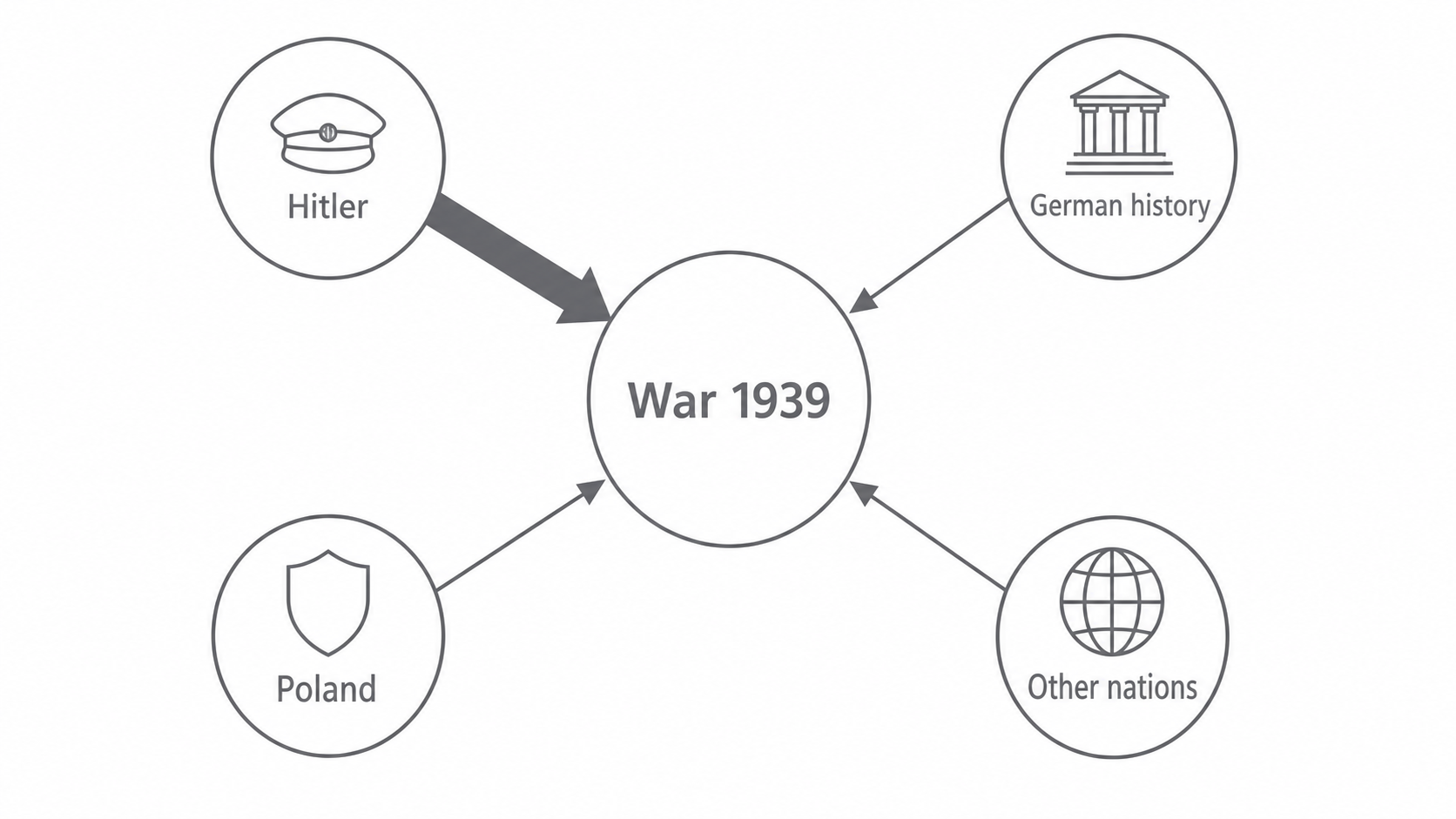
Use it when planning AO3 paragraphs: each interpretation can be placed on one arrow, then tested against whether it explains the outbreak itself or the conditions that made the outbreak possible.
The chronology matters because Hitler's foreign policy did not move at one constant speed. It escalated from revision of Versailles to open conquest.
| Date | Event | Why it matters |
|---|---|---|
| 1919 | Treaty of Versailles signed | Germany lost territory, accepted military restrictions, faced reparations, and saw Danzig and the Polish Corridor become symbols of grievance. |
| 1920s | Weimar governments pursued revision peacefully | Revision of Versailles was not uniquely Nazi, but Weimar revisionism usually worked through diplomacy. |
| January 1933 | Hitler became chancellor | Nazi ideology gained state power; on 3 February 1933 Hitler spoke privately to military leaders about rearmament and Lebensraum. |
| October 1933 | Germany left the League of Nations and Disarmament Conference | Hitler rejected the post-1919 collective-security framework. |
| January 1934 | Germany signed a non-aggression pact with Poland | This reassured Poland temporarily and weakened France's eastern alliance system, but it was tactical rather than permanent friendship. |
| March 1935 | Germany announced conscription and an air force | Open rearmament broke Versailles and prepared military power for later risks. |
| March 1936 | Germany remilitarised the Rhineland | France and Britain did not force reversal; Hitler gained security, prestige and confidence. |
| March-September 1938 | Anschluss with Austria and the Munich settlement over the Sudetenland | Hitler used self-determination claims and war threats to expand without major fighting. |
| March 1939 | Germany occupied Bohemia and Moravia | This destroyed the argument that Hitler only wanted German-speaking lands. Britain and France moved towards a guarantee of Poland. |
| April-August 1939 | Operation White, German demands on Poland, Pact of Steel, Nazi-Soviet Pact | Hitler prepared a war against Poland and reduced the danger of Soviet intervention against Germany. |
| 1-3 September 1939 | Germany invaded Poland; Britain and France declared war | Hitler's aggression triggered the European war, though he hoped it might remain local or short. |
For AO3, expect extracts to stress different emphases. One might argue that Hitler had a consistent programme from the 1920s. Another might stress opportunism, appeasement, economic pressures, or the collapse of collective security. Your task is to test each interpretation against the sequence and the mechanisms.
German History and Revisionism
German history influenced Nazi foreign policy because Hitler did not invent every grievance he used. He inherited a country with memories of empire, defeat, humiliation, border revision and strategic insecurity. This matters because one interpretation of the origins of the war argues that Hitler's policy looked, at least at first, like a radical version of aims many Germans shared.
The most obvious inheritance was the Treaty of Versailles. Germany lost Alsace-Lorraine to France, Eupen-Malmedy to Belgium, North Schleswig to Denmark, overseas colonies, and territory in the east to the restored Polish state. The Polish Corridor gave Poland access to the Baltic Sea but separated East Prussia from the rest of Germany. Danzig, with a largely German-speaking population, became a Free City under League of Nations protection, linked economically to Poland. The treaty limited the German army to 100,000 men, forbade conscription, banned an air force, restricted naval power and demilitarised the Rhineland.
These terms did not make a second war inevitable, but they created political material for revisionists. Many Germans saw Versailles as a dictated peace. The "war guilt" clause and reparations were widely resented. The stab-in-the-back myth claimed that Germany had not really been defeated at the front in 1918, but betrayed by socialists, republicans, communists and Jews at home. This was false, but politically powerful. It allowed nationalists to connect democratic Weimar government with humiliation.
Weimar foreign policy also aimed to revise Versailles. Gustav Stresemann's diplomacy in the 1920s sought German recovery, a better reparations settlement, evacuation of occupied territory, equality of status and eventual peaceful revision of the eastern borders. The Locarno Treaties of 1925 guaranteed Germany's western frontier but did not give the same guarantee to the eastern frontier with Poland and Czechoslovakia. That difference mattered. It implied that some western states accepted that Germany's eastern borders might be renegotiated in future.
This is where the continuity argument has force. Hitler's early successes often appealed to aims that seemed nationally respectable to many Germans: restore equality, rebuild the armed forces, recover the Saar through plebiscite, end the Rhineland demilitarisation, unite Austria with Germany, and revise the status of Danzig. A historian stressing continuity might argue that Hitler gained support because he made Germany look powerful again and achieved, by pressure and risk, what Weimar diplomacy had only partly achieved.
But continuity has strict limits. Hitler's worldview was not simply "revise Versailles". It drew on older German and European ideas of racial hierarchy, social Darwinism, anti-Semitism, anti-Bolshevism, militarism and eastern colonisation. The German Empire's wartime ambitions in eastern Europe and the 1918 Treaty of Brest-Litovsk gave some precedent for thinking of the east as a space for German dominance. Yet Hitler transformed such ideas into a programme for racial empire. For him, the future was not a stable diplomatic settlement inside Europe; it was a violent struggle for Lebensraum in Poland, Ukraine and the Soviet Union.
So German history helps explain why Nazi foreign policy was persuasive, but it does not excuse or fully explain the war. Versailles revisionism supplied grievances; Hitler supplied a radical answer. Older German nationalism made claims over Danzig and Austria intelligible to many Germans; Nazi racial ideology made the destruction and colonisation of eastern Europe central. The difference is crucial for judgement. If the question is why many Germans accepted or applauded early foreign-policy successes, German history matters greatly. If the question is why Europe was at war in September 1939, Hitler's radicalisation of those inheritances matters more.
Hitler's Ideas and Role
Hitler's responsibility lies in the aims he pursued and in the way he used power. His ideas were visible long before 1939. In Mein Kampf (1925-26) and later writings and speeches, he argued that Germany needed Lebensraum in the east, that history was a racial struggle, that Bolshevism and the Jews were mortal enemies, and that parliamentary diplomacy was weak. He did not want Germany merely restored to its 1914 position. He wanted a German racial empire that would dominate Europe and secure land, food and resources through conquest.
Lebensraum
'Living space': Hitler's aim of conquering land in eastern Europe for German settlement, food and resources.
That ideological core shaped Nazi foreign policy in three ways.
First, Hitler treated Versailles revision as a starting point, not an end point. In public, he often claimed he was correcting injustice, defending German minorities, or seeking equality. These claims were useful because they divided opponents. Many British and French politicians believed some German grievances were legitimate. Yet privately and strategically Hitler went further. The remilitarisation of the Rhineland strengthened Germany's western security; Anschluss expanded the Reich; Munich broke Czechoslovak defences; the occupation of Prague showed that non-German peoples would also be brought under German rule.
Second, Hitler linked foreign policy to rearmament and economic preparation. Germany left the League and Disarmament Conference in 1933, announced conscription in 1935, built the Luftwaffe, and expanded the army beyond Versailles limits. The Four-Year Plan of 1936, associated with Hermann Goering, pushed the economy towards autarky and military readiness. Autarky did not mean peaceful self-sufficiency. It meant preparing Germany to withstand blockade and wage war for resources.
Third, Hitler's personal leadership mattered. Nazi Germany was not a normal state in which foreign policy was simply made by a professional foreign ministry. Conservative diplomats such as Konstantin von Neurath mattered in the first years, and the army, business elites, party agencies and SS all had interests. But Hitler set the direction and repeatedly chose the riskier option. In the Rhineland crisis of 1936, he took a gamble that France would not act alone and Britain would not back firm resistance. In 1938, he increased personal control after the Blomberg-Fritsch affair and appointed Joachim von Ribbentrop foreign minister. Ribbentrop was more ideologically aligned with Hitler and more willing to pursue aggressive diplomacy.
The Hossbach Memorandum of November 1937 is useful for interpretations. It records Hitler discussing Germany's need for living space and possible action against Austria and Czechoslovakia. It should not be read as a neat timetable for every later event. It is better evidence of intent, assumptions and urgency than of a fully fixed plan. It shows that Hitler expected expansion to involve war or the threat of war, and that he was already thinking beyond limited revision of Versailles.
The 1938-39 sequence confirms the escalation. In March 1938, German pressure produced Anschluss with Austria. In September 1938, the Munich Agreement transferred the Sudetenland from Czechoslovakia to Germany after Britain, France, Italy and Germany met without Czechoslovakia present. Hitler promised no further territorial demands in Europe. In March 1939, German forces occupied Bohemia and Moravia, and Slovakia became a German-dependent state. This was a turning point because Prague was not a Versailles border issue or a simple self-determination question. It revealed imperial domination.
Hitler's ideas and role were therefore central, but a precise answer should avoid making him seem all-powerful. He exploited opportunities created by others. He adjusted tactics when necessary. He preferred to isolate targets one by one and avoid a major two-front war until Germany was stronger. He did not necessarily intend a general war with Britain and France in September 1939. But that limitation does not reduce his main responsibility. He created the chain of crises and accepted the danger that aggressive expansion could trigger a wider war.
Other Nations and International Breakdown
The contribution of other nations was not that they wanted Hitler's war. It was that their choices, weaknesses and conflicts failed to stop escalation. The 1930s international system was badly placed to contain a state willing to break treaties in stages.
Britain is usually discussed through appeasement.
Appeasement
Trying to settle grievances by negotiation and concession, in the hope that war could be avoided and international order preserved.
Appeasement had reasons that should be understood before it is judged. Britain had memories of the First World War, fear of aerial bombing, imperial commitments, economic strain after the Depression, limited military readiness in the mid-1930s, doubts about the fairness of Versailles, and suspicion of the Soviet Union. Many British leaders also believed Hitler's earlier claims might be limited and negotiable.
The problem was that appeasement rewarded a method: threat, crisis, concession, and further demand. The Anglo-German Naval Agreement of 1935 accepted a German navy up to 35 percent of British surface fleet strength, weakening the united front against Versailles violations. British reluctance to oppose the Rhineland remilitarisation in 1936 increased Hitler's confidence. At Munich in September 1938, Chamberlain could claim he had avoided immediate war and bought time for rearmament. But Czechoslovakia lost the Sudetenland, its border defences, and much of its strategic security. When Hitler occupied Prague in March 1939, appeasement as trust in Hitler's limited demands collapsed.
Continue this lesson.
You’re previewing NovaLearn without an account. Create a free account to read the rest.
Create free account