1H Interpretations - Thatcher's impact on Britain, 1979-97
Margaret Thatcher left office in November 1990, but this enquiry runs to 1997 because Edexcel is asking about the longer impact of Thatcherism: what changed during her governments, what survived under John Major, and what still shaped British politics when Tony Blair won the 1997 general election.
The best answer is not simply "Thatcher changed everything" or "Thatcher changed nothing". Thatcher's governments made a deep break with the post-war language of full employment, public ownership, trade-union partnership and state economic management. Yet the state did not disappear, public services were not abolished, and some of the most damaging political consequences became clear only after she had gone. The argument is therefore about where Thatcherism was most transformative, where it was limited, and why its legacy was still contested by 1997.
The Enquiry Frame
Thatcherism was both a set of policies and a way of arguing about Britain. It favoured lower direct taxation, control of inflation, private ownership, reduced trade-union power, market competition, personal responsibility and a tougher attitude to public spending. It rejected much of the older post-war assumption that governments should manage the economy through nationalised industries, prices and incomes policies, corporatist bargaining with unions, and a commitment to keeping unemployment low at almost any cost.
Keep the time frame clear:
| Date | Turning point | Why it matters for impact |
|---|---|---|
| May-June 1979 | Thatcher became prime minister; Geoffrey Howe's first Budget cut income tax rates and raised VAT | This signalled a shift from direct taxation and demand management towards incentives, indirect taxation and anti-inflation policy. |
| 1979-81 | Exchange controls were abolished; interest rates rose; the Medium Term Financial Strategy was launched | The government treated inflation, not full employment, as the central economic problem. |
| 1980-82 | Recession, deindustrialisation and rapidly rising unemployment | The social cost of the economic turn became visible, especially in manufacturing regions and inner cities. |
| 1980 | Housing Act introduced Right to Buy | Council tenants gained a route to home ownership, while local authority housing was reduced over time. |
| 1983-87 | Second Thatcher government; BT and British Gas privatised; miners' strike defeated; financial deregulation | Thatcherism moved from experiment to a more confident restructuring of ownership, labour relations and finance. |
| 1988-90 | Top income tax rate cut to 40 percent; water privatised and electricity privatisation prepared; poll tax crisis; Thatcher resigned | The late Thatcher years showed both ideological ambition and political overreach. |
| 1990-97 | Major continued much of the programme; ERM crisis in 1992; Labour modernised; Conservatives collapsed in 1997 | Thatcher's legacy outlived her premiership, but it also divided her own party and forced Labour to adapt. |
This is a Paper 1 historical interpretations topic. Historians can read the same evidence in different ways. One interpretation might stress a Thatcher revolution: inflation was brought under firmer control, nationalised industries were sold, trade unions were weakened, council houses were sold, and even Labour abandoned its old commitment to public ownership. Another interpretation might stress the limits: unemployment and inequality rose, the state remained large and powerful, regulators replaced ministers in privatised industries, and the Conservatives were exhausted by 1997.
For AO3, always ask what the historian is treating as the measure of impact. Is it economic performance? Ownership? social unity? party politics? ideology? A judgement that works for one measure may not work for another.
Economic Policy and Outcomes
Thatcher entered office after the inflation, industrial conflict and weak productivity of the 1970s. Her economic policy challenged the assumption that government should keep demand high to protect employment. Instead, her governments argued that inflation had to be defeated, state borrowing controlled, taxes on work and enterprise lowered, and inefficient firms exposed to market discipline.
The first Budget in June 1979 showed the new direction. The basic rate of income tax was cut from 33 percent to 30 percent, and the top rate on earned income was cut from 83 percent to 60 percent. To pay for part of this and shift taxation from income to consumption, VAT was unified at 15 percent. Exchange controls were abolished in 1979, making it easier for capital to move in and out of Britain. Interest rates rose to 17 percent in November 1979 as the government and the Bank of England tried to squeeze inflation out of the economy.
The short-term consequences were severe. Inflation was 18.0 percent in 1980, but the anti-inflation strategy, high interest rates, a strong pound, global recession and existing industrial weakness produced a deep downturn. GDP growth was negative in 1980 and 1981. Manufacturing employment fell by about 1.5 million between 1979 and 1983. Unemployment rose from 5.4 percent in 1979 to 11.8 percent in 1984, and it stayed in double figures until 1987. For critics, this was not a temporary side effect but the central social cost of Thatcherism: whole communities paid for a policy that restored profitability by weakening labour.
The government did not retreat. The 1981 Budget tightened policy further even during recession, a controversial choice because many economists argued that it would worsen unemployment. Thatcher's supporters later treated this as proof of conviction: inflation fell to 4.6 percent by 1983, and the economy then recovered. Growth averaged about 3.8 percent a year from 1983 to 1989. The share of national income going to private company profits rose, and the "Lawson boom" of the late 1980s seemed to vindicate the argument that lower taxes, weaker union power and market confidence could revive enterprise.
The recovery was real, but it was not a simple economic miracle. The boom relied heavily on consumer spending, credit, rising house prices and financial services. Secured household lending rose sharply during the decade. Inflation began to rise again by the end of the 1980s, reaching 7.8 percent in 1989, and high interest rates helped push Britain into recession in 1990-92. Major's government then suffered the ERM crisis of 16 September 1992, when sterling was forced out of the Exchange Rate Mechanism. That damaged Conservative claims to economic competence even though the economy recovered strongly later in the 1990s.
By 1997, Thatcher's economic impact was therefore large but uneven. Britain had moved towards low-inflation policy, flexible labour markets, financial services, lower marginal income tax rates and less tolerance of loss-making state industries. Unemployment had fallen to 6.9 percent by 1997, far below the early-1980s peak. Yet the cost had included deindustrialisation, regional unemployment, greater inequality, a more insecure labour market and a lasting argument about whether economic efficiency had been bought at too high a social price.
Rollback of the State
The specification asks about the extent to which state intervention and the public sector were "rolled-back". The phrase needs careful handling. Thatcherism did roll back public ownership, union privileges and local-authority housing. It did not abolish state power, the welfare state or public services. In some areas the central state became stronger.
Privatisation was the most visible rollback. Before 1979, much of Britain's post-war economy was shaped by nationalised industries: coal, steel, gas, electricity, telecommunications, rail, buses, water and parts of transport and aerospace. The early Thatcher programme was modest, but after 1983 it accelerated. British Telecom was privatised in 1984; British Gas in 1986; British Airways, British Airports Authority and Rolls-Royce in 1987; British Steel in 1988; the water authorities in 1989; regional electricity companies in England and Wales in December 1990, just after Major became prime minister; British Coal in 1994; and British Rail in stages between 1994 and 1997.
This changed both economics and political culture. Government no longer owned and oversaw these industries. The Treasury received large sale proceeds. Advertising campaigns promoted a "share-owning democracy", especially during the British Gas "Tell Sid" sale. The number of individual shareholders rose from around 3 million in 1979 to about 8 million in 1987. Privatisation was meant to improve efficiency, expose managers to market discipline, reduce the need for subsidies and weaken the bargaining power of unions concentrated in nationalised monopolies.
Right to Buy was a second major form of rollback. The Housing Act 1980 gave many council tenants the legal right to buy their homes at a discount. In England, sales peaked at 167,123 in 1982-83, and about 1.286 million council homes had been sold under the scheme by 1996-97. This helped many tenants become homeowners and tied aspiration to property ownership. But because councils were restricted in how far they could use receipts to replace homes, the policy also reduced the supply and social mix of council housing. It turned a public asset into private property and changed the meaning of citizenship for many families: security was increasingly imagined through ownership rather than municipal provision.
Trade-union power was also rolled back. The Employment Acts of 1980 and 1982 narrowed legal immunities and restricted secondary action and closed-shop practices. The Trade Union Act 1984 required secret ballots before strike action. Further laws in 1988 and 1990 strengthened individual members' rights and made unions more legally vulnerable if they broke the rules. The impact was reinforced by recession and the defeat of the 1984-85 miners' strike. Certification Office figures show UK trade-union membership falling from about 13.2 million in 1979 to about 10.0 million in 1989. Working days lost to strikes also fell sharply across the later 1980s and 1990s.
Yet rollback had limits. The NHS was not privatised. Social security spending did not disappear, partly because unemployment increased benefit costs. Education remained a major state function, and the 1988 Education Reform Act actually increased central direction through the National Curriculum and testing. Local government was constrained by rate-capping and then the poll tax, but that meant stronger central control rather than a smaller state. Privatised industries needed new regulators such as Oftel and Ofgas. The state became less likely to own and manage industries directly, but more likely to set frameworks, enforce competition, discipline local authorities and regulate markets.
Use the diagram to separate two claims that are easy to blur. Look left for the parts of the post-war settlement that Thatcherism reduced; look right for the forms of state power that remained or became more important.
[DIAGRAM: asset_name: Rollback and retained state power; asset_slug: p1_1h_05_what_impact_did_thatcher_s_governments_1979_90_have_on_britain_1979_97__diagram_01; recommended_method: image_gen; description: A split-panel schematic showing Thatcherite rollback of public ownership, council housing and union power alongside continuing public services, regulators and central government control, with both sides feeding into an uneven legacy judgement.]
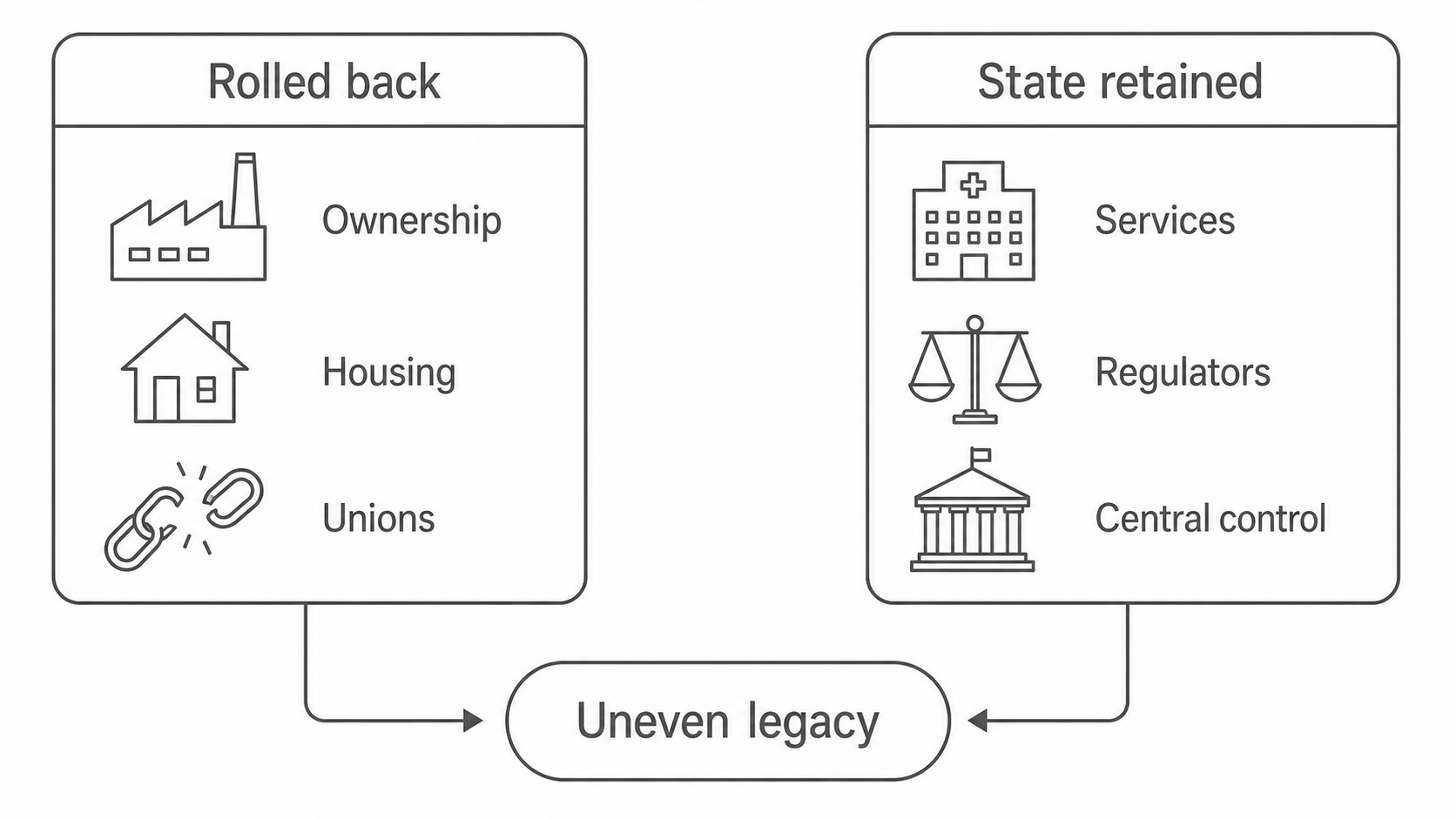
The takeaway is that Thatcher rolled back the post-war public-sector settlement, not the state itself. Public ownership, council housing and trade-union influence were reduced dramatically. But central government remained powerful, public services survived, and market reform often required new forms of state supervision.
Continue this lesson.
You’re previewing NovaLearn without an account. Create a free account to read the rest.
Create free account