9G - Connected rates of change
If water enters a vessel at a constant volume rate, must its depth rise at a constant speed? You will connect rates through a shared changing quantity, use geometric relationships at one instant, and interpret signs and time units in growing and shrinking objects.
Connecting rates through a shared variable
A rate with respect to time combines how two quantities are related with how quickly the input quantity changes.
If , the derivative measures change in per unit change in . It is not generally the rate of change per second. When also depends on time, the chain rule supplies that rate.
Connected rates
Use the derivative and the input rate at the same instant. If the output rate is known, rearrange this equation to find the input rate, provided .
Read the units as well as the symbols. For example,
This would connect the area of a square to its side length. Even if the side grows at a constant rate, its area rate changes as the side becomes larger.
Worked example 1: a given input value
Question. The numerical values of two lengths and , measured in centimetres, satisfy . At one instant and . Find then.
Plan. Differentiate the relationship first, evaluate its gradient at , then multiply by the input rate.
Answer. .
Check. If the input continues at the same rate for , becomes . The exact change in is , giving average rate , close to the instantaneous rate .
Now describe the instant by the output value. Recover the input value before evaluating the derivative.
Worked example 2: identifying the same instant
Question. The same length relationship , with , applies. At an instant when , is increasing at . Find the rate at which is increasing then.
Plan. Find the positive -value corresponding to , then use the chain rule.
Therefore
Answer. .
Check. Continuing the given input rate for would make and change by , an average rate of . The larger rate than in example 1 is sensible because the gradient is larger.
The rate and the derivative must describe the same moment in the next calculation.
Changing geometric quantities
A geometric formula gives the relationship to differentiate, and a changing dimension connects the rates.
Keep the changing dimension as a variable while differentiating. Replacing it by its current numerical value first would turn the expression into a constant and erase its change. Only genuinely fixed dimensions remain constants in the derivative.
For a sphere of radius ,
Both sphere formulae are provided on the examination formulae sheet. Differentiating them gives and , which connect volume and surface-area rates through .
Worked example 3: volume, radius and surface area
Question. A spherical balloon has radius at an instant when its volume increases at . Find the rates of increase of its radius and surface area at that instant.
Plan. Connect the volume rate to the radius rate, then use that same radius rate in the surface-area relationship.
Hence . Therefore
Answer. Radius rate ; surface-area rate .
Check. Eliminating the radius rate gives . At , multiplying by gives , confirming the surface-area rate.
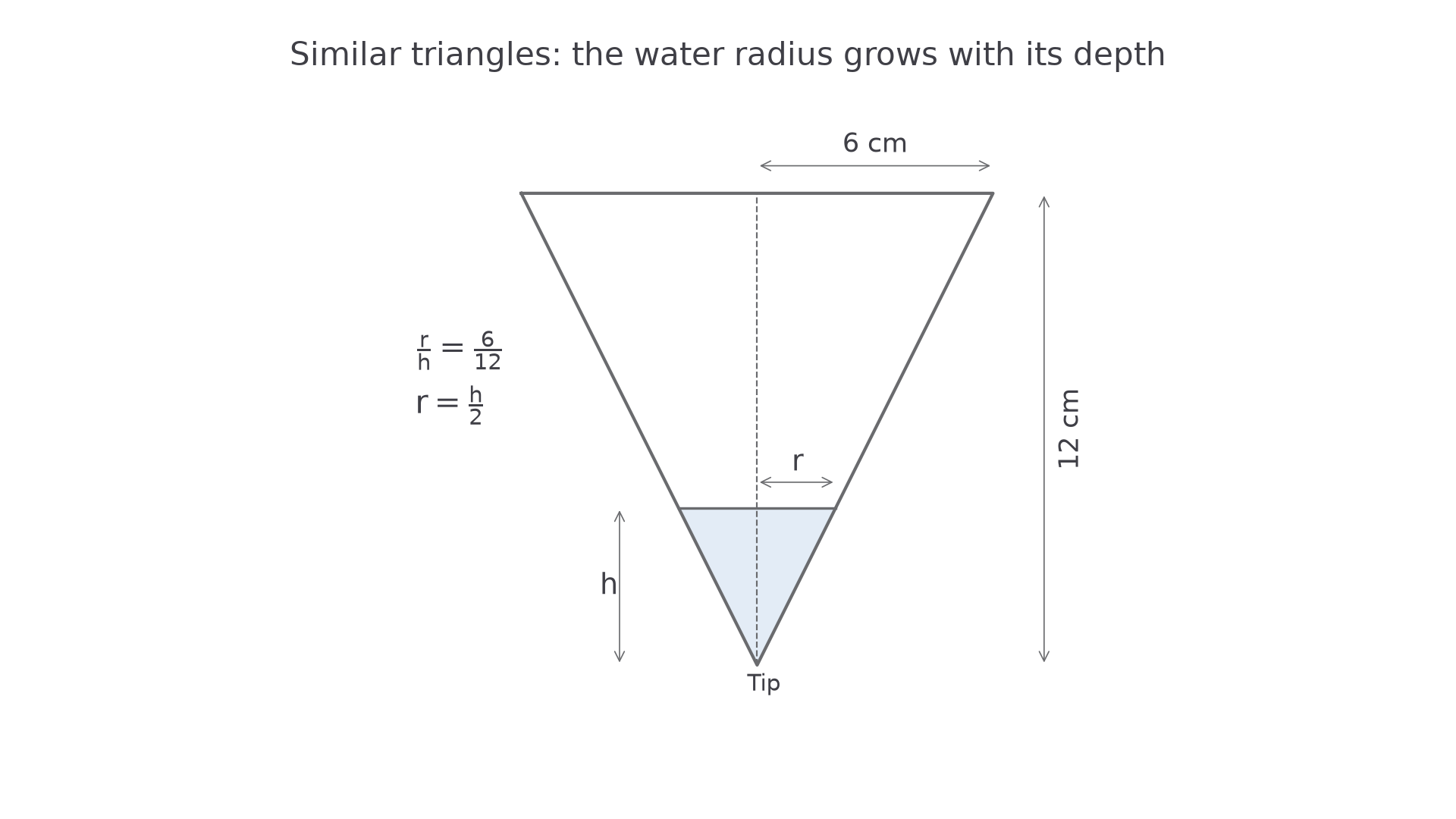
For a cone, two dimensions may change together. Use the geometry to express the volume in one changing variable before differentiating.
[DIAGRAM: asset_name: Similar triangles connect liquid depth and radius; asset_slug: cone-rates; caption: The fixed cone has radius 6 and height 12, so the liquid radius is half its depth; description: An axial cross-section of an inverted cone has full height 12 centimetres and top radius 6 centimetres. A horizontal liquid surface forms a similar smaller triangle with depth h and radius r. Dimension arrows show h and r separately, with r over h equals 6 over 12, so r equals h over 2.]
Continue this lesson.
You’re previewing NovaLearn without an account. Create a free account to read the rest.
Create free account