1B - Changing base and finding exponents
How can you find the exponent in when is not a familiar power of ? In 1B you will change logarithm bases, use reciprocal logarithms and calculate unknown exponents. You will also interpret those exponents as times in growth and decay models.
Changing the base
A logarithm can be calculated using another base, provided both logarithms in the resulting ratio use that same base.
For , the exact answer is already named by . A calculator may offer base-ten logarithms or natural logarithms directly. On calculators, the key labelled “log” usually means base ; the notation also means . The key is the natural logarithm, whose base is the constant .
The earlier standard graph used natural-number bases greater than . The algebraic laws and change-of-base formula also work for any real base that is positive and different from . A base of fails because never changes; zero and negative bases do not define a real logarithm for every positive argument.
Let , so . Taking logarithms to another valid base and using the power law gives
Because , the denominator is nonzero, so we can divide by it.
Change of base
For , , , with and ,
The argument goes on top and the original base goes underneath. This formula is provided on the examination formulae sheet.
Either or works. Mixing the two within one ratio does not apply the formula.
Worked example 1: using a calculator base
Question. Find to significant figures.
Plan. Change both logarithms to base , then round only the final value.
Answer. , to significant figures.
Check. , so the answer must lie between and . Using the unrounded ratio in gives .
Now change only the argument from to . A convenient base can give an exact answer without any calculator decimals.
Worked example 2: choosing a convenient base
Question. Find the exact value of .
Plan. Use base , because both and are powers of .
Answer. .
Check. .
Changing base also lets you evaluate terms before combining an expression. For example, and ; their bases need not be forced into a sum law. Evaluate these exact values first, then use ordinary fraction arithmetic.
Reciprocal logarithms
Swapping a logarithm's base and argument gives its reciprocal when both numbers are valid bases.
For example, and . In change of base, choosing the new base to equal the argument gives the general reason:
Reciprocal-base relation
For and , with and ,
The reciprocal-base relation must be learnt; it is not separately provided on the examination formulae sheet.
An ordinary logarithm may have argument , but that argument cannot become a base. Thus is valid, while is not. You also cannot take the reciprocal of a zero logarithm.
Worked example 3: expressing a reciprocal logarithm
Question. Given , express in terms of .
Plan. Swap the base and argument using the reciprocal relation.
Answer. .
Check. Since , raising both sides to the power gives , verifying the required logarithm.
Now let the unknown be the base itself. The reciprocal relation moves that unknown into the argument of a fixed-base logarithm.
Worked example 4: solving for a base
Question. Solve .
Plan. Require , , isolate the logarithm and swap its base and argument.
Answer. .
Check. , so . The base satisfies both restrictions.
Reciprocal logarithms are different from logarithms of reciprocals: , whereas . The first changes the argument; the second swaps the base and argument.
Finding an unknown exponent
Taking logarithms turns an unknown exponent into a multiplier that algebra can isolate.
In , the left side must be positive, so . For , , the power law gives
This is also . The logarithm method is useful when the two sides cannot easily be written as powers of one familiar base.
Worked example 5: an exponent with no simple exact value
Question. Solve . Give an exact logarithmic expression, then a value to significant figures.
Plan. Take logarithms of both sides and use the power law to isolate .
Answer. Exactly ; to significant figures, .
Check. , so . Substituting the unrounded value gives .
Keep the same base and result, but replace the exponent by . The logarithm finds that entire exponent before you solve for .
Worked example 6: an expression in the exponent
Question. Solve . Give your answer to significant figures.
Plan. Apply the previous calculation to , then solve the linear equation without rounding early.
Answer. , to significant figures.
Check. The unrounded value gives , so the original power equals . Substitution of the rounded answer gives a value close to , rather than exactly .
Keep the exact ratio or the full calculator value until the last step. In particular, dividing by a logarithm is ordinary division: it is not permission to divide the logarithms' arguments.
Use a permitted scientific calculator for the numerical logarithms. Examination calculators must not have facilities for built-in symbolic algebra, symbolic differentiation or integration, or retrieval of text or formulae.
Exponential equations in context
In a growth or decay model, the unknown exponent often represents elapsed time or a number of repeated steps.
For a model , is the initial amount. A growth rate of per time unit gives multiplier ; a decrease of gives , because remains. First isolate the power by dividing by , then use logarithms.
Worked example 7: finding a growth time
Question. A population is modelled by , where is time in years. According to this model, when does the population reach ? Give your answer to decimal places.
Plan. Divide by the initial population, then solve for the continuous time .
Answer. The model reaches after approximately years.
Check. After years the model gives about , and after years about . The crossing time should lie between them.
Now use decay and restrict the observation times to whole hours. The logarithm gives the boundary time, but the required reading must occur at a permitted time after that boundary.
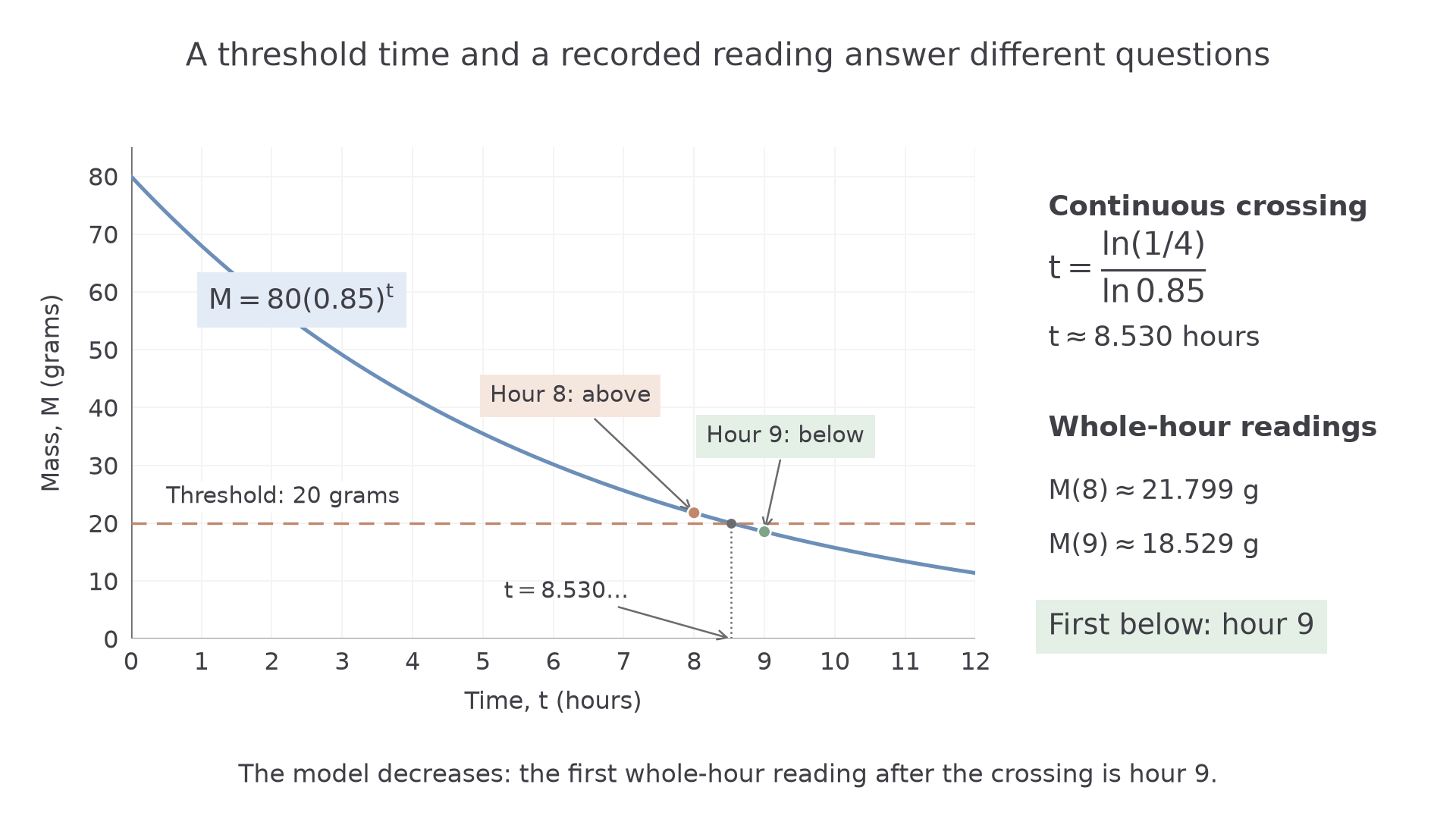
[DIAGRAM: asset_name: A decay crossing and the first whole-hour reading; asset_slug: decay-threshold; caption: The continuous model crosses 20 grams between hours 8 and 9, so hour 9 is the first whole-hour reading below the threshold; description: A decreasing curve M equals 80 times 0.85 to the t is plotted for nonnegative time t in hours. A horizontal dashed threshold is at M equals 20 grams. The continuous intersection occurs at about t equals 8.530, between marked whole-hour readings at hour 8 with mass about 21.799 grams and hour 9 with mass about 18.529 grams.]
Worked example 8: interpreting a decay threshold
Question. A sample's mass is modelled by grams after hours. Its mass is recorded at the end of each whole hour. Find the first reading below grams.
Plan. Find the time when the model equals , then check the neighbouring whole-hour readings.
The model is decreasing, so it is below after this crossing time. The first whole-hour time after is .
Answer. The first reading below grams is at the end of hour .
Check. grams, above ; grams, below . Thus the previous reading does not yet meet the condition.
Both logarithms in the decay ratio are negative, so their quotient gives a positive time. Do not round a boundary time to the nearest integer when the question asks for the first reading that meets a condition. If a boundary happens at an exact integer time, the words “below” or “above” exclude equality.
Problem-solving
Solve the equality to locate a threshold, use growth or decay to choose the correct side, then check neighbouring permitted times. State the result in the context's units.
Apply the same reasoning to a value recorded once per year.
Quick Recap
Change of base makes any valid logarithm accessible through a consistent pair of calculator logarithms. Swapping base and argument gives a reciprocal; taking logarithms turns an unknown exponent into a multiplier. The opening equation has exact answer , approximately . In a model, interpret that exponent as a time or step number before deciding how to round.